Care and Maintenance
Best Commercial Glass Cleaner: How to Choose
Compare the best commercial glass cleaner options, from ammonia formulas to pure-water systems. Find the right cleaning method for your building type.


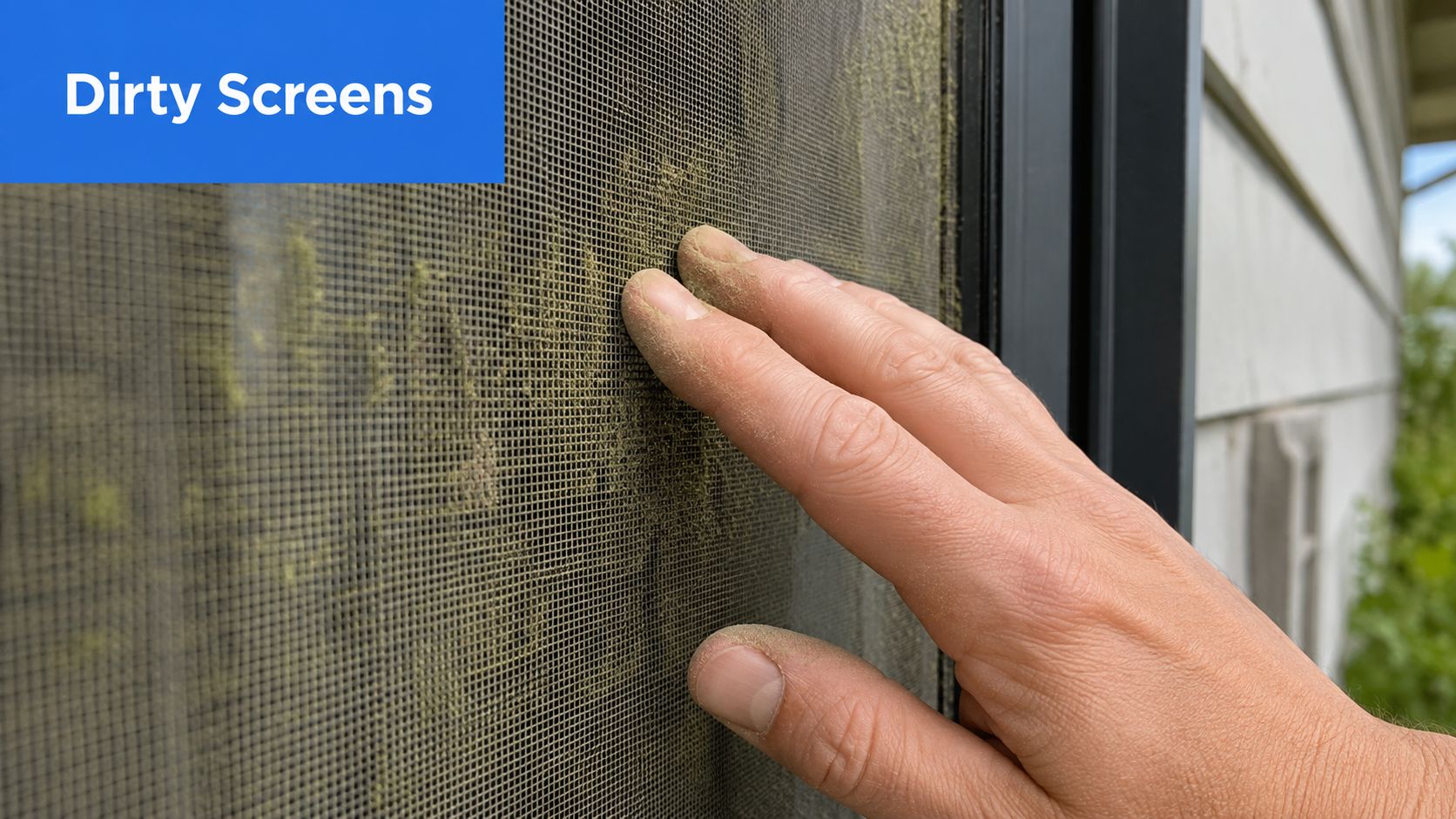
You can stand in front of a house, pull a screen off the frame, and feel the problem right away. The mesh looks intact, but it's packed with dust, pollen, and grease from the air, so the room never feels quite clean and the view still looks dull after the glass is done. That's where a screen washing machine earns its keep, especially on routes where crews keep pulling the same dirty screens over and over.
For window cleaning work, the question isn't whether screens can be cleaned. It's whether a machine saves enough handling time, reduces enough breakage risk, and improves enough consistency to justify the setup. In practice, the answer changes with the property type, the number of screens, and how much space you've got to stage, dry, and reinstall them.
A homeowner usually notices the issue first at the worst possible moment, when the windows look clean but the screens still make everything feel dusty. On a desert route in Las Vegas, Phoenix, or Scottsdale, that buildup happens fast, and in Denver it can show up just as stubbornly after wind and seasonal debris. A screen washing machine is built to solve that exact problem, by cleaning mesh screens efficiently without tearing them, warping the frame, or leaving residue behind.
A screen washing machine is specialized equipment, not just a bigger hose or a nicer sprayer. Industrial brochure material treats Screen Washing as its own product category, which matches what crews see in the field, these machines are designed for repetitive, controlled cleaning of screens in production environments. In commercial settings, that matters because a screen has to come back clean, dry, and ready for reuse without wrecking the frame or the mesh.
The long history of washing machinery also explains why the modern unit looks the way it does. The basic mechanics of today's machines, drums, rotation, and powered agitation, developed over a long patent timeline that began in 1691 and ran through 1851, 1858, and the first electric washer in 1907–1908 source. That doesn't mean a window screen washer is a laundry machine, but it does explain the engineering logic behind rotating, spraying, and staged cleaning.
Practical rule: If the machine can't match the biggest screen you install and the utilities you can actually support, it's too small for the job, no matter how impressive the brochure looks.
For residential crews, a screen washer makes the most sense when screens pile up on every stop and the team wants consistent results. For larger properties, it starts to matter more as a workflow tool, because a missed screen on a multi-unit building can turn into a return visit.
Industrial screen-washing systems can be very specific about size and infrastructure. One example, the Grünig G-WASH 112, supports screen widths from 1000 to 2000 mm in 250 mm increments, with a 1500 mm screen height, and it calls for 3 x 400 V power, 6 bar compressed air at 50 l/min, 1" water at 3 bar, and exhaust air of 500 m³/h at 450 Pa source. That kind of spec sheet is why layout matters so much, the machine's overall depth is 860 mm plus the screen width allowance source.
A good setup starts before the first screen goes into the washer. If the water supply is weak, the drainage is messy, or the staging area is cramped, the machine will still run, but the results will be uneven and the workflow will slow down. That is the jobsite reality, the washer only performs as well as the space and utilities around it.
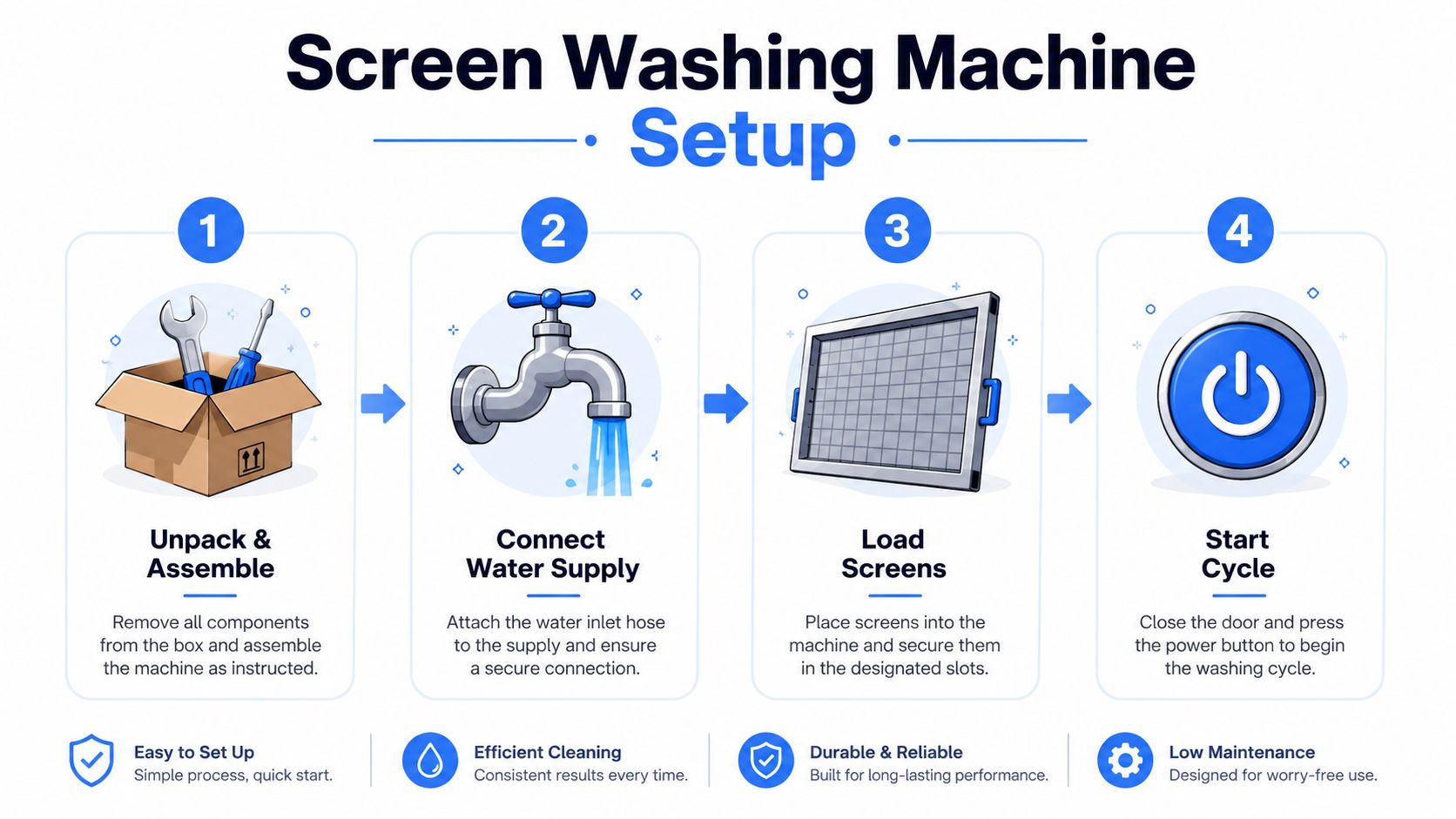
The most common setup mistake is treating the washer like a self-contained box. It is not. The staged cleaning systems used in commercial screen cleaning depend on water pressure, compressed air, filtration, and drying support, and one commercial unit lays out the process variables as Liquid temperature, Heating, Filtration precision, and Spray pressure(MPa) source. That tells you how industrial these systems are, even when the screen is a window screen instead of a print screen.
A practical loading rule is simple, match the machine's envelope and utilities to the largest format you will run. If the screen fits but the air supply or exhaust cannot keep up, drying slows down and spray behavior becomes less consistent. The engineering brochure for the G-WASH 112 makes that point clear by pairing format capacity with power, compressed air, water, and exhaust requirements source.
A screen washer is not just a rinse station. The better water-based systems use a staged process, cleaning → wind shearing → rinsing → wind shearing → drying, with the screen moving back and forth under high-pressure liquid jetting from four spray bars source. That sequence matters on real jobs, because loose grit, soap film, and rinse residue do not all leave the screen at the same pace.
The cycle has to fit the workload. One commercial system lists 1 to 3 minutes for cleaning, 1 to 2 minutes for rinsing, 1 to 2 minutes for drying, and 1 to 2 minutes for wind shearing, which puts a full cycle in the rough range of 4 to 9 minutes depending on soil load and substrate source.
The filtration side deserves the same attention as the spray. Fine carryover is what clogs nozzles and leaves a screen looking dirty again after drying, so the machine has to keep contamination moving out of the system instead of recirculating it. The same system uses 10 μm first-stage filtration and 0.45 μm third-stage filtration to remove impurities, labels, tin balls, and rosin particles source.
Air and exhaust look boring until they are under-sized. Then the washer gets blamed for a problem the utilities caused.
The video below is useful if you want to visualize the loading and workflow side of setup.
If you are pulling screens yourself and need the removal side of the process, this internal guide helps with the practical part of taking them out cleanly: how to remove a window screen.
A screen washer earns its keep in the shop, not on paper. On a small residential stop, hand-cleaning can still be the fastest way to get a few screens done and back in the openings. On a larger route, the picture changes fast. Screens have to be removed, washed, staged, dried, and put back in order, and that handling time can become the bottleneck if the process is not tight.
A discussion among window cleaners shows how quick manual work can be. One person can clean a screen in about 10 seconds with soap, circular agitation, and a quick rinse source. That is a useful reality check. The catch is the rest of the workflow. Once you add multiple screens, carrying them to a wash area, drying them, and reinstalling them without bending frames or mixing them up, the manual method loses some of that speed advantage.
| Factor | Screen Washing Machine | Manual Cleaning |
|---|---|---|
| Speed on one-off jobs | Can be more machine than the job needs | Often faster to get started |
| Throughput on larger routes | Works better when loading, wash, and drying are organized | Slows down as screen count rises |
| Cleaning consistency | Strong when filtration and spray stay dialed in | Depends on crew technique |
| Damage risk | Lower when the setup matches the screen format | Higher if screens are scrubbed too hard or handled carelessly |
| Utility needs | Requires water, air, and layout planning | Needs only basic tools and rinsing space |
| Best fit | Multi-screen properties, repeat routes, controlled workflow | Small residential jobs, quick spot cleaning |
The trade-off is straightforward. If the work is light and the screens are easy to reach, manual cleaning stays practical. If the route has a lot of screens, the machine pays off by cutting repeated handling and keeping the result more uniform from one screen to the next.
The break-even point shows up when the labor saved is greater than the setup time and the upkeep the machine demands. On a small residential job, soap, water, and a hand rinse can still beat a powered setup because there is not enough volume to justify the extra preparation. On commercial work, especially when screens come off in batches, the calculation shifts. Rework and inconsistency cost real time, and a machine helps control both.
Field workflow matters as much as the equipment. A practical window screen cleaning process depends on how the screens are removed, handled, and returned, not just on how hard they are washed. The machine is the better tool when the work repeats and the handling can be controlled. Manual cleaning is still the better choice when the job is too small to cover the extra setup.
A screen washing machine usually gives warning signs before it stops doing its job well. Spray patterns go uneven, nozzles start to clog, the pump changes tone, and drying takes longer than it should. By the time those signs show up in the finished screens, the machine is already asking for attention.
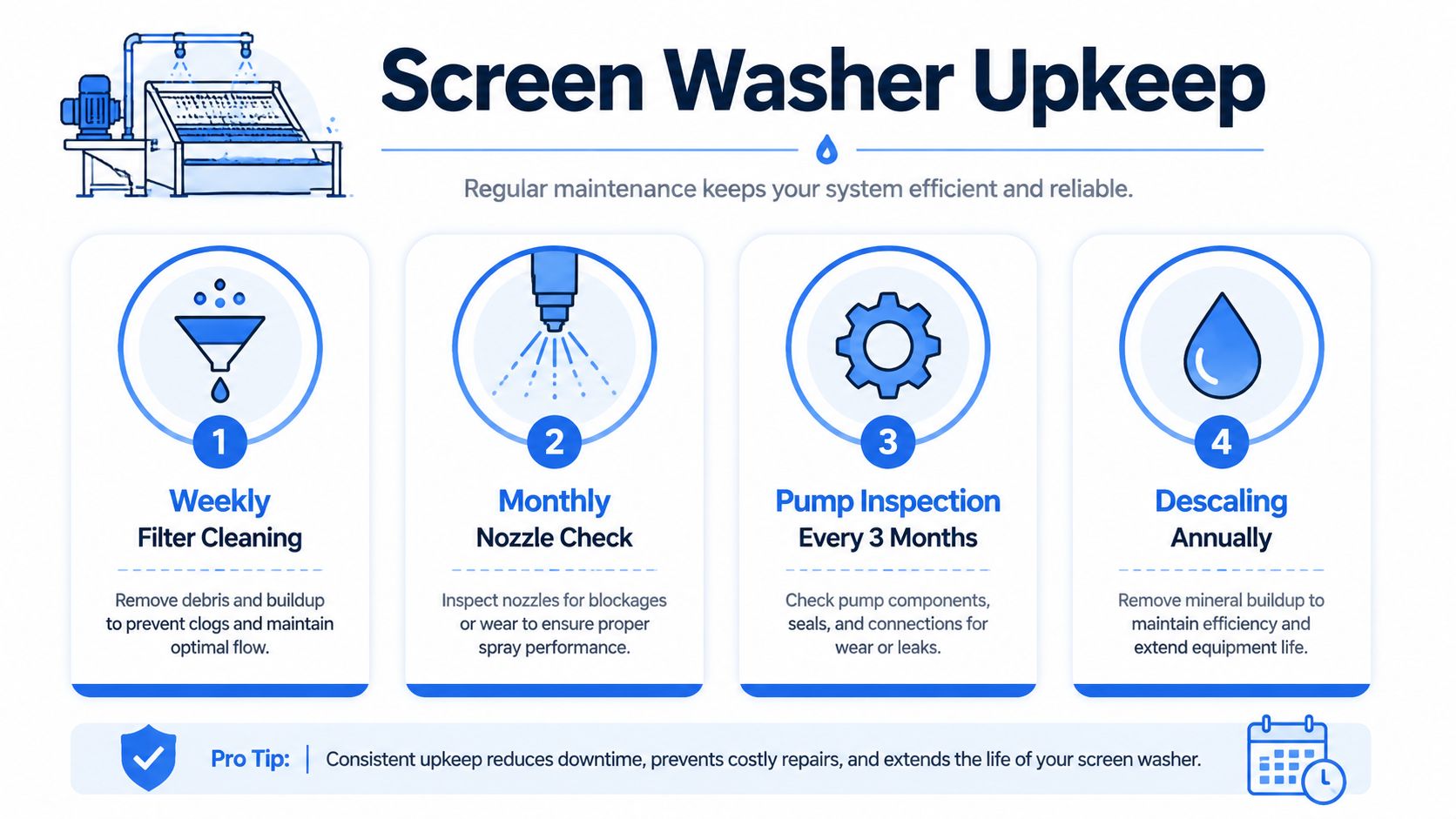
The maintenance routine needs to focus on the parts that shape the wash itself. Filters need cleaning, nozzles need inspection, and the pump should be checked before a small fault turns into poor cleaning quality. The 10 μm and 0.45 μm filtration stages used in commercial systems are there for a reason, because particulate carryover is a common source of clogging and redeposition source.
Air supply matters too. The same system specifies compressed air use within 0.45 to 0.7 MPa and 150 to 350 L/min consumption source. If air falls outside that range, the wind-shearing step becomes less consistent, and drying quality drops with it.
Clean screens are only part of the job. Good contamination control also depends on how the screens are staged, handled, and returned to service. A 2024 MDPI study on shared laundering systems found potential for microbial cross-contamination source. That does not create a screen-specific sanitation rule, but it supports a careful habit on routes where screens move between homes, apartments, schools, or medical offices.
A clogged nozzle usually means filtration has been ignored or the tank needs cleaning. Inconsistent spray often points to pressure imbalance, scale buildup, or a worn pump. Poor drying can come from weak airflow, overloading, or screens being moved on before they are ready.
Practical rule: If the screen looks clean but still feels tacky or shows redeposition, check filtration and drying before you blame the detergent.
Crews working around active job sites should also check the surrounding area before they stage equipment. A practical construction-oriented safety reference is spot hazards on construction sites, which fits the same habit of checking the environment before tools, water, and screens start moving through it.
A screen washing machine handles the screen itself, but plenty of jobs still belong with a professional crew. High-rise buildings, fragile legacy frames, and properties with scattered access issues all push the work past a simple machine setup. The equipment can clean the screen well, yet the full job still has to be handled safely, in order, and without creating extra contamination problems on site.

Professional window cleaners still rely on two methods, squeegee work or a pure-water system, and those methods often fit certain properties better than a dedicated screen washer. The reason is practical, the screen is only one part of the job, and the glass, framing, access, and safety setup can matter more than the screen itself. On mixed-site routes, manual methods also give crews more control over when screens are removed, cleaned, and put back, which helps limit cross-site contamination when parts are moving between different buildings.
A machine is hard to justify when the building calls for rope access, lifts, or careful site coordination. It also loses its advantage when the screens are delicate, custom-sized, or spread across many elevations. In those cases, the cleaning method has to follow the building, not force the building to fit the equipment.
The labor break-even point matters here. A screen washer makes sense when the same screen format keeps coming through the workflow and the setup stays predictable. Once the job adds ladder movement, access delays, or repeated handling, the time saved on the wash step can disappear fast. That is the point where a trained crew usually wins on total labor, even if the machine itself is efficient.
Contamination control is another trade-off that gets ignored in generic guides. Screens picked up from different homes, apartments, schools, or medical offices should be staged carefully, kept separated, and returned in a way that avoids mixing clean and dirty surfaces. A machine can help standardize the wash, but it does not replace good handling.
For busy property managers, responsiveness matters as much as cleaning quality. If scheduling, callbacks, and coordination are the headaches, a business assistant can help keep the workflow moving. A tool like SkipCalls cleaning business assistant is useful for companies that need faster call handling without adding another front-desk burden.
Ask one more thing before you hire anyone. How do they decide when a screen should be cleaned by machine and when it should be handled manually? A good crew should be able to explain the trade-off in plain terms, including when labor savings are real and when extra handling would create more risk than value. If you're managing property in Las Vegas, Phoenix, Denver, or Scottsdale, the right crew should be able to explain those choices without overselling the equipment or pretending every job fits the same process.
A screen washing machine makes sense when the same screens move through your operation over and over. On larger properties, apartment turns, or recurring service routes, the machine can save labor and keep the wash more consistent than hand cleaning. For a small set of residential screens, manual work may still be the better call, especially when setup time would eat into the gain.
The question is not whether the machine cleans screens. It does. The question is whether your workflow gives it enough volume to justify the handling, staging, and contamination control that come with it. If screens arrive dirty but predictable, and you can keep wash water, brushes, and drying space under control, the machine starts to earn its keep. If every screen needs special handling, manual cleaning can be faster and less risky.
Labor break-even matters here. A machine helps when repeated handling and rinse cycles would cost more in time than the equipment costs in attention. It loses ground when the crew spends extra minutes removing damaged frames, dealing with awkward access, or sorting screens that are too different to process in a steady run. That is why a field decision has to include more than cleanliness. It has to include touch labor, staging space, and how much contamination you can keep out of the process.
Use the machine when format, utilities, and workflow stay consistent. Use professional help when access, safety, or scale turns the task into more than screen washing. If you are in Scottsdale with a few screens or in Denver with a larger property, the right choice is the one that keeps the job clean, safe, and repeatable.
For crews that are comparing equipment, the distinction is practical. A screen washing machine built for steady production can support faster turnaround, while a manual method gives more control on delicate work or low-volume jobs, as described by VNBK Tech. A more automated unit can also reduce direct handling, but only if the screens are already sorted and the rinse area is managed well.
That trade-off shows up in contamination control. If dirty screens are piled together, or if wet frames are staged without enough separation, grime spreads right back onto clean work. Machines help most when the process is disciplined, not when they are expected to fix a messy setup. The same point applies whether you are evaluating a unit from Grunig or comparing it with hand washing in the field.
If you want a crew that handles window washing with the right method for the building, Professional Window Cleaning can help with residential, commercial, and high-rise work. They've been in business since 1999, and they know how to match the cleaning approach to the property instead of forcing one tool onto every job.
Read our blog posts regularly and keep learning.