Care and Maintenance
Window Cleaning After Dust Storms in Scottsdale, AZ and Las Vegas, NV
Dust storm or monsoon left your windows coated? Learn safe window cleaning after dust storms in Scottsdale, AZ & Las Vegas, NV and when to call the experts.


You're on the driveway with a spray bottle and a roll of paper towels, and the street-level panes look fine until the sun hits them. The second story still has a gray film, the tracks are gritty, and the west-facing glass is dotted with minerals. That result isn't a bad brand of cleaner. The bottle only wets the glass. Nothing in your hand removes the film in one pass, reaches the upper sash from stable ground, or checks whether the rinse water will dry clean.
A professional window washing kit is one system, not a pile of household gadgets. Each part handles one stage, and professionals use only two methods on the glass itself: a squeegee, or a pure-water system. Match the kit to building height, ground access, and water quality, and spotting, streaking, and safety problems point to the failed stage instead of the whole tool list.
A professional kit is a set of parts, and each part owns one stage of the job. Crews work in that order, not by grabbing whatever is closest.
The washer or applicator sleeve goes on first. It lays water or a light detergent on the glass and loosens soil so the film can move. A rubber-bladed squeegee follows and pulls that liquid off in one pass. A scrub brush and edge tool then works frames, sills, and tracks, where a blade never reaches. Household sprays and paper towels stop after a weak version of the first two stages, and only on glass you can touch while standing on the floor.
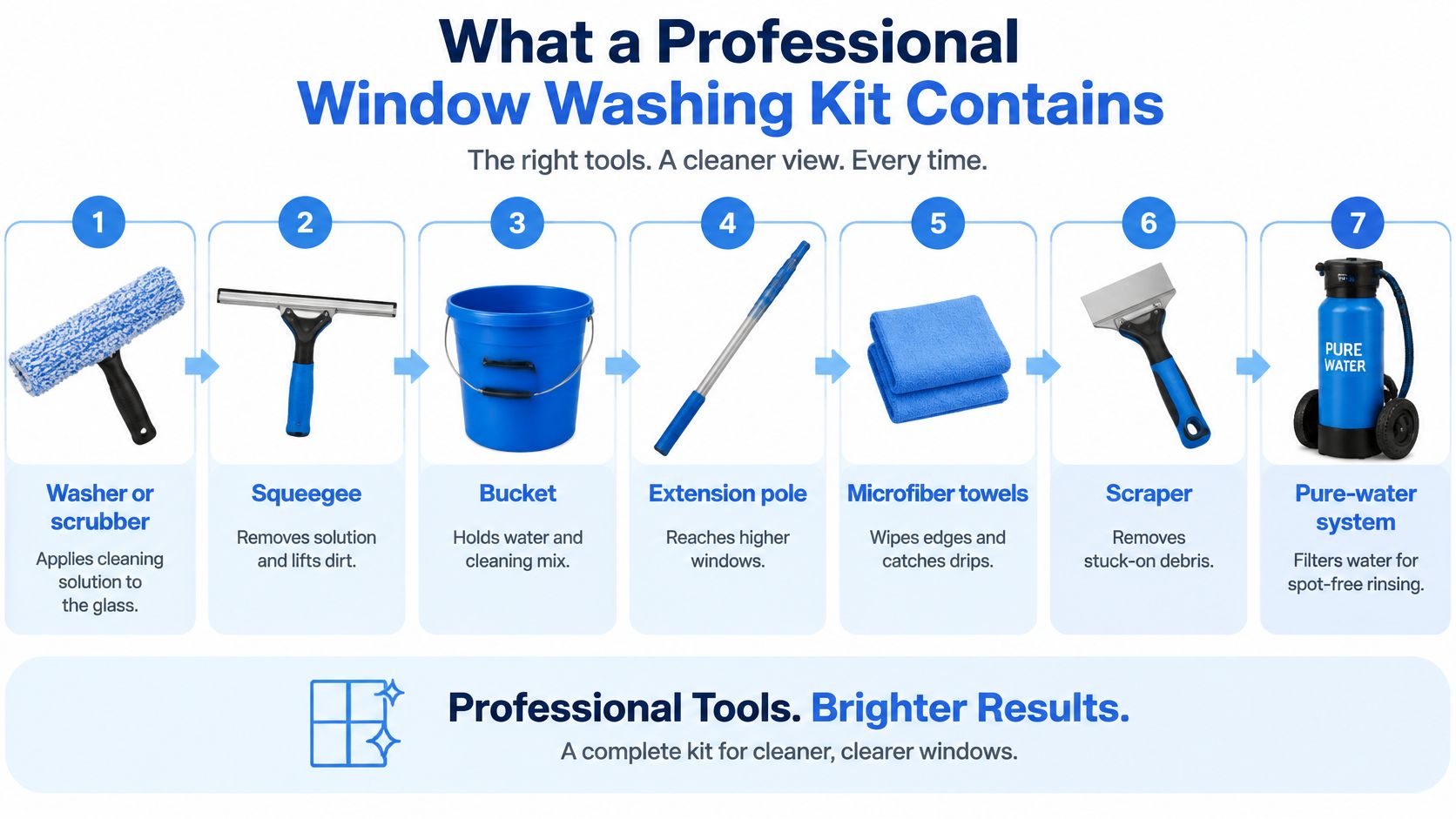
Reach and water are the parts that separate a ground kit from a pole kit. A telescopic or water-fed pole puts the brush at high glass while the operator stays on the ground. The UK Health and Safety Executive window cleaners' best practice guide identifies water-fed poles as a method that can clean windows up to approximately 80 feet (24 meters) from ground level, so some ladder and platform work can stay on the ground. A professional water-fed kit combines a telescopic pole, brush, pump, hose, and purified-water supply. Purified water travels through the pole, the brush agitates the glass, and the rinse carries loosened soil away without a bucket ride up a ladder.
The purified-water tank, its filter stages, and a TDS meter are the difference. Deionization or reverse osmosis strips dissolved minerals before the rinse touches the glass. The meter tells you the outlet water is pure. A hose, reel, and fittings move that water to the brush. Microfiber cloths and a bucket still matter for edges, drips, and small panes.
Practical rule: Specify a pole whose working height covers the glass and still leaves the operator on stable ground. Extra length adds leverage, fatigue, and loss of control.
The same guide flags trip hazards, defective equipment, high winds, overhead power lines, and thunderstorms as water-fed pole risks. Hose management and a pre-use check belong in the kit. On medical offices, dealerships, and retail fronts, cordons and warning signs are part of the procedure, not an extra.
| Component | Job in the cleaning process | Typical configuration | Where it matters most |
|---|---|---|---|
| Washer or applicator sleeve | Applies water or detergent to loosen soil | Sleeve on a pole or handle | Every job, especially film removal |
| Rubber-bladed squeegee | Removes the liquid film in one pass | Handle or pole-mounted rubber blade | Every squeegee job |
| Scrub brush and edge tool | Agitates frames, sills and tracks | Soft, non-abrasive bristles | Frames, sills and tracks |
| Telescopic or water-fed pole | Reaches elevated glass from the ground | Up to about 80 ft (24 m) for water-fed poles | Second story and higher glass |
| Purified-water tank and filters | Supplies pure water for the final rinse | Deionization or reverse-osmosis stages | Pure-water jobs |
| Hose, reel and fittings | Carries water to the brush head | Reinforced hose on a reel | Pole-based work |
| Microfiber cloths and buckets | Final wipe, edges and touch-ups | Lint-free cloths | Small glass and detailing |
| TDS meter | Checks purity of rinse water before it touches glass | Handheld digital meter | Pure-water jobs |
Before the next job, confirm five items: a wetting tool, a removal tool, an edge tool, a reach solution for the tallest pane, and a water test if you plan to rinse and walk away.
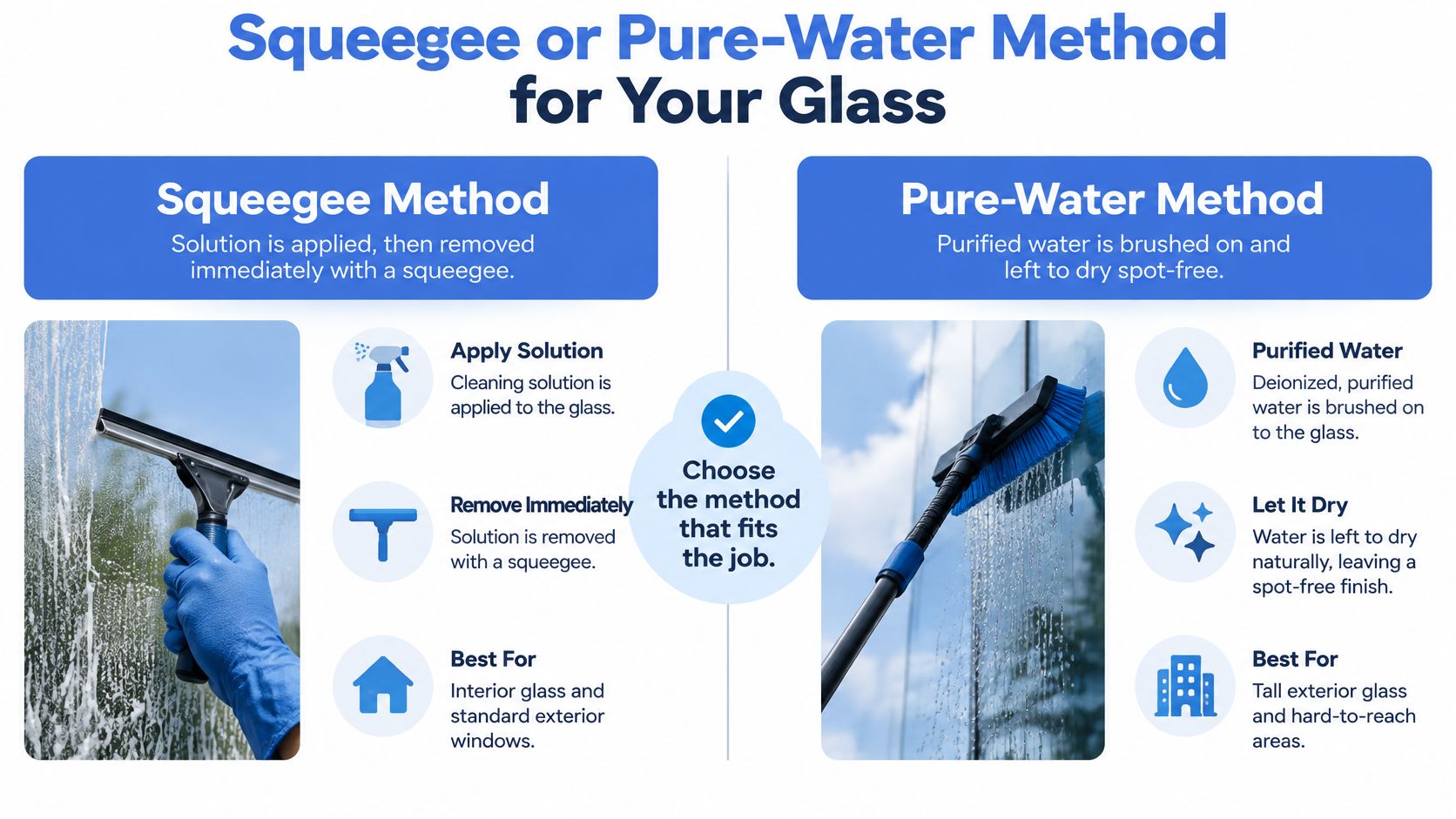
The Glass Association of North America procedures for cleaning architectural glass names two professional techniques: the conventional squeegee process and pure-water cleaning. Tool brands and pole lengths are variations. They aren't a third method.
In the squeegee process, cleaning solution goes on the glass and comes off immediately with a window-cleaning squeegee. Speed and a clean blade do the work. Leave the solution to dry, or drag a nicked rubber edge, and you get streaks.
In the pure-water process, water moves through a specialized extension pole, a non-abrasive brush agitates the glass, and a final pure-water rinse follows. The glass air-dries. Chemicals drop out of that last rinse, and the pole reaches glass a hand squeegee can't. The result still depends on water quality and filter upkeep. A longer pole with dirty water only paints minerals higher on the building.
| Factor | Squeegee process | Pure-water process |
|---|---|---|
| How glass is cleaned | Solution applied, then removed immediately with a squeegee | Purified water through a pole, brush agitation, final pure-water rinse |
| Equipment | Washer, squeegee, cloths | Pole, brush, pump, hose, purified-water supply |
| Chemical use | Detergent solution on the glass | No chemicals in the final rinse |
| Reach | Ground level and ladder work | Up to about 80 ft from the ground |
| Main failure risk | Streaking from a dirty blade or dried solution | Spotting when water quality or filters fail |
A street-level storefront with doors opening onto the sidewalk suits a squeegee set. You can reach every pane, you want the film gone before a customer walks through, and a hose run across the entry is a liability. A three-story office exterior suits the pole system. The glass sits above a comfortable ladder set, the facade is repetitive, and a ground-based rinse covers it without climbing.
I would not pick one method for a whole property. Most working kits carry both: a squeegee set for interior glass and low exterior panes, and a pole system for high exterior glass. Walk the building by zone. Hand height gets the blade. Glass you can't reach safely from the ground gets the pure-water pole, as long as the water test passes.
This short walkthrough shows the hand sequence on a single pane, which is the motion the pole kit is trying to replace at height.
Sort the building by height and access before you sort it by square footage. A wide single-story showroom and a narrow tower can have similar glass area and completely different kits.
A single-family home is mostly ground level plus a short ladder. A squeegee kit with a 12-20 ft pole covers upper windows. A pure-water setup is optional. The hard part is interior detail and frames, not reach.
A low-rise storefront stays at ground and first floor. Keep the squeegee kit, add brush and edge tools, and bring a pure-water pole only if the facade climbs. Foot traffic and cordons are the constraint.
A mid-rise office or medical building sits inside ground-based pole reach, up to about 80 ft. That calls for a full pure-water kit: water-fed pole, filters, and a TDS meter. Water quality and public entries decide whether the job runs cleanly.
A high-rise condominium or tower goes past pole reach. Use the pole kit on lower elevations and a separately approved access system above that line. Fall protection and a site survey set the limit, not the catalog length of the pole.
A car dealership or stadium mixes heights across a large glazed area. Carry the pure-water pole system plus a bulk water supply. Capacity and cordons fail before the brush does.
| Building type | Access and reach | Recommended kit | Main constraint |
|---|---|---|---|
| Single-family home | Ground level and short ladders | Squeegee kit with a 12-20 ft pole for upper windows; optional pure-water setup | Interior and frame detail |
| Low-rise commercial or storefront | Ground and first floor | Squeegee kit with brush and edge tools; pure-water pole if the facade is tall | Foot traffic and cordons |
| Mid-rise office or medical building | Up to about 80 ft from ground | Full pure-water kit with water-fed pole, filters and TDS meter | Water quality and public access |
| High-rise condominium or tower | Beyond pole reach | Pole kit for lower elevations plus a separately approved access system | Fall protection and site survey |
| Car dealership or stadium | Large glazed areas at mixed heights | Pure-water pole system with a bulk water supply | Water supply capacity and cordons |
A pole that covers the second floor does not cover the twentieth. Treat "beyond pole reach" as a different job, with different gear and a different schedule.
We set office, storefront, and high-rise work up the same way, including interior, exterior, seasonal, storm, and post-construction washing, because the building decides the kit.
A longer pole does not make work at height safe. Kit selection for high or difficult glass follows a hierarchy of controls, not a maximum-reach contest.
The HSE window cleaning topic page states that work at height should be avoided where reasonably practicable, for example by using telescopic water-fed poles or cleaning from inside. Where height exposure remains, employers must provide suitable access and fall-arrest equipment. A modular kit follows that order. Water-fed poles cover elevations you can reach from the ground. Separately approved access systems, harnesses, energy-absorbing lanyards, and suitable anchor points cover what you can't. Trained crews use harnesses, scaffolding, and other safety gear so the people on the glass and the customer's property stay protected.
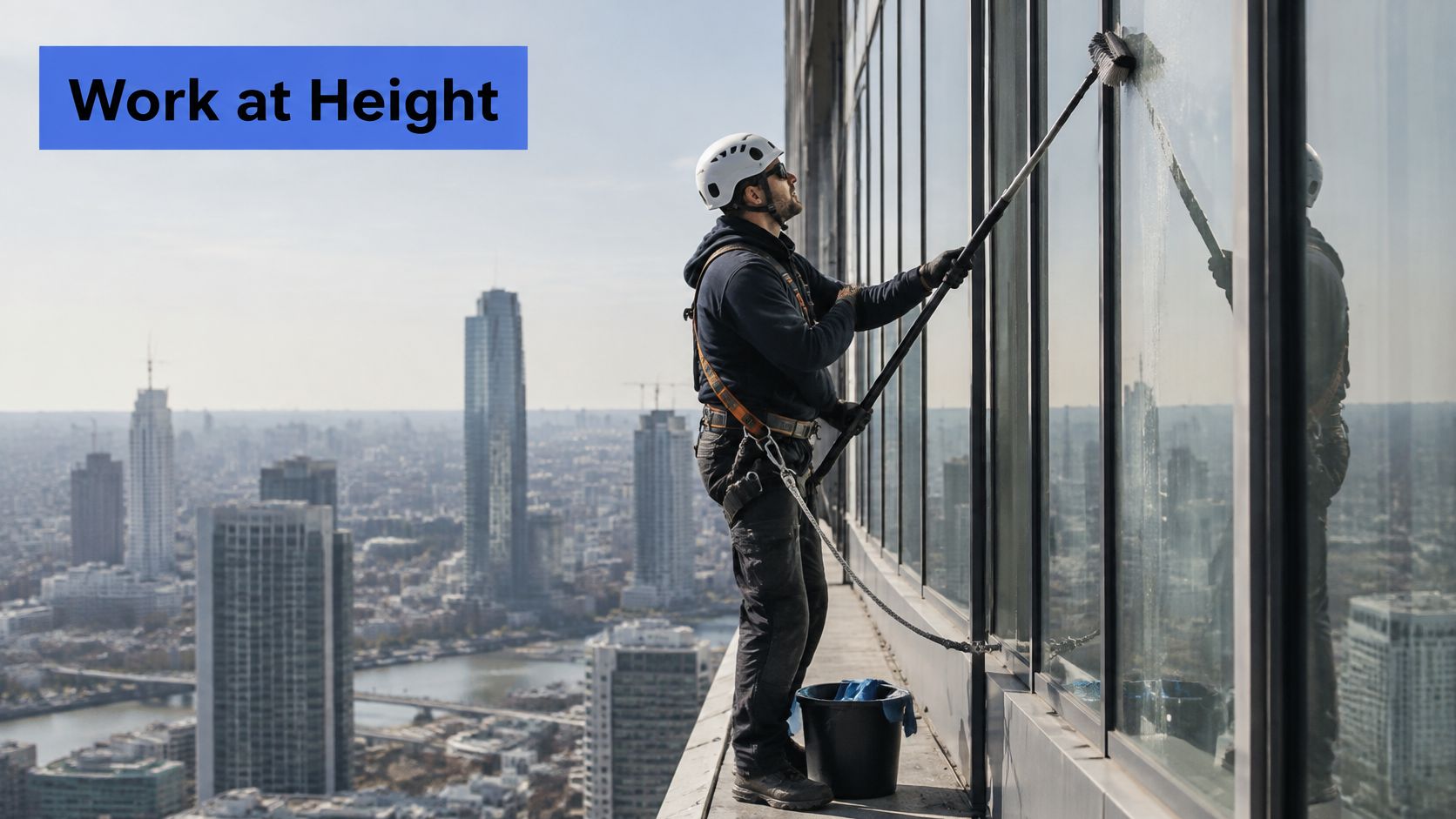
A pole can cut fall exposure on lower floors of a condominium or commercial tower. It does not make a roof edge, a suspended platform, or rope-descent work safe. Competent planning, supervision, equipment selection, training, and PPE still apply wherever residual risk remains. Our window cleaning safety equipment notes walk through that gear in more detail.
Water-fed pole work has its own failure points: trip hazards, defective equipment, high winds, overhead power lines, and thunderstorms. Before the pole leaves the truck, run a short inspection.
Write it down before anyone climbs or extends a pole: overhead electrical hazards, wind exposure, pedestrian traffic, footing, anchor suitability, and rescue arrangements. On medical offices, dealerships, and retail property, set cordons and warning signs so the hose and the work zone are visible. Treat the brush, pole, hose, purified-water system, and safety equipment as one kit. The configuration changes with the building.
Build a one-page pre-job survey and inspection sheet, and don't schedule the tall glass until that page is filled in.
Spotting after a pure-water job usually isn't a small tank or a short pole. Water-fed pole guidance traces poor results to contamination on frames, seals, and brickwork, or to a weak rinse, and it requires crews to monitor total dissolved solids, check pressure and filter condition, maintain reverse-osmosis membranes, and replace deionization resin before the glass starts to fail. A bigger tank in a hard-water market just stores more minerals. Source-water quality, consumable replacement, the first rinse, and dirty frames decide the finish.
That shows up fast in the Southwest, where mineral-heavy source water raises filtration demand. In Phoenix, test the tap before you assume a standard filter set will hold through the day. City-level hardness numbers aren't in that guidance, so the meter on your outlet is the number that matters.
A 2025 industry report, noted in that same guidance, described pure-water cleaning as faster, less physically demanding, and less dependent on chemicals. Those gains hold only while upkeep and water quality stay in range. Our notes on window cleaning with pure water sit next to this routine because the method fails without warning when the resin is spent.
| Component | What to check | Check interval | Failure sign |
|---|---|---|---|
| TDS meter reading at outlet | Dissolved solids in the rinse water | Before each job | Spotting or film on glass |
| Pre-filters | Sediment load and pressure drop | Weekly, or when flow drops | Reduced flow to the pole |
| Deionization resin | Exhaustion and rinse-water quality | Replace per manufacturer or when outlet TDS rises | Hard-water spots after rinsing |
| Reverse-osmosis membrane | Output quality and fouling | Per manufacturer specification | Higher TDS and slower output |
| Hose and fittings | Leaks, kinks and wear | Before each use | Pressure loss or a trip hazard |
| Brush head | Bristle wear and trapped debris | After each job | Scratching or uneven rinse |
| Squeegee blade | Nicks and hardening rubber | Every job | Streaks along the blade's path |
Replacement follows the manufacturer's specification. Don't stretch a resin cartridge because the glass "looked okay" last Tuesday.
Spread consumables across the jobs they cover: resin or membrane slices, pre-filters, water, and the minutes a TDS log takes. A spotting callback costs a return trip, a second setup, and a customer who now doubts the whole service. Set that against the cost of the maintenance check you skipped. If one resin change prevents two return visits, the change is the cheaper line on the sheet.
The same truck can be cheap on one address and expensive on the next. Height and access move the cost lines more than the brand on the squeegee.
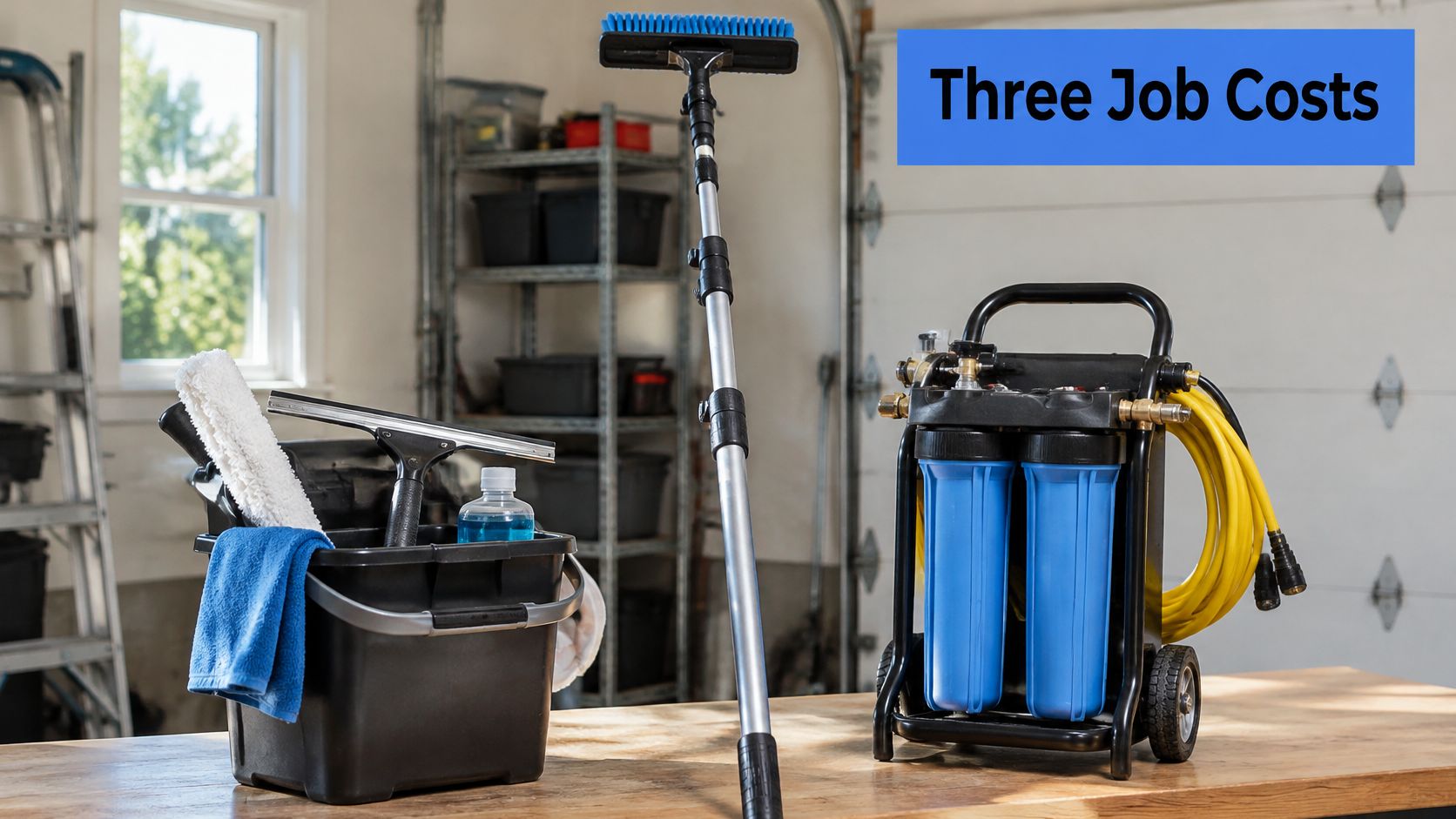
Interior glass and the lower exterior take a washer, a squeegee, and cloths. A 20-foot pole reaches the upper windows from the lawn. No pure-water system is on this job. Consumables are soap and a few cloths. Water is a bucket. Crew time stays on the glass instead of on filters and hose. Safety gear is a short ladder used correctly, not a harness day. Price it as four lines: consumables, water, crew time, and safety equipment. On this house, crew time is almost the whole bill.
Cloth cost is the small line. A 2025 marketplace listing on Accio put a professional microfiber window-cleaning kit at USD 0.69–6.19 per unit, with a minimum order of 1,000 pieces. Even at the top of that range, a cloth is noise next to an hour of labor or a day of access equipment. Use your own figures for water, labor, and any rental.
This one is an illustrative scenario, not a documented project. Lower floors take the pole kit from the ground. Upper glass needs a separately approved access system, and safety planning sets the schedule, not the number of panes. In Denver, wind, anchors, and a rescue plan can burn more of the day than the wash itself. Consumables stay modest. Water depends on whether the lower floors run pure-water. Crew time jumps because setup, exclusion zones, and the descent system are part of the job. Safety equipment, rented or owned, becomes a real line instead of a ladder you already carry. The kit didn't get worse. The building changed which lines dominate.
The glass is inside pole reach, so a pure-water kit fits, but the doors don't close for the crew. Cordons and warning signs go up before the hose does, and a TDS log records rinse quality so a spot complaint has a number behind it. Consumables include filters sized to that day's source water. Water volume is higher than the house job. Crew time includes the log and the pedestrian setup. Safety equipment here is mostly ground control, not fall arrest. Skip the cordons and the cheap job becomes a trip incident. Skip the log and a mineral spot looks like a lazy brush.
Take one building you own or manage. Write the same four lines, consumables, water, crew time, and safety equipment, and you'll see which constraint is writing the invoice.
A kit is ready when the building, cleaning method, water supply, and safety plan agree. Before adding another tool, answer five questions for the next address.
Treat the kit as one sequence. A squeegee job fails when the removal blade is missing. A pole job fails when the final pure rinse is cut short. Extra accessories cannot compensate for a skipped stage.
For high-rise or public-entry commercial work, complete the site survey before buying equipment or booking access. Record anchor points, footing, wind exposure, and how people move through the site. Those answers decide whether the job needs a pole-only setup, ground control, or an approved access and rescue plan. Choosing gear from a catalog first can leave the crew with equipment that cannot safely or legally finish the building.
Professional Window Cleaning has been cleaning windows since the company was founded in 1999, and we serve Arizona, Colorado, and Nevada. We offer residential, commercial, and high-rise window cleaning, and our satisfaction guarantee means concerns raised after the job are addressed promptly. Office work can include specialized treatments for hard-water stains and mineral deposits, so address the water problem before assuming the kit needs a bigger bucket.
Write the kit list for the next job. Mark each item owned, needed, or hired. Connect it to a pane zone, water stage, or safety requirement, then settle the list before the job date while a missing filter or anchor can still be fixed without a return trip.
Professional Window Cleaning matches the kit to your glass, from a squeegee set on a house to water-fed poles and approved access on taller buildings, and we back the work with a satisfaction guarantee. A free estimate is the simplest way to confirm which method and safety setup your property needs. Visit Professional Window Cleaning and tell us the building height, access, and water available on site.
Read our blog posts regularly and keep learning.