Care and Maintenance
Best Window Cleaner in 2026: 7 Top Picks Compared
Looking for the best window cleaner in Arizona, Nevada, or Colorado? We compare 7 providers on pricing, service range, and reviews.


A summer storm hits while the garden is already dry, and you watch sheets of water race off the roof, jump a clogged gutter, and pool against the foundation. That water could have filled a barrel for the beds, but only if the rain catchers and gutters are sized, sealed, and cleaned as one system. A screen on the gutter does not make the water safe to drink, and a bigger barrel does not fix a sagging run that never reaches the downspout.
The setup is simple. The gutter is the funnel. The barrel is only a reservoir for what that funnel delivers. Get the path right before you buy storage.
Say you have a 1,000-square-foot roof in a summer storm. Rain sheets off the shingles, picks up the dust that settled during the dry spell, and drops into the gutter. From there the path is fixed: gutter, leaf guard, downspout, first-flush diverter, barrel or cistern, then an overflow hose aimed away from the house. Whatever the gutter delivers, grit included, is what the diverter and the barrel have to handle.
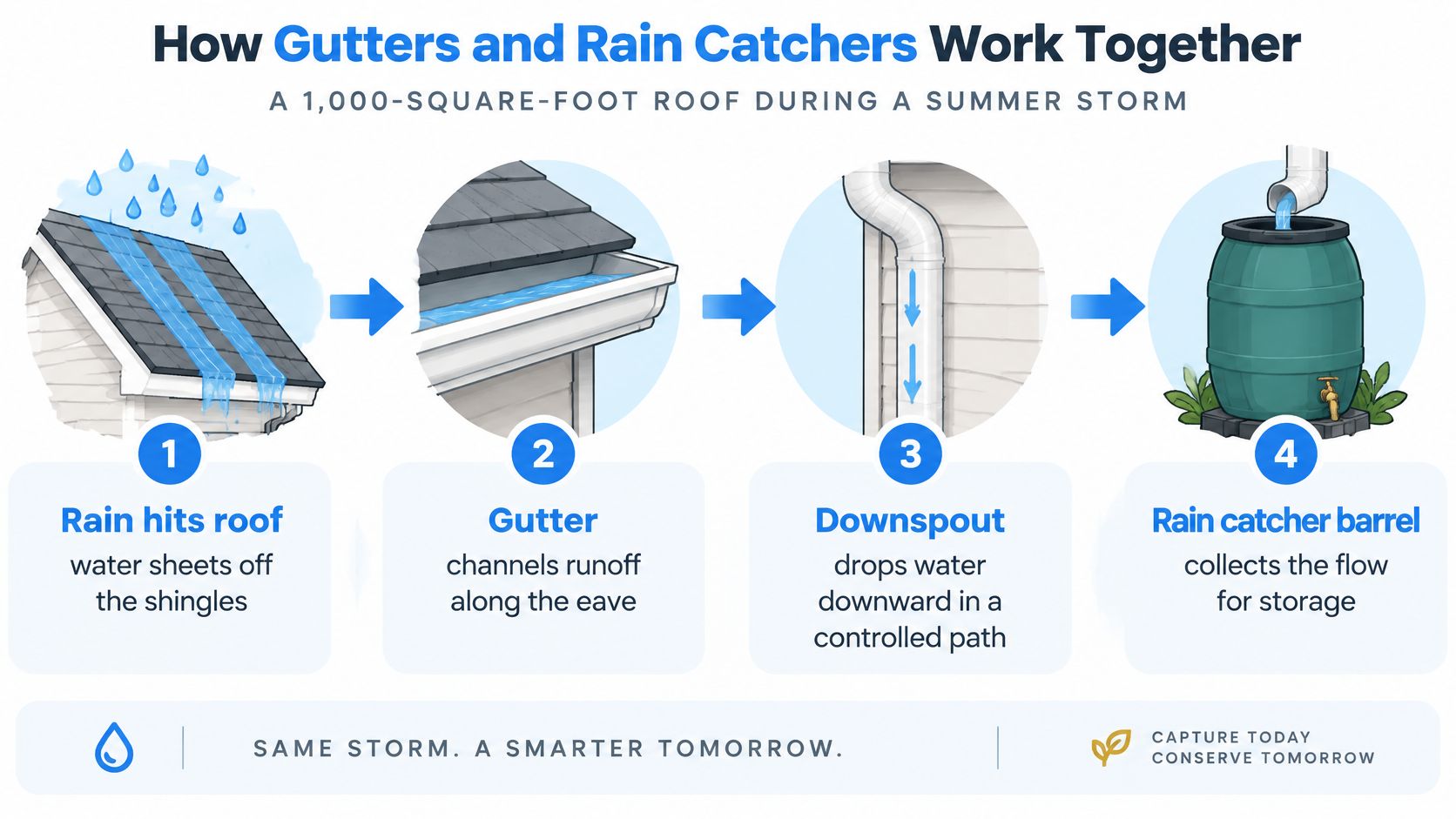
Every component in that path hands water to the next one, so the weakest part sets the limit for the whole system. A gutter that sags mid-run, drips at a mitered corner, or holds a mat of decomposed leaves sends water over the eave instead of down the spout, and the barrel never sees that storm. A clear downspout cannot compensate for a gutter that overflows upstream. A bigger tank cannot compensate for either.
| Component | Job in the system | Typical size or type | Main upkeep |
|---|---|---|---|
| Gutter | Collects roof runoff and moves it to the downspout | 5-inch K-style | Clear debris each spring and fall |
| Leaf guard | Keeps leaves and litter out of the gutter | Mesh, foam or reverse-curve cover | Brush off debris and check seams yearly |
| Downspout | Carries water from gutter to barrel or ground | 2 x 3 inch or 3 x 4 inch | Clear elbows and joints |
| First-flush diverter | Sends the first dirty runoff away from storage | Standpipe or valve type | Empty and rinse after each storm |
| Rain barrel | Stores water for garden use | 50 to 55 gallons common | Clean screen and interior each season |
| Cistern | Stores larger volumes for household or landscape use | 500 to several thousand gallons | Inspect yearly and remove sediment |
| Overflow hose | Routes excess water away from the foundation | Flexible hose, 1 to 2 inch | Check for clogs after heavy rain |
How hard each part works depends on the site. A roof under trees loads the leaf guard and the downspout elbows, while a roof in a dusty climate loads the first-flush diverter, since that first runoff carries the season's grit straight toward storage.
Stored rain is soft and carries no chlorine, which suits lawns, shrubs, and pots. It cuts the tap water you burn on irrigation, slows the sheet flow that cuts beds and saturates soil beside the wall, and eases pressure on storm drains. Water bound for edible crops needs more care than water bound for the lawn.
A quick field test tells you whether the path works. Once rain starts, water should leave the downspout in a steady stream within seconds, not dribble over the eaves. If the stream is weak or the front lip overflows, a crew can reset pitch, hangers, and outlets before you add storage; the repair scope covered by gutter services in metro Atlanta is the same list that keeps a collection run from leaking away at the eave.
Practical rule: If water spills over the front lip, fix the gutter before you spend money on a larger tank.
Use this installer rule of thumb. Each inch of rain on one square foot of roof yields about 0.62 gallons. Multiply the roof footprint, not the sloped shingle area, by 0.62, then by the inches of rain. For a half-inch storm, that is about 0.31 gallons per square foot.
| Roof footprint (sq ft) | Gallons per 0.5 inch storm | Barrels filled (55 gal) |
|---|---|---|
| 500 | about 155 | about 3 |
| 1,000 | about 310 | about 6 |
| 1,500 | about 470 | about 9 |
| 3,000 | about 930 | about 17 |
Take the 1,000-square-foot roof in a 0.5-inch storm. The table says about 310 gallons. A common 55-gallon barrel holds less than a fifth of that, so it overflows within minutes of a hard rain. Real capture is lower still. Gutter leaks, splash off the eave, the first-flush diverter, and the overflow all send water somewhere other than the tank. Plan on less than the theoretical figure, not more.
In a dry climate, one storm may fill a barrel while a cistern sits half empty until the next cell. In a wet week, a single barrel is full before you need the water, and the rest of the roof's yield leaves through the overflow. Storage should match the storm you typically get and how soon you will use the water, not the biggest tank on the shelf.
Before you buy, answer two questions. How many downspouts will feed this one barrel, and where will the overflow go when the barrel is already full? One downspout on a 3,000-square-foot roof will never deliver the 930-gallon line in that table. Two linked barrels on one corner still leave the other corners dumping on the lawn.
A larger tank only helps if the gutter can deliver the water and you have a place to use it before the next storm.
A working install has a short list of parts: a level base, a cut downspout, a diverter, a screened inlet, and an overflow that leaves the house. Skip one and the barrel either tips, breeds mosquitoes, or wets the footing.
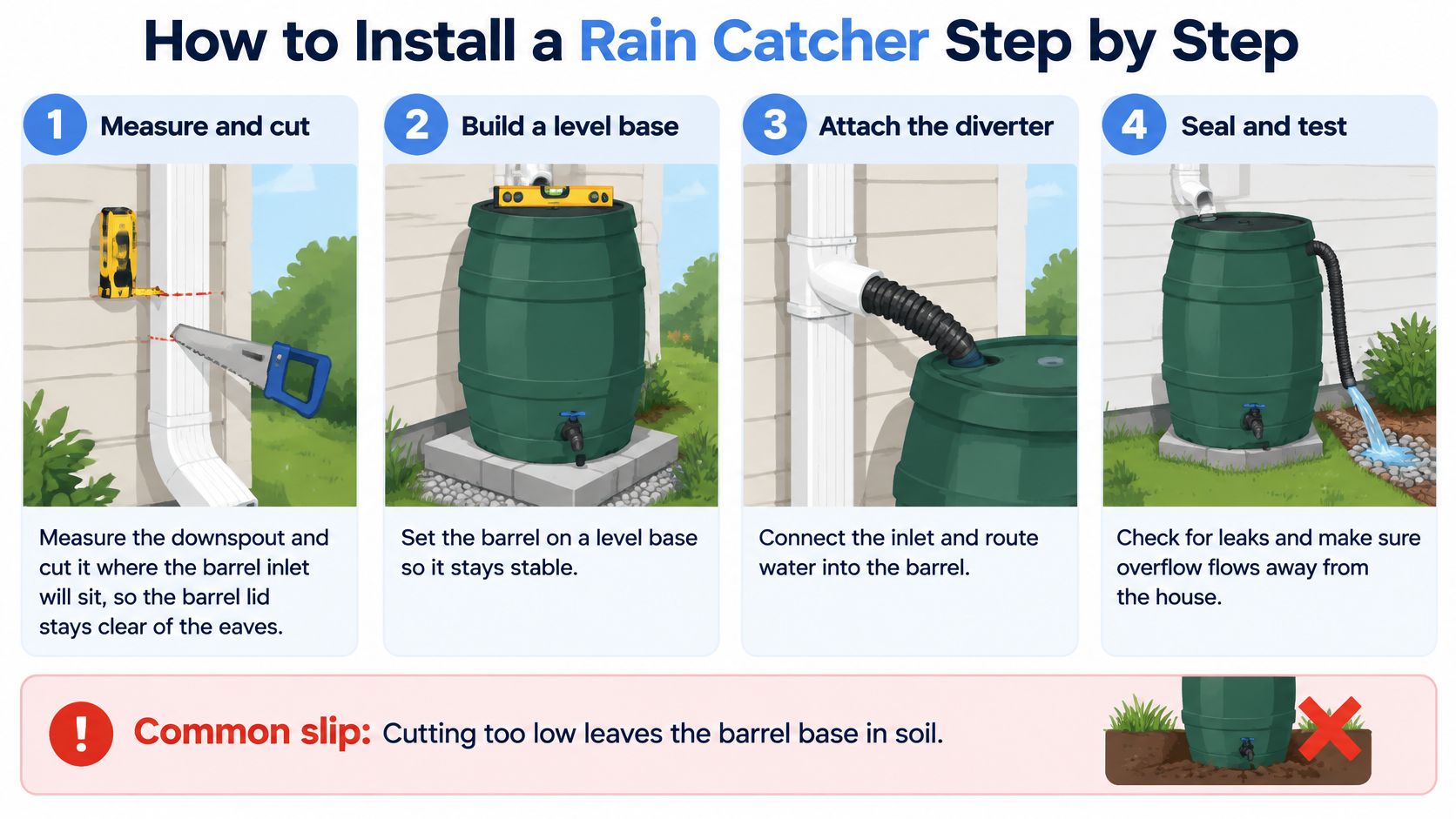
Measure the downspout and cut it where the barrel inlet will sit, so the lid stays clear of the eaves. Cutting too low is the common slip. The barrel then sits in soil, the spigot is useless, and the base rocks. Mark the cut with the barrel on its finished base, not on the bare ground.
Build a level base of concrete blocks or a stand high enough for a watering can or hose under the tap. A full 55-gallon barrel weighs about 460 pounds. An uneven pad can crack the tank or tip it toward the wall. I would start with two courses of solid cap blocks on compacted gravel, checked with a short level in both directions.
Fit the first-flush diverter above the barrel inlet so the first runoff is diverted. Skip it and roof dirt settles in the tank on every storm. A standpipe style fills a small chamber, then lets cleaner flow continue. Empty that chamber after the rain or it just becomes a second dirty barrel.
Attach the overflow hose at the top of the barrel and run it several feet away from the foundation, downhill to a gravel bed or a garden. Pointing it at the footing is the slip that erodes soil and keeps the stem wall wet. Use a 1- to 2-inch hose and keep the outlet lower than the barrel rim so it cannot back up.
Cover every opening with insect screen, including the inlet and the lid. Mosquitoes can breed in standing water in about a week. A tight lid with one unscreened hole is still an open tank.
Seal the joints with silicone or the manufacturer's fittings, then run a hose into the gutter and look for leaks before the next rain. Loose elbows drip onto the foundation even when the barrel looks full. If you want a clear photo sequence of outlets, elbows, and sealant, how to seal downspout connections from Two States Exteriors LLC is a useful reference while you dry-fit the pieces.
A good test looks boring. Water enters, the first flush diverts, the barrel fills steadily, and overflow leaves the property instead of the flower bed against the siding.
Watch a short install walk-through before you cut the downspout, then compare it with your own eave height.
Start in spring, when winter grit has settled in the gutters and the diverter still holds last season's sediment. That first cleaning sets the capture for the rest of the year, and it sets the water quality too. A barrel can be spotless inside and still stay empty if the gutter above it is packed, and a clean tank fed by a dirty roof still stores dirty water. Maintenance here does two jobs at once: keeping the barrel full and keeping what fills it clean.
| Task | How often | Why it matters |
|---|---|---|
| Clear gutters and leaf guards | Spring and fall | Clogs cause overflow at the eaves |
| Empty and rinse first-flush diverter | After each storm | Dirty early runoff otherwise reaches storage |
| Check downspout joints and hangers | Twice a year | Loose joints leak onto the foundation |
| Inspect and clean barrel screens | Monthly in wet seasons | Debris and insects enter the barrel |
| Scrub barrel interior and tank | Once a year | Sediment and slime build up |
| Clean roof and gutters after dry spells | After each long dry stretch | Dust and droppings build up before storms |
| Drain and disconnect before freezing | Before the first hard freeze | Trapped ice can crack barrels and fittings |
In arid stretches of Arizona and Colorado, dust and droppings build during long gaps between storms. Run the gutter cleaning after those gaps rather than on a fixed calendar date. A leaf guard helps, but fine sludge still collects under some covers, and the first storm after a dry month washes all of it toward the diverter at once. The steps for cleaning gutters with a gutter guard get that sludge out without pulling the whole cover off.
Cold regions run on weather too. Empty the barrel and disconnect the hoses before the first hard freeze, because ice trapped in a fitting can split the tank even if the plastic looked fine in October.
Three signs the system is healthy: the gutter drains without pooling, the barrel fills steadily during rain, and the overflow runs clear. A common failure in year two is a clogged or sagging gutter that starves the barrel. That is why the gutter check comes first each spring, before the tank gets scrubbed, and I would rather clean a gritty gutter twice than let one storm push a season of droppings into storage.
A gutter that looks clean does not mean the water in the barrel is clean. Rooftop runoff picks up bird and animal waste, bacteria, zinc, lead, pesticides, and whatever else has dried on the roof since the last storm, so treat stored barrel water as non-potable. Extension guidance on rain barrels, including this Rutgers Extension fact sheet, treats harvested roof runoff the same way.
How dirty that water gets changes from storm to storm. Testing of stored barrel water has turned up fecal bacteria and pathogens such as Legionella and Mycobacterium, sometimes above drinking-water limits. The heaviest load usually arrives in the first minutes of runoff after a dry stretch, while a roof that has already been rinsed by recent rain sheds much cleaner water. That is the case for a first-flush diverter: let the roof wash itself before the tank starts filling.
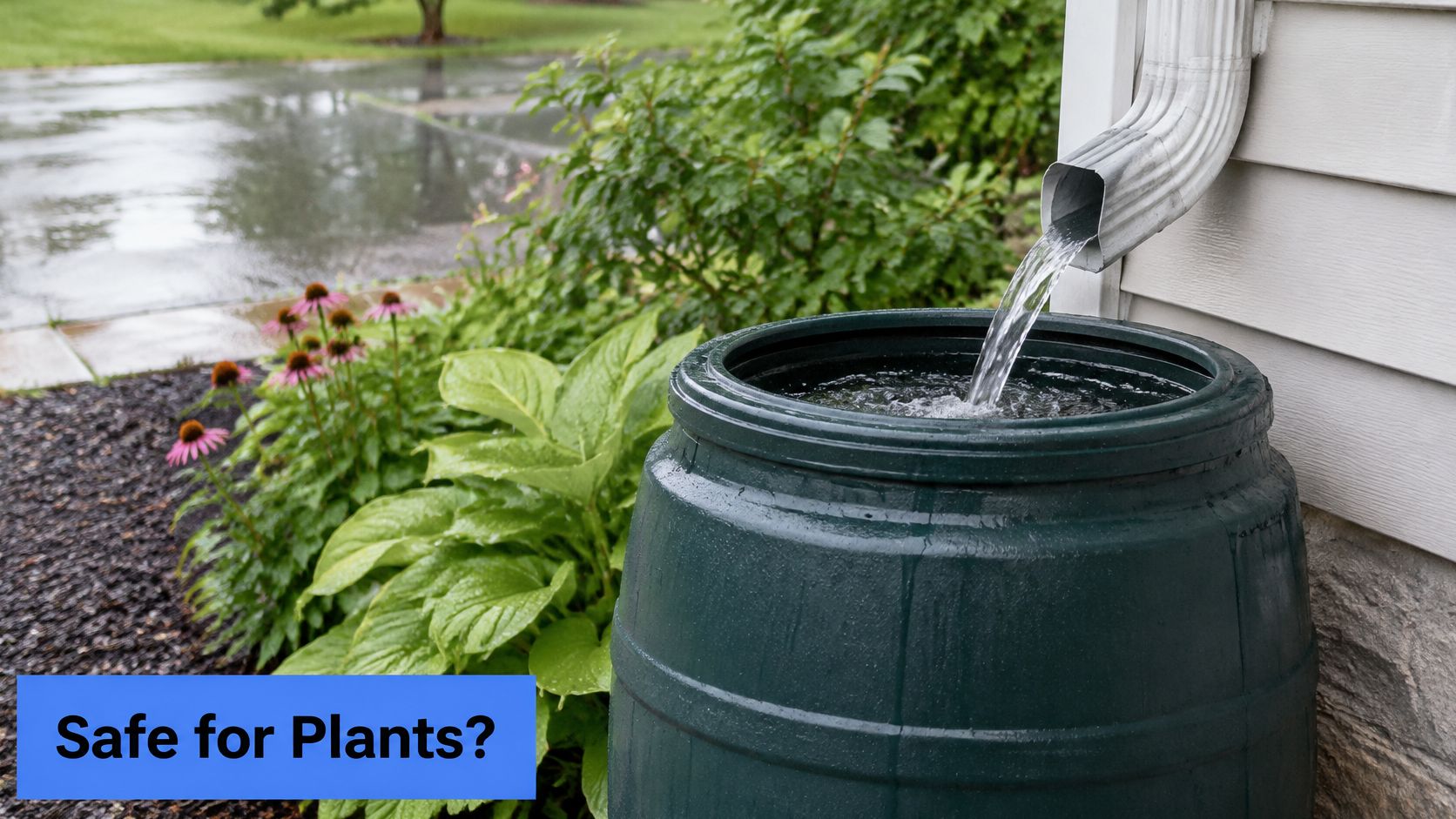
Water quality starts upstream of the barrel. Whatever sits in the gutter at the start of a storm ends up in the tank, so a clean trough is the cheapest water-quality control in the whole setup. Lawns and shrubs can take harvested water on the soil. Food plants need a stricter habit. I would use drip or a soaker at soil level, not a sprayer on leafy crops you will eat raw. A gutter guard does not change that split. It only keeps leaves out of the pipe.
Cut the risk in this order:
Dry Western states such as Arizona, Nevada, and Colorado can go weeks between storms. The longer the roof sits dry, the more waste accumulates for the next storm to carry into the tank, so the first rain of a monsoon or a spring front is the one to divert, not the one to save for the vegetable row.
Label non-potable water and keep it off any produce you eat raw.
A rain catcher has to balance limited storage, sudden high-volume runoff, overflow routing, foundation protection, and seasonal shutdown. Those pieces fight each other if you size the tank and ignore the weather.
In desert yards around Phoenix, Scottsdale, and Las Vegas, rain is infrequent. The University of Nevada Extension notes that dust, debris, and animal droppings can sit on the roof until a storm, so systems should divert the first few gallons, keep gutters and downspouts clear, control erosion at the overflow, and clean tanks and filters on a schedule. A barrel may take several storms to fill, and the design question is how you dump that early dirty water and keep the stored water from going stale between storms.
A monsoon-style burst is the opposite problem. One heavy cell can exceed barrel capacity in minutes. Check whether the overflow hose can carry the peak, and whether a second downspout or a larger tank is worth adding. A bigger barrel is not automatically better. If it is already full when the main storm arrives, a short or uphill overflow concentrates water at the foundation and cuts a rut in the soil.
Timing the clean matters as much as tank size. Our guide on when to clean out gutters is the checklist I would use before a forecast monsoon or a spring front at higher elevation.
Around Denver and similar elevations, plan a winter shutdown. Drain the barrel, disconnect hoses, and store or insulate fittings before freezing weather. A sturdy raised base and an overflow aimed away from the foundation still matter in July. They do not protect a tank full of ice in January.
Pick the setup from the roof, the use, and the climate, in that order. Read the yield table for your footprint. Decide whether the water is for ornamental irrigation or for food crops. Match dry gaps, cloudbursts, or freezes. Then check the pad, the base height, and whether you will rinse a diverter after storms.
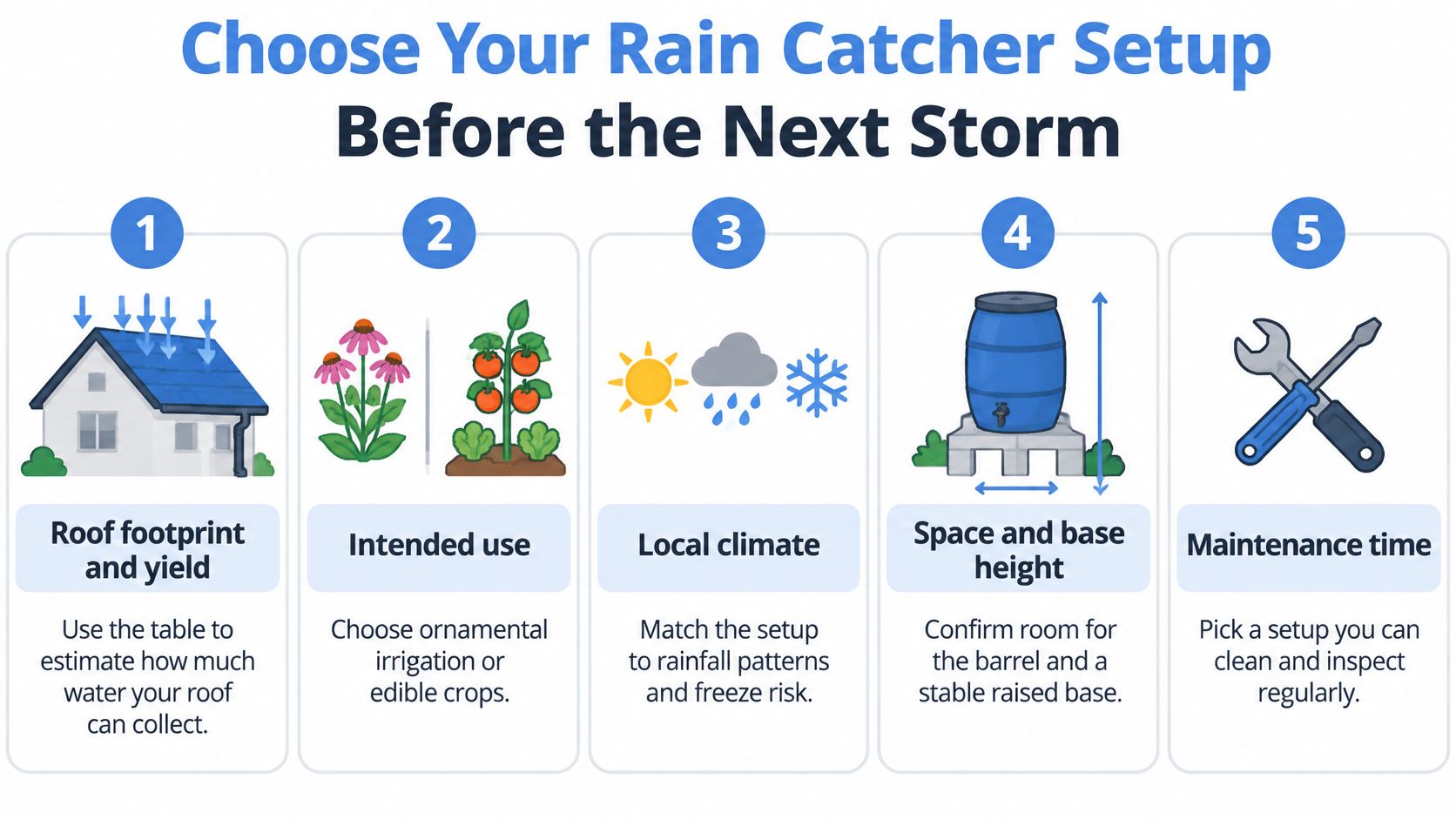
Under about 500 square feet of roof, a single 55-gallon barrel with a first-flush diverter and an overflow hose covers a typical shrub bed. Between 1,000 and 2,000 square feet, plan on linked barrels or a cistern of 500 gallons or more, with overflow to a gravel bed or rain garden. Above that, a cistern with a pump and someone who sizes inlets for the peak flow is the honest choice. One barrel on a large roof is a demonstration, not a water supply.
Local rules on collection differ, so check them before you build. Some cities want mosquito screening written into the permit. Others limit how you connect to a downspout.
Finish this week with a short list:
Measure the roof and clear the gutters before that storm. Storage can wait a weekend. A clogged eave cannot.
Professional Window Cleaning has been cleaning windows for over 26 years, and our crews use only two methods, a traditional squeegee or a pure-water system, as we describe in our notes on window cleaning methods. We also clear gutters, including guarded runs and the sludge that keeps a rain catcher from filling, and we offer a free estimate. If your eave and glass both need a reset before the next storm, visit Professional Window Cleaning.
Read our blog posts regularly and keep learning.