Care and Maintenance
Hard Water Stains on Car Windows: How to Remove Them
Learn how to remove hard water stains on car windows safely, avoid etching, and know when a glass pro is the right call. Step-by-step methods inside.


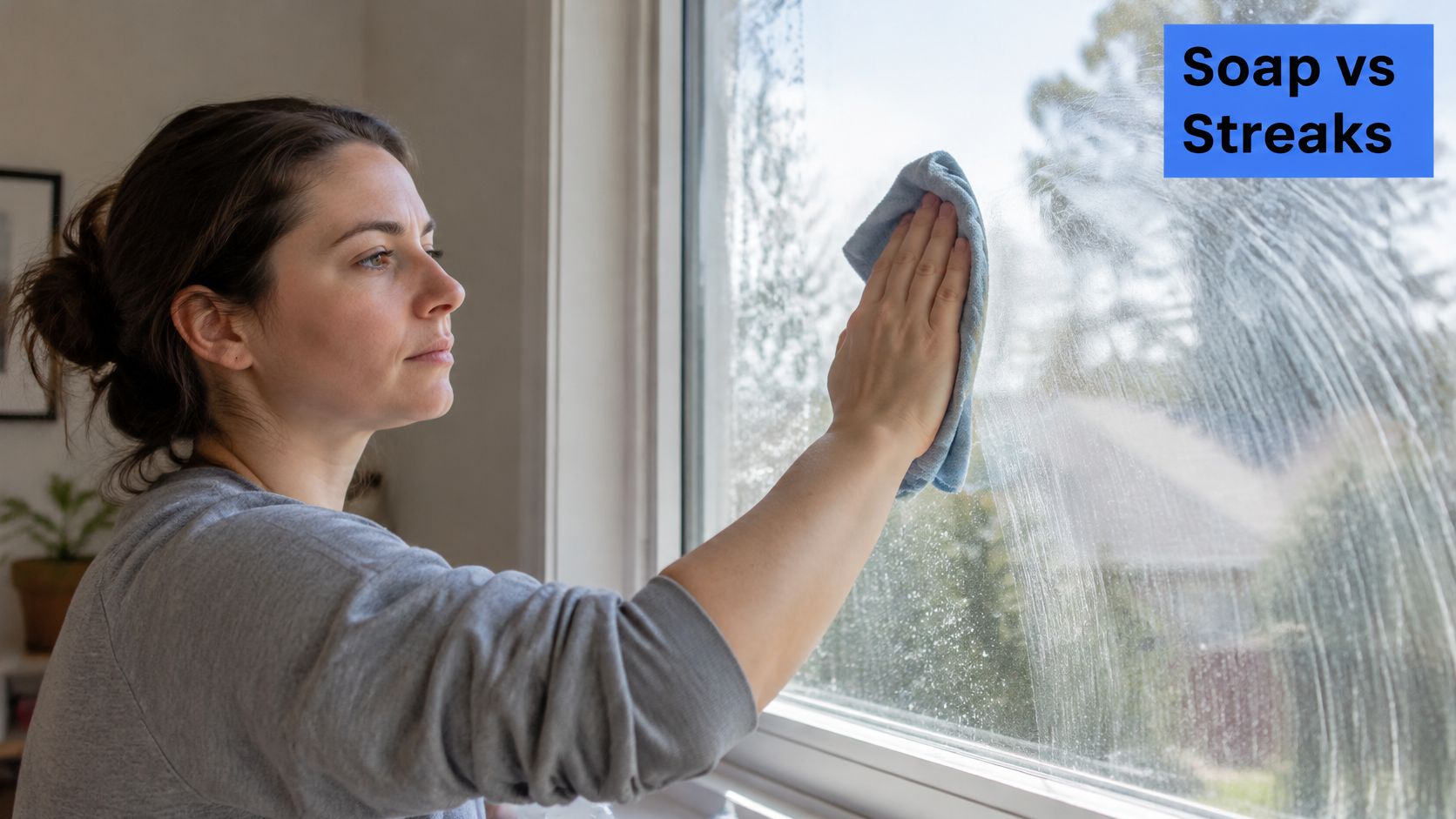
You wipe a pane with soapy water, step back while it's still wet, and it looks perfect. Ten minutes later, angled sunlight shows cloudy streaks you swear weren't there before. That gap between wet and dry is where most soap window cleaning goes wrong, and it's almost always fixable once you understand what's left behind.
A soapy pane can look clear while wet, then show cloudy streaks as it dries. The water temporarily hides residue; once it evaporates, leftover soap and loosened dirt become visible. Soap works best as a measured cleaning solution, followed by complete removal of the dirty liquid.
Many window cleaners use a squeegee method: cleaning solution loosens soil, and a rubber blade removes the liquid and suspended dirt. Some also use pure-water systems, which filter out dissolved minerals so the water can dry without leaving mineral spots. These are two approaches among several, and the right choice depends on the glass, the soil, and the cleaning setup.
Professional Window Cleaning has been in business since 1999. In a squeegee routine, soap helps lift grime, but more soap does not mean cleaner glass. Dilution, water hardness, and local drying conditions all affect what remains on the pane. For small interior panes, a spray is another format; the Evo Dyne Products glass cleaning guide offers related information.
A pane can look clear while wet, then show a faint film as it dries. The soap type, amount used, and water quality all affect that result. Compare the options by how they clean and what residue they may leave.
| Type | Typical Examples | Strengths | Limitations |
|---|---|---|---|
| Commercial glass cleaner | Ammonia-free glass concentrates | Formulated for glass; consistent results and low residue | Costs more; check the label for coated glass |
| Commercial pH-neutral soap | Mild professional soaps for glass and frames | Gentle on sealants, frames, and screens | May be less effective on heavy grease and film |
| DIY dish soap solution | Clear dish soap in warm water | Inexpensive to mix and effective on grease | Can foam and leave a film if overdosed; may be harder to rinse |
| DIY castile soap solution | Unscented liquid castile soap | Plant-based option | Can form scum in hard water and needs a thorough rinse |
The visual below summarizes these trade-offs.
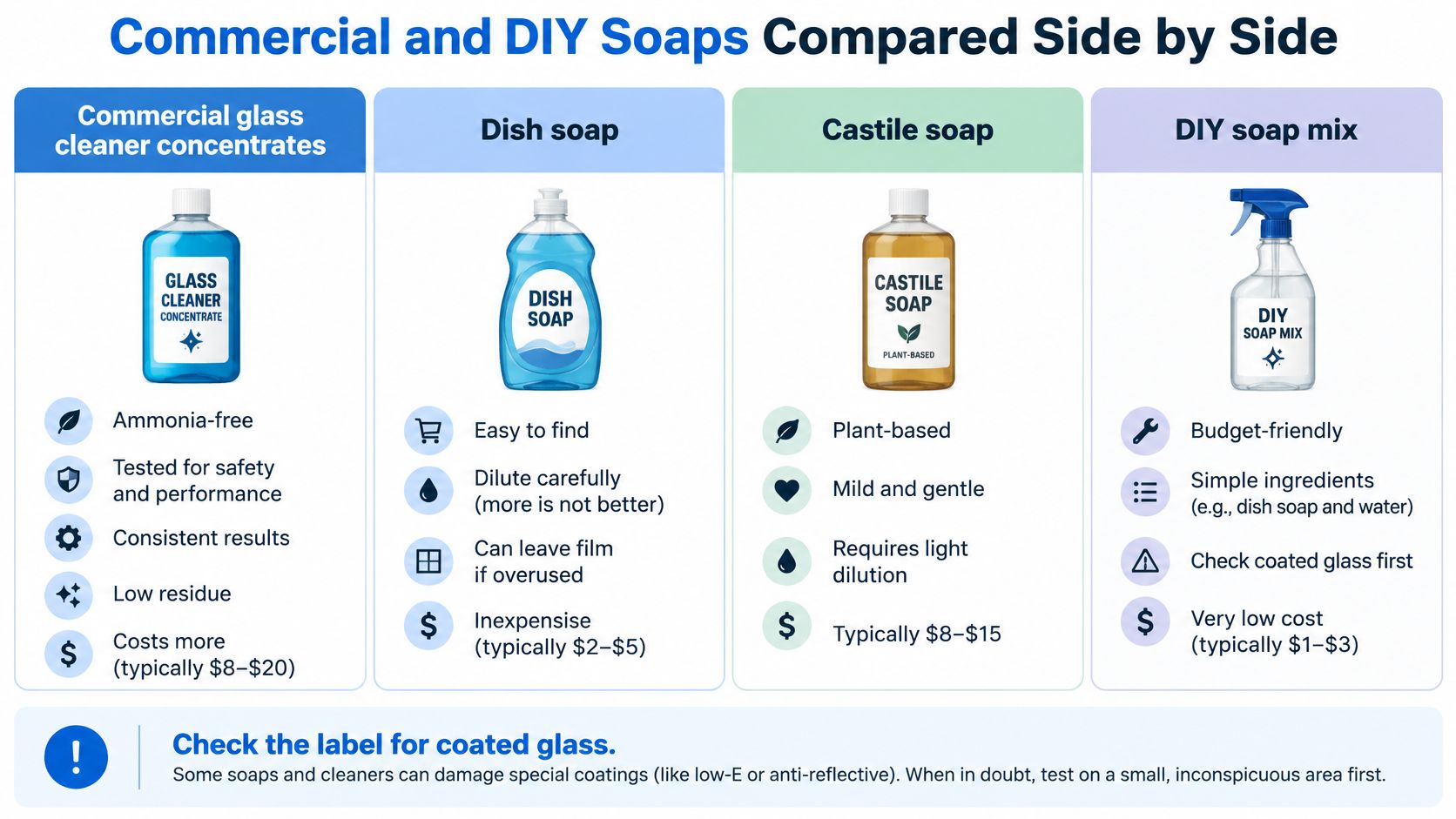
A commercial concentrate is like a measured recipe: its formula is designed to behave consistently when mixed as directed. A DIY solution is more like seasoning by eye. Different dish soap brands vary in strength, and an unmeasured pour can change how much residue remains.
Dish soap can loosen kitchen grease and fingerprints. Castile soap offers a plant-based choice, but mineral-rich water can react with soap and leave a dull film. Commercial products also vary, so check the label before using one on coated or low-E glass.
The video below shows how application and removal affect the finish.
A natural label alone does not determine a product's environmental impact. A large scientific review summarized by Aarhus University concluded that common soaps, shampoos, and detergents pose very low environmental risk when used responsibly and treated in a proper wastewater plant. Bio-based alternatives are also growing.
Consider the whole cleaning process: where the runoff goes, how much soap you use, and how much water it takes to rinse. In hard water, soap scum can mean extra rinsing and a hazy pane. The same dose discipline applies to other surfaces, as these floor care tips for West Georgia homes explain.
Choose soap based on the surface, water hardness, soil level, and your ability to remove the solution fully.
Check these points before mixing:
These answers help narrow the product choice. Its label then guides the appropriate dilution.
Use these mixes per litre of warm water as your starting point, not as a reason to add a little extra.
| Solution | Mix per Litre | Approx. Surfactant | Best Use |
|---|---|---|---|
| DIY dish soap, light cleaning | 5 mL (1 tsp) dish soap | About 0.1% | Routine glass and frames |
| DIY dish soap, heavy film | 10 mL (2 tsp) dish soap | About 0.2% | Greasy build-up, then a clean rinse |
| DIY castile soap, light cleaning | 2 to 3 mL castile soap | About 0.05% | Plant-based option; needs softened or deionized rinse water |
| Commercial glass concentrate | Per manufacturer label | 0.05 to 0.5% preferred range | Follow label; never exceed stated strength |
| Final rinse, deionized water | 0 mL soap | 0% | Last pass on hard water to prevent spotting |
Plain water beads on glass and rolls off oily dirt. Surfactants fix that in three steps. They lower water's surface tension so the solution spreads in a sheet, they loosen and emulsify oily soil into the water, and they keep particles suspended so the dirt leaves with the liquid instead of settling back.
It's like washing a greasy plate. A little soap lets water lift the grease away. A lot of soap doesn't lift more grease, it just leaves more soap to rinse off. Glass shows that leftover layer the moment it dries.
Technical formulations reflect that balance. The American Cleaning Institute soaps and detergents reference notes that technical glass-cleaner formulations commonly keep total detergent surfactant near 0.02 to 1% by weight, with preferred ranges around 0.05 to 0.5%. Above what you need for wetting and glide, a heavy surfactant film can remain after evaporation and create haze or streaks, especially when glass is wiped instead of thoroughly rinsed or squeegeed.
Practical rule: Use the minimum concentration that gives uniform wetting and easy squeegee glide. If the blade drags, rewet the pane before you reach for more soap.
Start at the lowest ratio, clean one pane, and let it dry fully. Then look at it under oblique light, standing to the side so light rakes across the surface. Residual soap shows as directional smearing that follows your strokes. Mineral trouble looks different, as separate white dots.
That distinction tells you what to change. Smears mean lower the dose or remove solution more completely. Dots mean the water, not the soap dose, needs attention. Don't adjust both at once or you won't know what worked.
Replace the bucket solution once it turns cloudy, because you're then spreading suspended soil back onto clean glass. In hot, dry conditions the solution evaporates faster, so work in smaller sections and keep the working edge wet. A labelled measuring cap or teaspoon beats a squeeze bottle guess every time, and it makes your next mix repeatable.
The surface, not the soap, decides most damage. Glass tolerates a light solution well, while coatings, stone, wood, and mesh each have a limit you shouldn't test on a full window.
| Surface | Soap Works Well When | Watch For |
|---|---|---|
| Standard glass | Light dilution, squeegee removal follows | Film if solution dries on the pane |
| Coated or low-E glass | Label confirms compatibility | Abrasive pads damaging coatings |
| Vinyl frames | Mild, pH-neutral soap with a microfiber cloth | Prolonged soaking causing dulling |
| Aluminum frames and tracks | Soap loosens grime in tracks | Residue left in tracks unless flushed |
| Window screens | Soft brush with mild soap | Torn mesh from hard scrubbing |
| Stone or marble sills | Only pH-neutral soap | Acid or harsh cleaners causing etching |
| Painted wood frames | Mild soap, then prompt drying | Water soaking into wood and swelling |
Coated glass causes the costliest mistakes. The pro is that a compatible, mild solution cleans it normally. The con is that an abrasive pad or the wrong chemistry can mark a coating you can't repair by rewashing, so the label check comes before the bucket.
Stone and marble sills are next. Mild, pH-neutral soap is fine, but acidic products people reach for on mineral spots can etch stone on contact. Treat frames and sills with the gentle care you'd give a kitchen countertop, not the scrubbing you'd give a stove.
Frames and tracks fail in quieter ways:
Screens reward a soft brush and light pressure. Push hard to chase a stubborn spot and you'll stretch or tear mesh that looked fine before you started.
If the surface isn't glass, test a small hidden spot first, rinse it, dry it, and only then clean the rest.
Standard glass remains the forgiving case. At light dilution with prompt squeegee removal, soap gives you wetting, glide, and soil lift with little risk. Let that same solution dry on the pane and the pro becomes the con.
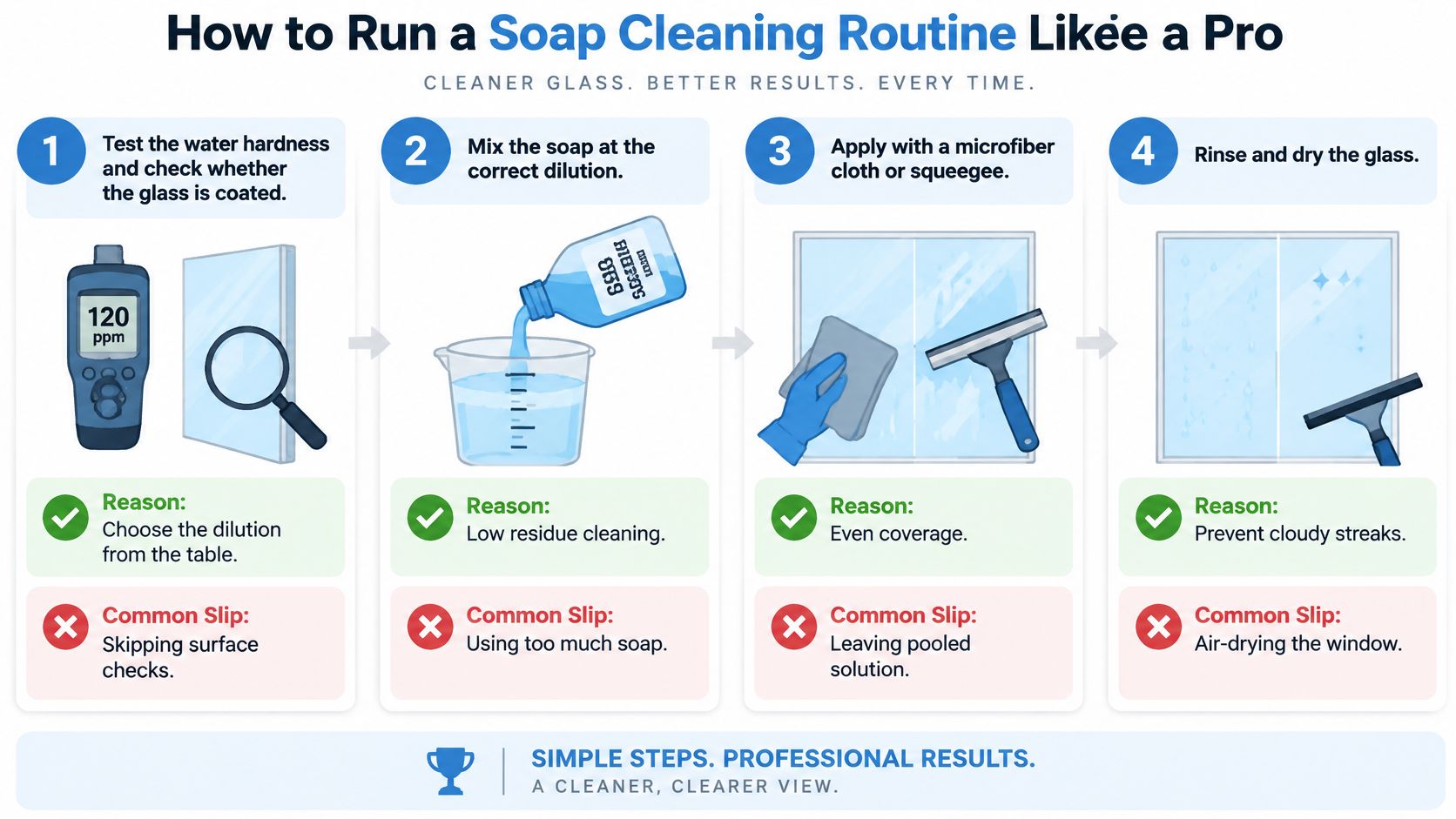
Each step below includes why it matters and the slip that usually undoes it.
Test water hardness and check for coatings. A hardness strip and a label check set your residue risk before you mix anything. The common slip is choosing a product first and discovering hard water or coated glass halfway through.
Mix in a labelled bottle or bucket with warm water. Warm water disperses soap evenly, so the first pane and the last pane get the same strength. Mixing by eye is how a light solution becomes a heavy one.
Wet the whole pane, then work in sections. Keep sections about one arm span wide so solution never dries on the glass. Starting a large pane in full sun gives evaporation a head start you can't catch.
The flow chart below condenses the sequence for quick reference at the bucket.
Agitate heavy film with a soft scrubber. Corners, edges, and cooking film need contact time and gentle friction, not stronger soap. Keep abrasive pads away from coatings even when a spot resists.
Squeegee top to bottom in overlapping strokes. Wipe the blade on a clean cloth after each pass, because a dirty blade redeposits the soil you just removed. Overlap slightly so you don't leave a wet line between strokes.
Rinse with the right final water. Use deionized water on hard-water sites and clean water elsewhere. Skipping this step on mineral-rich water undoes careful dilution.
Inspect under oblique light. Stand to the side, look across the dry pane, and re-squeegee any smear while it's fresh. Checking only from straight on hides the exact streaks sunlight will reveal later.
Clean frames and sills separately. Use mild soap and a microfiber cloth, which is how we clean sills and frames without damaging surrounding areas, then dry them so dirty runoff doesn't creep back onto glass.
A finished pane looks even and clear from an angle, with no smears, dots, or wet edges. If two of three panes pass and one doesn't, compare what changed on that pane, sun, drying time, or blade cleanliness, before you change the mix. That habit turns a routine into a diagnostic tool, and it's how you get the same result on the last window as the first.
White spots that appear only after drying are the most common complaint, and they're usually blamed on soap when water is the main cause. Read the symptom first, then pick the fix.
| Symptom | Likely Cause | Fix |
|---|---|---|
| White spots after drying | Hard-water minerals left as the solution dried | Keep glass wet, squeegee sooner, use deionized final rinse |
| Uniform cloudy haze | Soap film from an overly strong solution | Lower the dilution, rinse thoroughly, re-squeegee |
| Directional smears under oblique light | Residual surfactant not fully removed | Re-rinse with clean water and pull a dry squeegee |
| Haze only on sun-facing panes | Solution drying too fast in heat | Work in shade or smaller sections, cooler panes |
Calcium and magnesium in hard water react with soap or carbonate species and form poorly soluble deposits. As the wash solution dries, those minerals remain on the glass as white spotting or a dull haze, as Vitro Glazings' technical document on glass cleaning explains. Repeated drying cycles make the deposit progressively harder to remove.
That's why prevention beats polishing. Keep the glass continuously wet, work in manageable sections, and squeegee before the solution dries. Routine steps 3 and 6, section size and final rinse choice, do most of this work for you.
Measure source-water hardness or conductivity when spotting persists, so you're fixing a number instead of guessing. Softened water helps because softening replaces calcium and magnesium ions with sodium, reducing insoluble carbonate precipitation. Demineralized water goes further and removes dissolved ions more thoroughly, which is why it's the safer final rinse on problem panes.
Fresh spots often clear with a rewetted pane, prompt squeegeeing, and a low-mineral rinse. Older scale may need acidic descaling chemistry, and the vinegar treatment for window stains approach is one household option people consider for that stage. Test any descaler first on the glass, coatings, seals, adjacent frames, and stone, because mineral removers can affect all of them.
For a deeper walkthrough of stain removal, see our guide to cleaning hard water stains on glass. It pairs well with the symptom table above when spots survive a normal wash.
Fast evaporation makes all of this harder in hot, dry markets. Homeowners in Phoenix, Las Vegas, and Denver should expect shorter working time per pane and plan shade and section size accordingly. More rinsing with the same hard water has limits, since each wetting can leave more mineral behind if it dries in place.
Both professional methods are valid. The right choice depends on water hardness, window height, surface type, and how much residue you can accept.
Choose soap with a squeegee for routine maintenance on low-rise homes with soft to moderate water and light film. You get strong soil lift, simple tools, and direct control on every pane. It's also the better fit for interior glass and detailed frame work.
Choose a pure-water system for tall windows, hard water, heavy mineral build-up, and properties where spots are unacceptable. Our overview of pure water window cleaning explains how mineral-free water can dry clear without a blade at height.
Say a home in Scottsdale has hard-water film on south-facing panes that bake dry between strokes. Soap can still work in small shaded sections with a deionized rinse, but pure water removes the mineral variable that's causing repeat spots.
Say a multi-storey office in Denver needs consistent results at height across hundreds of panes. Height, access, and uniformity push the decision toward pure water, while ground-floor entrances may still suit a squeegee for detail.
Test the water, run a one-pane trial at the table dilution, and inspect the dry result under oblique light before you commit to the full job.
That trial costs you one pane and answers the question: does your water and dose dry clear here? If it doesn't, change the rinse water or the method, not just the soap brand. We offer a free estimate, and our window washing comes with a streak free guarantee, so you can compare a professional result against your trial pane with no guesswork.
If your trial pane still dries cloudy, or your property has hard water, coated glass, or windows you can't reach safely, we can match the method, squeegee with a measured soap solution or pure water, to your glass and water conditions. Visit Professional Window Cleaning to request your free estimate and get a streak-free result without the trial and error.
Read our blog posts regularly and keep learning.