Care and Maintenance
Steel Wool Glass: When It Is Safe and When It Is Not
Steel wool glass cleaning is safe only on some surfaces. Learn which grades to use, how to avoid scratches, and what professionals do instead.


You just got off the phone with a property manager who wants a number by tomorrow. The building "looks like a normal three-story office," the glass "isn't that dirty," and the last vendor "was around eight hundred dollars." That call feels like a win until the crew arrives and finds three roof levels, no permanent anchors, and a loading dock that blocks the only ladder set. The cheap number on the quote becomes the expensive job.
How to bid commercial window cleaning profitably starts by treating the proposal as an access and risk document, not a price per pane. I would rather lose a bid that hides lift time and anchor checks than win one that spends the margin on the first visit. Professional Window Cleaning has been cleaning windows for over 26 years, and the quotes that hold up name the building, the method, and the work we will not do for that price.
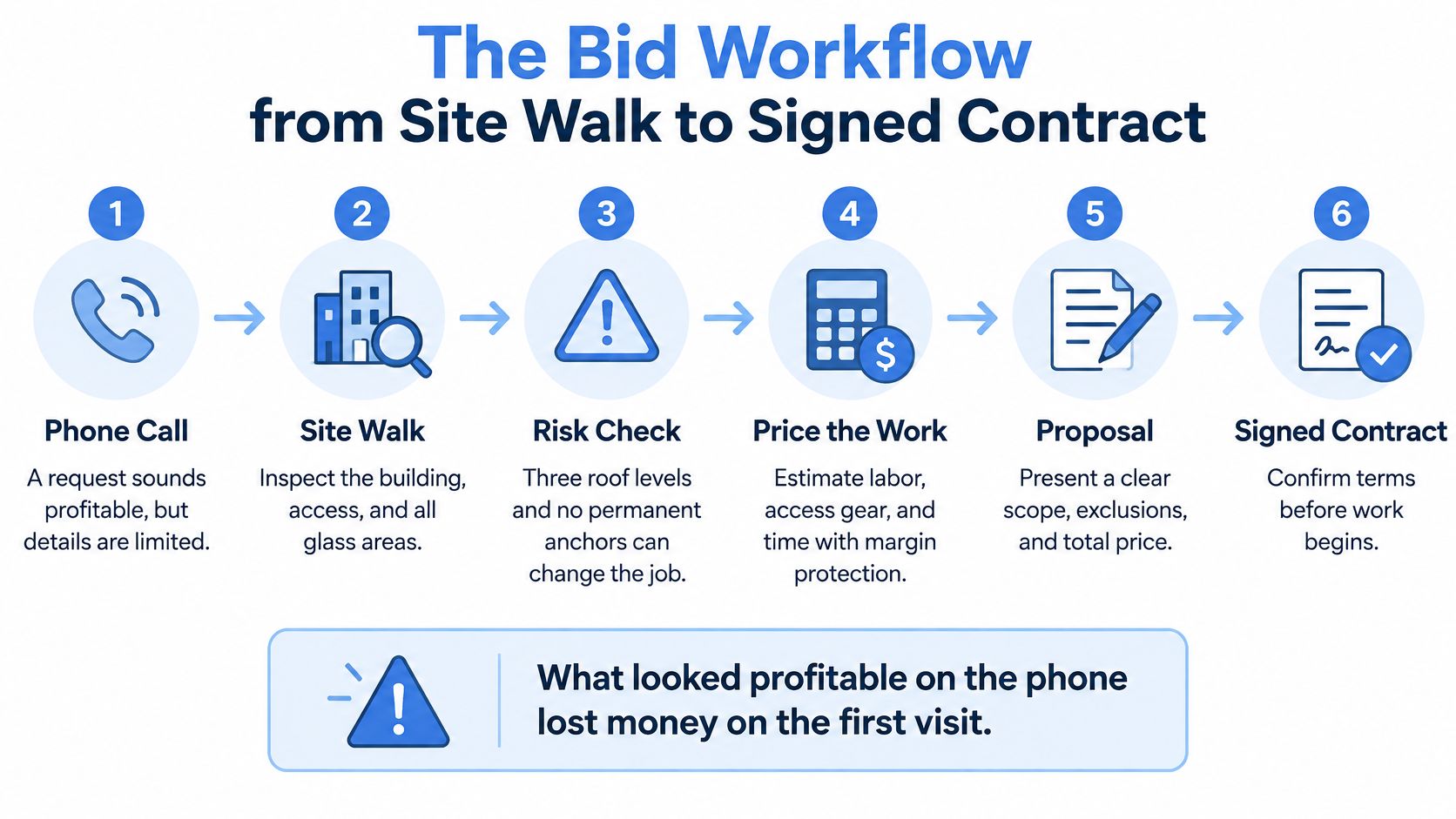
A commercial quote that never names how the crew reaches the glass is a price, not a bid. The low number can win the email, then lose the margin on a locked roof, a rental lift, or a return trip the proposal never priced.
Run every commercial quote in this order. Each step prices access and risk before the number goes out.
Skip the walk and the later steps are guesses stacked on a photo. I would rather send a higher number that names the lift, the tie-off, and the hours than a low pane rate that collapses when access fails.
Practical rule: If you didn't stand on the property, you don't have a price. You have a guess.
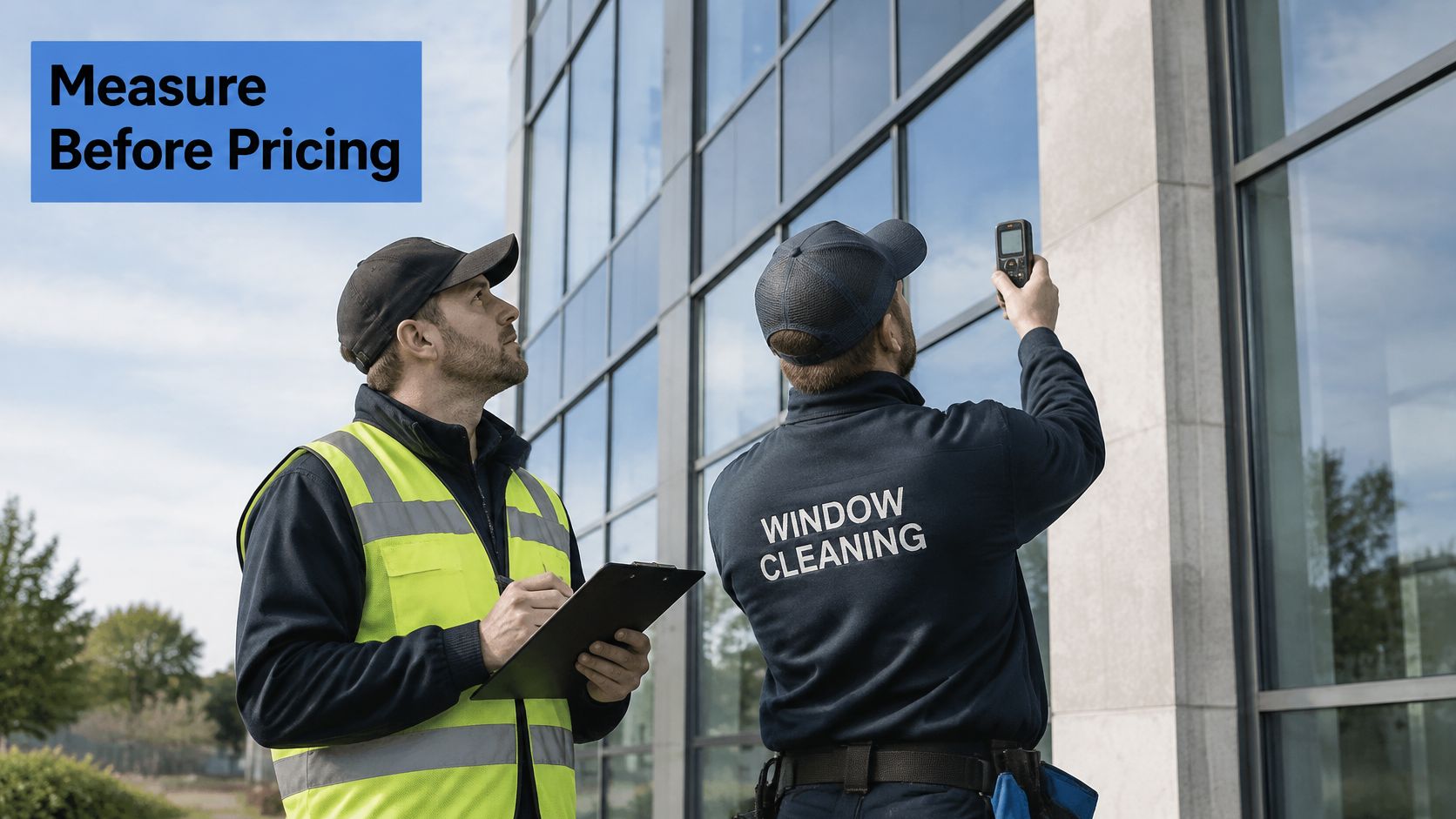
A phone count of "about forty windows" is not a takeoff. The site survey has to split glass by type, then attach an access method to each group. That is what makes a single price per pane unreliable.
| Item | How to measure | Pricing unit | Common counting error |
|---|---|---|---|
| Fixed pane glass | Width x height of each pane, both faces | Per pane or per square foot | Counting multi-lite units as one pane |
| Operable sash | Count each sash, interior and exterior | Per sash | Missing the back faces of tilt-in sashes |
| Storefront curtain wall | Total glass area and mullion count | Per square foot | Including spandrel panels as glass |
| Skylights and sloped glazing | Area plus lift or rope access required | Per square foot plus access charge | Pricing them at flat-window rates |
| Screens and tracks | Count separately by size | Per screen | Assuming they are included in the window price |
| Interior glass partitions | Linear feet of perimeter and fingerprint zones | Per linear foot or flat fee | Ignoring them entirely |
Also note floor heights, operable sash counts, and the route from the parking stall to the glass. A laser distance tool beats pacing a curtain wall and calling it close.
Ground reach with extension poles stays in the base labor line. Ladders and lifts add rental, spotter time, and a place to stage the machine. Roof access adds keys, hatches, and walking between levels. Suspended equipment or powered platforms are a different job.
Before you lock a fixed price on a high-rise, verify the anchorage. OSHA's interpretation on roof anchorages states that roof anchorages supporting window-washing devices must be permanent, sound, rigid, and capable of supporting the maximum intended load without displacement or deformation. The same interpretation requires separate anchorages for worker lifelines, and roof anchorages for portable suspension equipment must support at least four times the maximum intended load without deformation or failure. Ask for anchor documentation, or budget a site inspection and engineering coordination. Leaving that out understates the cost on condominiums and commercial towers.
In the squeegee method, the technician applies solution, pulls soil and water off the glass, and details edges and frames. In a pure-water system, a water-fed brush loosens dirt on exterior glass, frames, and sills, purified water rinses the surface, and the glass dries on its own. Name the method on each elevation. Don't write "windows" and hope the crew guesses.
Ask the building manager these questions before you leave:
The labor mistake is pricing the job at the worker's wage and calling that the cost. The U.S. Bureau of Labor Statistics reported that janitors and cleaners, excluding maids and housekeeping cleaners, numbered approximately 2,172,500 workers in May 2023, with a median wage of $16.84 per hour, up from $12.55 in 2018, about 34.2%. That figure is wage only. Payroll taxes, workers' compensation, benefits, vehicle time, equipment depreciation, safety controls, and nonproductive setup time are not in it. A recurring contract priced on an old wage loses money at every renewal.
A loaded labor rate starts with the wage and adds payroll taxes, workers' compensation, benefits, a share of supervision, and nonproductive setup. I would not bid commercial glass on the median wage alone. Estimate productive hours by glass type, by story, and by access method. Pole work on a storefront is not lift work on a third-floor return, and a pure-water elevation carries hose, filtration, and rinse time that a squeegee elevation does not. Exterior work also carries a workers' compensation exposure that interior janitorial does not, and that cost belongs in the rate before the first window is touched.
Benchmark the loaded rate against local crew wages before you set a number. Wages differ by metro, and a rate that covers a Las Vegas crew may not cover a Denver crew with the same headcount. For bids in Las Vegas, Phoenix, Denver, or Scottsdale, test the $38 loaded rate used below against your own payroll, burden, and supervision cost. If the local number is higher, the bid has to carry it.
A 40-window, three-story office with two technicians and a half-day lift builds up like this:
| Line item | Basis | Value (USD) |
|---|---|---|
| Crew labor | Two technicians, five hours, $38 loaded rate | 380 |
| Pure-water system depreciation and water treatment | Per visit allocation | 35 |
| Lift or ladder rental | Half-day rental | 220 |
| Supplies and cleaning solution | Per visit | 25 |
| Travel from yard | One round trip | 60 |
| Direct cost subtotal | Sum of direct lines | 720 |
| Overhead | 15% of direct cost | 108 |
| Supervision and inspection | 1 hour | 55 |
| Total cost | Direct cost, overhead, and supervision | 883 |
| Price at 25% margin | Total cost divided by (1 - 0.25) | 1,177 |
People drop the same lines every time. Travel stays at zero because the crew is already out. The lift is borrowed from another job and never hits this bid. Overhead is skipped because it does not feel like window cleaning. Supervision is the hour spent walking the glass with the manager, and it still costs money. Those omissions are how the low bid wins the work and then loses money on the first access problem. If the lift cannot set up where the site walk assumed, the half-day rental becomes a full day and the crew stands idle.
The U.S. commercial cleaning-products market was estimated at $33.23 billion in 2024, according to Grand View Research. Solution, pure-water treatment, and microfiber are bid inputs, not leftovers in the truck.
Rebuild the loaded rate at least once a year, and sooner if insurance or wages change. After the first visit, log hours against the five-hour assumption. If the crew needed seven, the next bid for that building uses seven. The equipment line works the same way: record what the lift, water treatment, and travel cost, then price the next visit from that record instead of from habit.
The cost stack is only half the bid. The model decides how that cost becomes a price the buyer can compare, and where you get hurt if the building changes.
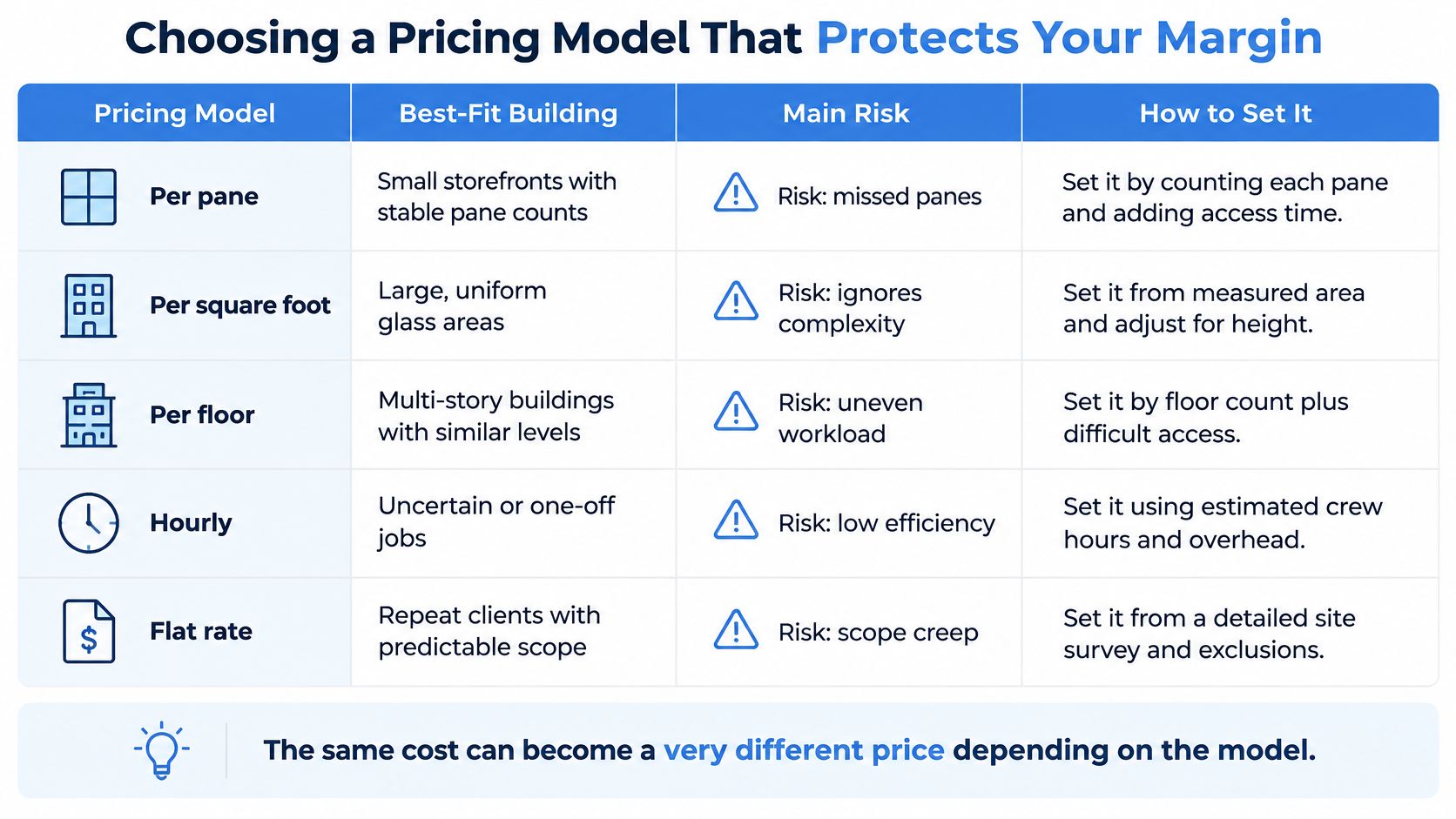
| Pricing model | Best fit | Main risk | How to set it |
|---|---|---|---|
| Per pane | Small storefronts with stable pane counts | Access time is underpriced | Price per pane plus a separate high-access line |
| Per square foot | Storefronts and curtain walls with measured area | Spandrels and frames counted as glass | Measure total glass area and exclude non-glass panels |
| Flat fee per visit | Regular exterior cycles with fixed scope | Scope creep between visits | Define the scope in writing and price extras separately |
| Monthly or quarterly retainer | Multi-site accounts with exterior and interior touch-up | Undefined interior visits | Set visit counts, response times, and exclusions |
| Time and materials | Unknown condition, restoration, or post-construction cleanup | Client resistance to open-ended cost | Cap the estimate and bill hourly rates above a set threshold |
Per-pane pricing is easy to explain, and it punishes you the moment a canopy or a third roof level shows up. A retainer rewards a stable route, but only if hard-water restoration, construction debris, and damaged seals sit outside the fee. If you want a sense of how buyers read these numbers, our notes on commercial window cleaning prices show why two quotes for the same facade rarely describe the same job.
A bid is a building-access and safety feasibility document. OSHA's powered platforms fact sheet treats window cleaning as building maintenance covered by powered-platform requirements, including competent training, fall-arrest protection, stabilization, inspections, and written emergency procedures for relevant installations. Personal fall-protection systems must be inspected before initial use during each work shift, and defective components must be removed from service.
That paperwork is why a higher number can win. Property managers on hospitals, dealerships, stadiums, condominiums, and high-rises often care more about a failed access day than about a lower rate. Separate routine glass from high-risk glass. Name owner duties for permanent anchors and tie-ins. Exclude anything you couldn't verify. Put mobilization or engineering in its own allowance.
A lower cleaning rate that assumes the roof is ready is not a discount. It is a change order waiting for the first windy morning.
Pair the model with the building. Per pane for a stable storefront. Per square foot for a measured curtain wall. A flat fee for a fixed exterior cycle. A retainer when several sites share a calendar. Time and materials when the glass is unknown, stained, or fresh from construction. If access needs a lift, a stage, or unverified anchors, put an access surcharge on its own line. Burying it in the pane price makes the next bidder look cheaper for doing less.
This short walkthrough is a useful reminder that the number only means something after the scope is fixed.
The proposal is a small set of documents, not a single total. I send a scope summary, a site and access sheet, a service schedule, a pricing schedule, and a terms section. Buyers read them in that order, and each page should tie back to a cost you already calculated.
The access clause should put permanent anchors and tie-ins on the owner, and give you the right to reprice or reschedule when access isn't verified. Weather rescheduling belongs in the same paragraph. Attach insurance certificates. State a response time for complaints, how a re-clean works, payment terms, and a change-order path for added scope.
Large buyers increasingly want green language they can audit. A market estimate from Dataintelo reports that approximately 42% of new commercial cleaning contracts above $1 million in annual value included explicit green-cleaning provisions in 2025, compared with 28% in 2021. The eco-certified cleaning-products segment is projected to grow by more than 7% annually through 2030. Offer a base scope plus an optional sustainability line that names the product standard, dilution assumptions, estimated water use per visit, waste handling, and the evidence you send after service. A modest premium is easier to defend than a vague "green" label, and bidders who can't document the option may be dropped before price is compared.
If a scheduled quarterly exterior visit is missed for a reason within our control, that visit is performed at no added charge within ten business days, or the period price is reduced by the published per-visit amount for that building.
That clause ties the schedule to the money. A missed visit has a defined consequence instead of a phone argument.
The assumption that the lowest complete bid wins is the one that empties the account. These six misses show up on the job, not in the spreadsheet.
Before you cut a price to sit under a competitor, check whether that scope drops access, the cleaning method, or the inspection. A thinner job is not a lower price for the same work.
Pre-submission checklist: in-person site walk done, every glass type measured, access and anchor status documented, method stated per elevation, loaded rates and equipment costs current, margin matched to the pricing model, exclusions covering hard-water restoration and construction debris, and insurance certificates attached.
Send the proposal with a clear decision date. If the buyer questions the price, offer an on-site review rather than a blind discount. Log the outcome so the next bid starts from what the building took. Our satisfaction guarantee is a response process: any concern a customer raises is addressed promptly, not left as a slogan on the last page. A quarterly exterior schedule is a sound starting point for most offices. Professional Window Cleaning offers a free estimate, and this checklist is the working document for the next bid, not a form you file and forget.
If you want a commercial quote built from a site walk, a named access plan, and a scope you can compare, Professional Window Cleaning will price the building you have. We clean offices, storefronts, and high-rise glass, and we would rather show the access cost than hide it in a low pane rate. Request a free estimate at Professional Window Cleaning.
Read our blog posts regularly and keep learning.