Care and Maintenance
Storefront Window Cleaning: Schedule, Methods and Safety
Storefront window cleaning guide: how often to clean, squeegee vs pure-water, safety steps and schedules that protect curb appeal.


You're looking through hazy patio glass, trying to decide whether the spots are outside, inside, or permanently in the pane. You search for a window cleaning service near me, get several quotes, and discover that nobody seems to be pricing the same job. One includes screens. Another counts each divided pane separately. The cheapest barely mentions how the crew will reach the upper windows.
Buy a defined scope, not the smallest per-pane number. A worthwhile quote names the cleaning method, explains access, and says what a normal wash won't remove. Clean glass should improve the view and preserve daylight access, but it isn't a glass repair or an energy retrofit.
| Property | What changes the price |
|---|---|
| Modest single-story home, exterior only | Pane count and whether screens are included |
| Single-story home, both sides | Screens, tracks, and hard-water spots |
| Home with grids, French doors, or a second story | Access height and divided lites |
| Storefront or small medical office | Glass area and after-hours timing |
| High-rise, stadium, dealership, or church | Lifts, anchors, and working height |
Use these property categories to organize estimates, not as a substitute for a written price. There isn't a supported local rate card here that justifies attaching dollar bands to your address. A single-story house with unobstructed glass and a house with French doors, removable storms, and difficult landscaping aren't equivalent jobs.
A low bid is a scope warning, not proof of poor workmanship. Before rejecting or accepting it, find out whether it covers exterior glass only, whether divided lites count separately, and whether restoration work is excluded. Don't assume a higher bid includes more either.
Routine washing removes ordinary surface soil. Mineral deposits, paint, adhesive, and construction debris need separate evaluation, and some marks are damage rather than removable dirt. A crew shouldn't promise that every cloudy pane will become clear through washing.
At Professional Window Cleaning, we provide a free, no-obligation estimate. Our window washing includes screen cleaning and sill and frame cleaning, so those parts of the opening aren't treated as somebody else's job. Put the requested track work and any stain treatment into the written scope too.
Price-check rule: Compare the same surfaces, access requirements, and exclusions before comparing totals.
Collect a pane count, identify which sides need cleaning, and photograph the stains before requesting an estimate. For commercial glass, include customer entrances and restricted work hours. An address-specific figure with explicit inclusions is more useful than an attractive starting price that grows after the truck arrives.
There are only two professional window-cleaning methods: a squeegee or a pure-water system. Brushes, applicators, poles, and access equipment support those methods. They aren't separate mystery techniques that justify an unclear quote.
The comparison below shows where each method belongs.

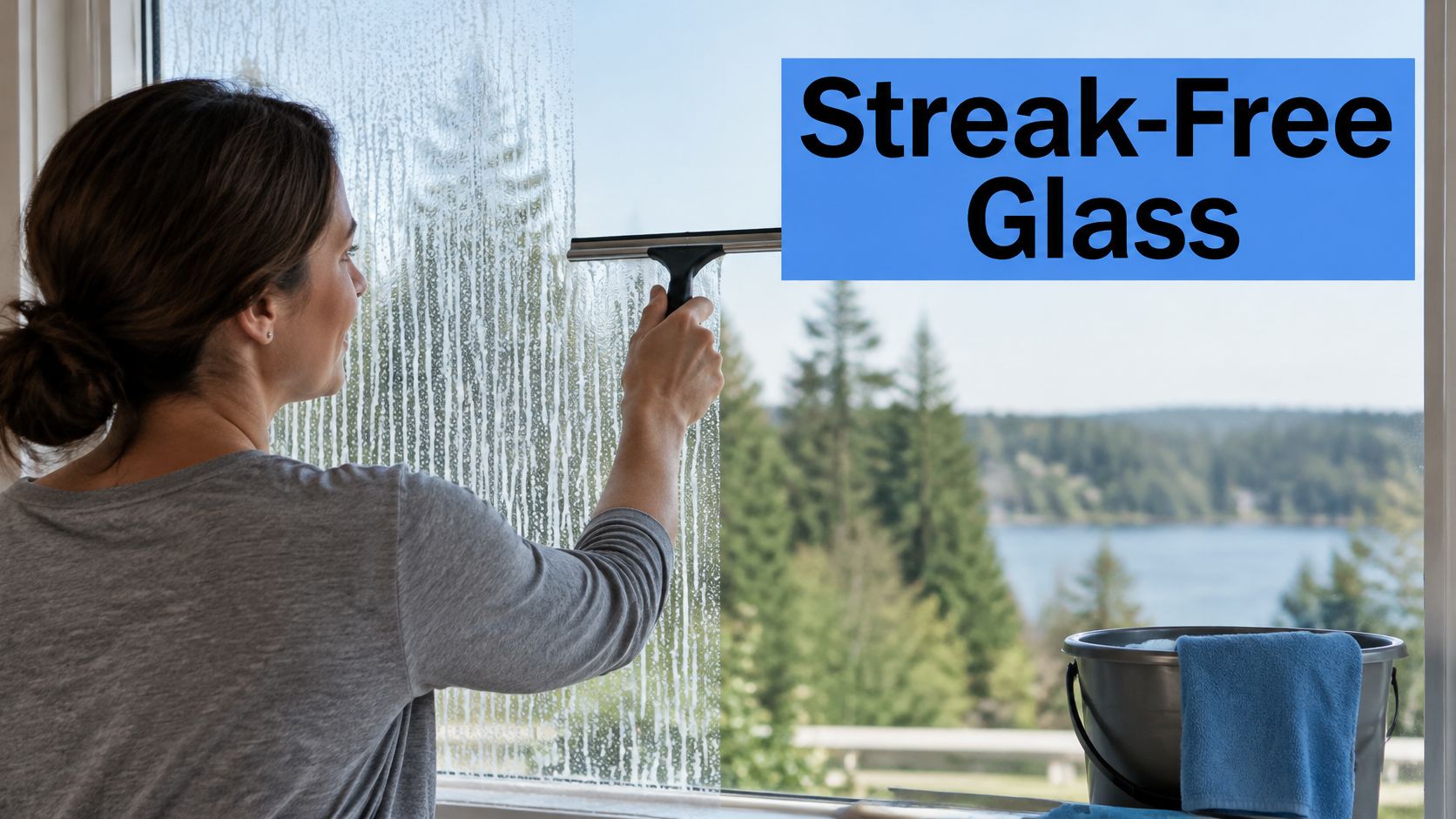
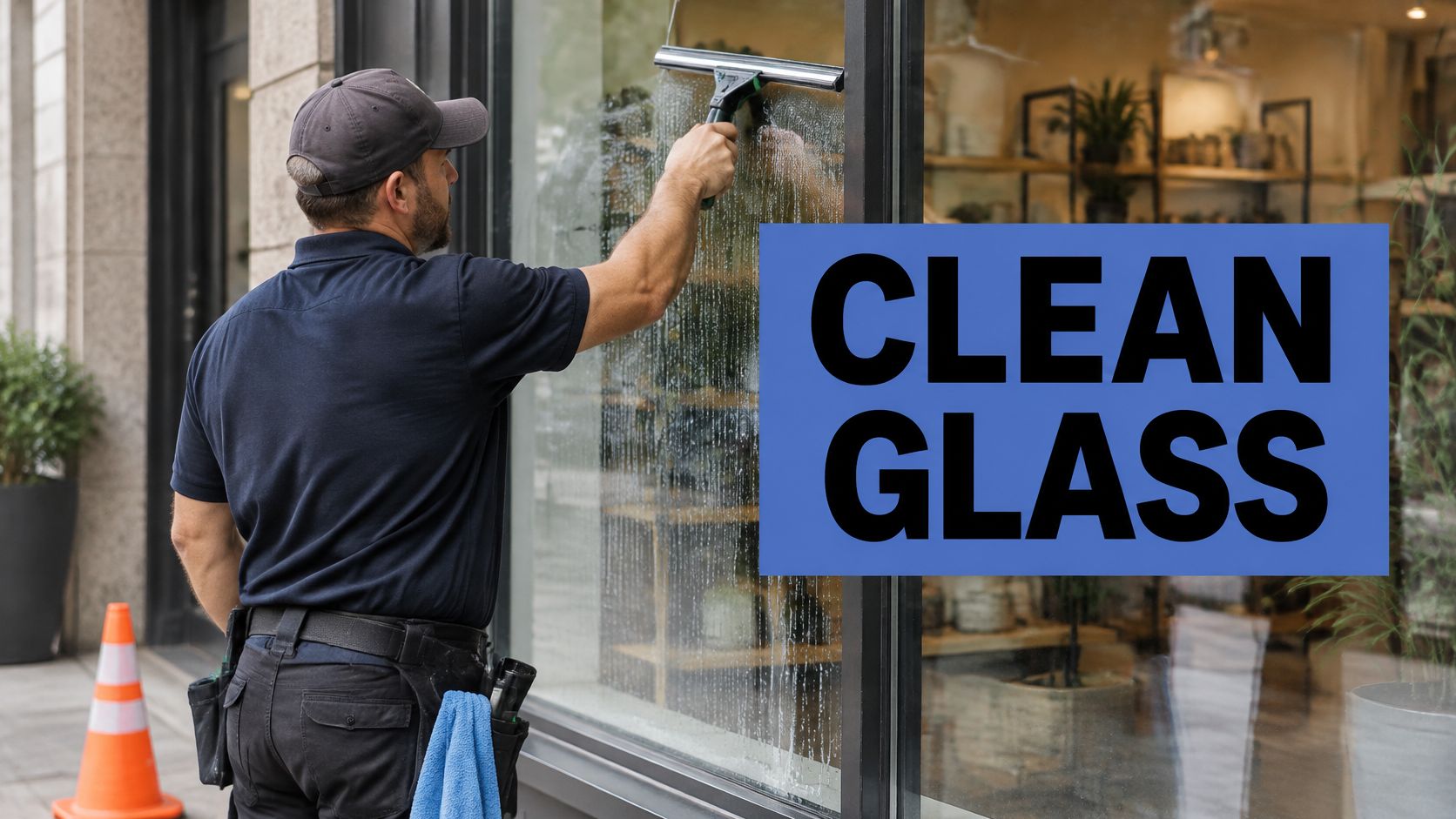
With the squeegee method, the cleaner applies solution using an applicator or sleeve, loosens the soil, and draws a rubber blade across the pane to remove water and suspended dirt. The National Window Cleaning Authority's guidance identifies this hand-cleaning approach and the common use of a squeegee finish indoors.
The finishing work matters. Overlapping passes prevent missed strips, and a clean, lint-free cloth removes moisture along the edges without smearing the center. The cleaner should inspect the result from different angles rather than judging everything from directly in front of the pane.
Inside an occupied home or office, this method gives the cleaner control over runoff. Furniture, flooring, desks, and electrical equipment still need protection, but the work doesn't require an uncontrolled rinse through an open window. Reachable exterior panes can receive the same hand finish.
A squeegee isn't automatically the economical choice for every high exterior pane. If hand contact requires a lift, the estimator must account for setup, ground conditions, and access. The tool that touches the glass and the equipment that carries the worker are separate decisions.
A pure-water system filters ordinary water, uses a pole-mounted brush to loosen dirt, and rinses the exterior surface with purified water. Some systems use reverse osmosis followed by deionization; Squeegee's window-cleaning resources explain that reverse osmosis removes roughly 90% of dissolved solids before the deionization stage.
Removing dissolved minerals allows the rinse to dry naturally with little spotting or residue. That's different from spraying a window with ordinary hose water and walking away. Proper brushing, adequate rinsing, and attention to the frames remain necessary.
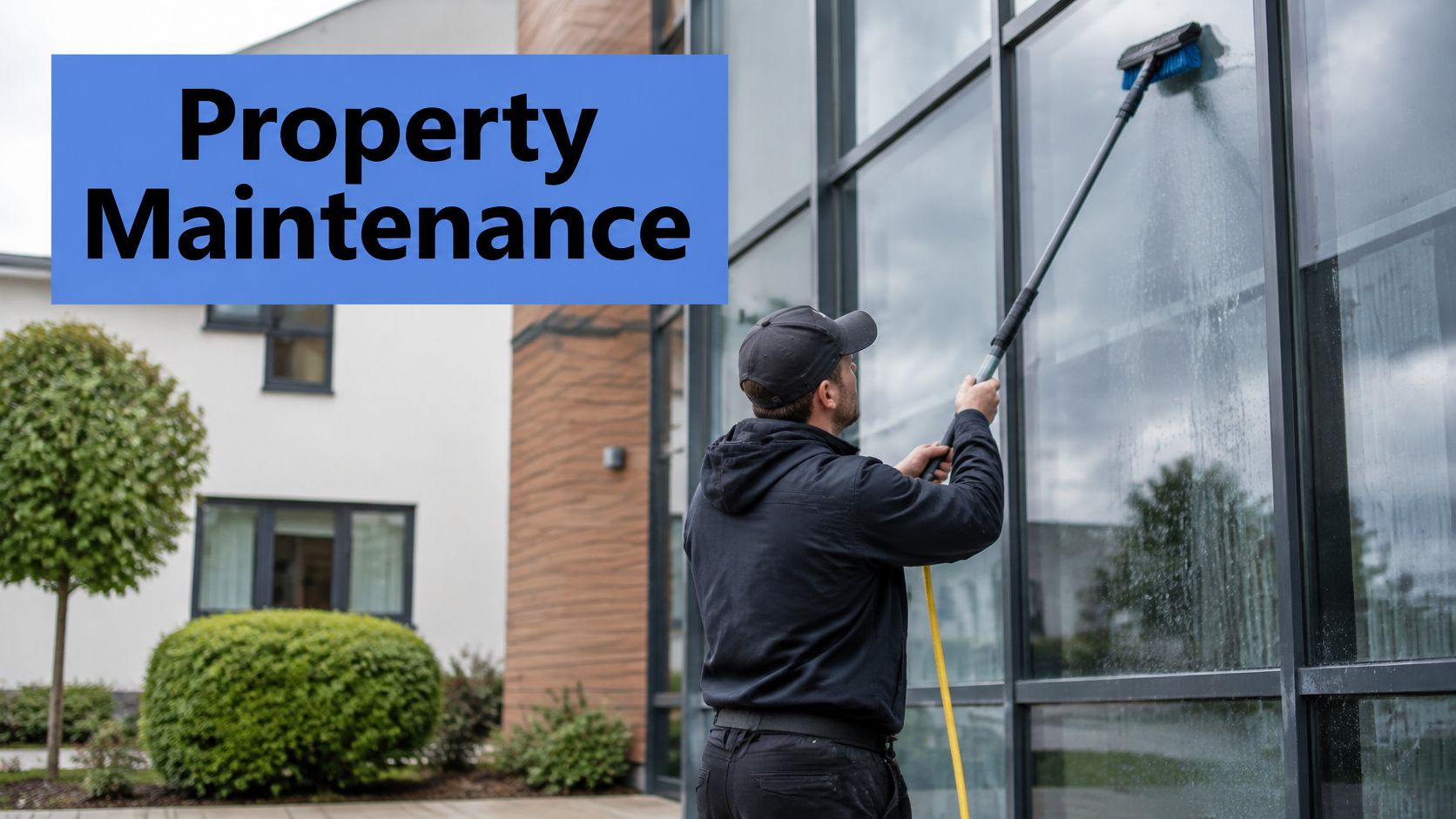
We use water-fed poles and eco-friendly solutions for high window cleaning. Suitable exterior panes can be cleaned from the ground, but a pole isn't a promise that every window is reachable. Deep setbacks, overhangs, landscaping, and awkward angles can prevent effective brush contact.
| Method | Best for | How it cleans | Poor fit |
|---|---|---|---|
| Squeegee | Interior glass and reachable exterior panes | Solution, agitation, overlapping blade passes, edge detail | Very high exterior glass without suitable access equipment |
| Pure-water system on a water-fed pole | Exterior glass, frames, and sills, including suitable upper panes | Filtered water, brushing, purified rinse, air drying | Interior offices where rinse water would drip inside |
Neither method excuses careless chemistry. Remove loose abrasive dust before agitation, use clean tools, and don't let cleaning solution dry onto hot glass. Residue deserves attention: NIST's glass-cleaning guidance notes that phosphate-containing detergents can leave deposits that make water bead and create an apparent dirty film.
Coated, tinted, laminated, and specialty glass need their manufacturer's cleaning limits checked before aggressive treatment. Don't accept improvised scraping just because a spot resists the first pass. A test area is preferable to discovering surface damage across an entire elevation.
A normal wash won't repair scratches, etching, failed insulated-glass seals, or damaged coatings. Nor should a standard wash become construction-debris removal. If an estimate says only soap and a rag, get a clear answer about which professional method will finish the glass and what the crew will do if ordinary cleaning doesn't remove the mark.
Hiring goes wrong when the caller describes a house and the estimator imagines a different one. Make the decisions below before agreeing to a visit, particularly if the building has occupied offices, removable storm windows, or glass above an entrance.
Use this sequence to keep the booking conversation specific.

Name the work you're buying. Choose interior, exterior, or both, then identify seasonal cleaning, storm windows, and post-construction cleanup explicitly. Our window washing covers interior, exterior, seasonal, storm, and post-construction work, but those descriptions still need to match your particular booking. A move-in clean with adhesive on the panes isn't the same scope as routine exterior maintenance.
Describe access before accepting a price. Note the building's stories, locked gates, pets, occupied desks, and glass above difficult ground. Explain whether the crew must pass through a tenant's suite or carry equipment across a finished lobby. If a courtyard can only be entered through the building, say so before the estimator assumes street-side access.
Match the method to the surfaces. Require the estimate to identify squeegee or pure water for the relevant glass. A mixed-method visit is reasonable when interior rooms and upper exterior panes need different treatment. What isn't reasonable is an answer so vague that you can't tell whether the proposed equipment can reach the work.
These decisions prevent avoidable changes on arrival. They also let an estimator distinguish a straightforward wash from work that requires an inspection. If you can't describe an upper window's access clearly, send a photograph instead of guessing.
Put the surrounding parts in writing. List screens, frames, sills, and tracks rather than relying on the phrase full service. We clean beyond the glass to frames, sills, and tracks, and our office window cleaning includes removing cobwebs and debris around window areas. Identify any heavily packed track debris or fragile screens so the expected finish is clear.
Choose a time that protects normal activity. For a storefront, decide whether the entrance must remain continuously open. For a clinic or office, identify private rooms, appointments, and desks that can't be disturbed. We offer flexible office scheduling to minimize disruption, so use that flexibility to establish a workable access window rather than leaving staff to improvise.
Send photographs that resolve uncertainty. Include a street-facing view, a close-up of the problem pane, and the obstacle beneath the difficult glass. Add a short description of what each photograph shows. The close-up identifies the cleaning concern; the wider views show whether the proposed approach makes sense.
A photograph of a stain doesn't show how to reach it. A photograph of the building doesn't show what's stuck to the glass. Send both.
The phone handoff matters too. A receptionist or dispatcher should capture the address, requested surfaces, access concern, and preferred callback time accurately. For contractors organizing that intake, SkipCalls' answering service for contractors is a relevant resource to evaluate for handling incoming calls, not a substitute for a technical estimate.
Use video as supporting context, not as evidence that a particular method suits your building. Your own photographs and written scope remain the basis for booking.
Before confirming, read the description as though you were the arriving crew leader. Could that person identify every included window, enter the property, and work without interrupting an activity you meant to protect? If not, clarify the missing detail.
Stop shopping once the written scope and the photographs describe the same job and the access proposal is credible. More quotes won't fix an incomplete request. They'll produce more prices for different interpretations of it.
In a historical construction-safety analysis, OSHA estimated 924 occupational fatalities annually, with at least 79 associated with scaffold work. That isn't a current local window-cleaning accident count, but it's a sound reason to treat work done at height as a controlled operation rather than an ordinary cleaning chore.
A buyer doesn't need to design the crew's safety system. You do need enough information to reject a proposal that ignores the building's height, electrical hazards, pedestrian traffic, or roof access.
Use this checklist to prepare the safety conversation.

Who will perform the work, and are they trained for this access? Don't stop at the salesperson's assurance that the company cleans tall buildings. Establish who is responsible for the crew, who assesses the site, and whether the assigned personnel are qualified for the proposed equipment.
A condominium manager should also establish how the crew will coordinate with building staff. Roof keys, restricted mechanical areas, resident balconies, and service elevators aren't details to discover after equipment arrives. Name the building contact who can resolve access issues without encouraging the crew to improvise.
Will the crew use a ladder, water-fed pole, lift, or suspended platform? Each answer should fit the actual work area. A ladder needs appropriate placement, a lift needs suitable positioning and clearance, and suspended access requires building-specific planning.
An estimator who hasn't considered the pavement beneath a lift or the obstruction beneath a ladder hasn't finished evaluating access. Likewise, a pole doesn't solve a location where the brush can't contact the pane properly. Our overview of window-cleaning safety equipment can help you recognize the equipment being discussed, but the site still needs its own assessment.
What is the plan for anchors, fall protection, electrical hazards, and weather? Require a specific answer appropriate to the access method, not a blanket statement that the crew is careful. For suspended work, building documentation and anchor suitability matter before anyone commits to the setup.
Weather decisions belong with the people responsible for safe operations. Wind, lightning, freezing conditions, and wet footing can change whether planned access is appropriate. Don't make keeping the appointment more important than responding to the actual conditions.
Does the insurance cover the proposed work at this building's height? Obtain current documentation and have your property manager or insurance adviser review its relevance. A document showing that a business has insurance doesn't, by itself, explain every covered operation or exclusion.
For a managed property, resolve contractor approval before the work date. The crew shouldn't arrive to discover that the building requires paperwork nobody requested. This is especially important when multiple parties, such as an owner, association, and facility manager, share responsibility.
Walk-away signal: A friendly price without a credible access plan isn't a bargain.
Church entrances, dealership forecourts, stadium concourses, and busy office sidewalks create another responsibility: separating people from active work. Discuss where pedestrians will walk, whether doors need temporary control, and who communicates with tenants or visitors.
Don't ask staff to stand beneath overhead work to keep business moving. Arrange an alternate entrance or a suitable work window when necessary. The plan should protect occupants without forcing the crew into unsafe shortcuts.
For towers and high-rise condominiums, expect more preparation than a residential driveway conversation. Roof access, equipment positioning, building rules, and weather may all affect the final appointment. Approve the work only when the contractor and building representative agree on how it will proceed.
Professional Window Cleaning provides residential, commercial, and high-rise window cleaning in Las Vegas, NV and Scottsdale, AZ, and works across Arizona and Colorado. Confirm your address on the service areas page before pricing a visit. A near-me search only proves a crew exists nearby.
The building changes the visit more than the city name. Desert glass collects sprinkler spotting, accumulated dust, and the haze left by strong direct sun. Cold-weather properties need scheduling around freezing conditions and safe access days. Match the work order to the exposure: interior, exterior, seasonal, storm, or post-construction window washing.
Homes and condos need arrangements for interior access and personal belongings. Offices and storefronts need coordination around customers and employees, and flexible scheduling keeps the crew clear of business hours. Churches and other unique facilities need planning built around the building itself. Vaulted and high-rise glass need an access decision before the price is dependable. Height alone won't rule out the job, since office window cleaning is available at any window height. The plan drives the price.
Treat clean glass as daylight maintenance rather than an energy retrofit. The Lawrence Berkeley National Laboratory's daylighting guidance treats useful daylight as part of an integrated façade and lighting strategy. Washing maintains the glass; the savings claim belongs to the lighting design.
For a commercial property, make the daylight review practical:
Can clean windows cut lighting costs? Potentially, inside a functioning daylighting system. Photograph the glass before and after, and treat a brighter room as a maintenance result rather than a meter reading. A crew that names its method, prices the access clearly, and makes that distinction beats the cheapest per-pane bid in the search results.
Professional Window Cleaning has been cleaning windows for over 26 years, with its founding in 1999 recorded in Salary.com's company profile. That history supports the company's longevity, but your booking should still stand on the details of your own property.
Our offices are open 24 hours, and window cleaning services are available 24 hours a day at every location. That gives you scheduling options, not a reason to skip access coordination or assume a particular appointment is already reserved. Call us for a recommendation on the right service for your glass.
Before accepting, establish whether the price is for a single visit or assumes recurring service. Discuss a cleaning interval based on the property's exposure and use rather than accepting a schedule unrelated to its condition.
We offer a satisfaction guarantee and address customer concerns promptly. At completion, identify any concern clearly, including its location, so it can be addressed without confusing a missed area with a pre-existing glass defect.
Once the method, access, and scope pass, book the visit. Don't let a slightly smaller number persuade you to accept unexplained exclusions or an unsuitable access proposal.
Professional Window Cleaning offers residential, commercial, and high-rise window cleaning with a free, no-obligation estimate. Visit Professional Window Cleaning, send your address and photographs, and request a written scope that identifies the cleaning method, access requirements, and included work before you book.
Read our blog posts regularly and keep learning.