
Care and Maintenance
Clean Window Cleaning Steps for Streak-Free Glass
Clean window cleaning uses a squeegee or pure water. Get DIY steps, desert-season timing, and when to hire a pro.


In May 2024, building-and-grounds cleaning and maintenance occupations employed approximately 4,496,150 people in the United States, according to the U.S. Bureau of Labor Statistics May 2024 occupational wage release. That workforce had a combined annual mean wage of $39,540. Janitors and cleaners, excluding maids and housekeeping cleaners, accounted for about 2,199,900 jobs at an annual mean wage of $37,460, while landscaping and groundskeeping added 943,430 jobs. Property maintenance isn't a side task you squeeze in when something looks dirty. It's a paid operating function, and owners who treat it as a measurable program spend less time chasing emergencies.
Property maintenance services are the recurring and one-off jobs that keep a building safe, clean, sanitary, and working. The scope changes with the asset, but the logic doesn't. A single home, an HOA community, and a 40-story office tower all need someone to clean, inspect, and flag defects before occupants notice them.
| Service type | Property type | Typical frequency | Usually ordered by |
|---|---|---|---|
| Exterior window cleaning | Storefronts, office towers, high-rises | Monthly or quarterly | Commercial owners, property managers |
| Sill and frame cleaning | Homes and commercial buildings | Alongside window cleaning | Homeowners, property managers |
| Screen cleaning and frame repair | Residential and commercial windows | Add-on at each visit | Homeowners, facility managers |
| HOA common-area service | Low-rise and multi-story communities | Per HOA contract | HOA boards |
| Building cleaning and upkeep | Offices, retail, medical facilities | Set by foot traffic and contract | Property managers |
| Grounds and exterior upkeep | Apartment communities, schools | Set by contract and season | Owners, property managers |
Exterior window cleaning drives first impressions, so storefronts and commercial buildings often need monthly or quarterly service. We recommend quarterly window cleaning for commercial properties as a baseline, then shorten the interval where foot traffic, road dust, or branding standards demand cleaner glass. Residential frequency depends on dust, weather, trees, sprinklers, and how much buildup the owner tolerates before light drops or frames start holding grime.
Sill and frame cleaning belongs on the same visit as glass whenever possible. Dirt sits in tracks and corners, holds moisture, and works back onto clean panes. Cleaning glass while leaving loaded sills is cosmetic only, and it shortens the time before the next complaint.
Screen cleaning and frame repair work as an add-on at each visit for homes and many commercial windows. A bent frame or torn screen won't fix itself, and a crew already on site can log it, photograph it, and price the repair while access is arranged. That's cheaper than a separate trip.
HOA work runs differently because a board approves scope, budget, and access windows for communal areas. Building cleaning and grounds upkeep then follow foot traffic, season, and contract terms rather than a single universal interval. Medical offices, for example, can't let patient-facing areas drift until they look neglected, while a low-traffic storage building can.
If you're building your first checklist, the Edinhart Realty and Property Management maintenance checklist is a useful cross-check for rental tasks you might assign to an in-house team versus a vendor. Use it to spot gaps, then set your own frequencies by building type and exposure. A generic list won't know your tenant hours or your gated entry rules.
Pick the row by who sees the building, how fast it gets dirty, and who signs off the budget, not by what a neighboring property buys.
The table is a starting point. Your right answer is the combination that keeps occupants from reporting problems you should've found first.
Most owners get this decision wrong by buying single jobs for a building that needs a schedule. The contract model sets your cost pattern, your scope, and who's accountable when a crew misses something. It also decides whether you're paying for prevention or repeatedly paying to catch up.
| Contract model | How it is billed | Best fit | Main trade-off |
|---|---|---|---|
| One-off clean | Per job, priced after a free estimate | Move-outs, first clean, post-construction | Higher cost per visit and no scheduled care |
| Regular maintenance program | Recurring plan at a set interval | Storefronts, medical offices | Needs a clear scope and agreed frequency |
| Quarterly commercial plan | Quarterly billing | Commercial buildings with steady foot traffic | Dirt can build between visits in peak seasons |
| HOA package | Per-community contract approved by the board | Condos, low-rise and multi-story communities | Board approval and access scheduling slow changes |
| Bundled multi-site contract | One agreement across several properties | Portfolio property managers | Small sites can be hard to price fairly |
A one-off clean makes sense for a move-out, a first clean after neglect, or post-construction glass. You pay per job after an estimate, and you get no protection between visits. That's fine once. It gets expensive when every visit becomes a restoration visit because nobody maintained the interval.
A regular maintenance program trades a predictable interval for a lower workload per visit. Storefronts and medical offices fit here because customers and patients judge the space at the door. Regular programs also help us ensure consistent care and hardware preservation for sills and frames, since tracks, seals, and frame finishes get attention before grit and moisture sit for months.
Our cleaning plans are flexible, ranging from one-off cleans to regular maintenance, and designed to fit the customer's needs and budget. We offer a free estimate before work starts, so scope, access, and frequency are priced from the actual building rather than a square-foot guess. If a provider quotes a high-rise and a storefront the same way over the phone, I wouldn't trust the number.
Say a medical office has patient-facing glass at the entrance and along a waiting room. I'd put that glass on a monthly program, with sills and frames included, because fingerprints, dust, and water spots read as poor hygiene before a patient reaches the desk. Interior partitions may need attention on the same cycle if staff and patients touch them daily.
An apartment courtyard is different. Residents notice dirty common-area glass, but the commercial pressure is lower and access runs through community rules. A quarterly plan with screen checks and a defect log usually controls cost without letting frames deteriorate. If the courtyard sits under trees or sprinklers hit the glass, shorten the interval for those elevations only.
HOA packages need board-approved scope and resident notice, so changes move slowly by design. Bundled multi-site contracts simplify administration for portfolio managers, but small sites can subsidize large ones unless each property keeps its own frequency, access note, and price line. One agreement shouldn't mean one blended, unauditable charge.
Before you sign, answer three questions in writing. How many visits does each building need each year. Who approves scope changes when a crew finds damage. Do tenant hours, clinics, schools, or gated access change when work can happen. If the contract can't answer those, it isn't a maintenance plan yet.
A small seal defect found during a routine glazing check takes a short visit, a photograph, and a minor adjustment or referral. The same defect found after water reaches a wall brings a larger crew, occupant disruption, and a repair bill. The glass didn't change the economics. The timing did.
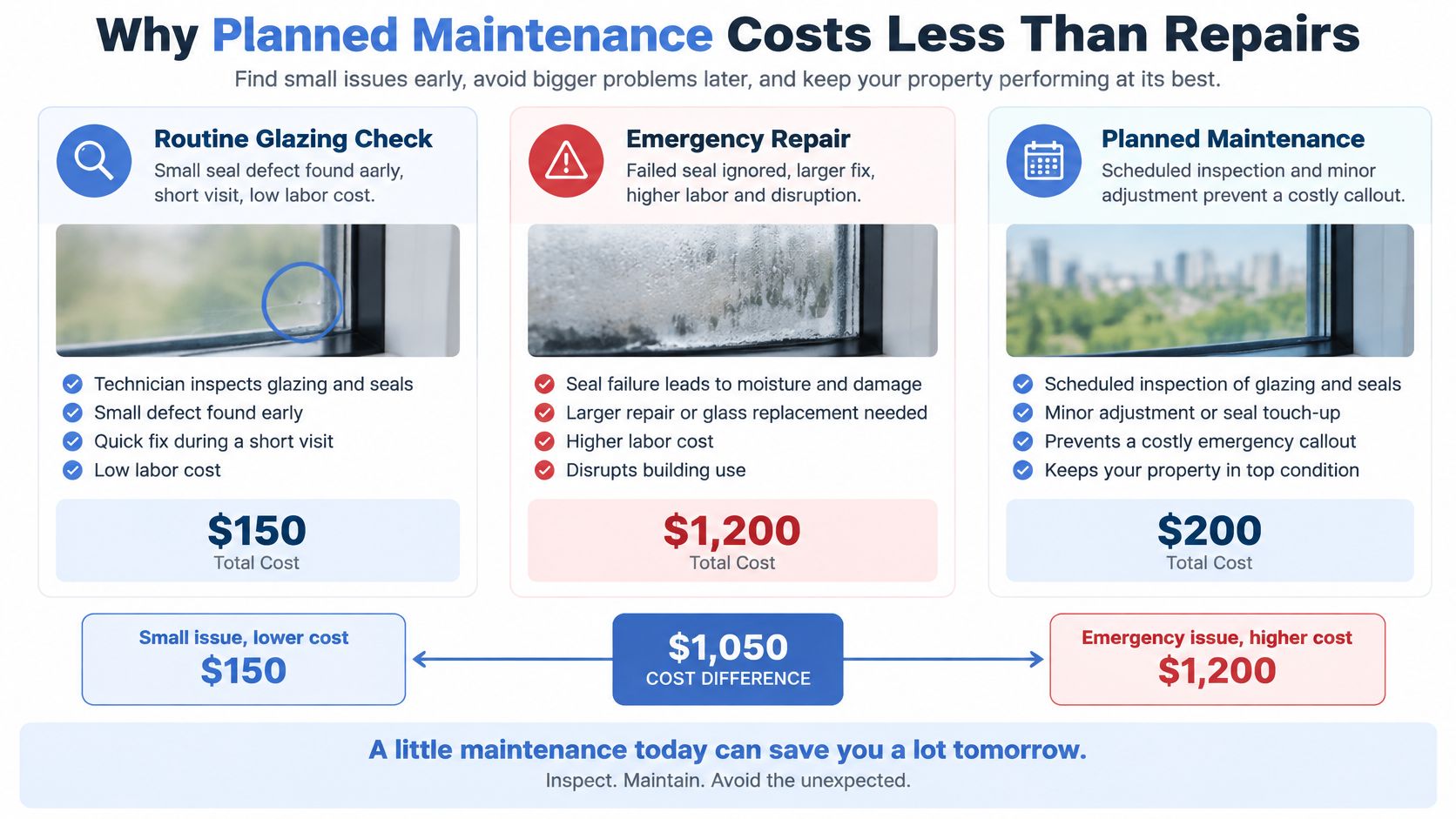
A 2021 study of 39,093 U.S. Air Force facility work orders, published through the ASCE Library study of preventive and corrective facility workCF.1943-5509.0001569), found that heating, ventilation, and air-conditioning systems, water and gas systems, and architectural finishes accounted for the largest maintenance-cost categories. As planned maintenance increased, corrective and emergency work-order labor hours decreased. Labor was the primary driver of average work-order cost.
That's the mechanism property owners miss. A routine visit adds labor on purpose, in daylight, with access arranged and materials on the truck. An emergency adds labor under pressure, often with return trips, tenant coordination, and damage that has already spread beyond the original defect. Fewer callouts can save money even though the preventive schedule itself costs money.
Practical rule: Judge planned maintenance after a full cycle of avoided emergencies, not by whether the first routine invoice looks cheaper than doing nothing.
The saving won't appear on the first bill. It appears as fewer urgent invoices, fewer disrupted tenants, and fewer weekends spent arranging access for a problem that started as a loose seal, a blocked drain path, or a finish failure nobody logged. If you cancel the program after two visits because nothing bad happened, you've confused the result with waste.
Put predictable tasks on a calendar. Exterior-envelope inspections, glazing and seal checks, drainage reviews, HVAC filter replacement, and finish-condition assessments belong there because exposure and use degrade them whether anyone complains or not. Set the interval by risk, then adjust it when inspection results say the building is holding up better or worse than expected.
Trigger other work by condition. A cracked pane, failed seal, bent screen frame, active leak stain, or inoperable vent should move from observation to a defined next step based on severity. The crew shouldn't decide informally that it can wait until next quarter if water can enter in the meantime.
We take the window cleaning burden off property managers so they can focus on other tasks, but that only works if each visit produces usable findings. A clean building with no record of a worsening seal is a missed opportunity. A slightly longer visit that documents the defect early is the cheaper outcome.
Professionals use two methods for window cleaning, the squeegee method and the pure-water system. The squeegee method wets and agitates glass, then pulls the dirty water off with rubber. The pure-water method brushes and rinses glass with treated, mineral-free water and lets it air-dry.
An industry account in the European Cleaning Journal guide to modern window cleaning describes selecting a squeegee wide enough to cover the glass in no more than two pulls, with several inches of overlap between passes to reduce streaking. It treats classical squeegee work and modern water-fed-pole cleaning as the two active professional approaches. Neither one makes the other obsolete.
| Factor | Squeegee method | Pure-water method |
|---|---|---|
| How it works | Wash and agitate, then pull water off with a rubber squeegee | Brush and rinse with treated, mineral-free water from a water-fed pole |
| Access | Ladder or lift for upper floors | Ground-level pole for many elevated windows |
| Drying | Wiped dry; streak-free when pulls overlap correctly | Air-dries without mineral spots |
| Best use | Interior glass and detailed frames | Hard-to-reach exterior glazing and high-rise facades |
| Limits | Slower on tall buildings and exposed access | Needs water-purification equipment |
With a squeegee, technique is visible immediately. The cleaner wets the pane with a washer or scrubber, agitates bonded soil, then removes water and loosened dirt in controlled pulls. Edge detailing matters around frames, mullions, signage, and interior partitions where drips can't fall onto floors or merchandise. That's why squeegees still suit interior glass and detailed frames.
Pure-water cleaning depends on preparation before the brush touches glass. Water runs through reverse osmosis and de-ionization to remove dissolved minerals and remaining charged impurities, then travels through a water-fed pole to the brush. Because the rinse water carries no mineral load, exterior glass can dry naturally without spots. Telescopic poles let crews reach many high windows from the ground, which changes access planning and reduces reliance on ladders at suitable heights.
Professional Window Cleaning has been cleaning windows since 1999, for over 26 years, and that history matters here because method selection is a field decision, not a sales preference. Wind, sun, frame material, soil type, water access, pedestrian traffic, and interior finishes all change the right tool. A crew that only wants to use one method will eventually use it where it doesn't belong.
For HOA communities, our service includes exterior window cleaning of high-rise and other exterior windows to remove dirt, grime and streaks, and it also includes removing hard water stains using specialized techniques and solutions. Pure-water poles often fit repeated exterior elevations where ground access is clear. Squeegee work fits communal interiors, entry glass, and detailed frames where control matters more than reach.
Screen service can include optional frame repair and protective coating applications in the cleaning package. Those add-ons should be specified per building, not assumed. A protective treatment on a frame doesn't help if sprinklers keep soaking the same pane every morning, so fix the exposure or shorten the interval.
I would choose the method after looking at access and finish risk, not before. Clean glass is the minimum outcome. No streaks, no damaged frames, no water where it shouldn't be, and no unfinished elevations are the actual standard.
Dust, high sun, wind, and hard water can shorten exterior maintenance intervals across much of Arizona, Colorado, and Nevada. Glass and frames collect mineral residue and fine grit, particularly near roads, construction, open desert, and sprinkler overspray. A schedule suited to a mild, wet climate may leave these buildings dirty between visits.

A commercial-building retrofit study of a 2,115-square-meter facility occupied by 250 people, summarized in the KFUPM commercial building retrofitting assessment, reported a 39% reduction in energy load after energy-efficiency and indoor-environmental-quality measures. Routine HVAC cleaning can also reduce fan and blower energy use, so check filters and coils on the same schedule as other dust-sensitive areas.
These findings are prompts to inspect conditions, not predictions of the savings a particular desert property will achieve. Check whether dust is reaching filters, coils, vents, and occupied spaces, as well as settling on glass. If exterior frames collect grit quickly, inspect what nearby intakes and filters are collecting over the same period.
Coordinate exterior work with other property systems. Building exterior maintenance planning can help managers align cleaning, filtration, ventilation checks, moisture control, and envelope inspections around shared access windows and observations.
The short field video below shows a planned exterior service and can help managers set access expectations before scheduling work.
Denver high-rises bring different scheduling constraints. Settle wind conditions, roof access, pedestrian protection, and the method for rope, platform, or pole work before a crew arrives. Snowmelt and road-treatment residue affect lower elevations, so ground floors may need a different cleaning interval from upper glass.
Professional Window Cleaning serves Las Vegas, NV, Phoenix, AZ, Denver, CO, and Scottsdale, AZ. Within each city, exposure matters more than the name on the map. Identify the dustiest properties and set their service intervals to match the buildup rate.
A usable plan turns visual upkeep into evidence. Owners need to see what changed, what a vendor found, and what happens next, not just receive an invoice that says service completed. That matters because 56% of owners identify maintenance support as the main reason they hired a property manager, while maintenance is also their top source of stress, according to the Buildium 2026 property management industry report.
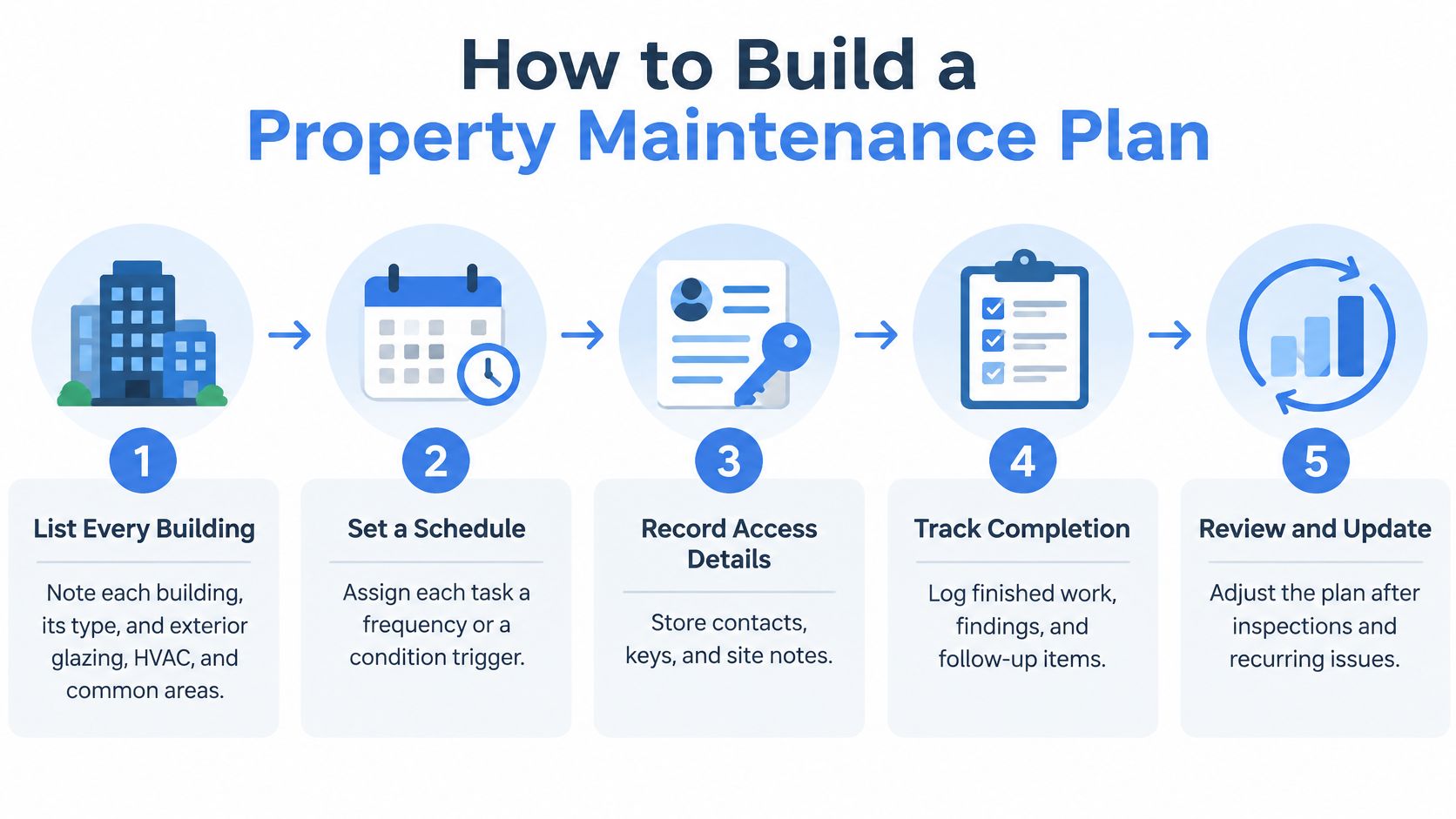
For portfolio-wide consistency, our notes on facility management best practices for reporting and vendor coordination can help you align field reports with work orders. The format matters less than consistency. Inconsistent basic records will undermine any dashboard, sensor, or software you add later.
Owners of rental homes can adapt the same discipline at a smaller scale with rental home upkeep advice from Global, then add vendor photographs and severity notes for exterior work. A monthly household list handles reminders. It doesn't replace a defect log for a multi-story or tenant-occupied building.
Photographs can reveal occupants, license plates, medical activity, security layouts, or sensitive operations. Tell vendors where photography is limited, how images are stored, and who may receive them. Rooftop and high-rise work also needs documented access controls, named contacts, and a record of zones a crew couldn't reach.
A vendor report should distinguish what the crew saw from what the crew concluded. The first is evidence, the second may require a qualified inspector or engineer.
The cheapest quote isn't always the lowest cost. Reactive call-outs add emergency coordination, repeat access arrangements, tenant disruption, and administrative time that never appear in the vendor's per-visit price. I would rather pay a clear recurring rate with reporting than win a low quote and manage the consequences myself.
A finished plan should fit on one page per building, backed by a schedule, a defect log, and a reporting standard an owner can read in minutes. If a manager can't explain why each task happens at its interval, the plan is still a chore list.
Gather the facts a provider needs before you call. A short property list with building type, approximate area, and floors prevents a vague quote. Add service history, recent work orders, known defects, and photographs of problem elevations.
Next, write down access rules, tenant hours, gated entry procedures, roof contacts, and any photography limits. Set a target frequency for each service type, building by building, and list the reporting fields the owner expects after every visit. If another trade is part of the same exterior review, such as obtaining a separate roof assessment through a page where you can request a free roofing quote, keep that scope and its findings separate from glass and frame observations.
Ask the provider to commit to a free estimate before any work starts, flexible plans from one-off cleans to regular maintenance suited to your needs and budget, and a written frequency for each building. We offer a satisfaction guarantee, and concerns a customer raises will be addressed promptly. Our technicians receive continuous training, safety certifications, and regular compliance checks before working on any property.
Window cleaning addresses appearance and glass condition. It doesn't repair structural problems, so require the estimate and later reports to separate cosmetic findings from anything that may point to a building-envelope concern. Send your property list through our estimate request page at Professional Window Cleaning and ask for a plan that sets a defensible frequency for each building.
Professional Window Cleaning offers residential, commercial, and high-rise window cleaning with flexible one-off and recurring property maintenance services suited to each building and budget. Send us your property list, access notes, and target frequencies, and we'll provide a free estimate with a clear schedule for every site. Visit Professional Window Cleaning to request your estimate and turn routine upkeep into a planned program instead of another emergency.
Read our blog posts regularly and keep learning.