Care and Maintenance
How to Get Commercial Window Cleaning Contracts in 2026
Learn how to get commercial window cleaning contracts: find property managers, price access and risk, write compliant bids, and keep accounts renewing.


You walk past the south-facing windows after lunch and the view looks milky. A hose rinse seemed like enough last month. By afternoon the same cloudy film was back, and the glass felt slightly rough under your thumb.
That film is the job in miniature. Clean and clear window cleaning turns on the water left on the glass, how the crew reaches it, and whether the safety plan matches the building. A cheaper quote, or a tighter schedule, can leave the same haze if the rinse is hard or the access plan is thin.
Say the sprinklers kiss the lower panes every morning. Each rinse with untreated water drops minerals that bake on in the sun. The next visit, using the same water, lays down another layer. Frequency did not fail you. The rinse did.
A medical lobby, a dealership showroom, and a condo tower go dull for different reasons. The decision is still the same. What is on the glass, how you get to it, and what the crew is allowed to do once they are there.
A homeowner notices that cloudy film on the south glass and wonders if a quick rinse will fix it. It usually will not. A clean and clear visit removes dirt, film, and mineral residue from the glass and leaves it in a state that stays clear between visits, instead of looking washed for an afternoon and hazy by evening.
The work starts with the glass itself, then moves to the parts that shed dirt back onto it. Frames, sills, and tracks hold grit that the next rain or the next hose will drag across a finished pane. Scope is not identical from one provider to the next, so the written list matters more than the phrase on the invoice.
| Component | Standard visit | Typical add-on |
|---|---|---|
| Exterior glass panes | Included | Hard-water removal or glass restoration |
| Interior glass panes | Often included | Interior-only visit |
| Window frames and sills | Light wipe-down | Deep frame scrubbing |
| Tracks and screens | Usually excluded | Screen cleaning or track vacuuming |
| Skylights and storm doors | Not in the standard visit | Quoted separately |
| Gutters | Excluded | Gutter cleaning as a separate service |
Exterior panes are the core of a standard visit. Interior panes are often included when access inside is straightforward. Frames and sills get a light wipe-down, not a deep scrub, unless you add that work. Tracks and screens are usually excluded because they need different tools and more time. Skylights, storm doors, and gutters sit outside a normal glass visit and should be priced on their own line.
Every professional visit cleans the glass with one of two methods, a squeegee or a pure-water system. The choice changes the result more than an extra trip on the calendar.
Before you book, list every item you want covered and ask the provider to confirm each one in writing. If screens, tracks, or a skylight are missing from that list, they will not be on the truck.
Professionals use only two glass-cleaning methods. One is the squeegee method. The other is the pure-water method. There is not a third technique hiding behind a brand name. Height changes the access gear, not the way soil leaves the pane.
In the squeegee method, the technician wets and agitates the glass, then uses a rubber-bladed squeegee to pull the water and loosened soil off the pane. In the pure-water method, tap water passes through filtration that removes dissolved minerals. That water goes through a brush on a telescoping water-fed pole to scrub and rinse the glass. The National Window Cleaning Authority equipment overview describes both approaches, and it notes that purified water with total dissolved solids near 0 parts per million can dry without the mineral deposits untreated water leaves behind.
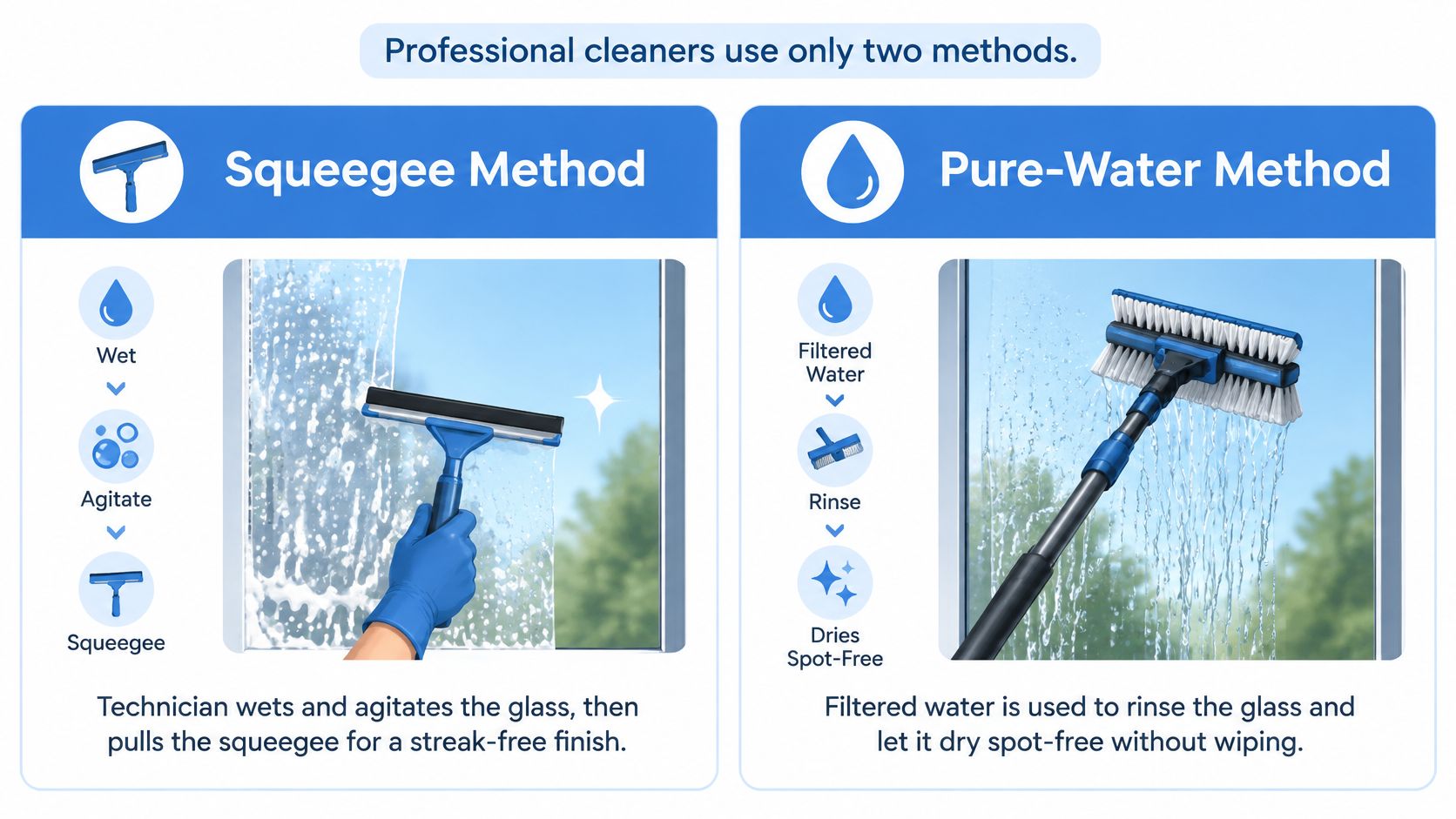
Water chemistry is the split that owners miss. A perfect squeegee stroke still spots if hard water is left to dry on a hot pane. Pure water does not need a blade to finish the pane, because there is almost nothing dissolved in it to stay behind when it evaporates.
| Factor | Squeegee method | Pure-water method |
|---|---|---|
| How it works | Wet and agitate, then pull water off with a rubber blade | Filtered water on a brush at the end of a telescoping pole, rinsed clean |
| Water quality needed | Standard water works if the glass is rinsed well | Water with dissolved solids near 0 ppm |
| Spot risk | Mineral spots form if water dries on the glass | Little or no spotting when it dries |
| Reach | Ground level or ladder work | From the ground on a water-fed pole |
| Best for | Easy access, ordinary soil, clear glass | Hard-water sites, screens, taller panes |
Squeegee work suits easy, ground-level glass with ordinary soil, dust, and fingerprints. You can see the blade, you can see the edge, and a missed corner is obvious before the crew leaves. Pure water suits hard-water sites, screens, and taller panes, because the brush reaches the screen mesh and the rinse does not reload the glass with minerals.
Site conditions in Las Vegas, Phoenix, Denver, and Scottsdale decide the pick. A shaded townhouse with soft soil is a squeegee job. A sun-baked storefront hit by irrigation overspray is a pure-water job. Taller faces that a pole cannot cover move to rope or a platform, which is an access change, not a new cleaning method.
Practical rule: Ask which method the crew will use, and why that method fits this glass, this water, and this height. A quote that will not name the method is not finished.
Dirt on the outside of a pane acts like a dirty camera lens. It scatters light before that light reaches the room, so a well-designed window can still look dull and deliver less usable daylight.

Glass is an optical surface, not only a decorative one. Visible transmittance measures the fraction of visible light passing through the complete window unit across approximately 380–760 nanometers. An Andersen Windows performance document notes that the U.S. Department of Energy places most double- and triple-pane windows at VT values of roughly 0.30–0.70. Surface film then lowers what the room receives.
Clear glass pays off in three practical ways.
Commercial owners with large glazed facades, property managers protecting presentation across many units, and homeowners with south- or west-facing glass feel this first. Cleaning maintains visual performance. It does not replace glazing upgrades, insulation, or an energy program.
A short walk-through of how crews read a dirty pane against the light makes the seasonal check easier to copy.
Walk the property in reflected daylight once each season. Note haze or residue, and schedule service when that haze returns faster than it used to.
A pane can look hazy again soon after cleaning if the rinse water leaves minerals behind. In Arizona, Nevada, and Colorado, many spots come from mineral deposits rather than dust, fingerprints, or pollen. More frequent washing with untreated water can make the residue build up instead of clearing it.
Regional guidance on Arizona window washing reports that Arizona municipal water commonly ranges from approximately 145–420 mg/L as calcium carbonate, a level characterized as very hard. As rinse water evaporates, it leaves minerals on the glass. Stretching the interval and finishing with purified water protects the glass better than a monthly visit that reloads it with minerals.
Identify the condition before choosing a fix. Removable mineral spots sit on the surface and can lift with the right rinse. A bonded haze needs a stronger, non-abrasive cleaning pass. Permanent etching is damage within the glass, so routine cleaning cannot remove it.
| Symptom | Likely cause | Routine fix | When to escalate |
|---|---|---|---|
| White chalky film after rain or sprinkler overspray | Mineral deposits from untreated water | Pure-water final rinse | Film remains after cleaning |
| Cloudy or rainbow haze | Bonded mineral layer on the surface | Stronger cleaning with a non-abrasive method | Haze remains after two careful passes |
| Rough or frosted patch | Etching from long-term mineral exposure | None; cleaning cannot remove etching | Refer to glass restoration |
| Streaks on dry days | Water left to dry on the glass | Squeegee and rinse | Streaks return within days |
| Spots on coated or tinted glass | Abrasive or aggressive cleaning | Non-abrasive method matched to the glass | Check the glass manufacturer's limits first |
Do not treat coated or tinted glazing like ordinary clear glass. Abrasive pads and aggressive scraping can leave permanent marks, so match the method to the manufacturer's limits. The guide to cleaning hard water stains on glass explains which deposits may respond to cleaning and when the glass needs restoration.
Sprinkler overspray, cooling-tower drift, glass age, south and west exposure, and cleaning frequency affect how quickly minerals bond. A new pane in shade may resist mist for a long time, while an older west-facing pane under a sprinkler head can etch in a season. Conditions in Las Vegas and Phoenix vary from site to site. Irrigation, tower drift, and sun exposure are local, even along the same street.
Ask the provider to confirm in writing that the final rinse uses deionized, distilled, or reverse-osmosis water. Photograph the glass before service to record any existing etching. Rinse quality, access to exposed panes, and safe work positioning can matter more to the result than cleaning frequency alone.
Height and access decide the equipment, even though the glass method stays squeegee or pure water. The National Window Cleaning Authority's exterior guidance describes water-fed poles reaching roughly 70 feet from the ground, and rope access or suspended platforms where ground reach is not enough. OSHA's window-cleaning rules cover suspended scaffolds, rope descent systems, fall protection, inspections, and rescue planning. Crews still clean with a squeegee or pure water. The access system is what changes.
| Property type | Access method | Safety and planning | Scheduling |
|---|---|---|---|
| Residential homes | Ground poles or ladders | Standard ladder and fall precautions | Usually one short visit |
| Commercial offices and medical sites | Ground reach plus lifts where needed | Coordination with tenants, staff and security | Often off-peak or after hours |
| High-rise condos and towers | Suspended platforms or rope access | Anchor checks, exclusion zones and written emergency plans | Multi-day and weather-dependent |
Homes are usually a pole or a ladder, with ordinary fall precautions, and they often finish in one short visit. Ask how the ladder is footed, and whether the pole reaches the upper sash without someone leaning out.
Offices and medical sites mix ground reach with a lift where a pole falls short. The hard part is people, not glass. Someone has to clear tenants, staff, and security so a lift does not block an ambulance bay or a clinic door. Those jobs often run off-peak or after hours.
High-rise condos and towers use a suspended platform or rope access. That means anchor checks, a pedestrian exclusion zone, and a written plan for stopping work. Jobs can run for days and stop for wind. Building owners, not only the crew, may need to keep permanent maintenance systems and their records in compliant shape.
For a tower, ask who checks the roof anchors and who keeps the inspection records. If that answer is "the crew will figure it out," the quote is not ready.
A clear visit follows a set order so drips, missed panes, and surprise add-ons do not show up at the end.
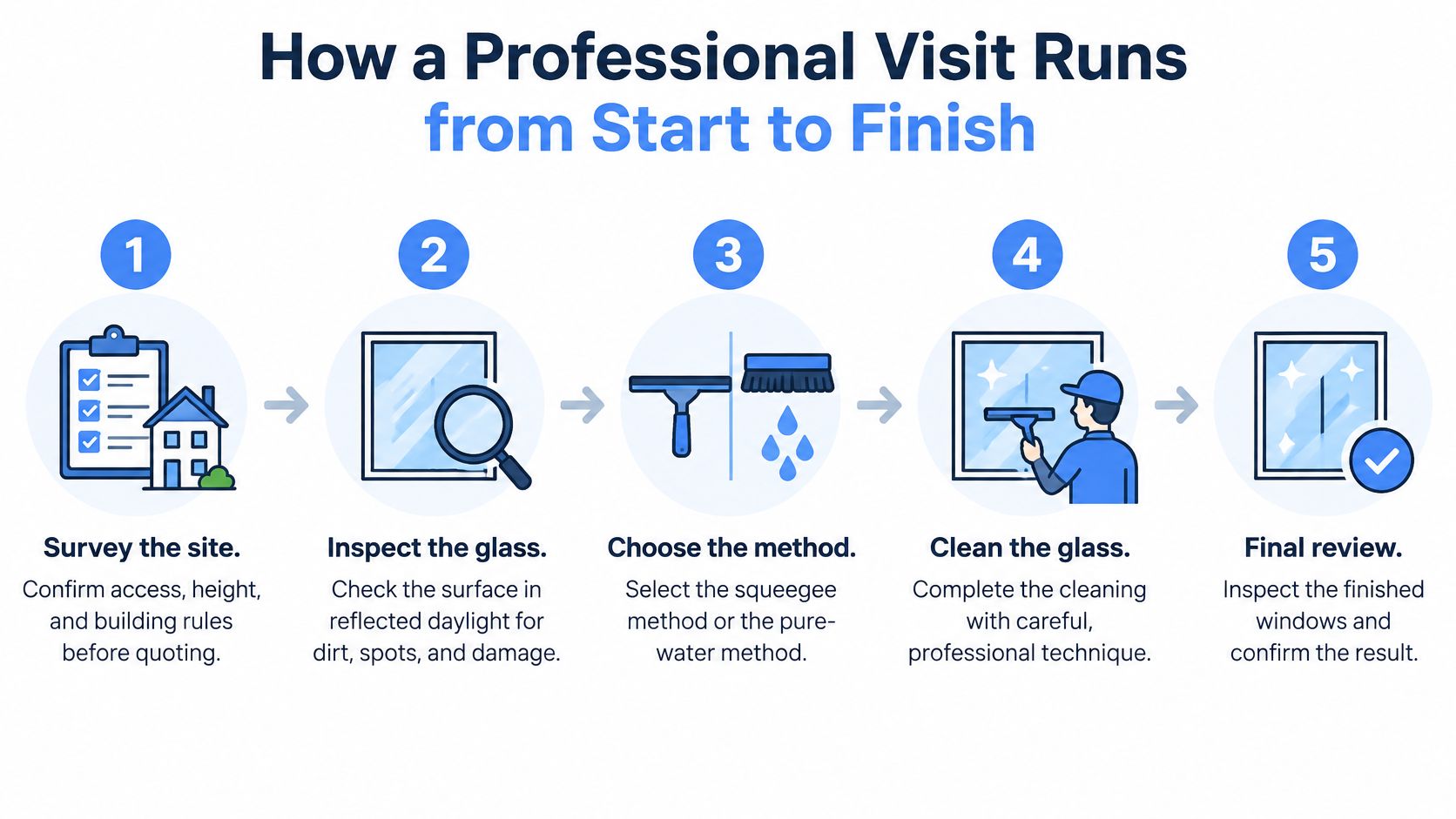
Homes often finish in one visit. Commercial sites may run in off-hours so patients, shoppers, or staff are not under a wet facade. High-rise work can be multi-day and weather-dependent, because wind and lightning stop suspended work even when the glass is ready.
At the walkthrough, confirm the scope list against what you see, and ask for any missed pane to be re-cleaned before you sign off. A second trip for three skipped panes costs more than five minutes at the end of the first one.
Two quotes for the same building can differ because they are not pricing the same work. Pane count, height, scope, method, mineral treatment, frequency, and safety planning each move the number.
| Factor | How it changes the price | Example |
|---|---|---|
| Number and size of panes | More panes and larger panes mean more time | A house of 67 panes, inside and out |
| Height and access | Lifts or rope access add equipment and crew time | Two-story house versus a high-rise tower |
| Interior plus exterior | Doing both adds handling and time | Exterior-only versus full visit |
| Cleaning method | Pure-water needs filtration and a water-fed pole | Squeegee on easy ground-level glass |
| Hard-water treatment | Mineral removal or restoration is extra work | Mild spots versus bonded haze |
| Frequency | Recurring schedules lower the per-visit cost | Quarterly service versus a one-time job |
| Safety and planning scope | Rigging checks, documentation and tenant coordination add cost | Condo with roof anchors that need verification |
Take a residential job of 67 panes, cleaned inside and out, with mild hard-water spots treated by a non-abrasive method. That price is mostly pane count and time on site. A tower is platform hours, crew size, and rigging checks. The glass method can be the same. The hours are not.
A low bid may not be equivalent service. It can omit rigging verification, debris controls, tenant coordination, or emergency planning, and it may use abrasive methods that damage coated glass. OSHA scaffolding guidance states that suspended-scaffold workers more than 10 feet above a lower level must be protected by guardrails, a personal fall-arrest system, or both, and that users need training on fall, falling-object, electrical, and equipment hazards. Powered platforms also need written emergency procedures for power or equipment failure, plus competent-person training for operators. Those items have a cost. A bid that skips them is cheaper because it left the work out.
Compare quotes on scope and safety, not only on the total. Recurring schedules lower the per-visit cost because setup is already known. A one-time job carries more setup time, which is why the first visit often costs more than the fourth. Knowing when to send a quote helps you tell a firm price from a rough proposal before you compare totals. A window cleaning price calculator is a useful cross-check on pane count and add-ons, not a substitute for the safety lines.
You control three levers. Group exterior and interior glass into one visit, clear access before the crew arrives, and pick a frequency that matches sun and sprinkler exposure rather than a generic calendar.
Ask for an itemized quote that names the method, the scope, the water used for the final rinse, and the safety plan.
High-rise and condominium work fails in the planning, not on the pane. Run this list before the crew arrives.
This list matters for high-rise condominiums, medical offices, dealerships, stadiums, and towers in Las Vegas, Denver, and the Phoenix area. A low bid that skips these steps is not the same service at a better price. Owners may also need to maintain the permanent building-maintenance system and its records, separate from whatever the cleaning crew brings that day.
Service covers Arizona, Colorado, and Nevada. In Arizona that includes Flagstaff, Tempe, Chandler, Gilbert, and Scottsdale, plus Phoenix. Denver covers the Colorado work, and Las Vegas covers Nevada. Airports, government buildings, arenas, stadiums, construction sites, and homes sit in that same footprint, so a house and a tower are not different companies.
How often to clean follows the glass, not a fixed month. Sprinkler-exposed and high-sun sites need shorter gaps. Walk the panes in reflected daylight each season, and book when haze returns faster than it did last year. A shaded north elevation can wait longer than a west elevation under irrigation.
Confirm the method in writing, and ask whether the final rinse has near-zero dissolved solids. If the answer is "we use whatever is on the hose bib," you already know how the spots will come back.
The cheapest quote is the best deal only after the scope lines and the safety items match. Compare method, rinse water, anchors, exclusion zones, and emergency procedures before you compare totals. A lower number that drops those lines is a different job.
Professional Window Cleaning has provided window-cleaning services since 1999, which is over 26 years, for residential, commercial, and high-rise clients. Book a walkthrough, bring the scope list, and request an itemized quote that names the method, the rinse, and the safety plan.
Professional Window Cleaning handles residential, commercial, and high-rise glass with a squeegee or a pure-water system, matched to the water, the height, and the safety plan your building needs. If haze keeps returning after a cheap rinse, or a low bid skipped anchors and rinse water, start with a walkthrough and an itemized scope. Visit Professional Window Cleaning to set that visit up.
Read our blog posts regularly and keep learning.