Care and Maintenance
How Often Should You Seal Your Driveway? a 2026 Guide
How often should you seal your driveway? Most asphalt needs resealing every 2–3 years, sooner with harsh sun, heavy traffic or freeze-thaw cycles.


At the end of the second quarter of 2025, Phoenix held approximately 195.5 million square feet of office space across 9,037 buildings, according to the Phoenix Q2 2025 office market report. That scale reframes Commercial Window Cleaning in Phoenix as a recurring building operation, not an occasional cosmetic purchase. Thousands of properties need glass cleaned on different cycles, with different access systems, water controls, and tenant schedules.
A useful bid reflects that reality. It names the service types, the cleaning method, the access and fall protection plan, the stormwater controls, and the timing window that keeps crews safe in desert heat. Price per window tells you very little on its own.
| Service | What It Includes | Typical Properties |
|---|---|---|
| Exterior glass cleaning | Facade and curtain-wall glass, frames, sills and exterior debris rinse-off | Office towers and multi-story offices |
| Interior glass cleaning | Interior glass faces, partitions, glass doors and sill wipe-down | Offices, medical clinics and lobbies |
| Storefront and entry glass | Entry doors, display glass, frames and door tracks | Retail, restaurants and car dealerships |
| High-rise and hard-to-reach glass | Rope-descent, lift or platform work with fall protection | High-rise condominiums and office towers |
| Post-construction and vacancy cleaning | Construction film, paint specks and mineral spotting removal | New builds and leased-up or repositioned offices |
| Recurring maintenance programs | Scheduled exterior and interior passes on a fixed calendar | Multi-tenant offices and property management portfolios |
Most buildings don't fit one row. An office park often needs storefront and entry glass on a short cycle, plus a recurring exterior program for upper floors and periodic interior work in the lobby. A medical building may pair monthly interior partitions with quarterly exterior glass, while a dealership puts display glass first because customers judge the showroom through it.
Each service uses different labor, access, and timing. Interior work means tenant coordination, furniture protection, and after-hours access. Exterior work means water supply, sun exposure, and a ground exclusion zone. Post-construction cleaning is slower still, because technicians must soften stucco dust, paint specks, and film residue with water before any tool touches the pane, and they must check coatings before deciding whether a blade belongs on that glass at all.
List every service type that applies to your building before you ask for a price. A bid built on a mixed scope can't be compared with one built on exterior glass alone.
That inventory spread across thousands of Valley buildings makes commercial glass a year-round need, not a seasonal extra. Professional Window Cleaning has cleaned windows for over 26 years and serves commercial properties through its Phoenix service page, which is the right starting point when you're scoping a local property. Write down your rows from the table first, then request pricing against that exact list.
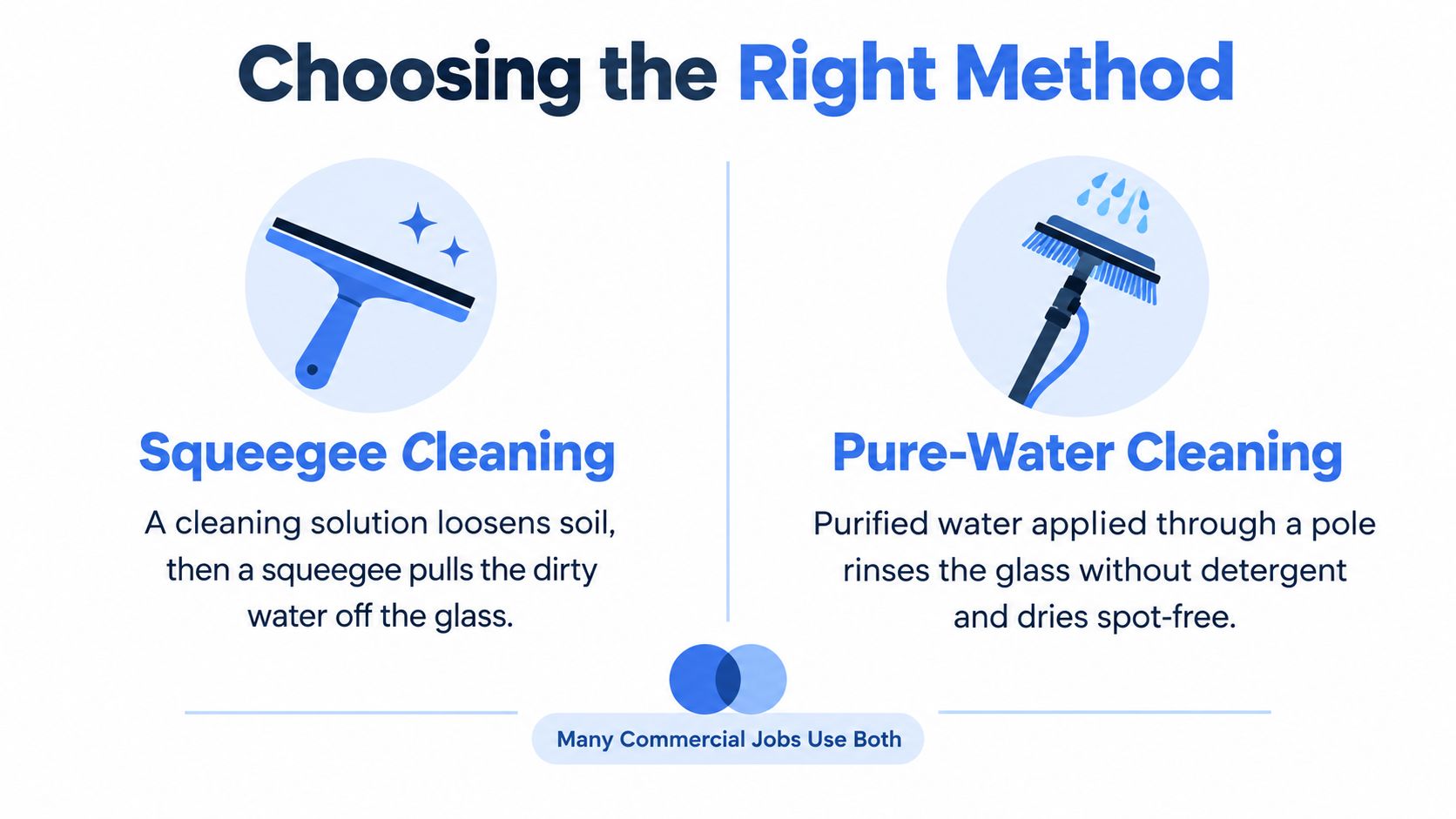
Professional window cleaning uses one of two methods, a squeegee or a pure-water system. Those are the only two options in common use. Many commercial jobs use both on the same building, because ground-level detail work and tall exterior glass reward different tools.
With squeegee cleaning, a cleaning solution loosens soil first. The technician then pulls the blade across the glass to remove the liquid and the debris suspended in it, keeping most of the blade on a wet surface and holding consistent pressure to avoid lines and streaks. It's direct, controlled work, and it's still the best way to finish frames, door tracks, and interior partitions where you can't let water run freely.
With pure-water cleaning, filtered water travels through a water-fed pole to a soft brush. The brush agitates dirt while the water rinses continuously, so there's no separate drying step. A typical system combines carbon filtration, reverse osmosis, and deionization, and operators check the water with a total-dissolved-solids meter, with a trade specification of below 10 parts per million at the pole for clean drying on uncoated glass, as described in this guide to pure-water systems for residential and commercial work.
The comparison below puts the two methods side by side.
| Criterion | Squeegee Cleaning | Pure-Water Cleaning |
|---|---|---|
| How soil is removed | Cleaning solution loosens soil; the blade pulls off liquid and debris | Soft brush agitates soil while filtered water rinses continuously |
| Water source | Standard water with detergent | Carbon-filtered, reverse-osmosis and deionized water |
| Drying behavior | Streaks possible if blade technique slips | Air-dries spot-free when TDS is below 10 ppm at the pole |
| Reach | Ground level, ladders or lifts, pole-based detailing | Water-fed pole reaches upper floors from ground level |
| Best fit | Storefronts, interior glass, frames, door tracks | Tall exterior glass and mid-rise facades |
| Main limit | Upper floors need lift or rope access | Needs a purified-water setup and TDS checks |
I'd specify squeegee work for storefronts, entry doors, interior glass, frames, and ground-level panes where detailing matters and runoff must stay controlled. I'd specify pure-water work for tall exterior glass where the alternative is a lift rental or a rope crew for routine maintenance soil.
Heavy construction debris changes the answer. A brush and purified rinse won't safely clear paint specks or cement splatter, and dragging any tool over dry grit can scratch new glass. That work needs soaking, coating checks, and hand detailing first. Put the method in the bid by elevation and glass type, not as a single line for the whole building.
On Phoenix towers, medical buildings, condominiums, stadiums, and dealership facades, the access system carries more risk than the glass. A weak access plan can shut a job down, damage a facade, or put a worker and your tenants in danger. Price can't fix that after the crew arrives.
OSHA requires suspended-scaffold support devices to bear at least four times the imposed load at the hoist's rated capacity, or 1.5 times the load at stall capacity, whichever is greater, under the OSHA scaffold standard at 1926.451. For permanently installed powered platforms used for building maintenance, structural supports, tie-downs, tie-in guides, anchoring devices, and affected building components must be designed or directed by a registered professional engineer experienced in that work.
Ask for these items in writing, in this order:
That same discipline applies to high-rise window cleaning, where the bid should name the access method, rated capacity, stabilization points, and rescue plan instead of pricing glass area alone.
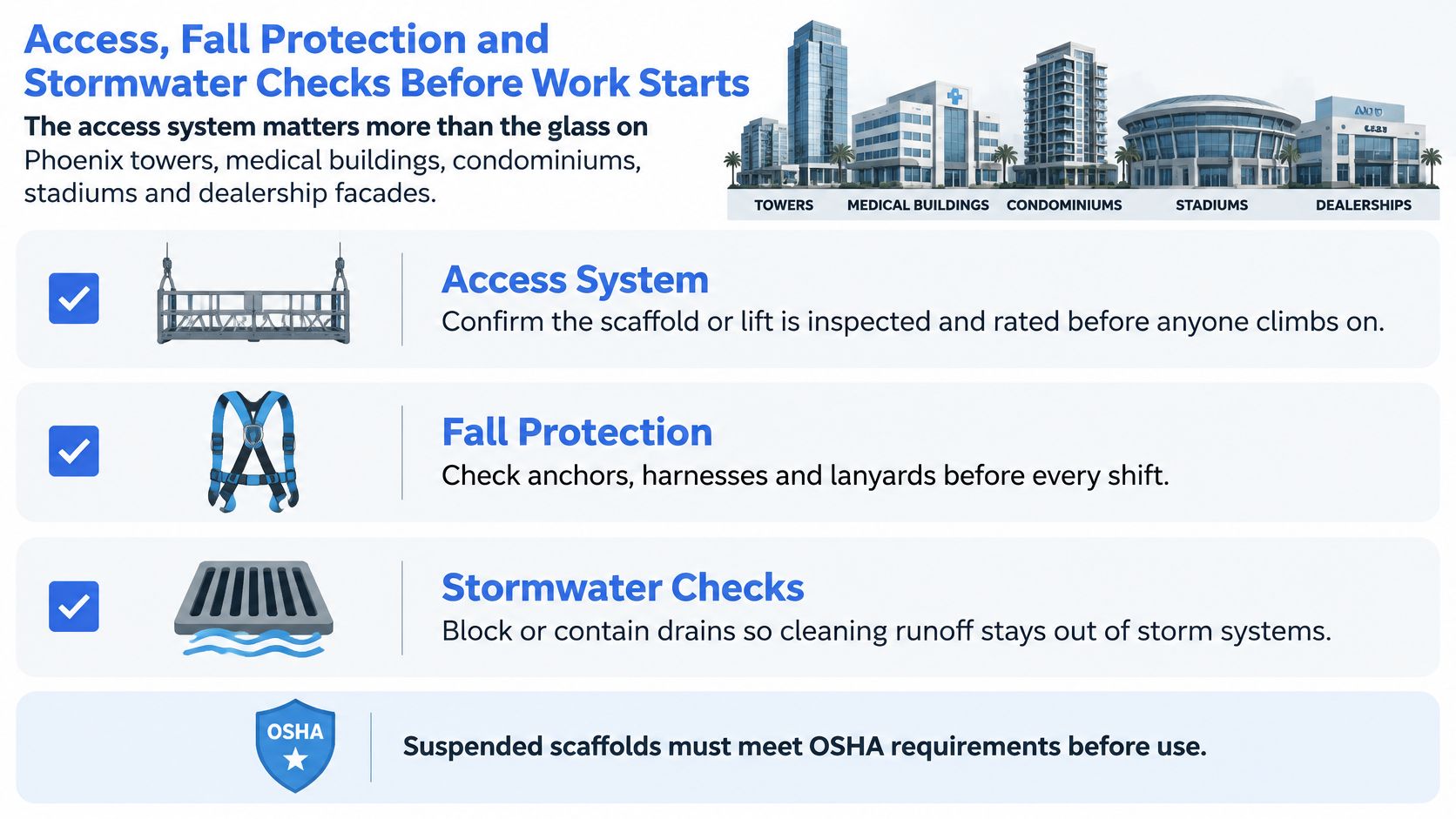
Runoff control belongs in the pre-job walk, not in a vague promise about eco-friendly service. The lowest water volume isn't automatically the most compliant choice. Poorly controlled runoff creates environmental and documentation risk even when the total volume is small, because detergent and dislodged soil still reach the drain.
Before work starts, confirm drain locations, wastewater capture or diversion, chemical disclosure, permission for hose use, and what post-service records you'll receive. Hand that checklist to every bidder. If a provider can't answer it, the bid isn't complete.
Commercial pricing comes from measurable inputs, not a per-window rate card. Crew time, equipment, risk, and administration set the number. Once you see those inputs, you can judge whether a low bid is efficient or missing scope.
Say you're pricing a three-story medical office with storefront glass at the entries and standard exterior panes at the rear. A water-fed pole and squeegee detailing may cover the whole building with a small crew in one visit. Now compare a 12-story tower where rope or lift access, fall-protection planning, tenant notification, and after-hours timing add setup hours before anyone touches glass. The second building doesn't cost more because its windows are special. It costs more because reaching them safely takes more people, more equipment, and more documented planning.
| Factor | How It Changes the Work | Effect on Price |
|---|---|---|
| Height and access | Rope, lift or platform work adds equipment, crew time and safety planning | Higher |
| Glass area and pane count | More panes mean more labor hours per visit | Higher |
| Window and frame type | Divided lites, coated or tinted glass and deep frames slow cleaning | Higher |
| Cleaning method | Pure-water needs purification equipment; squeegee needs more hand detailing on frames | Varies by building |
| Condition | Construction debris, paint or mineral spotting needs extra passes | Higher |
| Frequency | Recurring contracts spread setup and travel across visits | Lower per visit |
| Site logistics | Occupied tenant spaces, after-hours work, water access and parking | Higher |
| Documentation | Insurance certificates, safety plans and stormwater records add administration | Higher |
A useful bid states the access method, crew size, cleaning method by area, whether interior and exterior glass are both included, and whether you'll get a post-service report. If you're building your own estimating model, it's worth reviewing how square-foot inputs feed profitable window cleaning estimates with Estimatty so your internal budget logic matches what providers price in practice.
Practical rule: Compare bids only on identical scope. A low headline number often hides missing access, missing interior work, or missing documentation.
Recurring contracts usually lower the per-visit cost because setup, travel, and documentation spread across several visits, and lighter soil between visits cleans faster. This guide publishes no fixed rate card. A real cost range comes only from a bid made after a site walk on the scope above.
Frequency comes from exposure, not from a generic monthly package. Phoenix heat, sun angle, dust, nearby construction, and monsoon storms set the calendar, and they also decide what time of day the crew can safely work.
The City of Phoenix advises heightened precautions above 100°F, including hydration, frequent breaks, reduced outdoor exposure, and scheduling outdoor activity during the coolest times, in its city heat safety guidance. Phoenix also adopted a 2024 heat-safety labor ordinance for city-contractor employees requiring shade or air conditioning, water, rest, training, and heat-stress protections. Your vendor's protocol should be just as explicit, even when the ordinance doesn't directly govern your contract.
The image below shows the kind of suspended exterior work that heat planning has to account for, since rooftop and rope access add sun exposure on top of the air temperature.

Hot glass dries water before the rinse finishes. Dissolved minerals then concentrate on the pane and frame as visible spotting, especially on west and south faces that take afternoon sun. Clean those elevations first, in the coolest hours, and finish exterior passes with a purified final rinse verified by a TDS check so the water itself doesn't leave the deposit you're paying to remove.
Monsoon grit creates a different problem. Wind-driven dust settles as an abrasive film, and wiping it dry can scratch the pane. Schedule a follow-up pass within days of a major storm, with enough water to float grit off the surface before a brush or blade makes contact. Dust from nearby construction settles daily during build-out, so buildings next to active sites need higher frequency until that work ends.
Specify the protocol in the contract: early-morning or evening windows, maximum exposure limits, rooftop and suspended-access checks, tenant notifications, and clear stop-work criteria. Hospitals, senior housing, schools, dealerships, and high-rise condominiums need this in writing because disruption and exposure carry higher consequences there.
The video below shows professional exterior technique in motion, which helps property managers see why pacing, rinse control, and access setup take real crew time.
| Property Type | Starting Frequency | Timing Notes |
|---|---|---|
| Medical offices and clinics | Monthly interior, quarterly exterior | Outside patient hours |
| Office towers | Quarterly exterior, monthly lobby glass | After hours or before occupancy |
| Retail storefronts | Biweekly to monthly | Before opening, early morning |
| Car dealerships | Biweekly to monthly display glass | Before showroom opens, sun-facing glass first |
| High-rise condominiums | Twice yearly exterior | Coordinated with association and access schedule |
| New builds after construction | One post-construction clean, then quarterly | After drywall and paint are finished |
| Vacant or leasing spaces | One clean before showings | Before listing photos and tours |
Treat those intervals as starting points. A storefront on a busy west-facing street may need a biweekly pass in July, while the same storefront on a shaded north face stays monthly. If you want the fuller reasoning behind interval selection, this overview of how often commercial windows should be cleaned is a useful companion before you lock a contract.
Set a start date, agree on the timing window, then review the interval after three visits. Soil load, tenant complaints, and spotting patterns will tell you whether the cadence is right far better than a sales package will.
Send a short set of building facts and you'll get a bid that reflects your real scope instead of a guess. Providers can then choose the method, price the access plan, and include the right documentation the first time.
Include these items with your request:
Professional Window Cleaning has been cleaning windows for over 26 years and provides commercial and high-rise service, with local details on its Phoenix city page. Follow three steps from here. First, request a quote with the details above. Second, compare every bid on the same scope. Third, confirm the access, safety, and documentation items before you sign.
Professional Window Cleaning provides commercial, storefront, and high-rise window cleaning for Phoenix properties, with method, access, and scheduling matched to your building instead of a generic package. Send your building details, desired frequency, and timing constraints to get a scope-based quote you can compare fairly. Visit Professional Window Cleaning to request your Phoenix commercial quote today.
Read our blog posts regularly and keep learning.