Care and Maintenance
How Much Can a Window Cleaning Business Make in 2026
Wondering how much can a window cleaning business make in 2026? See real revenue, profit margin, and owner income numbers for solo, crew, and high-rise


A tenant calls at 8:15 on Monday morning. The lobby glass is streaked, fingerprints cover the entry doors, and an important client is expected before lunch. The cleaning vendor can send a crew, but the visit is reactive, rushed, and more disruptive than a planned service.
That situation raises the practical question property managers ask: how often should commercial windows be cleaned? The answer isn't one universal interval. A storefront, a quiet warehouse, a medical clinic, and a high-rise office tower collect different contaminants, serve different occupants, and place very different demands on the glass.
Professional Window Cleaning has been cleaning windows for over 26 years, and the most reliable schedules are built around exposure rather than habit. Property type, traffic, surrounding land use, glass specification, access requirements, and local climate all matter. A useful baseline exists, but the right plan should be adjusted after inspecting how quickly each elevation becomes dirty.
A window cleaning schedule is part of facility maintenance, not just a cosmetic line item. Tenants notice streaks and haze in shared spaces, visitors form opinions from the entrance, and employees spend their day looking through glass that affects daylight and the feel of the workplace.
Contaminants can also become harder to remove when they remain on the surface. Mineral deposits, hard-water spots, pollutants, and irrigation residue may bond to glass over time. Routine washing removes those materials before they become embedded or contribute to etching. Once glass is permanently etched, ordinary cleaning won't restore it, and replacement may be the only practical remedy.
Property managers already schedule inspections for roofs, façades, drains, and mechanical equipment. Windows deserve the same preventive approach because the glass and surrounding frames are exposed to weather, airborne particles, landscaping runoff, and human contact.
A predictable service interval helps you:
Independent commercial maintenance guidance commonly places professional window cleaning at a minimum of twice per year for most commercial properties, while many office buildings use a quarterly cycle and high-traffic storefronts use weekly to bi-weekly service. This commercial window cleaning guide also notes that windows shouldn't go more than 6 months without a professional clean.
Practical rule: If the building looks dirty before the planned visit, the interval is too long for that elevation, even if the contract is technically being followed.
The cost problem usually begins when managers wait for visible failure. Reactive cleaning may require heavier restoration, more labor, and more disruption than a lighter recurring visit. A schedule based on exposure protects the building envelope, supports presentation standards, and gives the maintenance team a defensible operating plan.
Professional window cleaning uses two primary methods, a squeegee or a pure-water system. Crews may use different brands of buckets, channels, brushes, poles, or filtration equipment, but the underlying approaches remain these two.
The traditional method applies a cleaning solution to the glass, agitates the surface, and removes the water with a rubber squeegee. Technicians use detailing towels and sometimes specialized tools for edges, frames, sills, and stubborn marks.
Squeegee work is particularly effective on interior glass, storefronts, entry doors, display panes, and areas where spotting isn't acceptable. The technician has close control of the surface and can inspect the glass while working. That control matters in a busy lobby, where fingerprints, hand marks, film, and edge buildup are more noticeable than light dust on an upper exterior pane.
The trade-off is setup and labor. Interior furniture, displays, flooring, security points, and pedestrian traffic may need protection or coordination. A crew may also need to work in sections so the building remains operational. For that reason, squeegee service often aligns with tenant schedules, presentation dates, and recurring lobby upkeep.
A pure-water system filters water until minerals are removed, then delivers it through a pole and brush. The brush loosens soil while the purified water carries it away. Because the water contains no typical mineral residue, it can dry without leaving the spotting associated with ordinary water.
Pure-water systems are well suited to upper exterior glass, especially on buildings where ladders, lifts, rope access, or suspended scaffolds would add complexity. They can improve reach while keeping technicians on the ground where site conditions allow. This professional explanation of window washing systems describes squeegee-based cleaning and pure-water, water-fed pole systems as the two principal professional methods.
The method affects scheduling, but it doesn't replace inspection. A pure-water finish may help exterior glass stay presentable between visits, while interior squeegee work still needs to follow fingerprints, tenant traffic, and appearance standards. The crew should also choose equipment based on glass condition, access, frames, seals, weather, and the type of soil present.
Professional Window Cleaning provides residential, commercial, and high-rise window washing services, including work where access and exterior reach influence the cleaning approach. A property manager shouldn't select a method by equipment label alone. The right question is whether the method safely produces the required result on that specific elevation.
A useful baseline starts with the building's use. Customer-facing spaces generally need tighter intervals because fingerprints, road film, and visible dust affect the visitor experience. Less exposed buildings can often use a longer cycle, provided inspections show that the glass remains acceptable.
Industry guidance differentiates schedules by use and access. Commercial maintenance guidance from Dura-Shine identifies weekly or every two weeks for many retail storefronts, monthly to quarterly service for offices, 1 to 2 times per year for industrial or warehouse sites, and quarterly to semi-annual cycles for high-rise façades where access is more complex.
| Property Type | Exterior Frequency | Interior Frequency |
|---|---|---|
| Retail storefront or restaurant | Weekly to bi-weekly where exposure is high | Weekly to bi-weekly for doors, displays, and customer-facing glass |
| Office building | Monthly to quarterly, with quarterly as a common baseline | Monthly to quarterly, focused more often on lobbies and entrances |
| Medical facility or clinic | Monthly to semi-annually, depending on exposure and façade access | Monthly or more often in entrances, lobbies, and patient-facing areas |
| Hotel | Monthly to quarterly for prominent elevations | Monthly to bi-weekly in entrances, lobbies, and public areas |
| School or university | Semi-annually for general elevations, with busier buildings reviewed more often | During planned breaks, with high-traffic interiors reviewed more often |
| Warehouse or industrial facility | 1 to 2 times per year | Quarterly for offices and employee-facing areas |
| High-rise tower | Quarterly to semi-annually for accessible or scheduled façade work | Monthly to bi-monthly in lobbies, atriums, and entrance areas |
Commercial office windows commonly follow a quarterly baseline, while high-rise exteriors are often cleaned once or twice per year because rope access and suspended-scaffold logistics make full-building work more demanding. Lobbies, atriums, and ground-floor glass may need monthly or bi-monthly attention even when upper façades remain on a longer cycle. National Window Cleaning Authority's commercial frequency guidance describes this split between façade logistics and tenant-facing areas.
These are starting points, not promises that every building fits neatly into a row. A property manager handling multiple sites may also benefit from better communication and issue tracking, especially when tenants report access or appearance concerns. An AI answering service for rental properties can help route maintenance requests, but it shouldn't replace a documented inspection and service plan.
The practical approach is to assign different elevations and zones their own frequency. A tower may need quarterly exterior work, monthly lobby glass, and a faster response for a street-level entrance.
Frequency should move up or down after you score the property against four operating conditions. Don't average the whole building if one elevation faces a freeway and another faces a sheltered courtyard. The dirtiest, most visible exposure usually sets the service requirement for that zone.
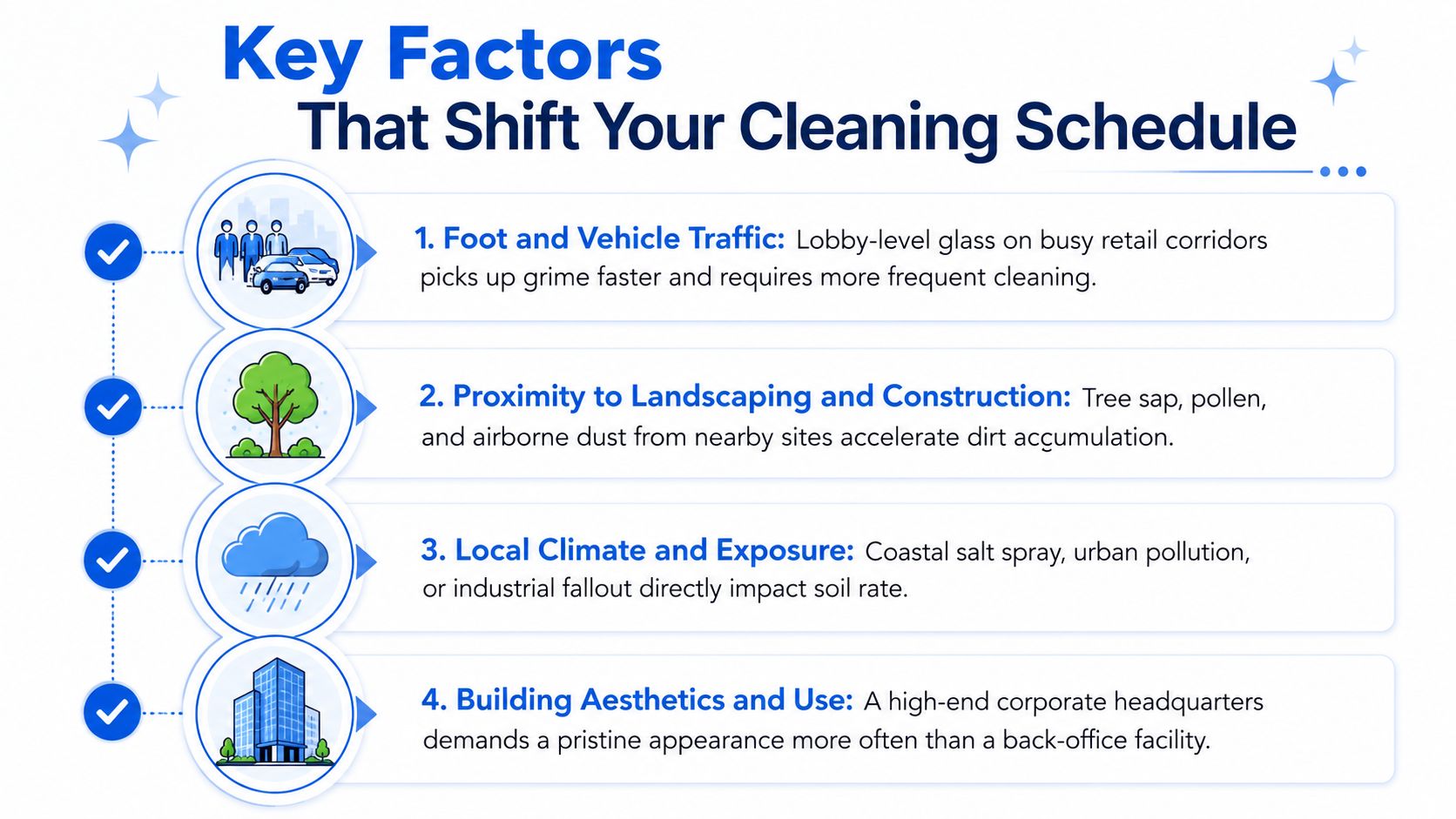
Foot and vehicle traffic drives rapid soil buildup at the bottom of a building. Entry doors collect fingerprints, lobby glass receives repeated contact, and street-facing panes pick up film from nearby vehicles. Busy retail corridors usually belong in a higher-frequency tier than upper floors with limited public contact.
Look separately at doors, sidelights, vestibules, elevator lobbies, and display glass. Cleaning the entire façade on a short cycle may waste resources when only these zones need frequent attention.
A nearby construction site can coat glass with fine dust. Rail lines, freeways, loading areas, industrial operations, landscaping, and parking lots also affect how quickly particles reach the façade. Trees add pollen, sap, and bird activity, while irrigation can create recurring mineral deposits on lower panes.
Record what sits around each elevation, not just the property's general address. A courtyard protected from wind may need a different interval than a wall facing active earthwork.
Low-E coated, tinted, reflective, and other specialized panes require appropriate techniques and careful inspection. Spotting can be especially noticeable on reflective surfaces, while mineral deposits may become more difficult to remove if a crew leaves them untreated.
Ask the cleaning contractor to identify glass types and note existing damage before work begins. That protects both parties and prevents a restoration issue from being mistaken for ordinary dirt.
A Class A headquarters, medical facility, showroom, or luxury hotel generally carries a tighter appearance standard than a back-office or industrial flex building. Lease language, tenant complaints, visitor volume, and the importance of natural light should influence the tier.
Use a simple assessment:
The schedule should reflect the highest-risk conditions for each area, not the average condition of the property.
A generic calendar can mislead property managers because residue behaves differently from one market to another. Climate and exposure often matter more than the month printed on the work order. A building with modest dust but constant irrigation overspray may need more attention than a taller building in a sheltered location.
Arid markets such as Las Vegas, Phoenix, Scottsdale, and Denver commonly present hard-water deposits, alkaline dust, low humidity, and irrigation residue. On exposed commercial properties, monthly cleaning is common, particularly where sprinklers, fountains, pools, or washdown activity reach the glass. The residue can bond aggressively as water evaporates.
Coastal buildings face a different problem. Salt spray can cloud the glass and contribute to corrosion around frames and hardware. Windward elevations may require cleaning every 2 to 4 weeks when salt exposure is persistent, while sheltered sides can follow a longer interval after inspection.
| Climate/Region | Primary Concern | Typical Adjustment |
|---|---|---|
| Arid inland market | Alkaline dust, hard-water residue, irrigation runoff | Move exposed elevations toward monthly service |
| Coastal or salt-exposed site | Salt film and corrosion risk | Use a tighter cycle, often every 2 to 4 weeks on windward glass |
| High-rainfall region | Water spotting, splashback, and pollutant residue | Inspect after wet periods rather than assuming rain cleaned the glass |
| Seasonal pollen area | Pollen film and organic residue | Add service during the active pollen period |
| Wildfire- or smoke-affected area | Fine airborne particles and haze | Schedule an inspection and temporary cleaning after heavy exposure |
| Active construction zone | Dust and material residue | Increase frequency until nearby work is complete |
Rain can reduce loose dust temporarily, but it doesn't make glass clean by itself. Droplets can dry into mineral spots, and runoff may carry soil onto lower panes. Pollen, wildfire smoke, and construction activity can also create short-term surges that override the normal plan.
A property manager in Scottsdale and one in a high-rainfall coastal city shouldn't follow the same chart without checking actual glass conditions. Local exposure should override a generic frequency recommendation.
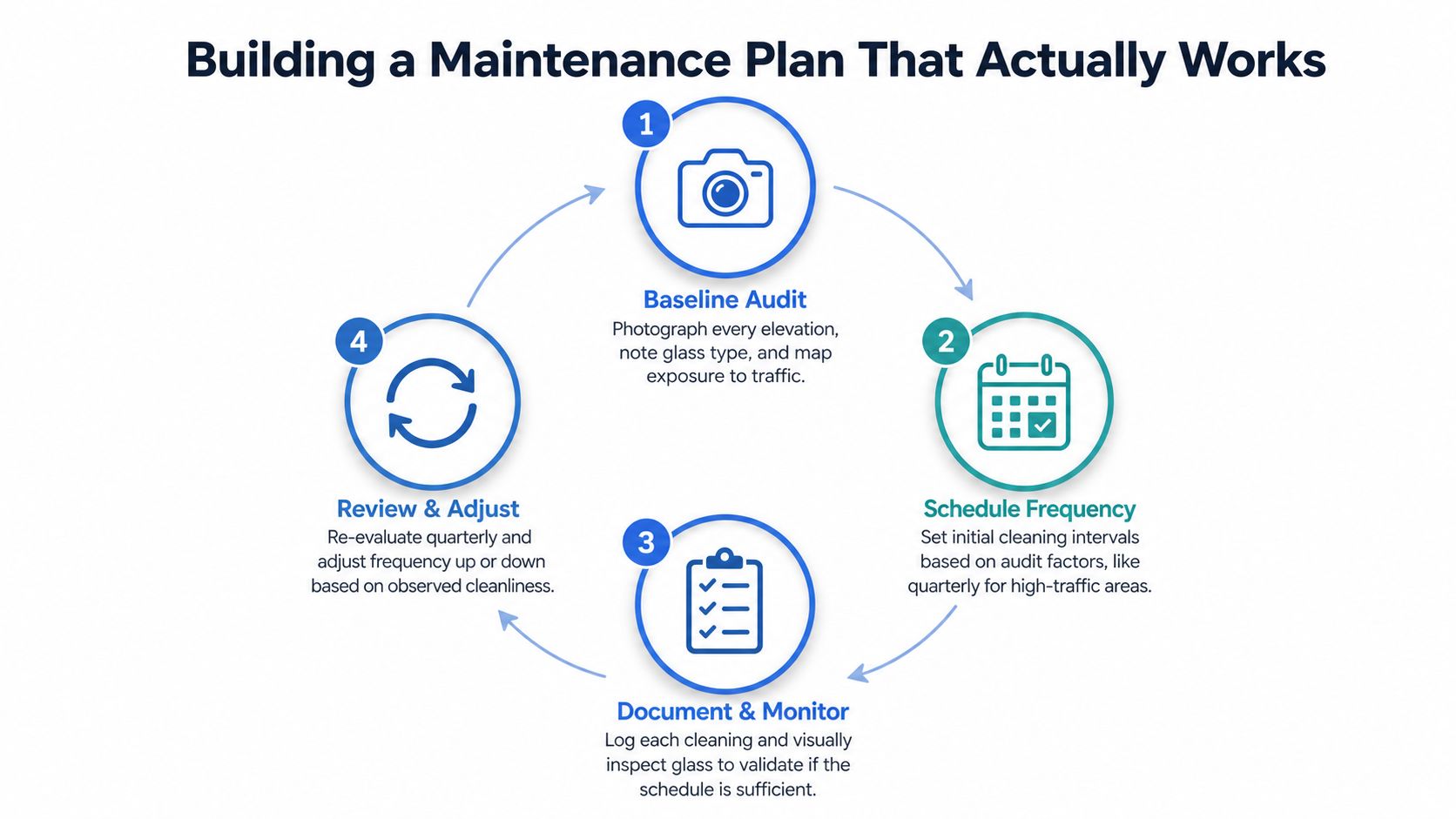
A dependable plan is a living document. It tells the crew what to clean, when to clean it, how to access it, and how the property manager will decide whether the interval still works.
Walk every elevation and divide the building into practical zones. Photograph the glass before service, note whether panes are clear, tinted, reflective, or coated, and record nearby roads, landscaping, construction, loading areas, irrigation, and pedestrian traffic.
Include the areas people notice first:
Give each zone a starting tier instead of assigning one interval to the whole property. A high-traffic entrance may need weekly or bi-weekly attention, an office façade may fit a quarterly baseline, and a warehouse exterior may need only periodic professional service. The frequency must still be validated by inspection.
This commercial window cleaning services guide can help property managers define the scope and access questions that belong in a vendor conversation.
Align window cleaning with related exterior tasks when practical, such as pressure washing, gutter clearing, façade inspections, or landscaping changes. Coordination can reduce repeated access planning and limit tenant disruption, but don't delay window work if deposits are actively damaging the glass.
Write the scope in plain language. Specify interior and exterior panes, frames, sills, tracks where applicable, entry doors, screens, water marks, access equipment, safety responsibilities, and acceptable scheduling windows. Comparable bids are impossible when one vendor prices glass only and another includes frames and sills.
Property teams that want a broader preventive maintenance record can download the PM template from Value Tools Co. Use it as a starting point, then add the window-specific fields your building needs.
The review cycle matters as much as the initial schedule. At each review, compare before-and-after photographs, note tenant feedback, inspect deposits, and ask whether the glass became unacceptable before the next visit. Increase service for zones that fail early, and reduce it only when inspection shows the longer interval is safe.
Myth one, windows only need cleaning when they look dirty. Visible streaks are a poor trigger by themselves. Mineral residue and hard-water deposits can accumulate before a casual observer notices a problem, and pollutants may remain on the surface long enough to contribute to etching. Preventive service removes the material before restoration becomes necessary.
Myth two, every pane can be cleaned the same way. Low-E, tinted, reflective, and tempered glass each require a suitable process. Harsh abrasives, aggressive scraping, or inappropriate high-alkaline solutions can damage coatings or finishes. A professional should identify the glass and inspect its condition before choosing tools and chemistry.
Myth three, rain washes windows naturally. Rain may move loose dust, but it also carries pollutants and can leave dried mineral spots. Splashback from pavement and landscaping can make lower glass worse after a storm, so a property manager should inspect rather than assume the weather completed the job.
Myth four, frequent cleaning always costs more. A sparse schedule can leave heavier deposits that require restoration, specialized treatment, or eventual glass replacement. Consistent light cleaning is often a more controlled long-term maintenance expense than waiting until ordinary washing no longer works.
Safety matters: A low bid isn't useful if the crew lacks proper façade access training, uses unsuitable agents, or skips site-specific safety planning.
Frequency is a protective investment when it matches the building's exposure. It keeps the scope manageable, protects appearance, and reduces the chance that a minor cleaning issue becomes a costly glass or access problem.
Professional Window Cleaning can assess commercial, storefront, office, and high-rise glass, then build a service schedule around exposure, access, and presentation requirements. Visit Professional Window Cleaning to discuss a practical cleaning plan for your property and the elevations that need attention first.
Read our blog posts regularly and keep learning.