
Care and Maintenance
Sliding Window Cleaning That Actually Works
Learn sliding window cleaning the right way with pro tips on tracks, sills, and glass, plus the tools, solutions, and safety habits that prevent streaks


You've cleaned the windows, but the glass still looks tired a few days later. Dust returns to the screens, mineral spots remain around the lower panes, and a gutter over the entry is beginning to spill during rain. That's the point at which window cleaning becomes window cleaning and more, a coordinated approach to the exterior surfaces and components that affect one another.
Clean glass matters, but it's only one visible part of a building. Screens, frames, sills, gutters, walkways, siding, and water runoff all influence how long that clean appearance lasts and whether small maintenance issues become expensive repairs.
A homeowner in Scottsdale once scheduled a glass-only cleaning before putting the property on the market. The panes looked bright when the crew finished, but the inspection around the windows told a different story. Several screens were torn, the lower sills held mineral residue, and a gutter above the patio had collected enough debris to send dirty water down the wall during the next storm.
Nothing had failed dramatically. That was the problem. Each issue was small enough to overlook during a quick visit, yet together they made the exterior look neglected and left vulnerable areas unaddressed.

A cracked screen lets dust, leaves, and insects enter the window opening. Dirty tracks then make the window harder to operate, while debris around the frame can obscure early signs of seal or moisture problems. Cleaning the glass without checking the screen improves the view temporarily, but it leaves the source of recurring dirt in place.
Gutters create a different chain reaction. When water backs up, it can run over fascia, siding, frames, and glass. That runoff may leave streaks or mineral deposits, especially in dry markets such as Phoenix, Scottsdale, and Las Vegas, where irrigation overspray and hard-water residue are common maintenance concerns.
Practical rule: If one exterior component repeatedly makes another component dirty, schedule the inspection and the cleaning together.
A coordinated visit also gives technicians better access to the building envelope. They can note stained sills, damaged screens, clogged gutters, pressure-washing runoff, and suspected hard-water etching while the relevant surfaces are visible. The relationship between windows and gutter cleaning is especially important because water management affects more than curb appeal.
The goal isn't to sell every service on every visit. It's to stop treating connected problems as isolated chores. Clean the glass when that's all the property needs, but bundle related work when the inspection shows that the surrounding exterior is shortening the life of the result.
Professional window cleaning uses two methods: the traditional squeegee method and the pure-water system. A qualified crew chooses between them according to glass condition, height, access, water quality, and the surrounding work included in the visit.
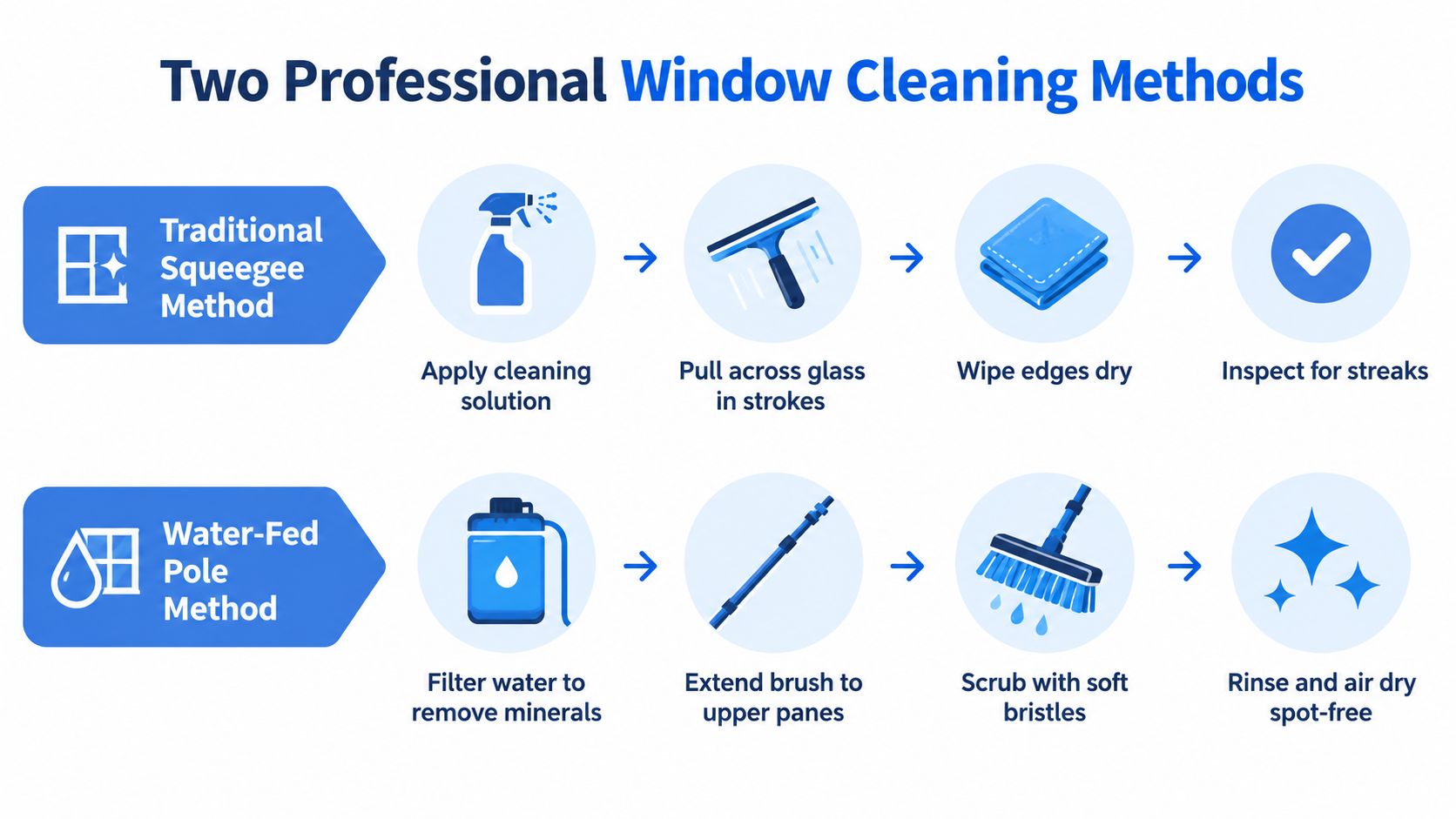
The squeegee method is hands-on and precise. The cleaner applies an appropriate solution, agitates the glass with a washer or sleeve, pulls the squeegee across the pane in controlled strokes, and details the edges with a microfiber cloth. The final inspection checks corners, frames, sills, and any remaining marks.
This method works well for interior glass, reachable exterior panes, detailed restoration work, and windows that need close visual attention. It also gives the technician direct contact with the surface, which helps identify paint, construction debris, damaged seals, or coating concerns before aggressive removal is attempted.
The limitation is access. Upper panes may require ladders, lifts, or other equipment, and the work area must be controlled carefully around occupants, vehicles, landscaping, and pedestrian routes.
A pure-water system treats water through carbon filtration, reverse osmosis, and deionization. Carbon filtration addresses chlorine and organic contaminants, reverse osmosis removes most dissolved solids, and deionization removes remaining ionic material. The resulting water is delivered through a water-fed pole, where a soft brush agitates the glass before the pane is rinsed and allowed to dry naturally, as described in this overview of pure-water treatment.
One technical source identifies water below 10 parts per million of total dissolved solids, with below 5 parts per million described as preferable for optimal results, in its explanation of water-fed pole cleaning. The method can keep technicians on the ground for many reachable elevations, though it doesn't remove every access or falling-object hazard.
The right question isn't which method sounds more modern. Ask which method fits the glass, height, soil, water quality, and added services. A squeegee may be the better choice for interior detailing and stain assessment. Pure water may be more efficient for exterior panes where safe reach and mineral-free rinsing matter.
Window cleaning earns its name from the glass, but the practical work often extends to everything that affects the glass before, during, and after the visit. The best bundle is built around cause and consequence, not a menu of unrelated add-ons.
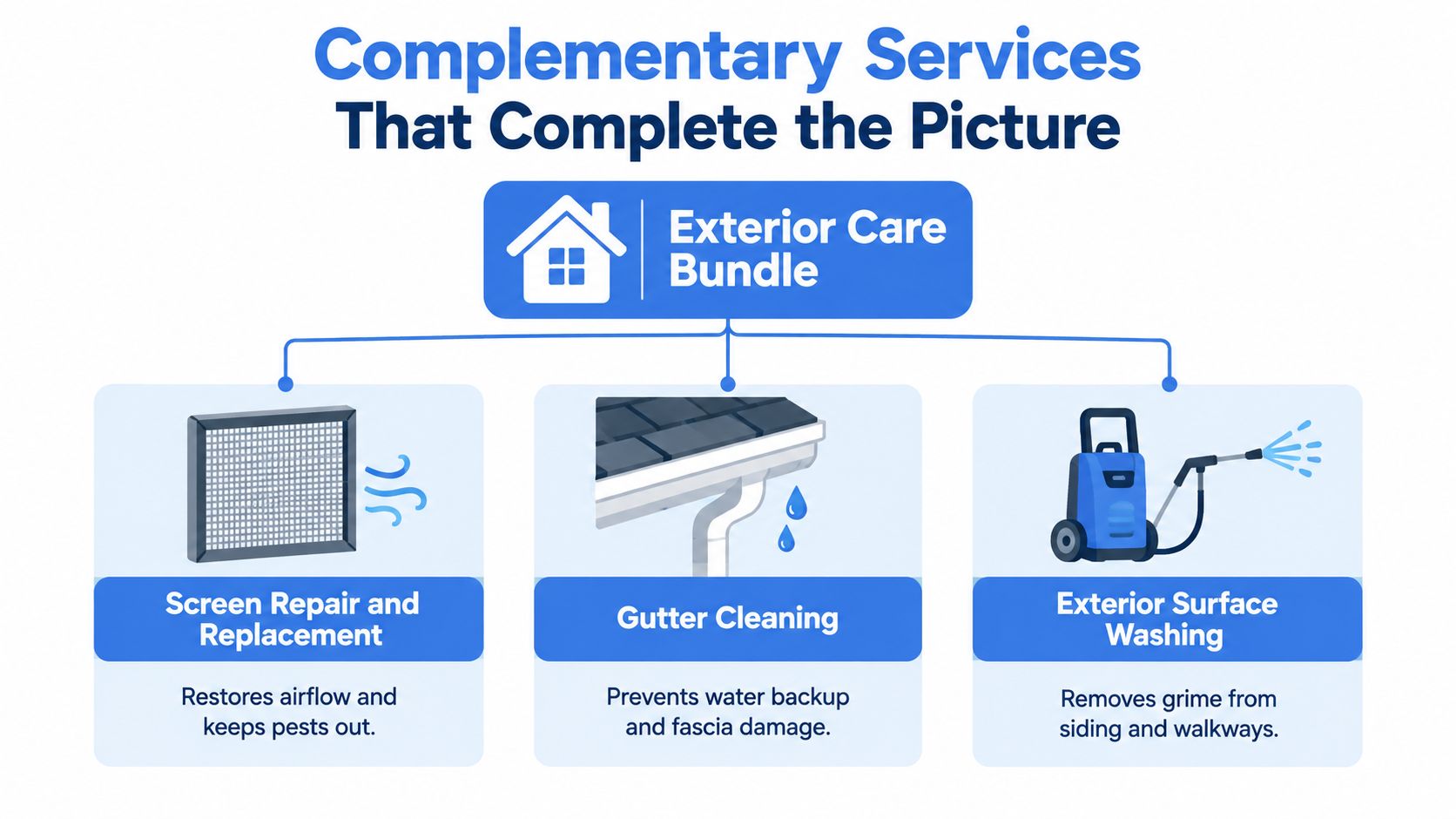
Screen repair and replacement restore airflow while keeping insects and loose debris outside the opening. A technician should inspect mesh, spline, corners, frames, and fit. Replacing a damaged screen after the glass is cleaned prevents the homeowner from reinstalling a dusty or sagging barrier that immediately undermines the finished appearance.
Gutter cleaning is exterior water management. Removing leaves, roof grit, and accumulated debris helps keep overflow away from windows, siding, fascia, and entry areas. It won't repair a wrong slope, separated joint, or damaged downspout, so the service report should distinguish debris removal from a repair recommendation.
Pressure washing can remove grime from walkways, entries, low walls, and other exterior surfaces. Sequence matters. If heavily soiled concrete is washed after the windows, runoff can splash onto clean glass and create avoidable rework. Crews should plan water flow, protect sensitive finishes, and use pressure appropriate to the material rather than assuming maximum force is better.
Hard-water stain removal is different from routine washing. Calcium and silica deposits may need specialized treatment, but aggressive chemicals, blades, or abrasive tools can damage low-emissivity coatings, tint, seals, frames, or nearby stone. The technician should identify the glass, test a small area, record the water source and dwell time, and stop if the condition appears to be etching rather than removable residue.
Property managers who want a broader exterior-maintenance perspective can also review Outdoorbrite's exterior care resources. The useful principle is simple: schedule tasks in an order that protects completed work and reduces repeated setup, access, and cleanup.
A single service makes sense when the problem is genuinely isolated. If a ground-floor office has clean gutters, intact screens, sound exterior surfaces, and only dusty glass, window cleaning alone may be the efficient choice.
A bundle earns its place when several tasks share the same access points, inspection areas, or scheduling constraints. A crew already working around a two-story home may be able to inspect screens and sills while cleaning the panes, then coordinate gutter or surface work without requiring the owner to arrange separate visits.
| Factor | Single Service Approach | Bundled Service Approach |
|---|---|---|
| Scheduling | One task is easy to book, but related work may require separate appointments. | Connected tasks can be planned around one site visit. |
| Accountability | Different vendors may disagree about whether runoff, deposits, or damage came from another service. | One coordinated scope creates clearer responsibility for the completed work. |
| Access | Ladders, lifts, drop zones, and occupant notices may be arranged repeatedly. | Shared access planning can reduce duplicated setup. |
| Inspection | The technician may focus only on the requested item. | Screens, frames, sills, gutters, and adjacent surfaces can be reviewed together. |
| Cost control | A lower initial invoice may lead to repeated mobilization or rework. | The total scope may be more efficient when tasks are physically connected. |
| Best fit | Minor, isolated maintenance needs. | Recurring buildup, multiple defects, or properties with difficult access. |
Don't accept “full exterior service” without written detail. Confirm whether the price includes interior glass, frames, sills, screens, gutter interiors, downspouts, pressure-washed surfaces, mineral treatment, and post-service inspection.
Also ask what isn't included. A clear provider will identify repair work, difficult access, damaged glass, restoration, and heavy mineral etching as separate decisions when appropriate. Bundling should reduce confusion, not hide it.
A bundle is valuable when it coordinates related work. It isn't valuable when it adds services the property doesn't need.
Windows are part of the building envelope, not just decorative openings. The U.S. Department of Energy estimates that windows account for about 10% of total building energy use and influence end uses representing approximately 40% of building energy use. Those figures establish why glazing deserves attention, but they don't mean routine glass cleaning alone creates a fixed 10% energy saving. See the Department of Energy guidance on windows for the broader building-performance context.
Cleaning contributes in a more practical way. Clear, unobstructed glass supports daylight access and lets owners, facility teams, and technicians inspect seals, frames, screens, sills, and visible damage. That inspection can reveal problems that cleaning cannot solve, including failed insulating-glass seals, damaged coatings, persistent condensation, poor shading, or deteriorated frame joints.
Window replacement economics depend on glazing properties such as U-factor, solar heat-gain coefficient, visible transmittance, shading, and orientation. A clean pane with poor solar control is still a poor solar-control pane. Conversely, a sound window with dust, residue, or obstructed glass may only need cleaning and screen or frame maintenance.
A life-cycle analysis from Argonne National Laboratory states that windows can influence about 25% of heating and cooling energy use, 10% of total building energy use, and 45% of envelope heat transfer. The same Argonne analysis of window life-cycle performance reports that high-performance residential retrofits produced net greenhouse-gas reductions over a 20-year period, with some laminated or tempered configurations reaching greenhouse-gas payback periods of 2–15 months. Those findings concern glazing and retrofit choices, not the energy effect of washing glass.
Across Arizona, Colorado, and Nevada, intense sun, dust, and temperature swings make the distinction especially important. Cleaning should be treated as a low-cost diagnostic and maintenance step before approving a capital project. A property manager who documents deposits, seal condition, shading, and recurring interior temperature complaints has a stronger basis for deciding between another cleaning, a repair, or replacement.
For commercial owners, the same logic applies to large façades, offices, dealerships, and public facilities. Practical guidance on commercial building windows and doors belongs alongside cleaning schedules, not after a failure occurs.
Price and availability are useful filters, but they aren't enough for homes, medical offices, dealerships, stadiums, condominiums, or high-rise buildings. The provider must match the work method to the property and show how the crew will protect people, glass, finishes, and surrounding assets.

A serious quote should identify pane access, interior and exterior scope, glass type, water quality, screens, mineral deposits, gutters, adjacent surfaces, and occupant or pedestrian controls. For work at height, ask for a documented hazard assessment covering drop zones, anchor or tie-off requirements, access equipment, weather, glass condition, and emergency procedures.
OSHA general-industry fall protection is commonly identified at 4 feet above a lower level when guardrails or equivalent protection are absent, although the correct control method depends on the platform, ladder, suspended system, or other equipment. The trade guidance on working at height reinforces the need to treat high-rise work as a fall-protection operation, not ordinary cleaning.
Use this checklist before approving the work:
Professional Window Cleaning states that it has operated since 1999, giving the company more than 26 years of operating history, and identifies its footprint as Arizona, Colorado, and Nevada. Its listed service locations include Flagstaff, Las Vegas, Denver, Scottsdale, Tempe, Chandler, and Gilbert, as described in its company history and service-area information.
A provider with local experience should understand that desert dust, irrigation overspray, mineral deposits, heat, and access conditions affect the work. Don't confuse local familiarity with a guarantee of quality. Verify the actual scope, method, safety documentation, and finish standard for your property.
A clean window should be the beginning of a maintenance record, not the end of a transaction. After each visit, property owners and facility teams should know what was cleaned, what was observed, what remains uncertain, and what needs a different trade.
Track the location and type of issue rather than writing only “windows cleaned.” Useful notes include:
Window condensation deserves particular attention. The Environmental Protection Agency recommends indoor relative humidity below 60%, ideally 30–50%, and advises improving ventilation, dehumidifying, and addressing leaks or cold-surface insulation gaps. The EPA guidance on biological contaminants and indoor air quality also identifies 24–48 hours as the critical drying window for water-damaged materials to help prevent mold growth. Cleaning won't correct the moisture source, but it can make the frame, sill, and adjacent finishes easier to inspect.
Cleaning alone is appropriate when the glass is dirty, the surrounding components are sound, and no recurring source of damage is present. Add screen work when mesh or fit is compromised. Add gutter service when drainage threatens walls, frames, or walkways. Escalate to repair or replacement when seals fail, frames deteriorate, coatings are damaged, or mineral deposits have etched the glass.
Commercial owners can apply the same logic to a broader roof and façade plan. A practical roofing and maintenance program guide can help place window observations inside a larger inspection cycle, where drainage, roof edges, exterior walls, and glazing are reviewed as connected assets.
The payoff is not a promise that every cleaning will prevent every repair. The payoff is better timing. Owners see defects while they're still observable, schedule related work together, and avoid paying repeatedly for the same access or cleanup.
For homeowners and facility managers in Flagstaff, Las Vegas, Denver, Scottsdale, Tempe, Chandler, and Gilbert, the next step is straightforward. Arrange an exterior assessment, request a written scope for glass and related services, and ask the provider to document anything that requires repair rather than treating every issue as a cleaning problem.
Professional Window Cleaning provides residential, commercial, and high-rise window washing, along with related exterior-care services such as screen work and hard-water stain removal. Visit Professional Window Cleaning to request a coordinated assessment for your property and turn the next cleaning into a practical maintenance plan.
Read our blog posts regularly and keep learning.