
Care and Maintenance
8 Home Window Cleaning Tips for a Clearer View
Use these home window cleaning tips for better tools, timing, seasonal care, DIY methods, and knowing when professional help makes sense.


You're staring at a south-facing window covered with dried paint flecks. A wet cloth removes the dust, but the pale specks remain, and the first tool that comes to mind is a razor scraper. That's where many otherwise careful homeowners get into trouble. A tool that removes residue quickly can also leave permanent damage if the glass, blade, or technique is wrong.
Professional window cleaning has been cleaning windows for over 26 years, and the trade uses only two professional cleaning methods: the squeegee method and the pure-water system. The word “scraper” can describe part of either approach, but a daily-use squeegee and a small razor scraper have very different jobs. Understanding that distinction is the safest way to choose equipment and avoid treating every mark as a scraping problem.
A dried paint fleck remains after washing, so the natural instinct is to reach for a blade. First identify the tool and the glass. In window cleaning, “scraper” can describe two very different instruments: the squeegee used every day and the razor scraper reserved for isolated deposits.
The squeegee has a handle, a channel, and a flexible rubber blade. A washer or T-bar spreads solution over the pane, then the squeegee removes the liquid in controlled passes. Its rubber edge carries away water and loosened soil, much like a windshield wiper. It cleans the surface without cutting into it, so it is the normal choice for dirt, fingerprints, and soap solution.
The razor scraper has a handle, blade holder, and replaceable metal blade. It removes paint flecks, sticker residue, and small construction deposits through direct contact. That contact gives it more removing power, but also more opportunity to mark glass when the wrong blade, angle, pressure, or surface is involved.
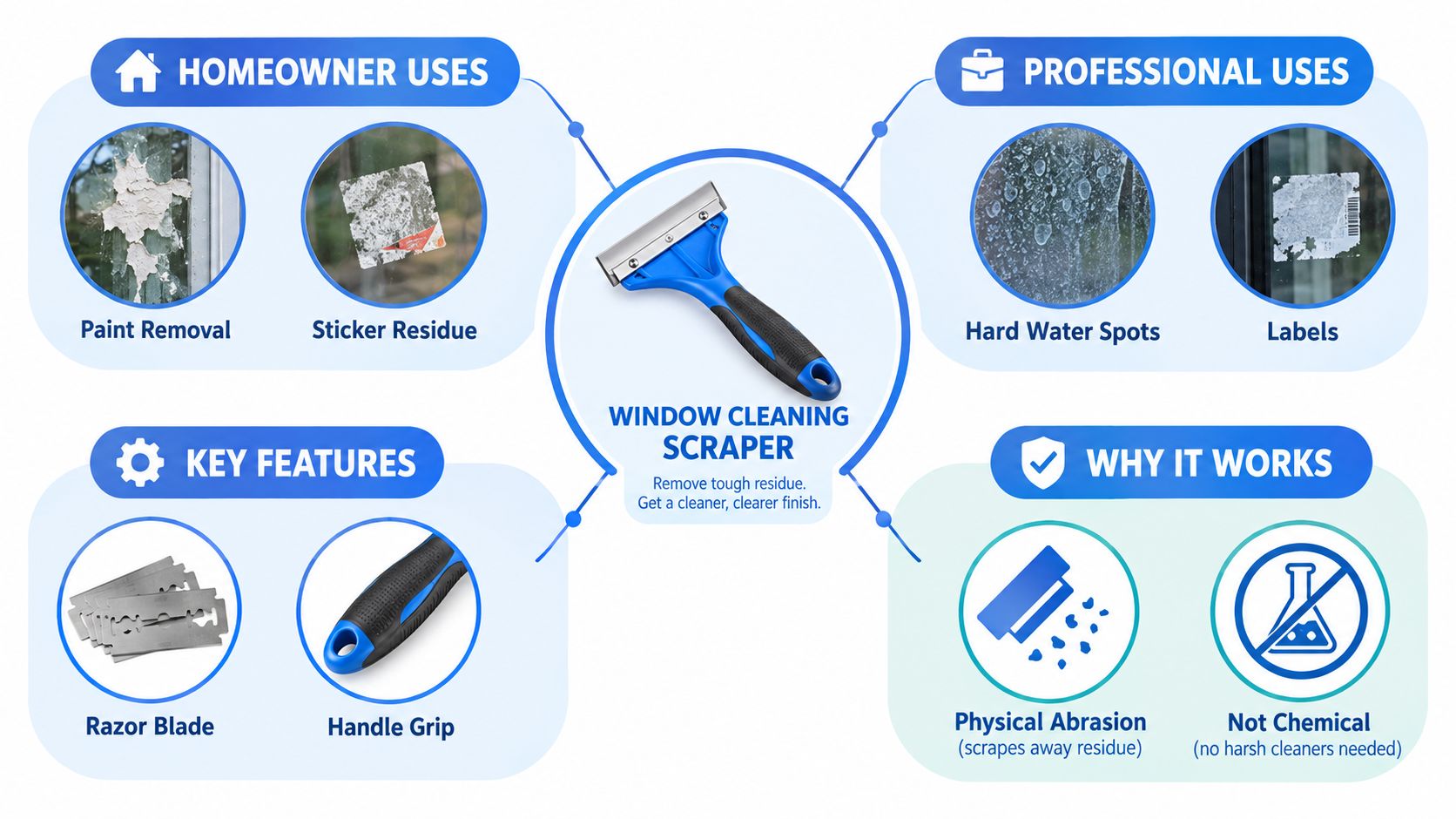
A technician normally washes and squeegees the pane first. If one spot remains, the technician identifies the glass and considers whether water or a cleaning solution can soften the deposit before using a razor.
The safe method depends on the glass type, not just on blade sharpness. A rubber edge and a metal edge are not interchangeable, especially when a deposit sits on coated or heat-treated glass. A squeegee is a routine cleaning tool. A razor scraper is a precision removal tool.
The modern scraper didn't appear as one finished invention. It developed through a long series of improvements, each addressing a practical problem faced by people cleaning glass.
Anthony L. Lewis received U.S. Patent No. 483,359 on September 27, 1892, for a window cleaner that combined a flexible water reservoir with a scraper attached to a handle. The operator could apply water and remove dirt and liquid with the same tool. That design helped move window cleaning beyond the older bucket-and-sponge routine. The patent record documents a category that has now developed through more than 130 years of design changes, as shown in the record for U.S. Patent No. 3,013,290.
A major change came in 1936, when Ettore Steccone patented the single-blade T-type squeegee known as the “New Deal.” Historical accounts describe the older Chicago Squeegee as a heavy frame with two thick rubber blades and 12 separate screws. Steccone's design reduced that cumbersome arrangement to a lighter tool centered on one continuous rubber edge.
That simple edge is still central to professional work. A good rubber blade channels water evenly across flat glass, while the handle and channel give the operator control over pressure and direction. The principle remains useful on everything from a Denver high-rise to a Phoenix home.
Innovation continued after the 1930s. A squeegee patent filed on June 18, 1920, was granted as U.S. Patent No. 1,375,682 on April 26, 1921, while later patents addressed replaceable, reversible, and push-pull blade arrangements. U.S. Patent No. 5,809,605 was filed on April 15, 1997, and granted on September 22, 1998, for a squeegee assembly used on windows, windshields, tile, floors, and other flat surfaces. Another window-cleaning squeegee patent was published on February 2, 1999, reflecting the move toward specialized, replaceable components.
The history explains why professionals care about blade condition and handling. The tool may look simple, but its performance depends on a small working edge making controlled contact with a delicate surface.
A homeowner shopping for a window cleaning scraper may see several tools that all appear capable of cleaning glass. They aren't interchangeable. Match the tool to the work, the surface, and your experience.
A hand-held squeegee combines a handle, channel, and rubber blade. It's the standard choice for interior panes, shower glass, mirrors, and accessible exterior windows after the glass has been washed. A medium channel is easier to control on residential windows than an oversized commercial channel.
A T-bar or strip washer has a sleeve rather than a rubber drying edge. You use it to apply and agitate a lubricating solution before using the squeegee. The washer helps loosen soil and keeps the glass wet, which is especially important when a professional is assessing whether a remaining spot needs isolated treatment.
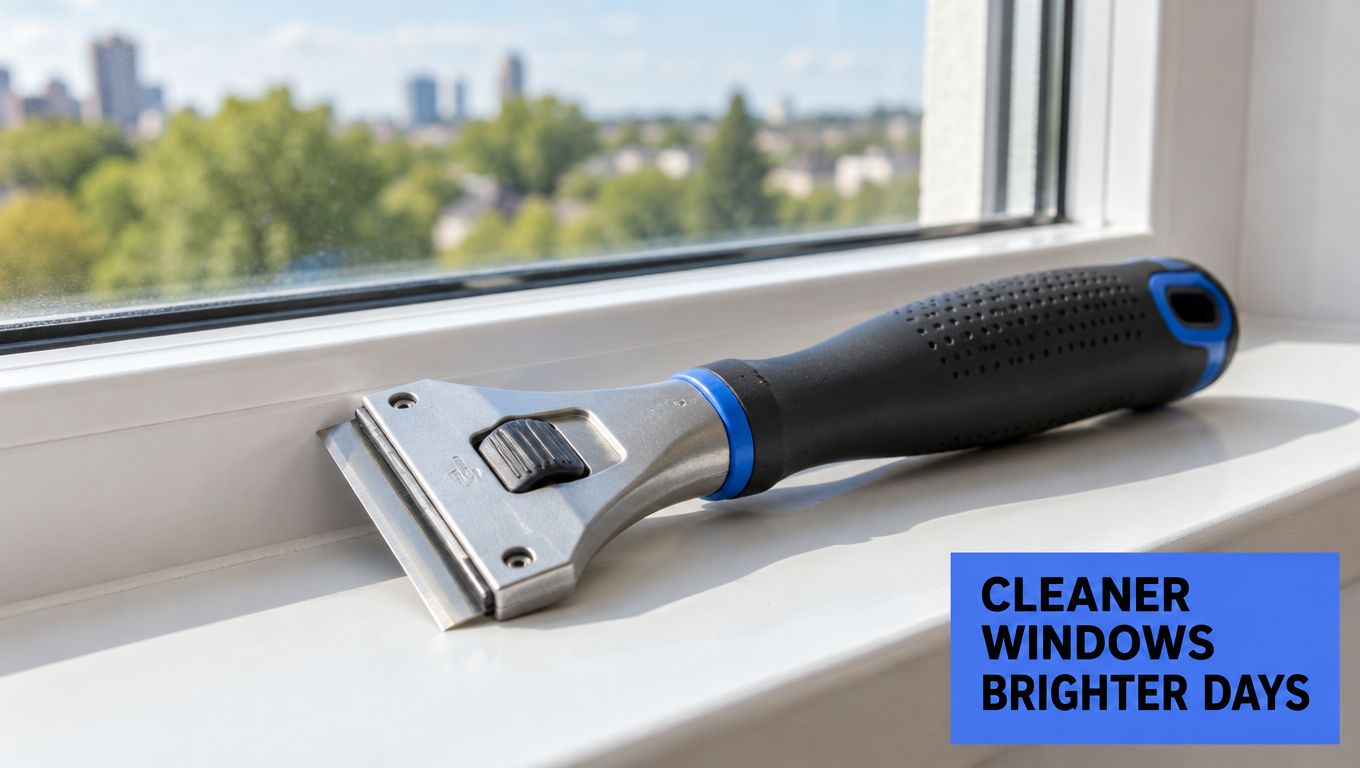
A retractable razor scraper is for spot removal, not whole-pane cleaning. Look for a secure blade holder, a guard, an ergonomic grip, and a simple replacement mechanism. A fresh blade can remove an isolated paint speck, but the same blade can scratch glass if abrasive particles sit between the edge and the surface.
A pure-water system uses a telescoping pole and a soft brush head to wash and rinse exterior glass without a conventional squeegee on the pane. Commercial teams use pole-mounted tools where reach, access, or a delicate exterior workflow makes a ground-based method practical. The brush head may be called a scraper head in some product categories, but it isn't a razor tool.
| Type | Materials | Best for | User |
|---|---|---|---|
| Hand-held squeegee | Channel, rubber, handle | Routine water removal on washed glass | Homeowner or technician |
| T-bar applicator | Sleeve, fabric, handle | Applying solution and loosening soil | Anyone cleaning multiple panes |
| Retractable razor scraper | Guard, blade holder, metal blade | Small areas of confirmed removable residue | Experienced user |
| Pure-water pole head | Telescoping pole, brush, water-fed hose | Exterior glass and hard-to-reach surfaces | Trained professional |
Price varies by construction, replacement parts, and intended workload. A homeowner who cleans a few accessible panes occasionally doesn't need the same equipment as a technician working across storefronts or high-rise properties. Pay for control, replaceable components, and safe storage before paying for decorative features.
The safest scraping technique starts before the blade touches the glass. First identify the surface. Low-emissivity coatings, tint films, laminated glass, heat-treated glass, and other manufacturer-applied treatments may be damaged by metal blades. If you can't confirm the glass type, pause and check the window documentation or ask a glass professional.
For confirmed uncoated glass, wet the area thoroughly with a lubricating detergent solution. Water alone can help, but a solution that reduces friction is more forgiving because it helps suspend loose particles. Inspect the blade under good light. A nick, rust spot, residue, or dull edge is a reason to replace it, not a reason to press harder.
Hold the scraper at approximately 30 to 45 degrees relative to the glass, using light, controlled pressure. A shallow working angle lets the leading edge lift a deposit rather than dig into the surface. Make short, parallel passes in one direction, then wipe away loosened material and inspect the area. Don't use aggressive back-and-forth strokes.
Glass rule: Never assume a sharper blade is safer. If the glass has a coating or film, the safest scraper is no scraper at all.
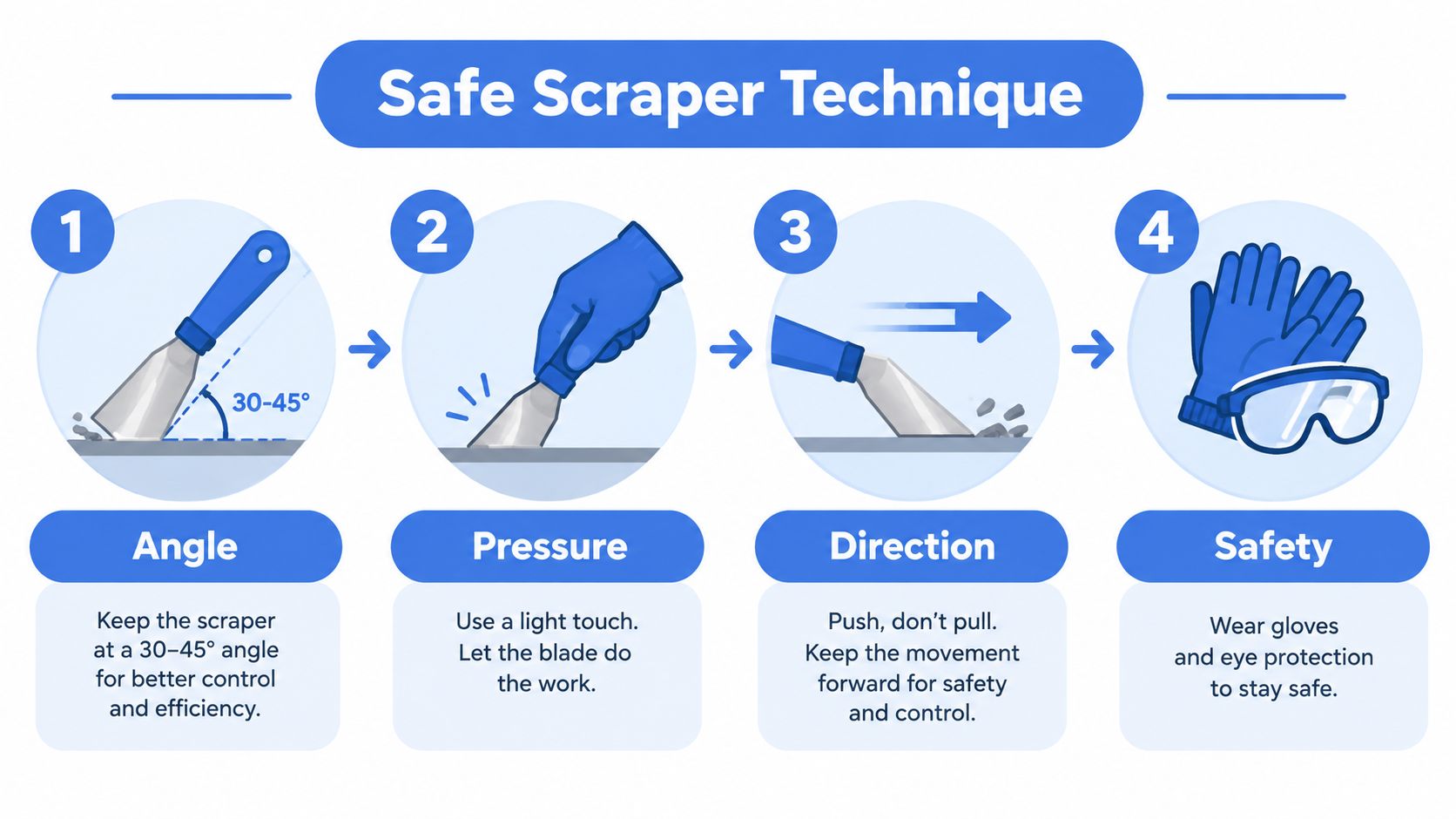
Loose grit is a serious warning sign. Microscopic particles trapped beneath the blade can drag across the pane and create scratches, even when the blade itself is new. Heat-treated and laminated glass can be particularly scratch-sensitive, and window film should not receive a metal blade.
Wear gloves and eye protection, keep the blade pointed away from your body, and cover or retract it when it isn't in use. If a manufacturer prohibits scraping, use a permitted solvent or another nonabrasive method instead. The International Window Cleaning Association's procedural bulletin provides technical guidance on wetting, blade condition, angle, and controlled movement.
A short demonstration can help you see how pressure and direction affect the edge.
Construction cleanup is where the common advice, “just wet it and scrape it,” becomes unreliable. Cement, silica, mortar, metal particles, fabrication debris, paint, and adhesive can cling to glass in different ways. Some deposits sit on top. Others act like abrasive grit that can be dragged across the pane.
Start with abundant clean water and a careful pre-wash. The purpose isn't only to loosen dirt. It's to remove loose particles before a hard edge moves across the surface. Use separate tools for the glass, seals, and frames so grit from a frame or sill doesn't transfer onto the pane. Guidance from the German flat-glass cleaning bulletin warns against using a bladed scraper over whole areas and emphasizes clean water and controlled tool separation.
Look for tiny dark specks, rough patches, drag marks, or material that remains fixed after washing. Those signs can indicate embedded or abrasive debris. Photograph existing scratches before work begins, preferably with a consistent angle and enough light to show the surface. On a remodel or commercial handover, that record can help distinguish pre-existing damage from cleanup damage.
A one-inch spot treatment is not the same job as scraping an entire pane. If you can isolate a clean, confirmed uncoated area, test an inconspicuous corner while the surface remains wet. Stop immediately if the blade catches, chatters, or leaves a line. Chemical softening may be safer for adhesive or residue when the glass supplier permits it.
Some renovation tasks involve tools beyond ordinary glass-care equipment. If you need to buy the 2 x 6 inch small, treat it as a separate material-removal tool, not as a substitute for a controlled glass scraper. For detailed razor-blade considerations, see this guidance on razor blades for cleaning.
The residue determines the risk more than the apparent sharpness of the scraper. A clean, lubricated, documented surface gives you a chance to make a sound decision. A pane covered with construction grit may need specialist assessment instead.
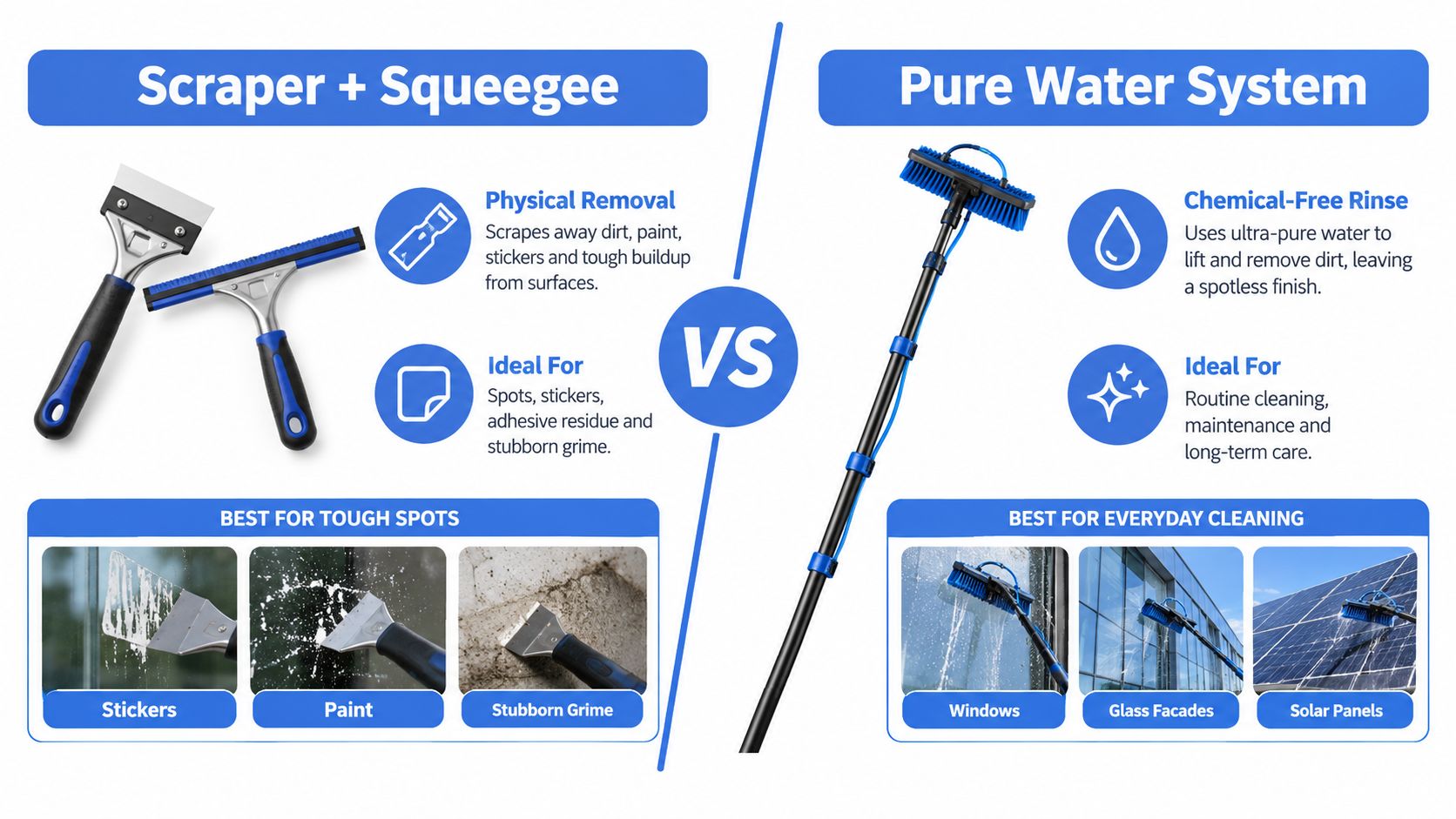
Professional window cleaners use two methods: the squeegee method and the pure-water system. The scraper belongs to the first method as a spot-removal accessory, while pure-water work generally relies on a telescoping pole, a brush head, and a controlled rinse.
The squeegee method works well for interior glass, storefronts, detailed spot work, and jobs where the technician needs close control over the pane. A washer applies solution, the technician removes soil with the rubber squeegee, and a razor scraper may address a confirmed isolated deposit. It's a hands-on process that suits reachable glass and careful restoration of specific spots.
Pure-water cleaning is different. A water-fed pole delivers purified water to a brush head, which agitates the exterior surface before the glass is rinsed. The method is useful for third-story residential windows, solar panels, and exterior areas where ladder-free access reduces the need to work from a narrow support point.
A squeegee can clean high-rise glass, but the access system determines whether the work is acceptable. OSHA requires suspension-scaffold support devices to rest on surfaces capable of supporting at least four times the scaffold load at the hoist's rated load, or at least 1.5 times the load at the hoist's stall load, whichever is greater, as described in its suspension-scaffold requirements. Two-point and multipoint suspension scaffolds must also be secured against swaying when a competent person determines stabilization is necessary.
OSHA's powered-platform factsheet requires fall protection and building stabilization for high-rise maintenance systems. With intermittent stabilization, anchors may be spaced no more than three floors or 50 feet, 15.3 meters, apart, whichever distance is less. Employers also need a written emergency plan and trained platform operators.
For a boatswain's chair, OSHA says it should be used only when windows can't be cleaned safely and practically by another means, as explained in its access-selection guidance. Suspended-scaffold work more than 10 feet, 3.1 meters, above a lower level requires guardrails, a personal fall-arrest system, or both, and suspension ropes must be inspected before each shift and after events that could affect their integrity, according to OSHA's scaffolding guidance.
In Las Vegas and Phoenix, a property may need both methods on the same visit, with pure water for accessible exterior glass and squeegee work for interiors or detailed spots. The right choice depends on the surface and access, not on which tool looks more professional.
Buy for the work you do. A homeowner cleaning accessible glass occasionally needs control and safe storage more than a large collection of specialty tools. A technician needs replacement parts, consistent handling, and equipment that works across many types of panes.
For home use, look for:
For frequent work, brass or stainless channels offer durable construction, while replaceable rubber lets the technician keep the working edge in good condition. A pole-compatible channel can help on storefronts and other exterior panes. Keep a supply of fresh blades, but don't treat blade sharpness as permission to scrape every surface.
Brand recognition matters less than fit, replacement availability, and the tool's handling. A professional in Arizona, Colorado, or Nevada may prefer a setup different from another technician because window sizes, access, and glass specifications vary. The guide to choosing a squeegee for window cleaning is useful when comparing channel design, rubber, and handle choices.
Professional Window Cleaning offers residential, commercial, and high-rise window-cleaning services, so its technicians may use different combinations of squeegees, spot tools, and pure-water equipment according to the property. For a homeowner, the useful question isn't “Which scraper is strongest?” It's “Which tool matches this glass and this deposit?”
Use these rules to decide whether a scraper belongs on the glass:
A homeowner may handle a small, clearly identified spot on confirmed uncoated glass. Stop and reassess if the pane is coated, the residue comes from construction, the window is above a safe reach, or access requires suspended equipment. A razor scraper is only one tool. A squeegee removes water and cleaning solution, while a razor targets specific deposits. Confusing those jobs can turn a cleaning mark into permanent damage.
Professional Window Cleaning has served residential, commercial, and high-rise properties for over 26 years. Its service network includes Las Vegas, Phoenix, Denver, and Scottsdale. Technicians also document pre-existing scratches before post-construction work.
For paint flecks, construction residue, coated glass, or hard-to-reach windows, Professional Window Cleaning can assess the surface and choose squeegee work, controlled spot removal, or pure-water cleaning. Visit Professional Window Cleaning to request service for a home, commercial property, or high-rise building.
Read our blog posts regularly and keep learning.