Care and Maintenance
Window Cleaner with Extension: How Far It Reaches
A window cleaner with extension reaches high glass from the ground. See both pro methods, real reach limits, and when a crew is safer.


Commercial glass cleaners are concentrated or ready-to-use formulas made to lift soil off big panes of glass without leaving haze behind. Pros get that streak-free finish by matching the right cleaner with one of only 2 methods professionals use: a squeegee or a pure-water system.
A commercial glass cleaner has two jobs to do. It loosens the grime, then helps it rinse away clean.
Think dish soap on a greasy plate, only here there can't be any film left to see.
| Cleaning product | Main purpose | What it does not do |
|---|---|---|
| Commercial glass cleaner | Loosen fingerprints, dust, grease, and everyday soil | Remove every dried mineral deposit |
| Squeegee | Carry loosened soil and liquid off the glass | Loosen soil that has not been treated |
| Pure-water system | Rinse and dry glass without adding mineral residue | Replace treatment for heavy, baked-on deposits |
In other words, the cleaner is the soap that breaks up the grease. The squeegee is what hauls it off the glass.
Spray by itself just pushes dirt around. How you remove it is what decides how much actually leaves the pane.
The bottle is only half the job. Great commercial glass cleaning comes down to the right solution, the right removal method, and careful application.
A kitchen window is easy. Spray it, wipe it, done in minutes. A commercial building is a whole different story.
Crews are dealing with doors, partitions, mirrors, storefronts, and curtain walls, all with different traffic, weather exposure, and dry times.
Ready-to-use spray is perfect for fast touch-ups in lobbies and restrooms. Concentrated formulas make more sense for large areas because they can be diluted down. WipesBlog.com glass cleaning advice explains how these products are formulated for business environments and the importance of using them correctly.
Always read the label. Follow the dilution ratios, test unfamiliar surfaces first, and keep overspray off frames, floors, and landscaping unless the product allows it. Stronger mix doesn't mean cleaner glass — too much solution can leave a film that just attracts more dust.
Most pros stick with two window cleaning methods: a squeegee or a pure-water system. A squeegee pulls the treated soil and liquid off in overlapping passes. Purified water rinses the pane and dries without the mineral spots you get from regular tap water.
That difference really shows on large exterior glass. Sun can flash-dry the solution and bake residue into streaks before you finish the pane.
For quick touch-ups, work in small sections with a clean microfiber cloth. For a full office or storefront job, treat the glass, pull the soil off, then wipe down the surrounding sills and frames with care.
Professional Window Cleaning has been cleaning windows for over 26 years, serving offices and storefronts at any window height. The company serves business properties in Las Vegas, Phoenix, Denver, and Scottsdale.

For dependable results, match the commercial glass cleaner to the soil, then pick the removal method that fits the glass and access. Schedule a professional assessment through Professional Window Cleaning before choosing a product for a large commercial property.
Commercial glass in a dealership, clinic, or office does a lot more than show off the space. It quietly tells customers what kind of business you run, whether they're walking into a showroom, sitting in a waiting room, or stepping through your front doors.
That's why commercial glass cleaners are really an operations tool, not just a cosmetic buy now and then. A storefront can pick up fingerprints in a matter of hours, interior partitions grab that fine airborne grease from kitchens, and exterior panes in dry climates will literally bake on dust and water spots.
And it's not only about looks. Cloudy glass cuts down daylight and kills the view, while dirty doors and partitions can make even a tidy workplace feel run-down. Most customers form that impression before anyone even says hello.
A household routine is simple: wipe the glass when you see a smudge. Commercial work runs on a different clock because doors, partitions, mirrors, storefronts, and curtain walls all soil at their own pace.
| Household Habit | Commercial Practice |
|---|---|
| Spray and wipe until the glass looks clear | Treat the pane, then remove solution with a squeegee or pure-water system |
| Clean only when a mark is noticed | Schedule recurring service based on traffic, exposure, and soil |
| Use one product and cloth for every surface | Match the cleaner, tools, dilution, and access method to the building |
| Leave the pane to air-dry | Control drying and remove residue before it settles |
Smart buyers look at four parts together. The product matters, sure, but so do the equipment, how you get to the glass, and how you keep people, frames, and landscaping safe while you work.
A storefront plan might focus on entry doors and showroom glass. An office plan usually goes further — partitions, mirrors, sills, frames, screens, and those hard-to-reach spots. Hot spots also shift with occupancy, weather, cooking, and HVAC airflow, so the schedule has to shift with them.
Professional Window Cleaning has spent more than 26 years doing recurring commercial window care. The plans are built around the actual building, not a one-size product, with office service customized for the property and available at any window height.
Local conditions play a big role, too. Professional Window Cleaning serves Las Vegas, Phoenix, Denver, and Scottsdale, where sun, wind, water supply, and traffic all create different cleaning challenges.
Exteriors take more than a bigger jug of solution. Crews need professional-grade squeegees and brushes, soft brushes and microfiber cloths for sills and frames, and the right treatments for hard-water stains and mineral deposits.
The real purchase is a consistent appearance, not a larger jug of solution across every pane, opening, and workday schedule.

Not all commercial glass cleaners work the same way. Some are made for fast touch-ups, others for big storefronts, and a few for those stubborn spots that just won't budge.
Picking the right one saves time, cuts down on waste, and keeps the glass looking its best.
Purpose-made glass cleaners first showed up back in the 1930s. Before that, most people just mixed up whatever they had on hand.
Those early formulas were mostly water with a tiny bit of active ingredient. That's still true today, which is why dilution still matters. Adding extra solution to the bucket doesn't make it clean better — it usually just leaves more residue behind.
Ready-to-use trigger sprays are perfect for the everyday stuff — entry doors, office partitions, mirrors, and anywhere hands leave marks.
Grab the bottle, wipe a small area, and you're done. No measuring, no mixing.
They handle fingerprints, dust, light grease, and normal indoor buildup really well. Where they fall short is baked-on mineral scale. A quick mist will often just smear that around instead of dissolving it.
Think of a trigger spray as a touch-up tool, not a fix for every kind of window soil.
For storefronts, curtain walls, and other big expanses of glass, concentrated commercial glass cleaners make a lot more sense. You dilute them with water before use, so you're not hauling around a case of spray bottles.
Key reasons crews like them:
There is one catch. Mix it too strong and it can leave a hazy film that actually attracts dust. Always follow the dilution on the label — “stronger” is rarely better.
Some spots laugh at regular glass cleaner. We're talking about hard-water rings around sprinkler heads, faucet splash zones, exterior edges, and any pane that gets hit with hard water over and over.
That's where hard-water stain removers and mineral-deposit treatments come in.
These need a little more patience:
Here's the simple rule pros follow: let the soil dictate the product, and let the tool do the removal. For commercial windows, that usually means only a squeegee or a pure-water system. Household sprays and brushes just aren't reliable on high glass, where proper tools and controlled access really count.
It breaks down like this:
Match product strength to the soil, not to the size of the container.
In occupied clinics and offices, it matters even more to choose products that are effective, safe, and environmentally friendly. Professional Window Cleaning brings more than 26 years of hands-on experience and can look at your glass, building access, and cleaning schedule before recommending the right solution.
Professionals really only rely on two methods: a squeegee or a pure-water system. The cleaner does the loosening, the method does the removing — before anything has a chance to dry into streaks.

It starts with getting the pane good and wet. A pro applies commercial glass cleaner with a washer or brush, then works it around so the soil actually lets go of the glass.
Then the squeegee takes over. The blade moves down in overlapping strokes, pulling solution and dirt off with it instead of letting it dry in place.
Removing the film matters. Squeegeeing a shower door takes the water film off, while wiping it with a towel mostly just pushes that film around.
That comparison explains a lot about streaks. More spray and harder wiping won’t fix it. A squeegee removes the moisture in a controlled path, and each pass overlaps the last just enough so no bands get missed.
Pro-grade squeegees and brushes help crews get that same clean finish from window to window. It’s steady technique and the right tools, not a heavier mix of solution.
A pure-water system is water that’s been filtered to strip out dissolved minerals. When that purified water dries, there’s nothing left behind to turn into visible spots.
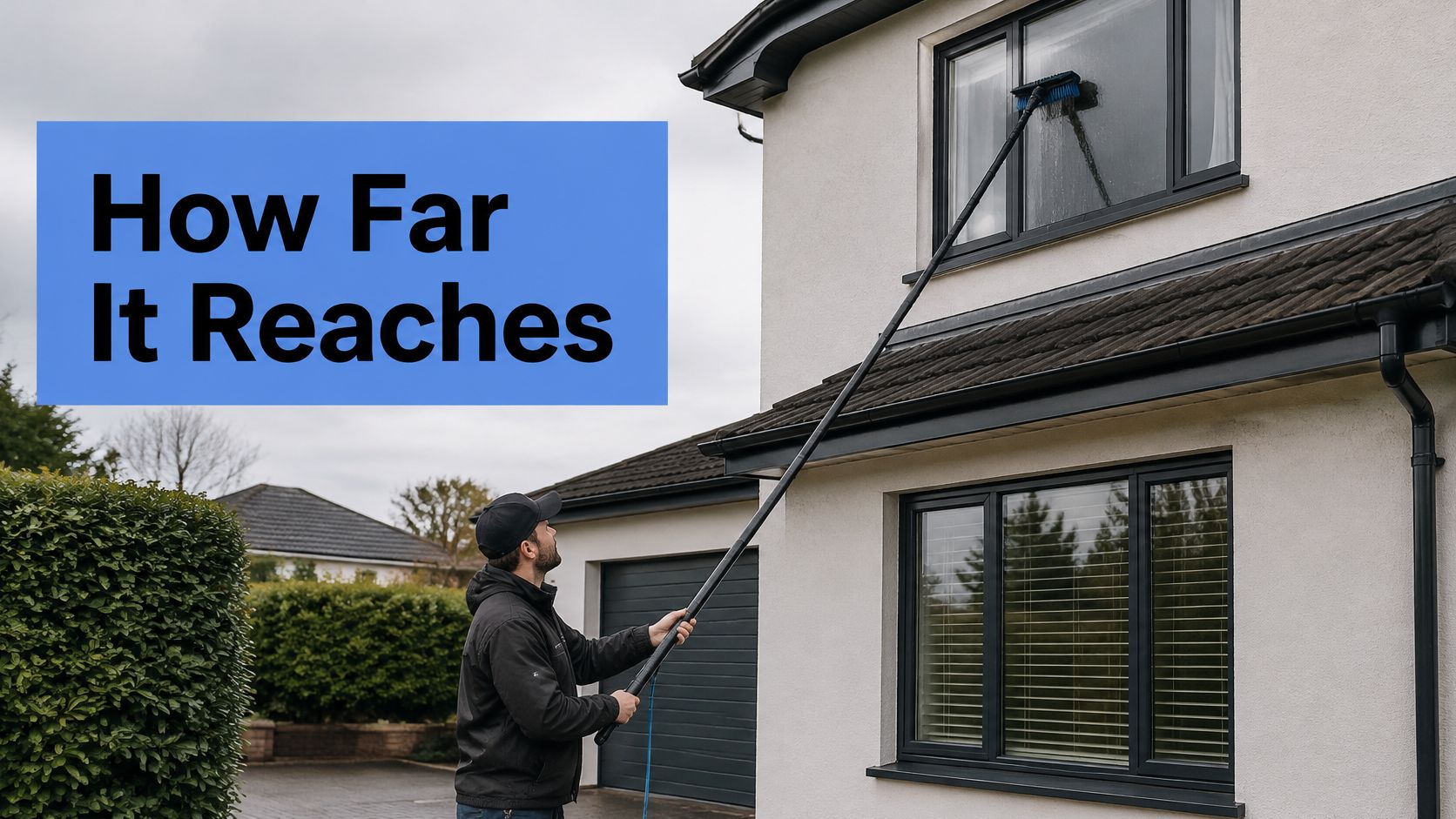
This is a lifesaver on high or awkward panes because crews can reach them with extension poles. It also means less solution ends up on nearby frames, doors, and landscaping.
That said, filtered water won’t magically cut through everything. Light rain dust and everyday grime rinse off fine, but heavy buildup still needs treatment and some agitation first.
The right call comes down to access, glass condition, and nearby surfaces. It’s not about preference, and spraying on extra product is never the answer.
| Access Or Condition | Better Fit | Main Reason |
|---|---|---|
| Ground-level glass with light soil | Squeegee | Controlled removal of cleaner and dirt |
| High exterior panes | Pure-water system | Pole access and mineral-free drying |
| Heavy buildup | Squeegee | Brushing agitates soil before removal |
| Glass beside paint or metal | Pure-water system | Less solution reaches surrounding surfaces |
Glass gets the squeegee or filtered-water treatment, while frames and sills get soft brushes and microfiber cloths. Keeping them separate protects painted surfaces, metal finishes, screens, and nearby landscaping from unnecessary wear.
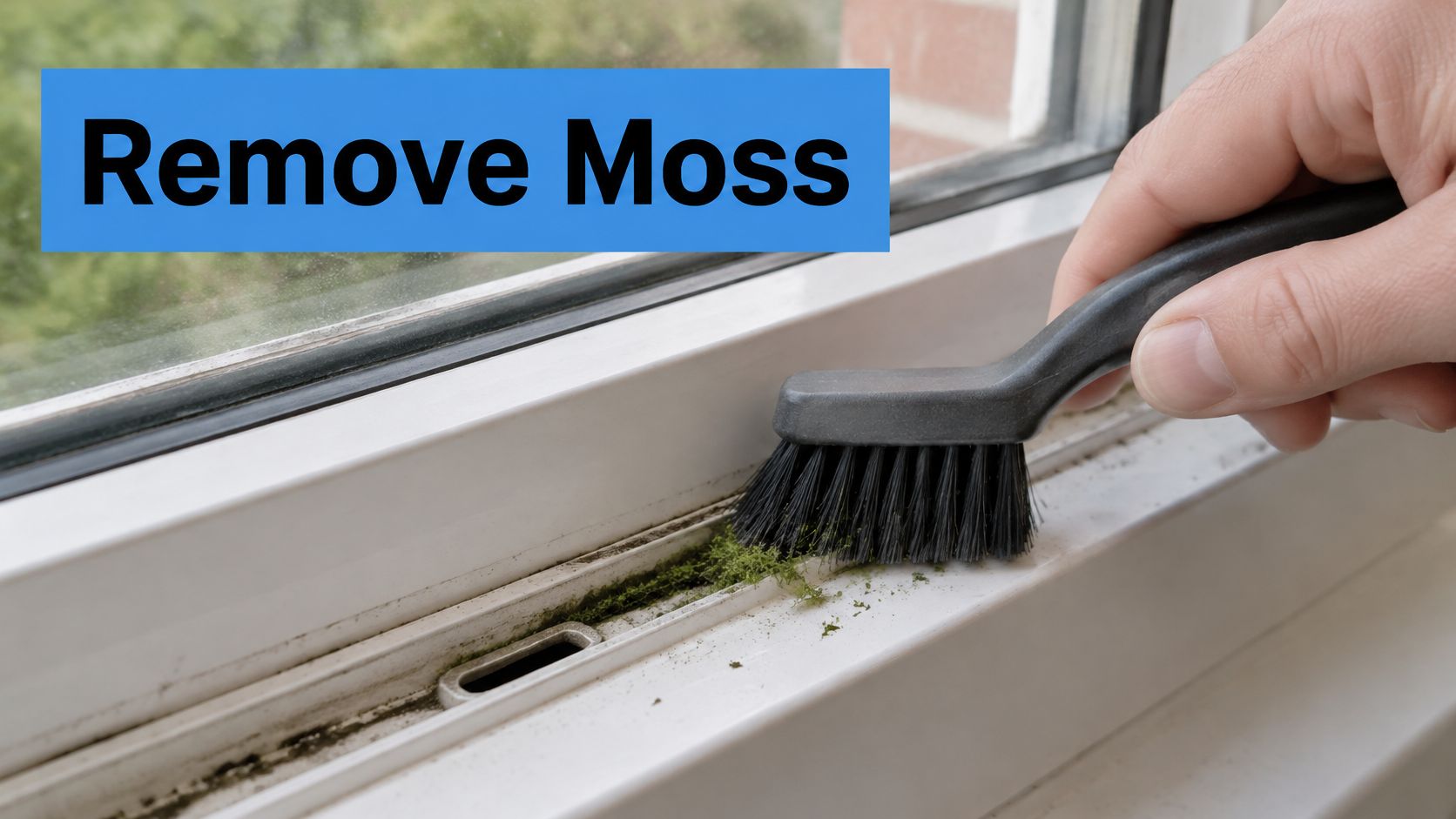
For instance, a soft brush can lift dust out of a narrow frame without dragging grit across the glass. A microfiber cloth can then pick up leftover moisture and loose residue without scratching the finish.
Professional Window Cleaning uses that careful pairing on all of its commercial window work. Learn more about the best way to clean commercial windows for a fuller look at prep and results.
Choose the method for the pane, then use the gentlest effective tool on everything around it.
Schedule a professional assessment for your commercial glass so the right removal method, equipment, and frame care are matched to your building’s access and condition.

No two commercial buildings soil glass the same way. What works for a showroom door can cause real problems in a clinic, a stadium suite, a vaulted lobby, or a condo tower.
Access, foot traffic, and daily operations shape every choice.
A car dealership showroom lives with fingerprints, dust, and road film. A diluted commercial cleaner with a squeegee usually does the job, as long as crews shield vehicles, trim, and display floors from overspray.
A medical office waiting area is a different story. Patients and staff stay close by, so the product needs to be environmentally friendly, effective, and safe. Most pros spray the cloth instead of the glass and work quietly around normal traffic.
At the stadium suite level, you are dealing with grease, food residue, and dust on doors, mirrors, and balcony glass. Soft brushes, microfiber cloths, and careful squeegee passes clean the corners without harming finishes.
| Property Type | Soil Challenge | Recommended Method | Attention Points |
|---|---|---|---|
| Dealership showroom | Fingerprints, dust, road film | Diluted cleaner and squeegee | Vehicles, trim, floors |
| Medical office | Handprints, airborne grease | Safe ready-to-use product and microfiber cloth | Patients, staff, waiting areas |
| Stadium suite | Grease, dust, food residue | Agitation followed by squeegee | Finishes, corners, occupied schedule |
| Vaulted lobby | Dust, rain spots, hard-water marks | Concentrate or mineral treatment with squeegee | Sills, frames, landscaping |
| High-rise condominium | Weather exposure, mineral deposits | Pure-water system or squeegee | Access, occupants, landscaping |
A vaulted lobby shows everything. Every streak and missed corner stands out under that light. Concentrated cleaner helps cover the big panes, but hard-water stains and mineral deposits should be treated on their own before the squeegee comes out.
For a high-rise condominium tower, access sets the plan. A pure-water system with extension poles can reach upper glass, while a squeegee still makes sense for heavier buildup where techs can get close to the surface.
The right plan follows the building, not the property next door. Office cleaning covers all glass surfaces, including hard-to-reach areas, screens, tracks, sills, frames, and specialized mineral treatments.
One shower can dirty a clean pane again when tracks, corners, and sills are loaded with residue. Soft brushes and microfiber cloths lift that buildup without scratching glass or scuffing the surrounding finishes.
Landscaping deserves the same care. Keep solution off plants, and never drag dirty frames across the glass. For elevated work, review our high-rise window cleaning guide before you schedule.
A building-specific plan beats a copied checklist because occupancy, weather, access, soil, and finishes change from site to site.
Professional Window Cleaning has completed commercial glass work for more than 26 years. Contact the team to request a building-specific assessment for your storefront, office, dealership, clinic, stadium suite, lobby, or condominium tower.
If the glass looks streaky, it is almost never the bottle's fault. Nine times out of ten, it comes down to how it was cleaned.
The biggest culprit is sun. Hit a hot pane in direct light and the solution flashes dry before you can wipe it off. Work in shade or during the cooler part of the day instead. That gives the cleaner time to loosen the dirt and gives you time to pull it away clean.
Using too much Commercial Glass Cleaners causes trouble too. Heavy spray leaves behind a light, tacky film. That film grabs dust fast, so the window looks dull again a day later. Stick to the dilution on the label, mist your cloth rather than the wall around it, and fight the urge to add extra soap when a spot won't budge.
A streak points to technique, a spot points to minerals. Regular glass cleaner will just smear baked-on scale around because it was never made to dissolve it.
Paper towels belong in the trash here, not on glass. They shed lint, drag grit across the surface, and can leave fine scratches over time. Clean microfiber cloths are a far better bet, along with the right pro tools for the job — including soft brushes for frames and sills.
Wiping just the center of the pane leaves the job half done. Frames, tracks, and sills hold a surprising amount of dirt.
Skip them and the next rain will wash all that grime right back down over your clean glass. A proper service cleans the whole window, not just the part you look through.
How often you need it really depends on the building. A busy storefront on a main road might need attention every week, while a sheltered home can go much longer between visits. Foot traffic, weather, and exposure all play a role. Inside offices often get cleaned during business hours, while outside work has to be timed around wind and heat.
Pros really only rely on two approaches, a squeegee or a pure-water system. More spray is never the fix. What matters is removing the solution completely, not leaving more of it behind.
Before each visit, it helps to run through a quick check:
Professional Window Cleaning has been handling windows for over 26 years, with commercial glass care for offices and storefronts. Request a building-specific assessment through Professional Window Cleaning before you schedule service.
For a small, low window with just light dust, a store-bottle spray can get you by. But once you're dealing with tall glass, heavy fingerprints, or months of buildup, it just doesn't cut it.
Pros almost never rely on spray-and-wipe alone. We use a squeegee or a pure-water system instead, because spraying leaves dirt and a hazy film behind.
There’s no one-size schedule that works for everyone. A busy office might need weekly interior touch-ups, while a quieter space can easily go longer between visits.
Storefronts are a different story. Dust, fingerprints, and rain spots show up fast, and dealerships usually need service more often than a standard office. In dry, sunny areas, mineral buildup happens even quicker, so traffic, exposure, climate, and curb appeal should drive the schedule.
Yes — when they're matched to the job and mixed at the label dilution, they clean just as well.
In busy medical offices and workplaces, effective, safe, and environmentally friendly products mean less exposure and less overspray for everyone inside. Good crews also protect floors and finishes, never spray around people, and finish with a squeegee or pure-water rinse so there’s no residue left behind.
Start with access: how will they reach every pane, and what height capability and safety procedures do they follow? Then ask if screens, frames, tracks, and sills are included in the price.
Also confirm they handle hard-water and mineral-deposit treatments, how they work around occupied areas, and exactly which glass surfaces are covered. Getting those details upfront saves a lot of headaches after you sign.
Professional Window Cleaning has served Las Vegas, Phoenix, Denver, and Scottsdale for over 26 years.
Request a commercial window cleaning assessment from Professional Window Cleaning through Professional Window Cleaning.
Read our blog posts regularly and keep learning.