Care and Maintenance
How to Clean Low E Glass Without Scratches or Streaks
Learn how to clean low e glass safely with mild detergent and soft lint-free cloths. Protect the coating from scratches and streaks with these simple steps.


The glass looks fine until about four in the afternoon, when the sun drops low enough to hit the patio door straight on. Then the film appears, three long horizontal streaks near the handle, and a grey line of grit parked in the bottom track where the panel rolls.
Sliding doors don't fail all at once. The track collects grit, the glass picks up a mineral film, and the rollers start to complain, in that order. It's tempting to attack the glass first because it's the part you can see, but that can drag sand across the pane with a paper towel.
Learning how to clean sliding glass doors properly means treating three separate systems: the glass, the frame and sill, and the track and roller assembly. Each one wants a different method. Here's the order that works, starting with the setup most guides skip.
The setup takes longer than people expect, and it decides whether the job goes well or turns into a repair bill.
A ground-floor door you can reach while standing on stable flooring is a routine household task. A balcony door, an upper-floor slider, or a high-rise condominium pane is a different job with a different risk profile. A HealthDay summary of an OSHA analysis reported 88 window-cleaning accidents over a 15-year period, including 62 fatalities, which is roughly 70.5% of the recorded incidents. Ladder mishaps were a leading accident category. The report's own recommendations are practical: secure the ladder, fit levelers or stabilizers, check the combined weight of worker and equipment against the ladder's rated capacity, and work with a second person whenever possible.
Those numbers don't make ground-level door cleaning dangerous. They show why high-placed glass shouldn't be treated like a household chore. If your door opens onto a drop, plan fixed access or bring in a trained crew.
Cleaning lifts dust into the air before it removes it. The EPA's guidance on biological contaminants and indoor air quality notes that cleaning activities can resuspend particles and recommends that sensitive people avoid exposure during vacuuming or have someone else do it. So close the interior doors to the rest of the house, vacuum the track before any wet cloth touches it, use a damp cloth rather than a dripping one, and keep children and anyone with asthma out of the room until surfaces are dry.
Practical rule: If the sill is still wet after a run of dry weather, you have a water problem, not a cleaning problem.
Cleaning won't fix a failed seal, a blocked weep opening, or a roof leak running down the frame. Find the source first, or the stain will be back within the month. The EPA also puts healthy indoor humidity around 30% to 50%, which is worth knowing if the same door fogs up every winter.
Rain hits the door, dries, and leaves a map of every mineral in the local water supply. You wipe it, it smears, and the streaks seem to relocate rather than disappear.
The kit is short: a squeegee with a clean, un-nicked blade, two microfiber cloths, a soft nylon brush, a vacuum with a brush attachment, and a mild non-abrasive cleaner.
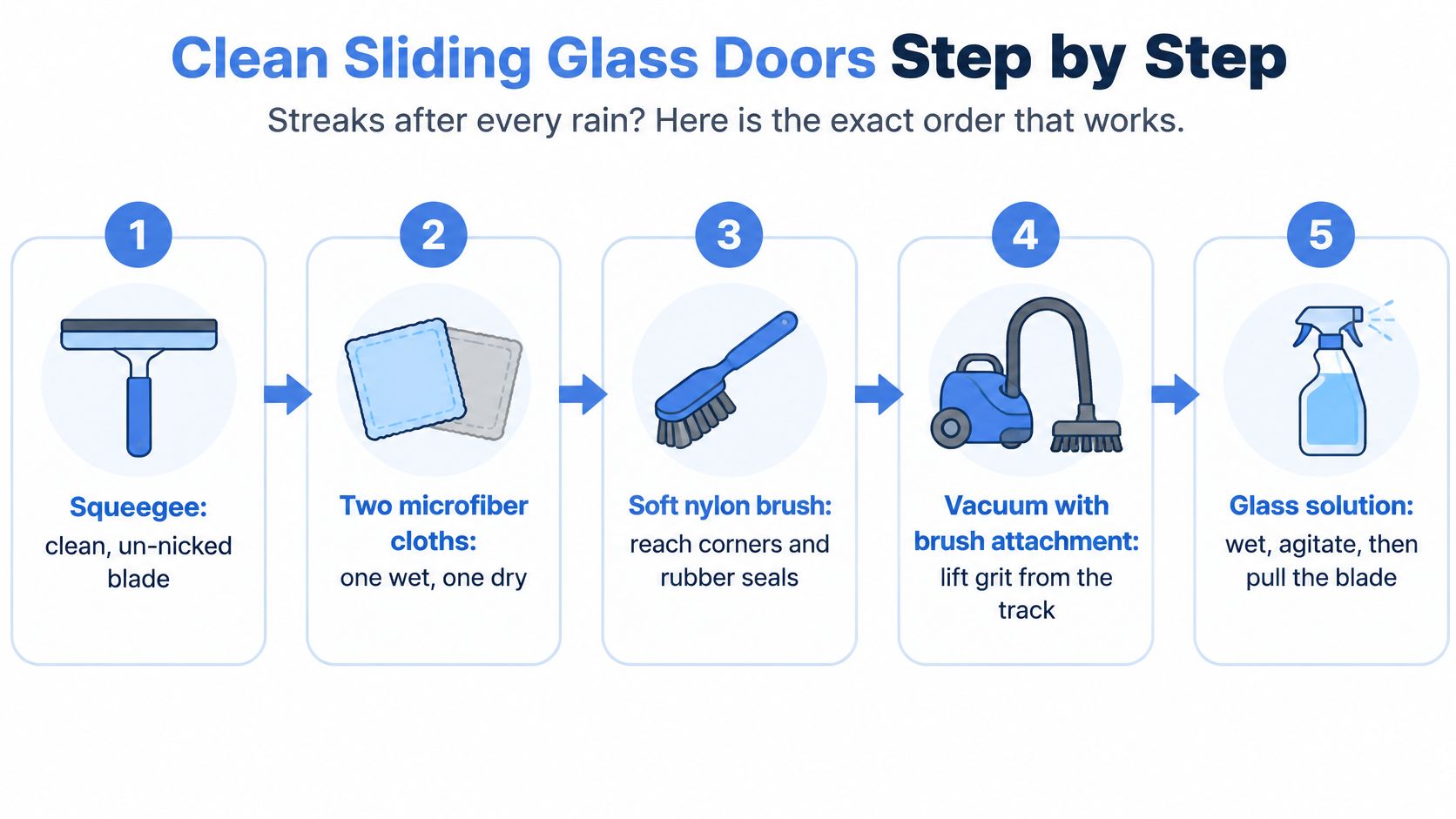
Razor blades and metal scrapers shouldn't be standard equipment for this job. The Glass Association of North America's 2023 guidance on cleaning architectural glass warns against routine contact between metal tools and glass, and one drag of grit trapped under a blade can gouge a pane permanently. Abrasive pads, strong acids and aggressive alkaline cleaners stay off coated or treated glass unless the manufacturer approves them.
That same GANA guidance caps wash and rinse water at no more than 20 parts per million of total dissolved solids to minimize spotting and streaking. Ordinary tap water can exceed that depending on your location, which is why a final rinse with filtered or distilled water makes such a visible difference on a sunny façade.
Once the pane is dry, look at it from inside and from outside under low, oblique daylight or a portable inspection light. Horizontal wiping trails, runs at the edge and leftover mineral spotting show up at that angle and nowhere else. Ignore claims that a method leaves glass "99% clean." There's no accepted success-rate benchmark behind that number.
| Door part | Safe cleaner or method | Avoid |
|---|---|---|
| Standard glass | Mild non-abrasive cleaner in clean water, squeegee immediately | Abrasive pads, razor blades, metal scrapers |
| Coated or treated glass | Test a small hidden area first, then a manufacturer-approved cleaner | Razor blades, strong acids, aggressive alkaline cleaners |
| Aluminum frame and sill | Mild detergent on a separate microfiber cloth | Abrasive pads, mineral acids, scraping the anodized finish |
| Vinyl frame | Mild soap solution and a soft cloth | Solvent cleaners, abrasive pads, sharp scrapers |
| Fuzzy pile weatherstripping | Vacuum, then wipe with a damp cloth | Silicone lubricant, petroleum-based products |
| Wash and rinse water | Water at or below 20 ppm total dissolved solids | Hard tap water left to dry on the pane |
Slide the door before you clean anything. That one test tells you whether you're doing maintenance or chasing a mechanical fault.

Push the panel through its full travel and listen. A door that grinds, scrapes or needs a shoulder behind it has grit in the channel, dry or worn rollers, or a carrier out of alignment. Cleaning is worth trying first. Forcing a stiff panel is how tracks get bent.
Track work is mechanical maintenance, not a cosmetic wipe-down. Specifications for sliding entrance hardware describe carrier systems running on ball-bearing wheels over nylon or Delrin-covered track components, and they call for smooth operation with manufacturer-approved lubrication and adjustment (University of Houston sliding automatic entrance specifications).
The failure mode is flooding the channel. Water carries grit straight toward the roller assemblies, and it can stay trapped beneath the threshold, where corrosion starts. Spraying cleaner directly into the track is the same mistake with extra steps.
The small openings at the bottom of the frame let water out. Check them with a soft brush or a thin plastic pipe cleaner and clear the debris. Sharp tools and high-pressure water are the wrong answer here. A Milgard care and maintenance guide for moving glass wall systems recommends removing loose debris with a vacuum or soft cloth, checking and cleaning the drainage systems, and using dry silicone lubricant on compatible tracks and hardware. It also warns against silicone on fuzzy pile weatherstripping, abrasive pads, acidic or caustic cleaners, petroleum-based chemicals and high-pressure spraying, which can push water past the seals.
My rule of thumb: lubricate last, and only with dry silicone, on a track that's already bone dry. Oily household lubricants collect dust and turn into grinding paste within weeks.
If the channel needs more detail work than this, our guide to how to clean window tracks covers the corners and weep openings in depth.
If resistance survives debris removal, a full dry-out and correct lubrication, stop. Misaligned carriers, worn rollers, damaged guides or a bent track need parts, not more chemical. On most models the panel has to come out to reach the rollers, and that isn't a homeowner job.
| Symptom | Likely cause | Fix |
|---|---|---|
| Door sticks or jerks when moved | Grit in the track or dry rollers | Vacuum and brush the track, dry it, then lubricate only if the manufacturer allows |
| Water pools at the sill | Blocked weep openings | Clear drainage openings with a soft brush or thin plastic pipe cleaner |
| Door rattles or wobbles | Misaligned or worn rollers | Stop forcing it and call a repair technician |
| Haze or spots after drying | Hard water residue | Rinse with low-mineral water and dry the pane immediately |
| Fuzzy weatherstripping looks dirty | Debris trapped in the pile | Vacuum gently and avoid silicone |
The parts people skip are the ones that undo the work. A screen packed with dust dumps it back into the channel every time the door moves.
Check the manufacturer's instructions before you lift a screen out. If removal is approved, wash the mesh with mild soapy water and a soft brush, rinse it, and let it dry completely before it goes back in. A wet screen drips into the freshly dried track and you're back where you started.
Clean the interior glass with the same wet-then-squeegee sequence. Lay a towel along the sill first, move anything breakable off the floor, and keep solution out of the track. Work the top down so drips land on glass you haven't cleaned yet rather than on a finished pane.
A door that lives in a sandy, windy spot needs its track serviced several times a year. A door under a deep eave may need it twice. Watch the door, not the calendar.
Professional window cleaning comes down to two methods: the squeegee and the pure-water system. Everything else is a variation on one of them.
This is the sequence from the step-by-step section, done at speed. The glass gets wet with cleaning solution, the surface is agitated, and the liquid comes off in overlapping blade passes, followed by edge detailing. The squeegee method and the pure-water system, as described in Professional Window Cleaning's service overview, are the two systems the trade uses. The squeegee wins on interior glass and reachable exterior panes because the operator controls how much solution goes on and collects the runoff instead of letting it drip.
Here, minerals come out of the water before it ever reaches the glass. IPC's window cleaning training material describes the process as reverse osmosis followed by de-ionization, producing mineral-free water that's delivered through a telescopic water-fed pole to a brush head. The brush scrubs the pane, frame and sill while the purified rinse carries the loosened dirt away. Because the rinse carries almost no dissolved mineral content, evaporation leaves far fewer spots, and the pane air-dries without detergent residue.
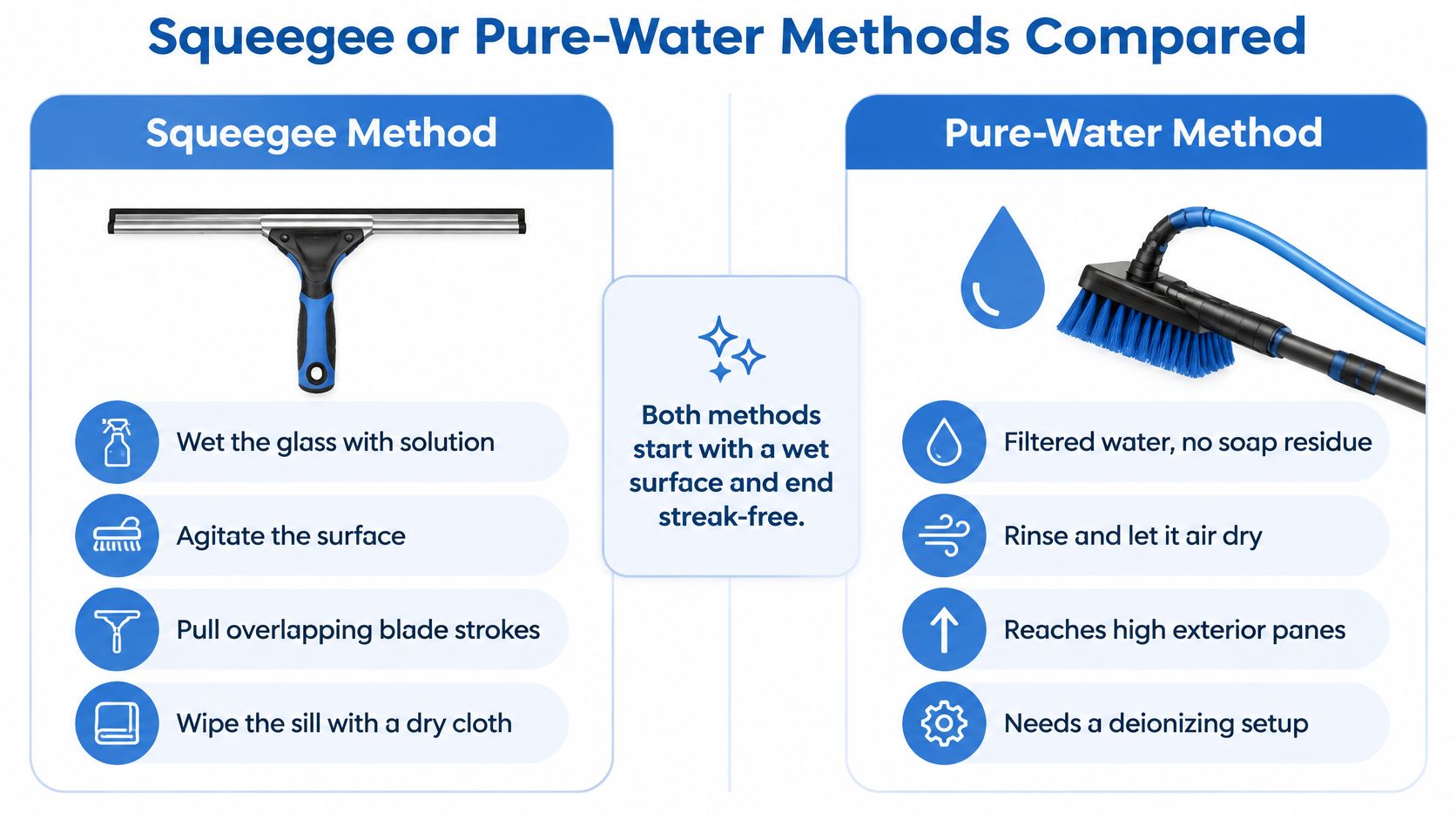
The pure-water setup lets an operator clean upper-level and exterior glass from the ground, which removes the ladder risk entirely. It's a poor fit for interior doors, where rinse water drips into the room. Match it this way: interior glass and any exterior pane you can reach safely suit the squeegee, and a high exterior pane reached from the ground suits pure water.
A homeowner can copy the squeegee technique with a $20 blade and a couple of cloths. Pure water needs a filtration rig, a pole and a brush, which is why it stays in professional hands.
The choice depends on access, condition and how many doors need attention. Angi reported in 2025 that DIY sliding-glass-door cleaning typically takes about 3 hours and costs $25 to $50 per job. Fixr reported in 2025 puts professional cleaning at approximately $3 to $8 per sliding glass door.
For one ground-floor door, a few hours and the cost of supplies may be a reasonable trade. The calculation changes with multiple doors, stubborn mineral stains or balcony access. If a panel binds, cleaning may not fix the problem: check the dry track and rollers, and don't force the door.
| Option | Typical time | Typical cost | Best fit |
|---|---|---|---|
| DIY cleaning with household tools | About 3 hours | $25–$50 per job (Angi, 2025) | Ground-floor doors you can reach safely |
| Professional cleaning | Depends on door count and access | About $3–$8 per door (Fixr, 2025) | Elevated, high-rise or hard-to-reach doors and binding tracks |
For a closer look at the trade-offs, read whether professional window cleaning is worth it.
Professional Window Cleaning offers residential, commercial and high-rise window cleaning in Arizona, Colorado and Nevada. Its process includes inspecting and assessing the sills and frames before cleaning, then applying protective treatments to help guard against dirt accumulation, water damage and wear. The service extends beyond the glass to frames, sills and tracks, and window washing comes with a streak-free guarantee. Find service areas in Las Vegas, Phoenix, Denver and Scottsdale.
Clean reachable glass yourself when the door is in good working order. If the track still binds after it is dry and correctly lubricated, stop forcing the panel and arrange an inspection.
Read our blog posts regularly and keep learning.