Care and Maintenance
Commercial Glass Cleaners: Types, Uses and How to Choose
Compare commercial glass cleaners by type, ingredients, safety and cleaning method, then pick the right product for your building.


A single unit at The Martin closed for $16.25 million in 2021, a year in which research tracking 21 Las Vegas high-rise towers recorded 1,321 sales, more than double the 2020 total and well above the previous record of 970 sales in 2017 (Business Press). Nobody pays that for a building whose glass looks tired.
The exterior is the only part of a tower that every resident, guest and prospective buyer sees before they decide anything about it. Cleaning it is a different trade from washing a house. It starts with anchorage records, the glazing specification and the wind exposure of a specific elevation, and only then gets to water, soap and a blade.
What follows is the working version of that trade in the valley: the buildings that need it, the two methods professionals use, the safety rules that decide whether a job can happen at all, and the documents I would want in hand before a rope goes over a parapet.
By 2025 Las Vegas had approximately 176 completed high-rises, ranking 66th worldwide and 18th among U.S. cities for skyline height, according to Wikipedia's list of tallest buildings in Las Vegas. Of the city's 40 tallest skyscrapers, 39 were completed after 1997. Nearly the entire vertical skyline went up inside one generation, and every one of those towers now needs its exterior maintained on a cycle.

High-rise window cleaning covers exterior glass hundreds of feet above grade, along with frames, sills, curtain-wall panels and terrace glazing on the way down. We offer high-rise window cleaning for towers, hotels and casinos, and the plan for a 30-story condominium looks nothing like the plan for a resort tower with amenity decks, a gaming floor below and a convention calendar to work around.
Four property types generate most of the tower work here. Each one changes the access method, the insurance paperwork and the crew size.
| Building type | Usual service | Confirm first |
|---|---|---|
| Condominium tower | Exterior and common-area glass for owners and HOAs | Board approval and building anchorage records |
| Hotel or casino tower | Exterior high-rise glass across many floors | Access plan that fits the property's operations |
| Office or commercial tower | Exterior glass and storefront-level glazing | Tenant schedule and roof access |
| Low-rise HOA community | Multi-story exterior glass | Access points and clearance at ground level |
The service split follows the building, not the budget. Homes usually need residential window cleaning, storefronts and offices need commercial window cleaning, and multi-story towers need high-rise window cleaning. Getting that classification right saves a wasted site visit and tells you which questions to ask. The condo side alone is substantial: Las Vegas had approximately 10,000 high-rise units, including about 5,000 condominiums and 5,000 condo-hotel units, as reported in 2024 by the Las Vegas Review-Journal.
Our HOA work covers high-rise buildings for condominiums as well as many lower-building structures, which is usually where a board starts before it ever needs a suspended platform. Three stories of glass over a walkway still needs clearance planning at ground level, and that planning is what keeps a crew from blocking a fire lane on a Tuesday morning.
Before you call anyone: write down the building type, the floor count and who controls roof access. Those three answers decide half the conversation.
Identify the building type before you compare providers. A condominium board needs board approval and anchor records. A casino needs an access plan that keeps the valet circle and the gaming floor untouched during a convention week. Request a walkthrough through the Las Vegas city page and the first visit will settle the rest.
Professional window cleaners use two methods, and only two. Everything else is a variation on them: a different pole, a different blade, a different filter. If a quote names a third technique with a proprietary label, ask which of the two it really is.
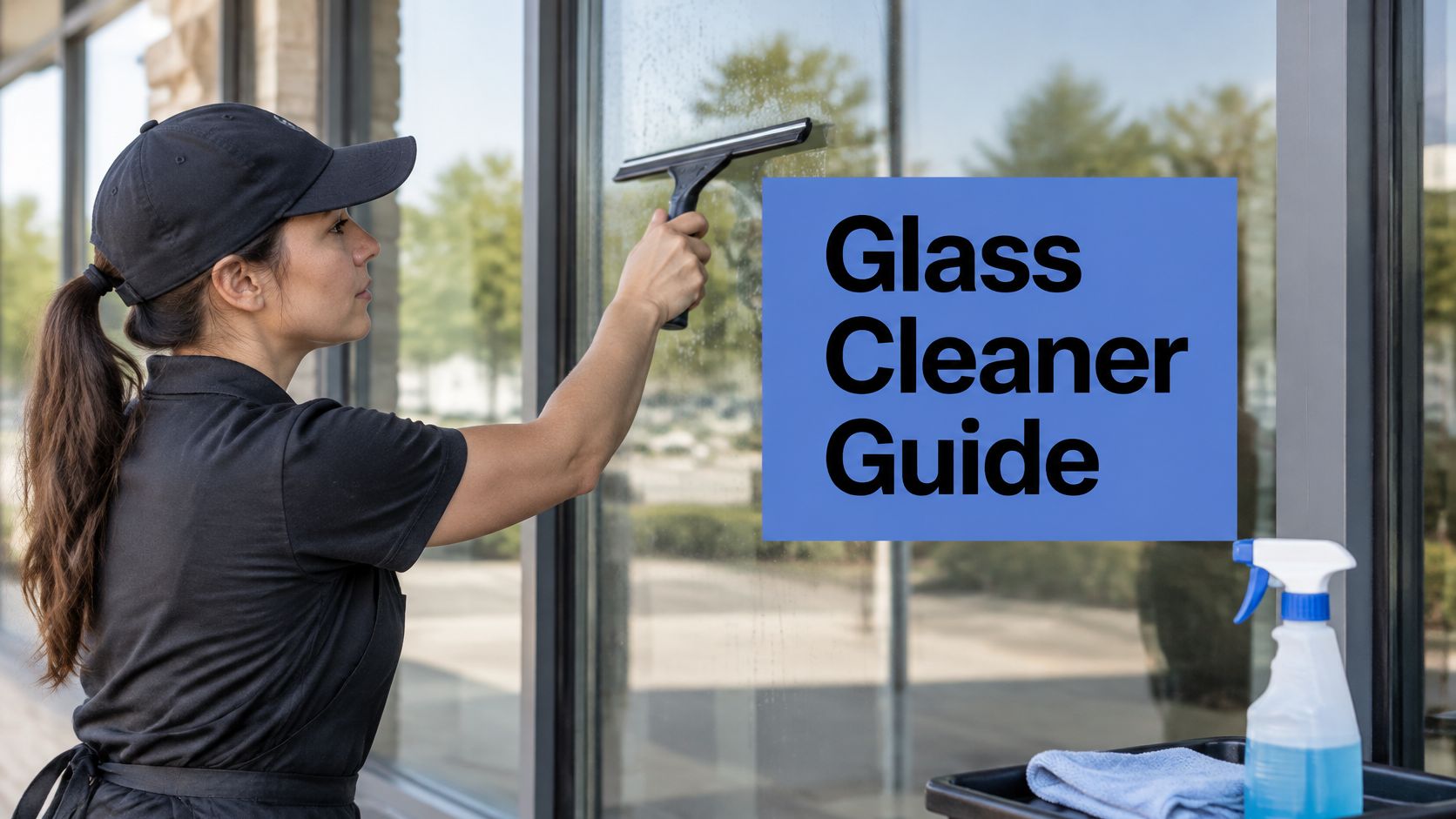
The squeegee method applies water and a cleaning solution to the glass, works it loose with a scrubber or strip washer, then a blade pulls the dirt and water off in overlapping strokes, with a cloth detailing the edges. It's quick on glass carrying a light film and the operator sees the result instantly, but it depends on a clean, sharp blade and disciplined drying. Rush the edge work and the streaks show by mid-afternoon.
The pure-water system runs water through filtration until the minerals are gone, applies it with a pole and brush, and lets the glass air dry with no wipe. No minerals means no spotting, and no soap means no residue film left to bake on under desert sun.

The decision comes down to what the glass shows and how the surface is reached, not to which system sounds more advanced.
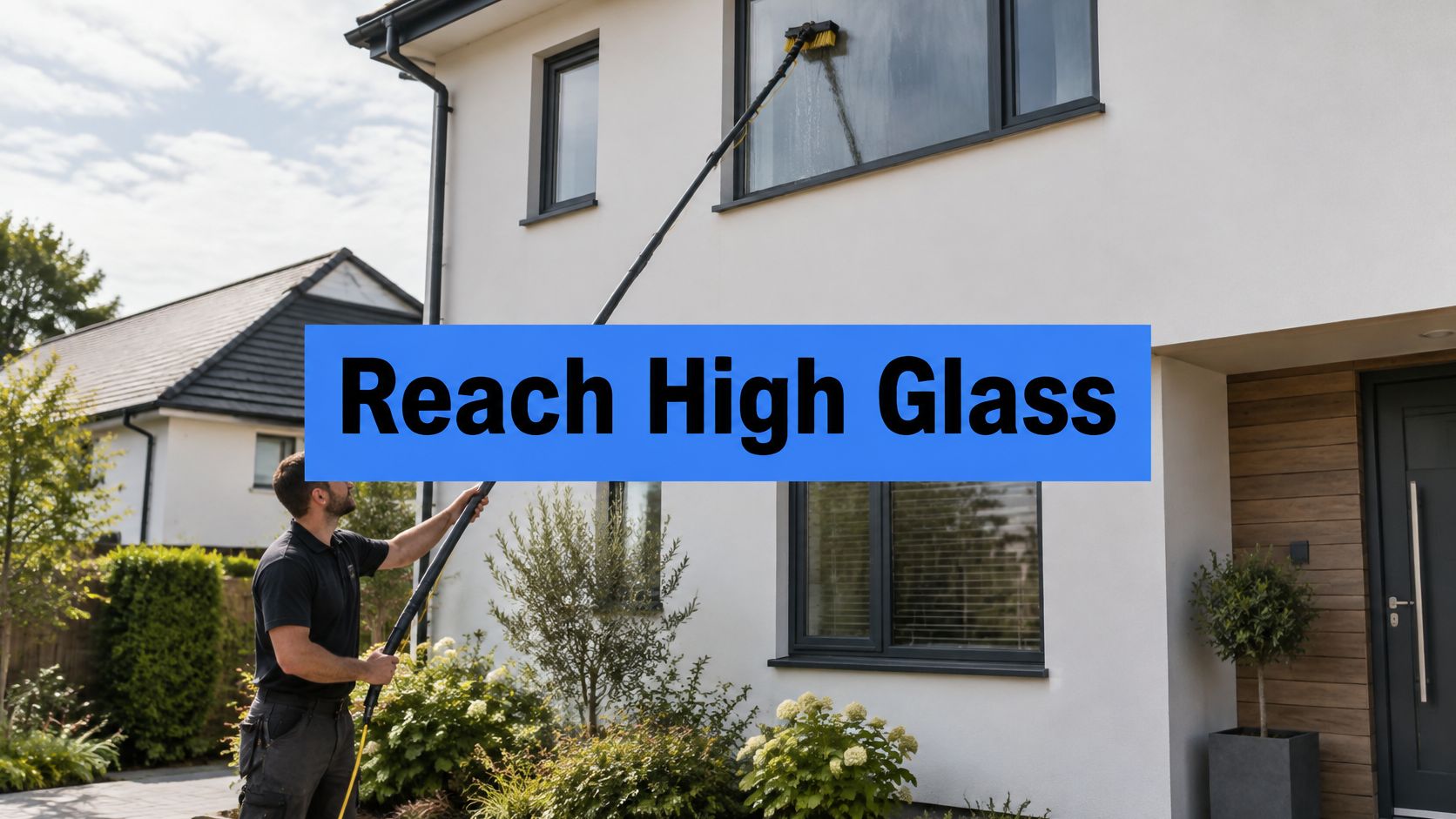
Here's the pole-and-blade work in motion. Watching blade angle and overlap teaches more than a paragraph about it.
| Method | How it works | Best suited for | Main limit |
|---|---|---|---|
| Squeegee | Water and cleaning solution applied, then a blade pulls off dirt and water | Glass with a light film on accessible surfaces | Depends on a clean blade and careful drying; streaks if rushed |
| Pure-water system | Deionized water applied by pole and left to air dry | Glass with mineral spotting or residue, and surfaces reached from a pole | Requires filtration and a reliable water supply |
Three questions turn a sales call into a technical conversation.
Professional Window Cleaning has been cleaning windows for over 26 years, and our quotes name the method for each surface before they name a price. That's the point where a homeowner, a property manager or a board can compare two bids on equal terms, because the method is the largest variable in what the glass looks like afterward.
Façade work on a Las Vegas hi-rise carries the highest risk in any window cleaning contract, so the rules governing it are written around construction equipment rather than a bucket and a rag. Suspended platforms must be designed by a qualified person and erected, moved, altered or dismantled under competent-person supervision, and two-point suspension scaffolds must be tied or otherwise secured against sway, with window-cleaner anchors barred as substitutes for those tiebacks, per OSHA's suspended scaffold guide.

Anchorage is where shortcuts hide. OSHA's guidance on two-point suspended scaffolds is blunt: tiebacks must connect to structurally sound building anchors, and vents, electrical conduit, standpipes and other piping are not acceptable anchorage points. Single tiebacks installed at an angle are prohibited outright. A rooftop pipe that has held for 20 years is still not an anchor.
Run these in order and record each one. A missing record means the check didn't happen.
OSHA classifies window cleaning as building maintenance, and its powered platform standard treats it accordingly. Permanently installed exterior platforms need a professional engineer to design or direct the design of supports, tie-in guides, anchoring devices and affected building components. Workers need fall-arrest protection, and the building needs a written emergency plan covering power failure, equipment failure and other emergencies. Where intermittent stabilization is used, anchors must sit no more than three floors or 50 feet apart, whichever is less.
Weather is a stop condition, not a judgment call. Work stops during storms or high winds unless a competent person determines conditions are safe and the required fall-protection controls are in place.
Every rule above is satisfied only when its check is documented and available on site. Ask for the rigging drawings, the anchor inspection and the rescue plan before the truck is unloaded. A crew that carries them produces them in a minute. A crew that doesn't will change the subject, and that is the whole evaluation.
Height changes the loads, not just the view. Las Vegas structural-design provisions require exterior windows, curtain walls, skylights and other cladding to be designed for wind pressures adjusted for building height and exposure category, and the multipliers climb with mean roof height: 1.00 in Exposure B and 1.66 in Exposure D at 30 feet, then 1.16 and 1.81 at 50 feet, per the 2020 Las Vegas structural design provisions.
Those are design adjustments for the cladding, not a load rating for cleaning equipment. They inform planning without approving a single tool. What they do establish is that a window on a high floor is a different assembly from its twin below, which is why equipment selection belongs to the building's approved façade-maintenance documentation rather than to appearance.
| Mean roof height | Exposure B factor | Exposure D factor |
|---|---|---|
| 30 feet | 1.00 | 1.66 |
| 50 feet | 1.16 | 1.81 |
Identify the glazing type, curtain-wall zones, restricted panels, operable windows and approved attachment points before anyone touches the glass. Then write the plan as a per-floor document.
A floor-by-floor statement prevents the small accidents that damage a façade: a suction cup on a seal never rated for it, a clamp on a fixed panel, pole pressure against a frame with a failing gasket. It also gives a property manager something concrete to approve instead of a verbal promise.
Rope work belongs in that same document. Where a platform can't reach, the rope access window cleaning approach sets out anchorages, descent paths and rescue arrangements before a technician goes over the edge. The paperwork is what makes the descent repeatable, and repeatable is the only kind of exterior maintenance a board can budget for.
Las Vegas glass is not generic glass. Sky Las Vegas used approximately 92,000 square feet of Azuria glass and 87,000 square feet of blue-tinted glass over Solarban 60 low-e glass, and the manufacturer reports that Azuria transmits almost 40% of sunlight while blocking 76% of solar heat, according to the Vitro glazing case study. The façade is an energy-control system with a cleaning requirement attached, not a transparent surface.
That changes the method. Abrasive pads, harsh acids and heavy restoration can damage a coated surface, and the right approach depends on glass type, coating location, water quality and access. A crew that treats every panel identically is a warranty claim waiting to be filed.
| Condition | Effect on glass | Cleaning response |
|---|---|---|
| Desert dust and grit | Builds a film that dulls the glass between cleanings | Keep to a regular exterior cleaning cycle |
| Sprinkler hard water | Leaves mineral spotting on exposed glass | Use a pure-water rinse to avoid spotting |
| Intense sun on tinted or low-e glass | Coated layers can be damaged by abrasion | Confirm the coating maker's approved cleaning method first |
| Storm grit and high winds | Leaves debris and grit on the glass | Clean once conditions are safe and a competent person has confirmed access |
Owners often can't tell the difference, and the two need opposite responses. Mineral spotting is a deposit sitting on the surface, and it lifts with a pure-water rinse and the correct acidic treatment. Coating damage is a failure in the film itself, and cleaning harder makes it worse.
Get the glass inspected before it's cleaned. A pre-clean inspection plus the coating maker's written guidance settles the question for less than the cost of one replaced panel.
On frequency, no fixed tower schedule exists in the published guidance, so the schedule should come out of that inspection: dust load, sprinkler overspray, afternoon sun exposure and how quickly the glass dulls between visits. For single-family homes in the valley, most benefit from cleaning every three to six months because dust, monsoon storms and sprinkler hard water build up quickly, and upper floors usually collect a heavier film than anything at ground level.
Two honest limits. More frequent cleaning is not established as a way to cut cooling loads, so the case for it rests on visibility, appearance and warranty-sensitive maintenance. And cleaner windows should never be read as permission for abrasive restoration, since methods, chemistry and access all follow the glass. For the residential seasonal pattern that sits behind these tower schedules, the Las Vegas window cleaning service notes lay out the cycle month by month.
High-rise development here is uneven, and that shapes what a cleaning contract has to absorb. The region ranked 44th among major U.S. metros for apartment development, and Las Vegas was expected to receive its first completed residential high-rise in more than 15 years, with newer projects now advancing, including a planned 32-story, 240-unit tower targeted for completion in fall 2028, as the Las Vegas Review-Journal reports. Newer and more valuable doesn't mean simpler. Complex glazing and mixed-use amenities add coordination work even when construction quality improves, so a tower's height, façade design, wind exposure and anchorage system can matter more than its number of floors.
Collect documents before you collect quotes.
Then ask three access questions: who coordinates façade access, how balconies and architectural projections that block a platform are handled, and how the work gets scheduled around residents and businesses. Anyone can answer those in general terms. A provider with a plan answers with names, floor sequences and dates.
The tell is simple. Ask for the rescue plan. A crew that carries one knows the building.
Professional Window Cleaning has served customers since 1999 and has been cleaning windows for over 26 years, and we'll show these records for your building rather than describe them. For a Las Vegas hi-rise, call (702) 800-4994 and we can start with the roof plan instead of a price. Gather the documents first, then compare two quotes on the same method and the same safety plan. A cheaper quote built on a different method, or on no rescue plan at all, isn't cheaper.
Professional Window Cleaning cleans high-rise glass across Las Vegas, Henderson and Summerlin, from condominium towers to resort and office buildings that need a documented access plan before a platform ever goes up. Whether you manage one tower or a portfolio of them, the first step is the same: a walkthrough that checks anchorage, glazing and access before anyone quotes a number. Visit Professional Window Cleaning to schedule an estimate.
Read our blog posts regularly and keep learning.