Care and Maintenance
High Rise Windows Explained for Building Owners
Learn what high rise windows are, how they work, and how to hire pros to clean and maintain high rise windows safely and efficiently.


If you're managing a high-rise, you already know the glass is part of the asset. Tenants notice it. Prospects notice it. Owners notice it when a tower looks sharp from the street and from the top floor looking out. The problem isn't deciding whether the windows need attention. It's deciding how to get the work done without turning the property into a construction zone.
That's where rope access window cleaning usually enters the conversation. For the right building, it's the cleanest answer from both an operations and business standpoint. You get access to difficult elevations, less equipment crowding your site, and a crew that can move across the facade with precision instead of dragging a large setup through the property.
For property managers in markets like Denver, Scottsdale, and Las Vegas, that matters. Building design keeps getting more complex. Glass wraps around corners, setbacks interrupt straight drops, and rooftop logistics often decide the method before the first pane is touched.
At 7 a.m., before the lobby traffic builds, a property manager is usually weighing three questions at once. How visible is the glass problem, how much disruption can the site absorb, and what access method gets the work done without dragging out the schedule. On a high-rise, that decision affects tenant experience, curb appeal, and operating efficiency at the same time.
Top-floor tenants pay for daylight and a clean line of sight. Owners pay attention to presentation from the street. Once exterior glass picks up dust, mineral staining, runoff, or storm residue, complaints start coming from both directions.
Rope access often makes sense when the building height, facade shape, and ground conditions make heavier access equipment inefficient. Crews can reach the work from the roof, keep the footprint small at grade, and move across setbacks, corners, and recessed areas with less site disruption than methods that depend on large equipment staging. For a manager, that usually means fewer blocked entries, less conflict with valet or tenant parking, and a cleaner scheduling window.
The practical point is simple. Rope access is the way technicians reach the glass. It is not the cleaning method itself.
That distinction matters during bidding because managers often compare one proposal against another as if access and cleaning are a single choice. They are separate decisions with separate cost implications.
Ask bidders two direct questions. How will your crew access the facade, and what cleaning method will you use once you are there? That clears up a lot of bad apples-to-oranges comparisons.
In dry, dusty markets such as Phoenix and Las Vegas, managers often deal with frequent soil load and mineral spotting concerns. In Denver, wind, snowmelt residue, and seasonal swings can change the cleaning cycle and the labor needed on exposed elevations. The right choice depends on facade design, roof anchor availability, ground access, and how often the building needs service to protect appearance without overspending.
After enough years supervising these jobs, the pattern is consistent. The best result usually comes from matching the access method to the building first, then matching the cleaning method to the glass condition and finish standard. That is how managers control cost and still get a facade that looks right from the sidewalk and from the top floor.
Rope access window cleaning is a controlled descent system for exterior facade work. Technicians descend the building using industrial rope systems, a sit harness, descender hardware, and a separate backup line. It looks simple from the sidewalk. It isn't. Done properly, it's a tightly managed work method built around equipment standards, anchor verification, and technician training.
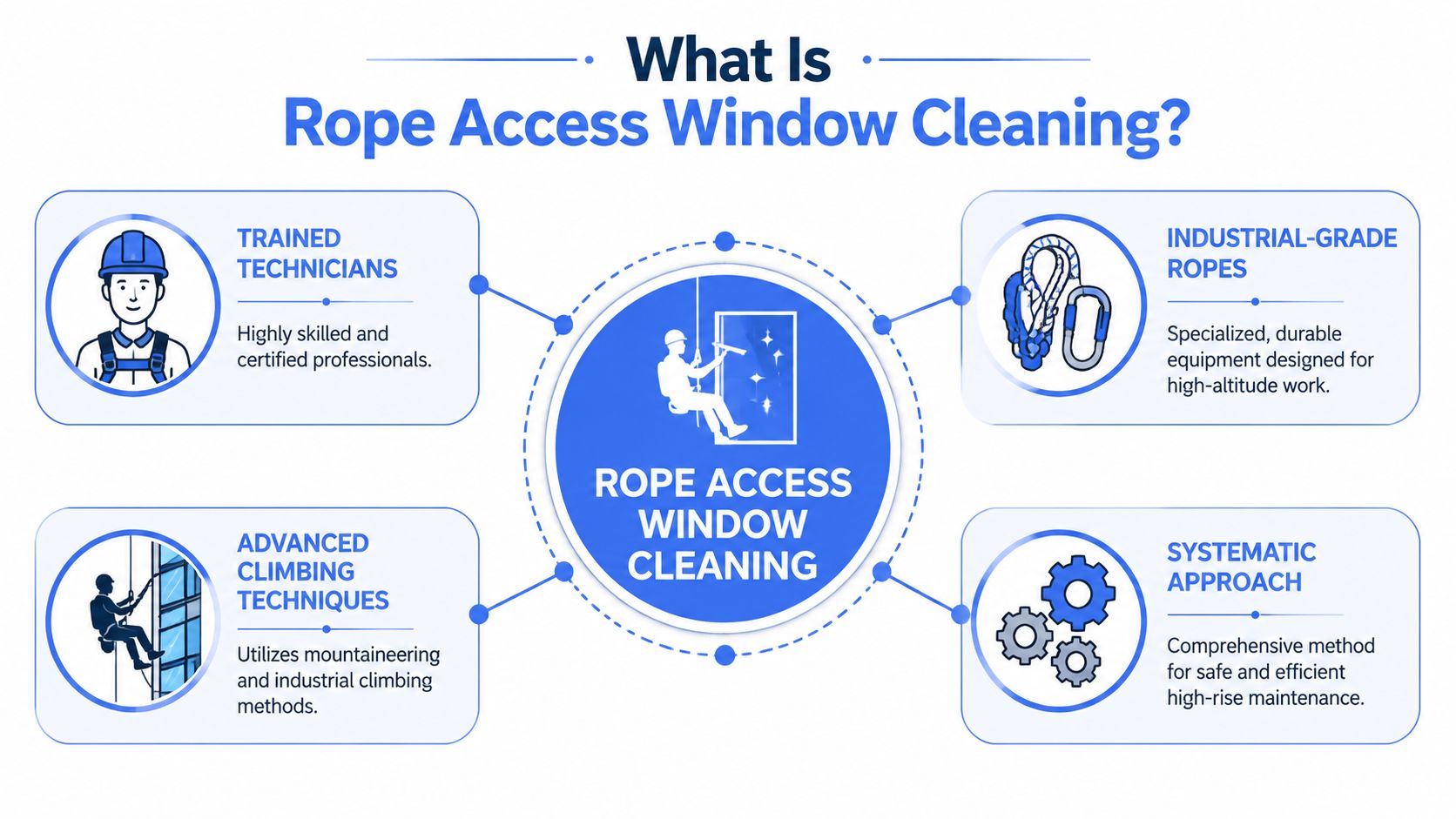
Think of rope access technicians as urban mountaineers working under industrial rules. The core setup includes several pieces working together:
For buildings above 6 stories, or about 75 feet, rope access is often the dominant method because conventional options start to lose practicality. The system relies on a dual-rope configuration, and the anchor points must support 5,000 pounds per worker under OSHA 1910.27(b)(1)(i), as outlined by the National Window Cleaning Authority overview of rope access window cleaning.
Not every building needs rope access. Some buildings shouldn't use it at all. The method becomes attractive when the facade creates access problems that other systems can't solve cleanly.
That usually includes:
A straightforward mid-rise with open ground access may be a good lift job. A tower with roof anchors, multiple offsets, and limited staging space is often a rope access job.
A good contractor doesn't force rope access onto every project. The building should decide the method.
From a management standpoint, rope access window cleaning is less about the dramatic visual of a technician on ropes and more about controlled logistics. The crew stages on the roof, protects edges, secures the drop zone, descends in planned sections, and cleans the glass using either squeegee work or a pure-water system depending on the facade and finish requirements.
That's why this method is so useful for properties that can't tolerate a slow, cumbersome setup. The system reaches difficult exterior glass without making the whole building feel like a work site.
A clean facade improves appearance. That part is obvious. The stronger argument for rope access is operational. Property managers choose methods based on time on site, disruption, access limitations, and total project friction, not just the final pane of glass.
Scaffolding and large lifts change the way a property functions while work is underway. You may lose staging areas, reroute foot traffic, coordinate around parking, and answer tenant questions all day. Rope access usually trims that footprint because most of the operation starts from the roof and along the facade, not from a large ground-based structure.
That matters most on active sites such as:
The business case gets stronger when the building geometry is awkward. Rope access can move into corners, around architectural breaks, and down elevations that don't work well for rigid access equipment. That means fewer skipped areas, fewer awkward partial cleans, and fewer debates about what was or wasn't reachable.
It also puts technicians close enough to the facade to spot problems while they're working. Sealant failure, loose trim, staining patterns, and damaged glazing details often show up during a close descent. A sharp crew won't turn a cleaning visit into a building envelope inspection report, but they can flag visible issues before they become larger maintenance calls.
Rope access doesn't win every pricing comparison. It wins when it removes expensive setup, avoids long mobilization, and fits the shape of the building. If a project would otherwise require a large temporary access plan, rope access often improves the total picture by reducing the amount of gear, transport, assembly, and site disruption involved.
For building managers, that's the key distinction. Don't ask only, "Which method has the lowest line-item price?" Ask, "Which method gets the facade cleaned with the least operational drag?"
The cheapest-looking bid can become the most expensive option if it slows tenant access, extends site time, or leaves difficult glass untouched.
The first question any building manager should ask about rope access window cleaning is simple. How is the fall risk controlled at every moment of the job? If the contractor can't answer that clearly, the conversation should end there.
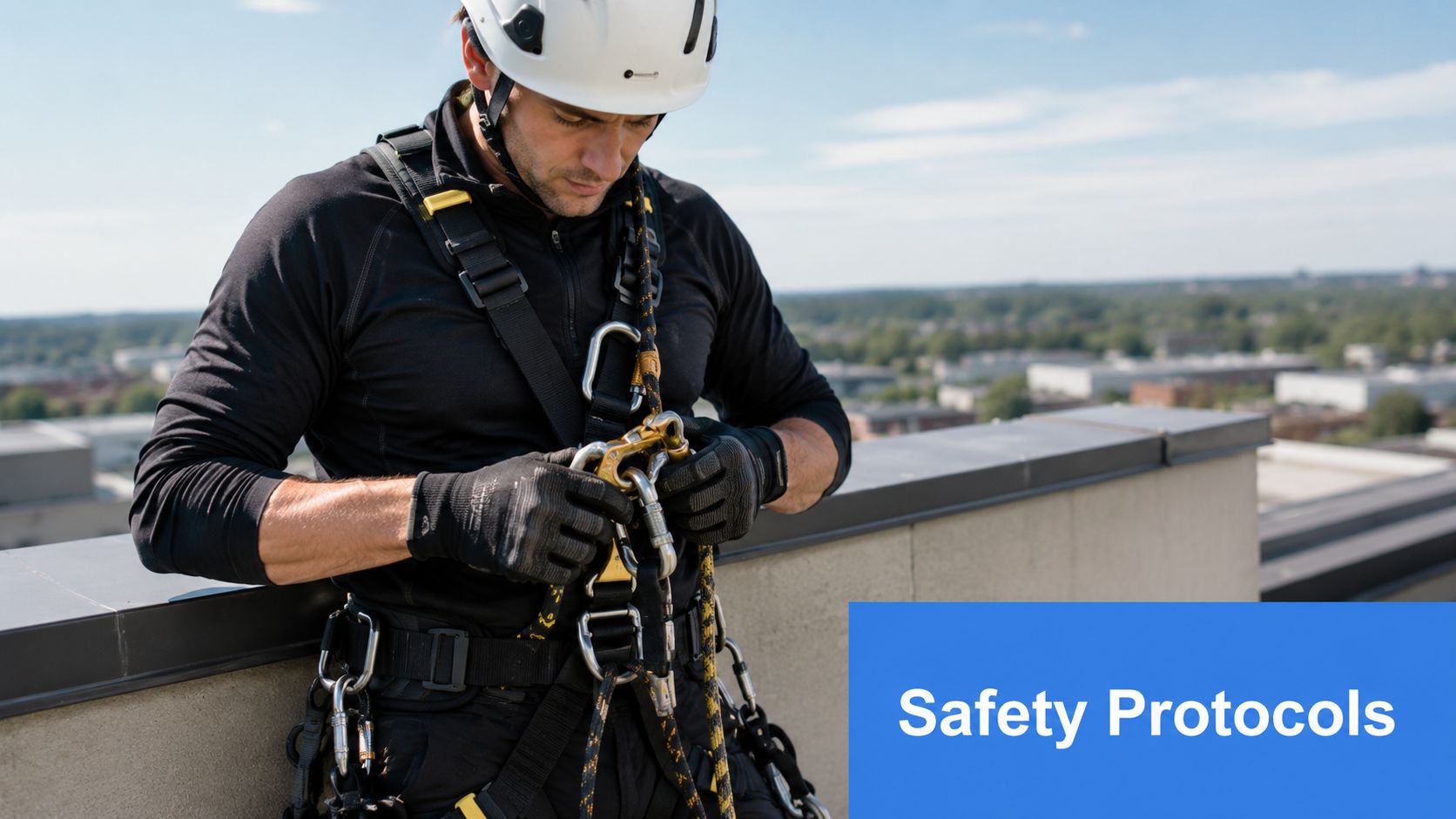
A professional rope access setup isn't one rope and a harness. The technical framework requires kernmantle semi-static rope, typically in the 10.5 mm to 11.5 mm range under EN-aligned standards, and the core rule is the two-point attachment rule. Operatives must remain connected to two independently anchored safety systems, and anchors must be certified to support 5,000 pounds under OSHA 1910.27(b)(1)(i), as detailed in this rope platform safety guidance for window cleaning.
That dual-line principle is the heart of the method. One line handles work positioning and movement. The second stands ready as the independent backup. A single failure should not create a fall.
A supervisor should be checking more than whether the crew showed up with helmets and ropes. Proper planning includes:
If you want a useful reference on the gear side, this overview of high-rise window washing equipment gives a practical look at what should be on site.
In this trade, credentials aren't decorative. SPRAT and IRATA certifications signal that technicians have trained within recognized rope access systems that emphasize safe movement, inspection routines, and rescue capability. For a property manager, that matters because the safety quality of the job depends on the workers' habits under real conditions, not just the equipment list on a proposal.
A strong contractor should be able to explain who is on the rope team, what certifications they hold, who is supervising the drop, and how rescue would happen if a technician became incapacitated.
This is the standard you should expect in practice:
Safety on a high-rise isn't a promise. It's a chain of verifiable decisions made before the first technician goes over the edge.
Property managers make better decisions when each method is judged by the same criteria. The right method depends on building height, facade shape, available anchors, ground conditions, and how much disruption the property can absorb while the work is underway.
| Method | Best For | Cost | Speed | Disruption |
|---|---|---|---|---|
| Rope access | High-rises with setbacks, recessed glass, irregular facades, or limited staging space | Often cost-effective when it avoids major setup, but project-specific | Fast once roof access and safety planning are in place | Low to moderate if drop zones are managed well |
| Scaffolding | Lower or mid-height projects needing fixed long-duration access | Often higher when assembly, dismantling, and occupancy impact are considered | Slower to mobilize | High due to footprint and obstruction |
| Boom lift or MEWP | Areas with clear ground access and reachable elevations | Can work well for targeted sections, but access limits matter | Good for simple elevations | Moderate to high depending on staging area |
| BMU | Buildings designed with permanent maintenance units | Strong fit where the system already exists | Consistent for scheduled cycles | Moderate, usually built into operations |
Rope access works best when the facade itself is the challenge. If windows sit behind setbacks, wrap around corners, or break across multiple planes, a rope team can often move more directly than a platform or lift. It also works well where the property can't spare much ground space.
Scaffolding works when you need a fixed workface for an extended period or when window cleaning is bundled with facade repair that requires carrying more tools and material. For cleaning alone, it can be more access system than the job requires.
A boom lift or MEWP makes sense when the building is accessible from grade and the sections to be cleaned fall within safe reach. It becomes less useful when landscaping, traffic lanes, parking decks, or overhangs interfere with setup.
In markets like Denver, Phoenix, and Las Vegas, climate and site patterns can push the decision in different directions. Wind exposure, tight downtown footprints, podium layouts, and heat all affect how efficiently a crew can work. That doesn't mean one access type is always better in one city. It means local conditions matter enough that blanket assumptions usually lead to poor bids.
Use this short filter before approving a method:
If the answer points toward agility and minimal site footprint, rope access usually moves to the front of the list.
The hardest part of pricing rope access window cleaning is that two buildings with similar heights can price very differently. Height matters, but it's only one variable. Key cost drivers are usually found in the details property managers don't see from the curb.
A useful benchmark from the buying side comes from a 2024 IRATA-related discussion of rope access supplier selection and cost visibility. It notes that 68% of building owners can't accurately estimate total project costs without a site-specific audit. That's consistent with what happens in the field. The shape of the building and the logistics around it usually decide the quote more than the story count alone.
Some pricing factors are obvious. Others show up only after a roof walk or site survey.
A low number on a proposal doesn't tell you much if you don't know what's behind it. One contractor may be pricing a straightforward wash cycle with clean roof access. Another may be accounting for edge protection, tighter drop control, difficult setbacks, and a slower production pace on architectural glass.
That's why the best pricing conversations focus on scope clarity:
If a quote looks dramatically lower than the rest, ask what the contractor excluded before you assume you found savings.
Local labor conditions, access constraints, and property design all influence the final number. A downtown tower in Denver may present staging and traffic issues that change labor flow. A Phoenix property may have facade soils and heat exposure that affect scheduling and cleaning method. In Las Vegas, a hospitality or mixed-use environment may create stricter timing windows and public-area controls.
Those variables don't produce a universal city price. They change the cost structure of the job, which is what a competent bid should reflect.
The right contractor will make the job feel organized before it starts. The wrong one will give you a thin proposal, vague safety language, and a lot of confidence unsupported by documentation. For rope access window cleaning, your hiring process needs to test both competence and discipline.
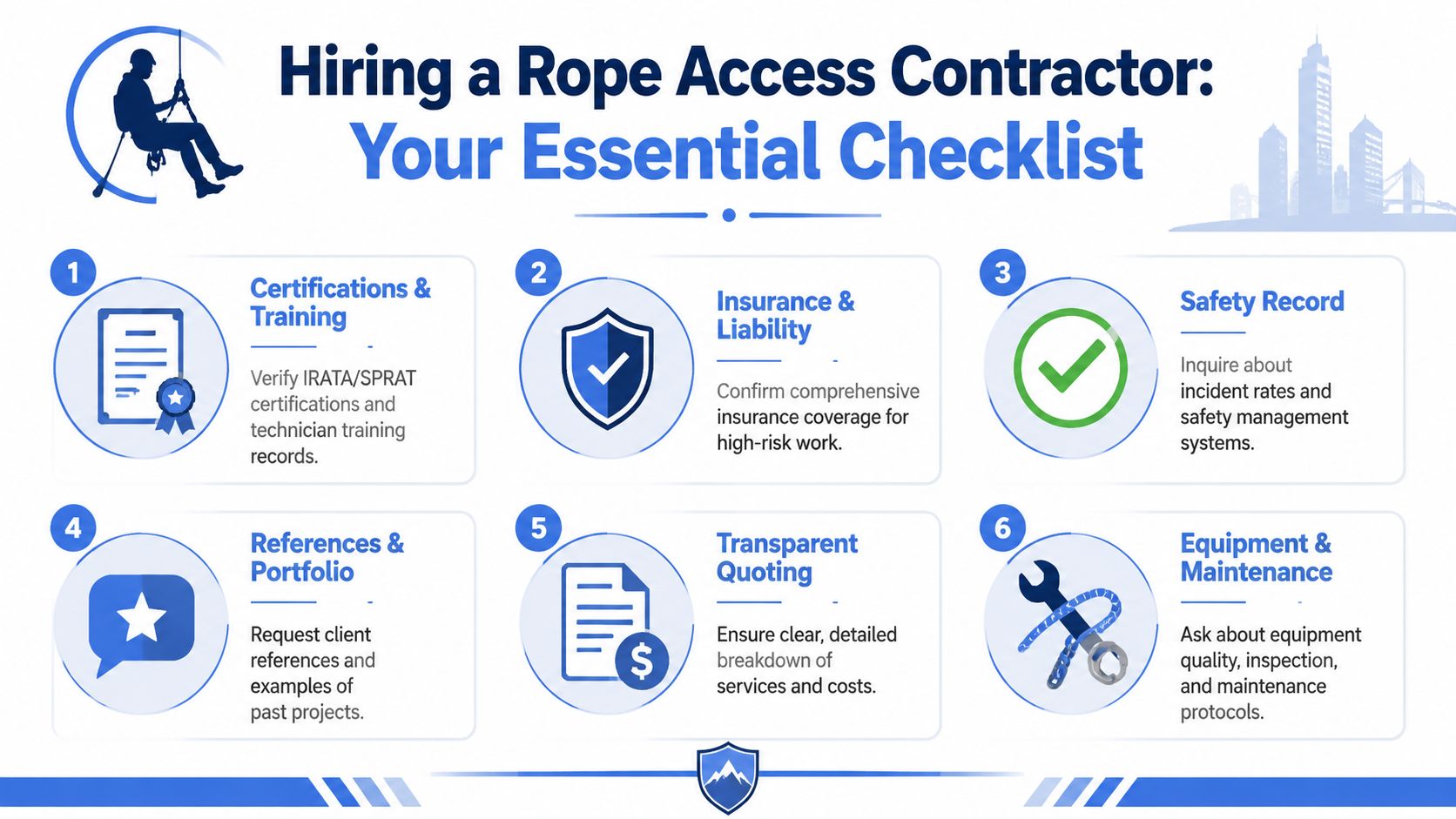
Start with the basics, then go deeper.
Good proposals describe the job in operational terms. They identify access assumptions, working zones, exclusions, scheduling concerns, and what is included in the scope. If you want broader context on evaluating providers and service expectations, this article on high-rise window washing is a useful companion read.
It also helps to evaluate how visible and established a contractor is in their local market. For building service companies, reputation often shows up first in search visibility, review consistency, and market presence. If you're interested in how that works, Northpoint Web has a solid guide to local SEO for contractors that explains why some firms are easier to vet than others.
Use this short decision filter before awarding the work:
A company with a long track record should be comfortable answering every one of those questions. Professional Window Cleaning has been cleaning windows for over 26 years, and that kind of longevity usually shows up in process quality long before the first technician reaches the roof.
If you need an experienced team for residential, commercial, or high-rise work in Arizona, Colorado, or Nevada, Professional Window Cleaning is a practical place to start. They've been in business since 1999 and serve property owners and managers who need reliable window cleaning without guesswork.
Read our blog posts regularly and keep learning.