Care and Maintenance
High Rise Windows Explained for Building Owners
Learn what high rise windows are, how they work, and how to hire pros to clean and maintain high rise windows safely and efficiently.


You're staring at a garage floor full of tangled strands, two dead bulbs, and a ladder you don't trust on the second story. That's usually the moment people start searching for professional Christmas light installers near me, because the core problem isn't the lights. It's the time, the height, the wiring, and the fact that a sloppy install can leave your roofline looking worse than bare.
The good crews solve all of that in one visit. They measure the property, cut the runs to fit the roofline, mount everything cleanly, and handle the takedown later so you're not stuffing wet decorations back into a box in January.
The DIY version always starts the same way. You pull the bins out, untangle one strand, test another, then realize the front gable needs a different length than the side eave. By the time you're on the ladder, you're already improvising, and that's where the mistakes start.
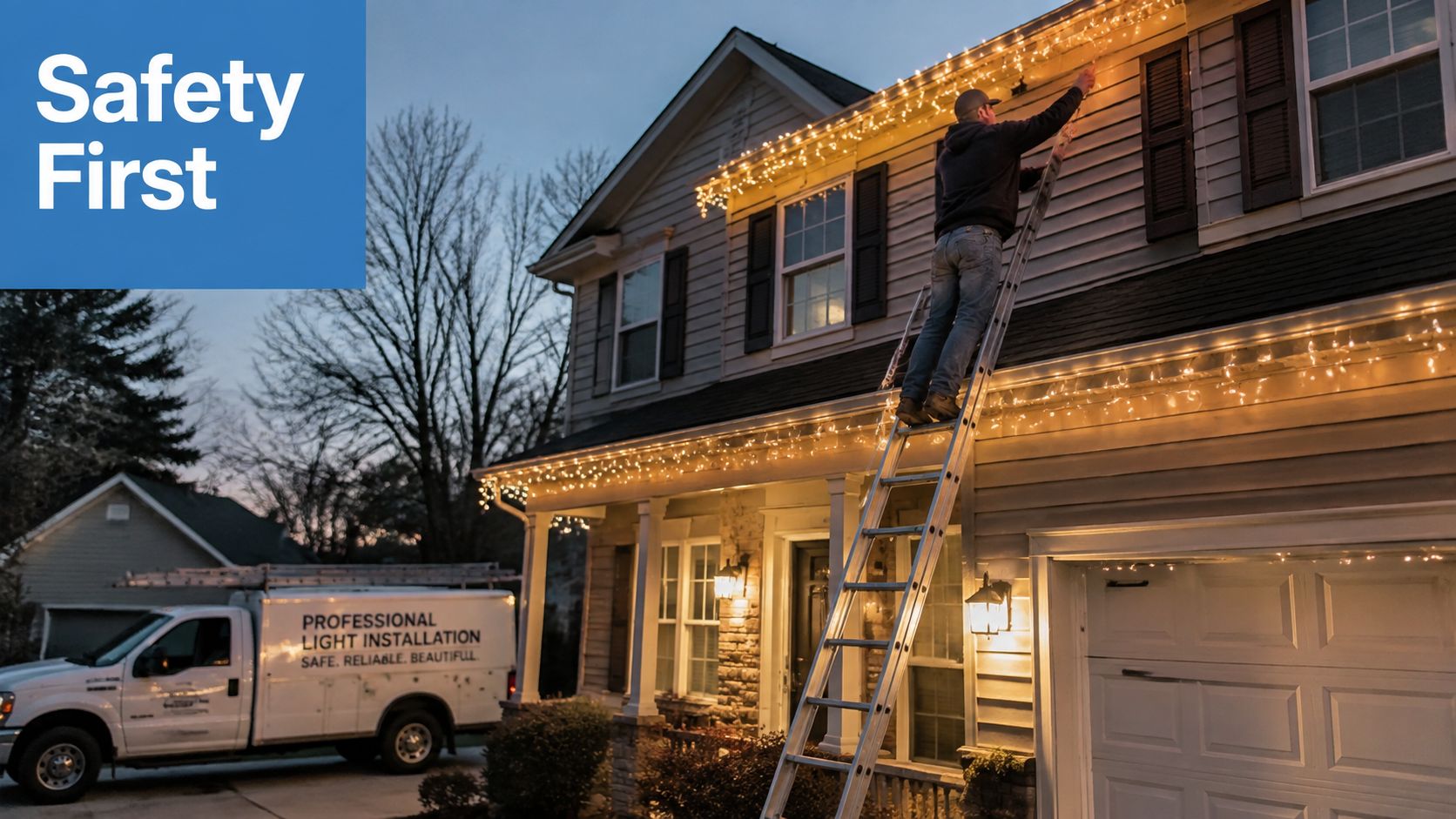
A professional crew doesn't sell you a pile of generic strands and wish you luck. They treat the job like a finish carpentry task, with measured runs, clean attachment points, and a display that matches the structure instead of fighting it. That's why a turnkey package matters. It usually covers design, installation, mid-season maintenance, takedown, and storage, which removes the hidden labor that homeowners always underestimate.
Practical rule: if a lighting company can't explain how it handles maintenance and January removal, you're not buying a full-service package, you're buying a short-term headache.
This is also where I'd point homeowners to Pinnacle Property Media's guide on DIY projects if they're still deciding which holiday jobs are smart to tackle themselves. Holiday lighting belongs in the category of projects that look simple from the driveway and become a mess on the roof.
The biggest win isn't just safety, although that matters. It's consistency. A professional install looks intentional from the street because the crew isn't forcing retail lights onto a roofline they were never cut for. Proper clipping also helps protect shingles, gutters, fascia, and siding from the pinching, stapling, and dangling leads that show up on rushed DIY jobs. If you want a display that holds up through the season, hire the crew that treats your house like a structure, not a backdrop.
Most bad installs fail before the first bulb goes on. The company shows up with consumer lights, a vague estimate, and no real explanation of how the roofline will be measured. That's the moment to stop the conversation.
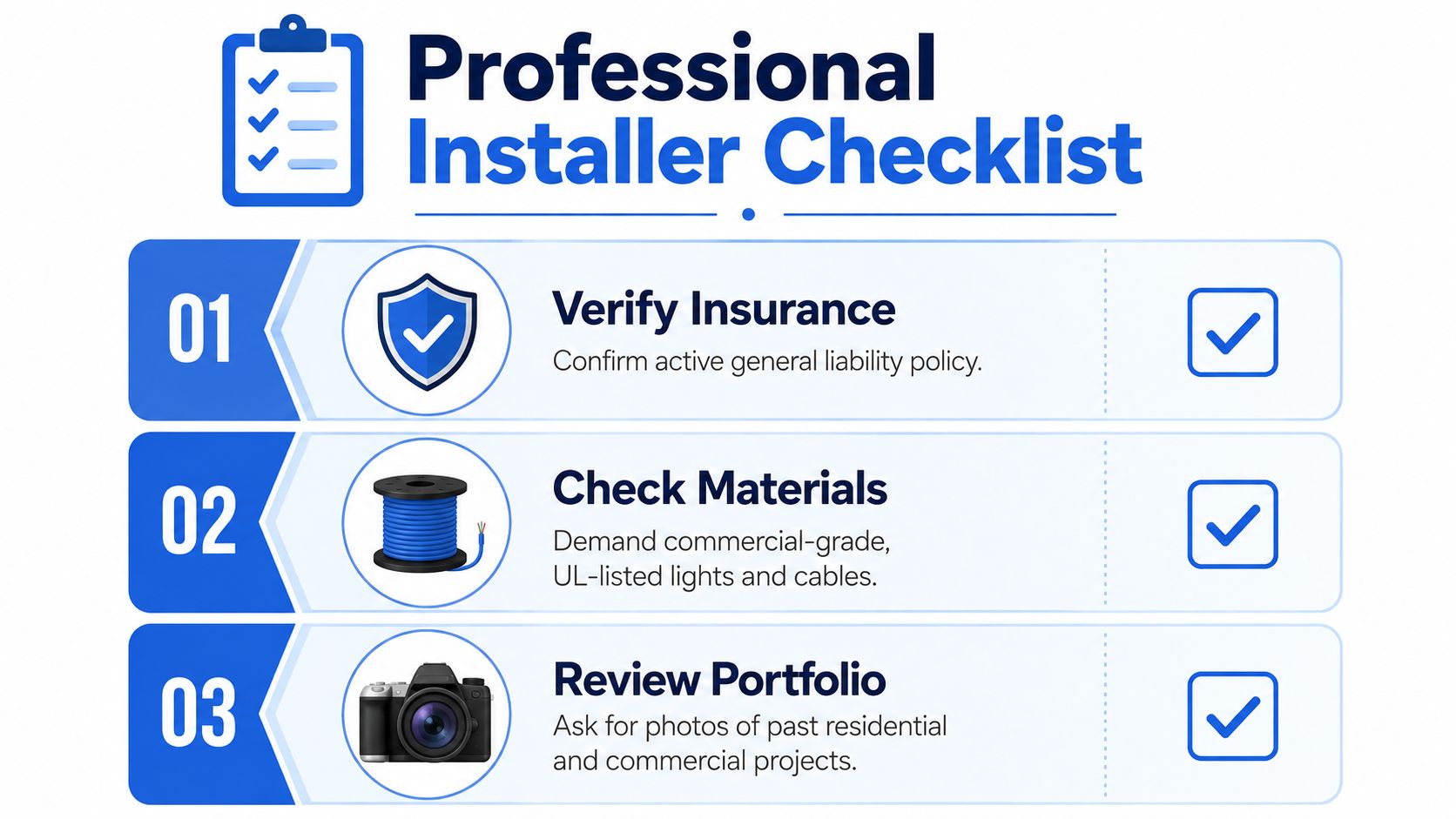
Ask for active general liability insurance and workers' compensation. If a crew member falls or a roof tile gets damaged, those policies are what separate a professional operation from a liability problem. I'd also push hard for an in-house crew instead of a handoff to random subcontractors. When the same company measures, installs, maintains, and removes the lights, accountability stays in one place.
Don't let anyone wave away insurance as paperwork. On a roof, it's part of the job, not a bonus.
Retail-box lights are built for consumer convenience. They're not the same as commercial-grade LED product with weather-rated connectors, and they don't hold up the same way on a custom roofline. A proper installer should be able to tell you exactly what it uses for C9 bulbs, mini-light runs, connectors, and attachment hardware.
The most important question is whether the crew custom-cuts wire to your footage. That's how the best installs avoid the sloppy tail hanging off the end of a roofline. It also reduces waste and keeps the display visually tight. If a company only offers pre-packaged strands, it's not really fitting the lighting to the house, it's forcing the house to adapt to the product.
A serious installer should show photos of finished jobs on similar rooflines, explain how it handles attachment on shingles or gutters, and tell you whether mid-season repairs and takedown are included. That's the difference between a holiday service and a one-off labor call. The right questions make the bad vendors obvious fast.
My rule of thumb: if the estimate doesn't start with measurement, material spec, and service scope, it's not a quote I'd trust.
Holiday lighting pricing only looks simple when you ignore the roofline. Once you measure the property correctly, the quote starts making sense, because the installer is really pricing labor, access, and custom fit. That's why per-foot pricing is the industry standard for professional installs.
A 2026 market analysis reports professional pricing of $8 to $35 per linear foot, with regional highs of $25 to $35 per foot in the San Francisco Bay Area and $22 to $32 per foot in Manhattan/Brooklyn. The same source lists Denver/Boulder at $15 to $22 per foot and Phoenix/Scottsdale at $12 to $18 per foot. It also places a standard single-family home at $800 to $1,500, larger or premium jobs at $1,500 to $3,500, and commercial properties at $2,500 to $15,000+, depending on scope. Market pricing analysis for Christmas light installation
| Region | Cost per Linear Foot | Average Home Total |
|---|---|---|
| San Francisco Bay Area | $25 to $35 | Higher-end residential quotes |
| Manhattan/Brooklyn | $22 to $32 | Higher-end residential quotes |
| Denver/Boulder | $15 to $22 | Mid-range residential quotes |
| Phoenix/Scottsdale | $12 to $18 | Mid-range residential quotes |
The key benchmark is still the footage. If two bids differ wildly, the first thing I check is whether both companies measured the same roofline and included the same service scope. The best quotes don't just list a number. They explain whether design, installation, repair, takedown, and storage are included.
Independent consumer-cost sources also place average installation near $444 to $425, with common ranges of $220 to $684 and higher costs for multi-story homes. Those figures reinforce the same point, the market is built around labor, roof complexity, and property size, not a flat sticker price. Residential cost overview for Christmas light installation
If you're comparing installers near you, ask for three things in writing, footage accuracy, material spec, and included maintenance/takedown. That combination tells you more than a glossy photo ever will.
Some homeowners want a December display and nothing else. Others want exterior lighting they can use for holidays, events, and year-round curb appeal. Those are different buys, and anyone pretending they're the same is selling convenience instead of judgment.
Search results show more installers now market permanent exterior trim lights alongside traditional holiday services, which signals a real shift in the category. The better comparison isn't “which is more modern.” It's whether you want lower commitment and lower upfront spend, or a system that stays up and serves more than one season. A strong decision framework is to match the lighting model to how often you'll use it and how much you care about year-round architectural effect. Permanent vs. seasonal lighting comparison context
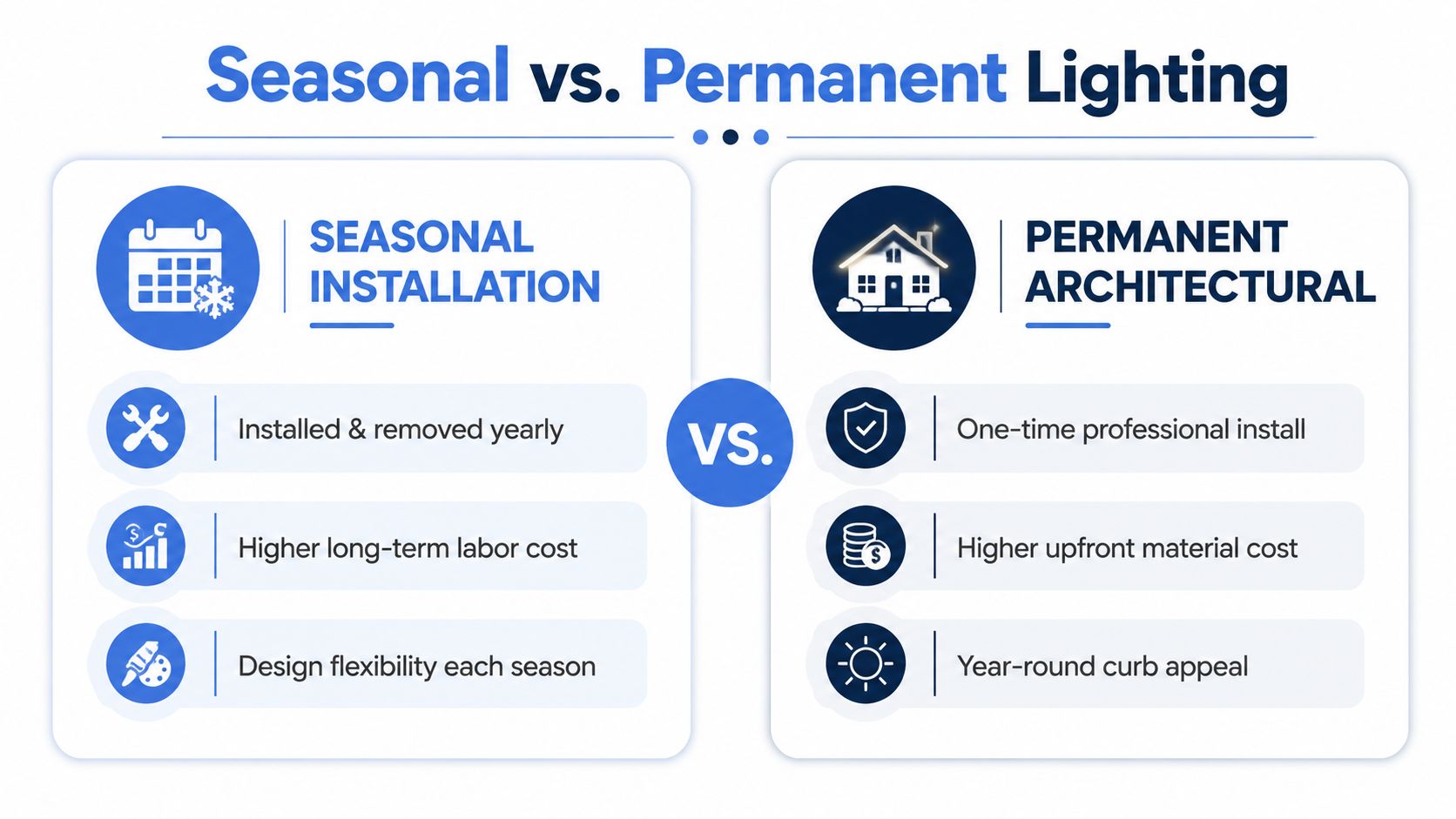
The seasonal model is the one I recommend for most homeowners and property managers. It gives you design flexibility every year, and you're not locked into one look forever. It also fits naturally with a full-service package, installation, mid-season service, removal, and storage.
Permanent systems make sense when the property owner wants programmable architectural lighting beyond December and is willing to accept the tradeoff in upfront material commitment. That can work well on homes that already run strong exterior design, but it's not a magic ROI play. The value depends on how often the system gets used and whether the property benefits from constant curb appeal.
If you only want holiday sparkle for a few weeks, seasonal installation is usually the cleaner decision. If you want architectural lighting all year, permanent trim systems deserve a real comparison, not a sales pitch.
Any crew working above a single-story roofline should be operating like a safety company first and a lighting company second. That means proper ladder setup, stabilized access, and a team that knows when weather or roof condition makes the job a no-go. High-elevation work isn't where you want improvisation.
Before you hire, ask whether the crew uses harness systems and ladder stabilizers, and whether the job is done by an insured, in-house crew. That matters most on multi-story homes and commercial buildings, where the margin for error gets small fast. The same applies to electrical load management, because a clean-looking display still has to be powered correctly.
For crews that work at height, proper training is essential. If you want to understand the kind of training standard that should be on the table, review get a working at heights ticket and use it as a reference point when you evaluate seriousness, not as a shopping list. Crews that take safety seriously won't mind the question.
Permitting can come into play for extensive commercial displays and for properties where the lighting build becomes more than a simple residential roofline. That's especially relevant in markets like Las Vegas, Phoenix, and Denver, where larger installs often sit on complex structures or commercial facades. If the company shrugs at permitting or wiring limits, keep looking.
For homeowners who want a broader maintenance plan around the holidays, the installation details matter too. I'd connect the lighting work with the guidance in this holiday lights installation guide, because the best crews think in terms of roofline access, exterior presentation, and cleanup, not just bulbs.
A bright roofline looks better on a clean house. Dirty glass, streaked frames, and cobwebbed entry areas pull attention away from the display, especially at night when the lights are doing most of the visual work. That's why I treat holiday lighting as part of a broader exterior prep plan, not a standalone project.
Window cleaning is the obvious add-on because it changes how the whole facade reads from the street. Professional crews typically use two methods, the squeegee and the pure-water system. Those are the core tools that turn cloudy glass into a sharp reflective surface that supports the lighting display instead of dulling it.
Property owners in places like Scottsdale, Tempe, and Gilbert often bundle exterior cleaning with holiday prep because it makes the house feel finished before guests arrive. The same logic applies to building managers who care about presentation on the driveway side and the tenant-facing side. A coordinated exterior plan keeps the lighting crew from working around grime, and it helps the property look intentional instead of pieced together.
If you already manage seasonal maintenance, the connection is straightforward. Pair holiday lighting with broader exterior upkeep, and use this building exterior maintenance guide to align the timing of window cleaning, facade presentation, and winter-ready exterior care. That approach cuts down on last-minute scrambling and makes the display land the way it should.
Professional Christmas light installation is a seasonal service, but the appearance it creates depends on the rest of the property. Clean windows, tidy exterior surfaces, and a clean roofline turn the whole setup into a real curb-appeal upgrade instead of just a bright outline.
If you want the roofline to look clean, the glass to look sharp, and the whole property to be ready before the season gets busy, visit Professional Window Cleaning. We handle exterior cleaning that supports holiday lighting and helps your home or building look finished, not just decorated.
Read our blog posts regularly and keep learning.