Care and Maintenance
How Often Should You Seal Your Driveway? a 2026 Guide
How often should you seal your driveway? Most asphalt needs resealing every 2–3 years, sooner with harsh sun, heavy traffic or freeze-thaw cycles.


You notice it first on a rough morning walk. The stucco has a new hairline crack near the window corner, the glass is filmed with dust after a wind event, and the gutter line is carrying mesquite leaves like it's been collecting them all season. On a Southwest property, that's not just curb appeal slipping, it's the envelope telling you where water, UV, and heat are already winning.
Building exterior maintenance works best when it's treated like risk management, not a cosmetic chore. The market for upkeep is large because the problem is real, the global building maintenance services market was valued at USD 412.6 billion in 2023 and is projected to reach USD 842.3 billion by 2032 (DataIntelo). Industry guidance also puts annual maintenance budgets around 1%–4% of replacement value, with older buildings usually pushed toward the higher end because weathering and envelope wear don't politely stop at the calendar (DataIntelo).
The smartest owners don't wait for a leak, a stain, or a tenant complaint. They build small, repeatable habits that protect the structure before the repair bill gets ugly.
A lot of owners still treat exterior care as a matter of keeping the place presentable. On the job, the priorities are different. Paint, sealant, flashing, gutters, windows, and masonry are the building's first barrier against sun, water, wind, and drifting grit. If you have watched a monsoon push dirty runoff over a clogged gutter edge, or seen a south-facing wall bake until the caulk starts to split, you already know the risk is not abstract.
Deferred work outside rarely stays outside. A missed crack can open a path for moisture, a blocked downspout can send water where it should never go, and a tired sealant joint can turn into a repeat interior stain that becomes someone else's problem later. A practical building exterior maintenance plan keeps those problems small enough to handle on purpose instead of under pressure.
Practical rule: if a defect can move water, air, or debris, it deserves attention before it gets worse.
That is why upkeep budgets exist, and why steady spending matters. When an owner keeps after the exterior in measured steps, the money goes toward controlled repair instead of collateral damage inside the building. The point is not a flawless façade. The point is keeping the envelope from becoming a liability that spreads into occupied space.
The same logic shows up in day-to-day service calls. Entry glass, parapet edges, sealant lines, and drainage points usually get checked first because they fail early and show warning signs clearly. A clean façade may look fine from the curb, but a sound façade keeps the rest of the property from sliding into bigger repairs.
Desert sun does not age every surface the same way. Heat and UV punish exposed elevations faster, especially on the faces that take the hardest afternoon blast. Dust makes it harder to spot early defects, and a storm can hide a real problem behind a layer of temporary grime.
That is why exterior care in the Southwest should follow exposure and condition, not a rigid date on a calendar. The owners who stay ahead are usually the ones who inspect with intent, clean the areas that reveal damage fastest, and fix what the weather is already stressing. On these properties, bundled inspection and cleaning work better than siloed tasks because the same visit often reveals the next failure point before it turns into a repair.
A preventive program starts with the building in front of you, not a generic calendar. You inspect the pieces that fail first, note what is changing, and use that record to decide what gets cleaned, sealed, repaired, or watched. That is the part many owners skip, then they end up paying for it later in leaks, staining, and interior damage.
A practical schedule should follow exposure and condition. One maintenance guide recommends checking sealants and joints every 1–2 years, masonry façades every 2–3 years, windows annually, and roofs and parapets twice per year, in spring and fall (Midcontinental). That cadence works because the envelope does not age evenly. South and west elevations take more sun, parapets catch more wind, and drainage points show trouble before the rest of the façade does.
Start with a walkaround that is honest about what the building is made of. Stucco, masonry, metal panels, wood trim, glazed openings, parapets, and rooftop edges all age in different ways, especially under desert heat and high UV. Record what you see with photos, defect notes, and follow-up work orders so the next inspection starts with a real history instead of a hunch.
The file itself should be plain and useful. Date-stamped photos, a short description of the issue, and a record of the repair are enough to show whether a problem is stable, spreading, or already recurring. That kind of paper trail also helps the next owner, the next manager, or the next contractor understand what was fixed and what still needs attention.
The budget needs the same discipline. Mature plans usually leave room for surprise exterior work, because the outside of a building rarely fails in tidy, predictable ways. A reserve line gives you room to respond without turning every defect into a rushed decision.
The better question is simple, what fails first on this building, in this climate, with these materials? Facade guidance points to annual cleaning, wet-season drainage checks, and faster sealant attention on south- and west-facing elevations because weathering is not even across the structure (Rimkus). That approach fits Arizona, Nevada, and Colorado, where heat, UV, dust, and freeze-thaw all push different parts of the envelope in different ways.
Bundled work makes more sense than isolated tasks. If a crew is already on site to inspect and clean, they should also be looking for the small failures that let water or dust get past the surface. That is how a building exterior maintenance program stays tied to actual conditions instead of drifting into a set of box-checking visits.
For moisture control, that same logic applies around the wall assembly. If you need a homeowner-level primer on where water gets in and how it lingers, prevent mold with this home guide is a useful companion resource, because it keeps the focus on stopping moisture before it settles into concealed areas.
Professional crews often use inspection logs to connect the envelope as a whole instead of treating each symptom in isolation. That is the same practical approach behind commercial building maintenance services, where cleaning, inspection, and follow-up are managed together so small defects do not get lost between separate visits.

In the desert Southwest, the first failures usually show up on the most exposed elevations. South- and west-facing walls take the worst UV and heat, so sealants, paint, and vinyl surfaces often show stress before shaded sections do. That's not a mystery, it's just uneven weathering, and it's why a building exterior maintenance plan should be exposure-driven.
Phoenix and Scottsdale bring intense sun, sustained heat, and dust that works into every seam. Las Vegas adds that same dryness, then throws in storms that can overload drainage in a hurry. Once runoff carries grit across a surface, the visual mess can hide the beginning of a real material failure.
For those markets, cleaning and inspection have to work together. Exterior cleaning guidance recommends inspecting for cracks, chips, warping, loose pieces, and openings around doors, windows, vents, and rooflines, then sealing them promptly before water infiltration and freeze-thaw cycling can enlarge the problem (CCI). Even in dry climates, water finds weak points fast when weather shifts.
Don't treat clean surfaces as safe surfaces. A washed wall can still have failed joints, tired caulking, or hidden openings.
That matters when you're deciding what gets priority after a storm or dust event. The goal isn't to scrub everything the same way, it's to find the part most likely to fail next and handle that first.
Denver brings a different kind of stress. Freeze-thaw cycling opens joints, works on roofline details, and turns small openings into recurring maintenance problems. That's why condition-based scheduling matters just as much there, even if the calendar looks different.
National Park Service preservation guidance emphasizes repairing flashing, sealing open joints, and keeping drainage away from the building (NPS). The lesson is simple. Water management is not one isolated service, it's a set of connected defenses.
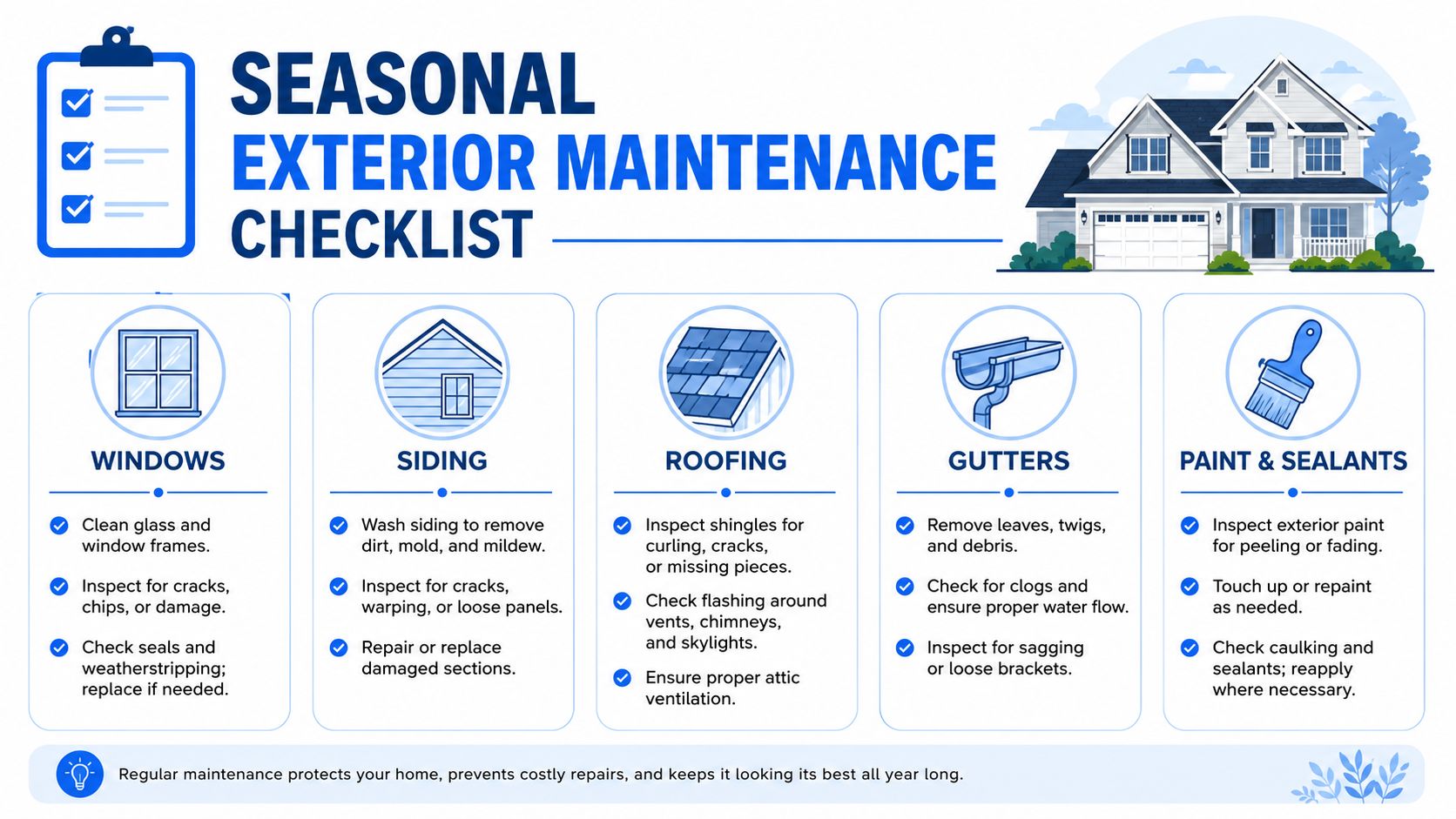
The fastest way to waste money is to treat every exterior task like it deserves the same interval and the same method. A better routine follows the component, not the month. That's especially true for owners in Phoenix, Las Vegas, and Denver, where the same building can face dust, sun, sudden rain, or freeze-thaw stress in different combinations.
For windows, the practical question is not just whether they look dirty. It's whether the seals, frames, and perimeter joints still hold. Professional window cleaners typically use two methods only, squeegee cleaning or a pure-water system, and both are legitimate when matched to the glass type and access conditions. In-ground work can often be done from ladder or pole access, while high or awkward glass usually needs a method that protects both the finish and the technician.
For siding and cladding, keep the inspection tight around joints, corners, and transitions. A façade checklist should include sealants and caulking around windows and doors, glazing damage, the waterproofing envelope, wall flashing, and problem points such as balcony concrete repairs or skylight and chimney connections (AMST). BC Housing also advises that any water ingress at exterior wall locations be reported immediately to the building manager, with cladding reviewed every year by a knowledgeable person and every 2 to 3 years by a building enclosure consultant (BC Housing).
Practical rule: bundle inspection, cleaning, and resealing in the same risk zone. Windows, parapets, and joints should not be treated like separate jobs when one failure can start all three.
Pressure washing has a place, but it's not universal. Technical guidance says it can remove dirt, mold, and algae, yet high pressure should be avoided on delicate materials like wood or vinyl because it can damage the surface (CCI). The safer sequence is inspect first, use the lowest effective pressure, and pair cleaning with repainting or refinishing when weathering has weakened the protective layer.
Roofs and gutters need their own rhythm. A general building-maintenance checklist recommends inspecting windows and doors at least annually, and checking roofs and gutters each fall and after major weather events, along with debris removal from gutters and downspouts (First Response MS). That's especially relevant where monsoon runoff or fall debris can clog drainage and push water where it shouldn't go.
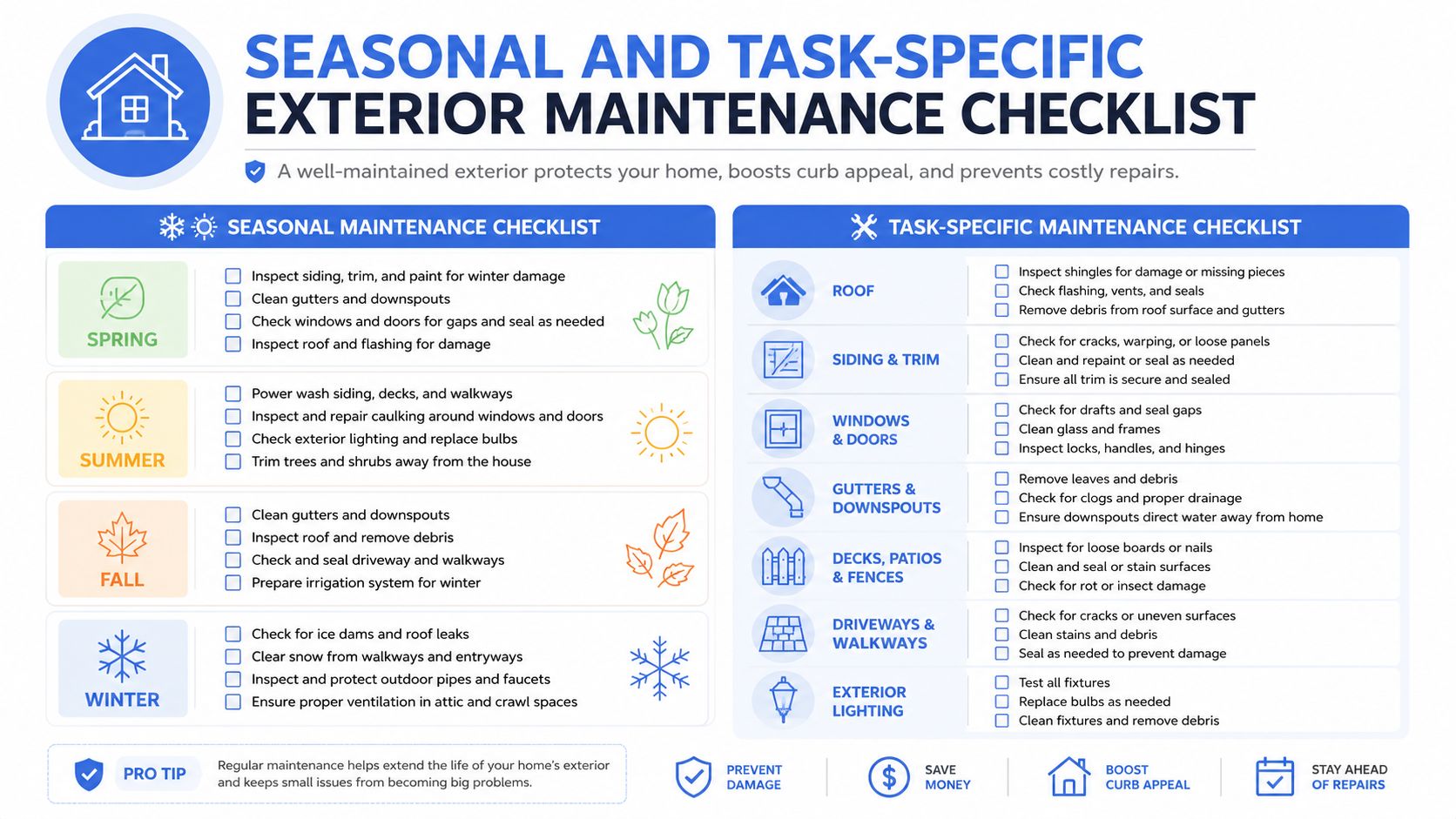
If you manage a property in Phoenix, Las Vegas, or Denver, the task order should follow exposure. Dust-prone glazing, cracked sealant, clogged drainage, and worn paint deserve attention before they become visible leaks or repeat callouts. That's the difference between a maintenance visit and a repair cycle.
Exterior work gets expensive when somebody falls. It also gets expensive when a well-meaning owner damages glass, dislodges flashing, or pressure-washes a sensitive surface into a bigger repair. The right choice depends on height, roof pitch, access, and how much risk the task creates for the person doing it.
Single-story gutter cleaning, ground-level debris removal, and simple visual inspections are reasonable for a handy owner with the right ladder and basic protective gear. Gloves, safety glasses, stable footing, and a spotter are not optional. Anything above one story, on a steep roof, or near a fragile façade belongs to a trained crew with proper access equipment.
High-rise or multi-story window work is in a different category entirely. That's where specialty contractors like Professional Window Cleaning come in, because the job needs both safe access and streak-free execution. In practice, that usually means the same crew is thinking about fall protection, water control, and the finish at the same time.
For roof-related concerns, it helps to use a specialist resource such as guide to roof inspection contractors from NW Claims Management when the question is not just cleaning, but who should inspect, document, and sign off on the roof condition. That's the kind of decision that saves money later because the right person spots the right failure mode early.
Some tasks are only hard, while others are unforgiving. A gutter line that's two stories up, a parapet edge with questionable footing, or a façade with hidden movement in the wall assembly is not a casual weekend project. Specialty crews have the gear and the habit of seeing the whole system, not just the dirty or damaged part.

If you manage buildings in Phoenix, Scottsdale, Las Vegas, or Denver, the value of a pro usually shows up in the details you don't want to relearn the hard way. Safe access, documented findings, and the right cleaning method matter more than squeezing one more job onto a Saturday.
A building exterior budget pays for itself when it stops the ugly, expensive surprises before they spread. The cheapest program on paper is usually the one that waits too long, then pays for swollen trim, failed sealant, clogged drainage, and repainting that could have been delayed with routine care. Many owners set aside a maintenance reserve around 1%–4% of replacement value, and older properties usually need to sit toward the higher end because heat, UV, dust, and water intrusion wear on the envelope year after year (DataIntelo).
A reserve also needs room for the unexpected. The 10%–20% contingency fund noted earlier gives a building some breathing room when a hidden joint opens up, a drain backs up, or a section of stucco needs attention sooner than planned (Midcontinental). That kind of cushion is what keeps a maintenance plan from turning into an emergency repair cycle.
Bundling saves money because crews are already on site and already set up. Inspection, cleaning, and sealing can happen in one visit when the condition calls for it, which cuts repeat mobilization and helps catch small failures before they become larger repairs. That same logic applies when exterior work is grouped with other property upkeep, and if you want to line up site-wide spending, the commercial landscaping cost guide is useful for comparing what belongs in the same budget.
For more details on professional exterior cleaning options, see our building exterior cleaning services guide.
| Month | Arizona (Phoenix/Scottsdale) | Nevada (Las Vegas) | Colorado (Denver) |
|---|---|---|---|
| January | Check sealant and window perimeters after cold snaps | Inspect glazing, paint, and dust buildup on exposed elevations | Watch roof edges and joints for freeze-thaw stress |
| February | Review south-facing stucco and trim | Flush debris from gutters and downspouts | Inspect flashing and parapet terminations |
| March | Clean windows and entry glass before spring exposure peaks | Schedule exterior cleaning on dust-prone sides | Look for cracks opening after winter cycling |
| April | Inspect drainage after spring storms | Check sealants around doors and vents | Review roof and gutter performance as weather shifts |
| May | Focus on UV-worn paint and caulk | Clean façades and scuppers before summer heat | Recheck joints on high-exposure elevations |
| June | Watch for heat-related cracking | Reinspect exposed sealant and trim | Plan midyear exterior review on vulnerable areas |
| July | Flush drainage after monsoon bursts | Clean gutters, scuppers, and runoff marks | Check windows, siding, and flashing on sun-exposed sides |
| August | Reinspect sealants after storm activity | Review roof edges and drainage paths | Spot-check joints that moved in summer heat |
| September | Repaint or reseal degraded surfaces | Schedule UV-focused reseal work | Prepare for fall roof and gutter inspection |
| October | Clean windows and verify drainage | Perform full exterior walkaround after summer wear | Inspect roofs and gutters in the fall cycle |
| November | Check parapets, joints, and window seals | Remove debris and confirm water runoff paths | Clear gutters and downspouts before freezes |
| December | Document any movement in stucco or trim | Review high-exposure elevations and plan repairs | Reassess exterior joints after the first freezes |
That calendar stays tied to exposure, not habit. A south-facing wall in Phoenix wears differently than a shaded elevation in Denver, and a dusty Las Vegas parapet does not fail for the same reasons as a freeze-prone roof edge in Colorado. The right schedule follows the material, the climate, and the first place the building shows stress.
Exterior maintenance pays off when it's steady, specific, and tied to what the building faces. Seal the crack before monsoon season, clean the glass before a listing or tenant turn, clear the drainage before the first freeze, and the envelope will usually reward you with fewer surprises.
If you're in Phoenix, Las Vegas, Denver, Scottsdale, or nearby service areas like Tempe, Chandler, and Gilbert, the right plan starts with a condition check and ends with documented follow-through. That's how a building keeps looking cared for, even after the weather has tried to say otherwise.
Professional Window Cleaning handles exterior window washing, high-rise window cleaning, and the kind of façade care that fits into a larger building exterior maintenance plan. If you want your property to look sharper and stay better protected, visit Professional Window Cleaning to request a quote or schedule a consultation.
Read our blog posts regularly and keep learning.