Care and Maintenance
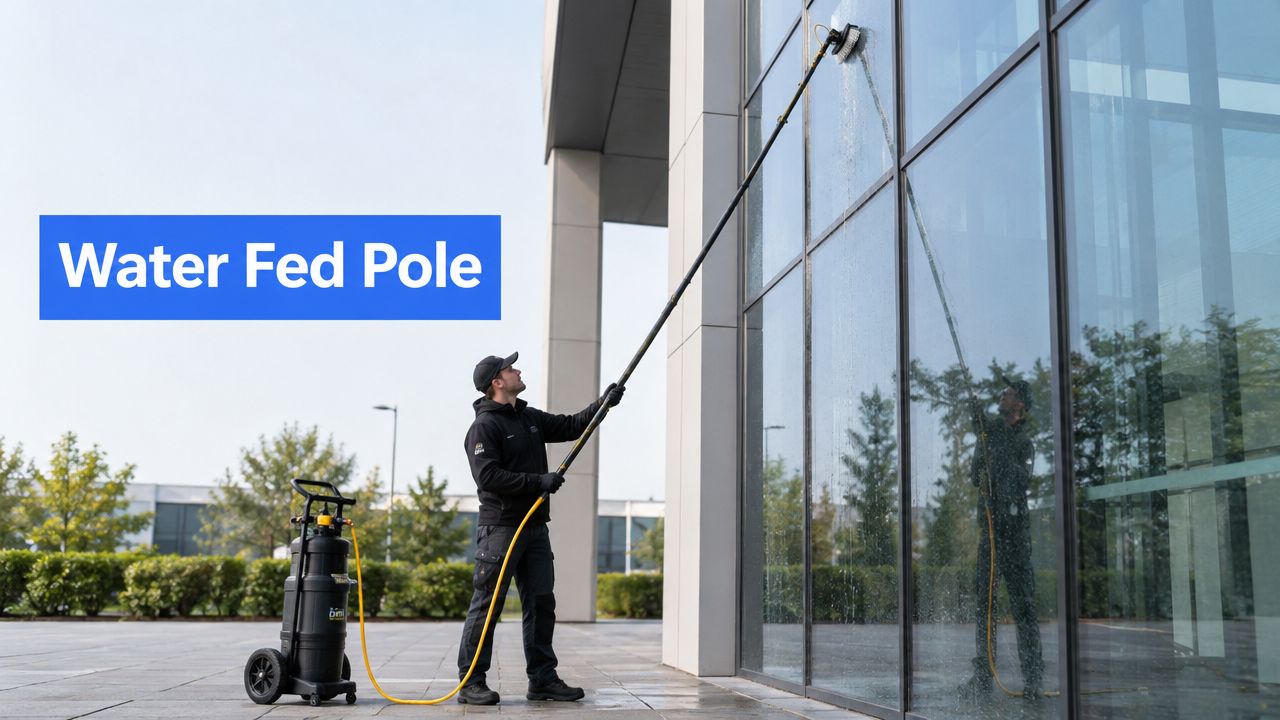
How Does Water Fed Pole Window Cleaning Work
Learn how does water fed pole window cleaning work, from purified water chemistry to telescopic poles, brush heads, safety benefits, and when to hire pros.


You're probably juggling the same mix of problems most new property managers face. A tenant complains that one restroom is out of supplies. A light is out in the parking area. The HVAC vendor says a unit needs attention before summer hits. Meanwhile, ownership wants costs controlled, the building to look sharp, and nothing to fail at the wrong time.
That's why commercial building maintenance services can't be treated as a loose collection of work orders. They have to run like an operating system for the property. When they do, the building stays safer, cleaner, more efficient, and easier to lease.
Commercial building maintenance starts where daily chaos usually begins. You're trying to keep occupants comfortable, protect the asset, avoid compliance problems, and stop small defects from turning into expensive disruptions.

The practical definition is simple. It's the coordinated care of everything that lets a commercial property function as intended. That includes mechanical systems, life safety, janitorial work, exterior upkeep, documentation, vendor oversight, and scheduled inspections.
Too many owners still see maintenance as a cost bucket. In real operations, it's a capital protection program. A clean, reliable building attracts better tenants, supports lease retention, and protects the value of expensive systems that are hard to replace on short notice.
That industry scale tells you this isn't a side concern. The global building maintenance services market reached $412.6 billion in 2025 and is forecast to reach $648.3 billion by 2034, with commercial buildings as the largest segment as outsourcing preventive maintenance becomes standard.
Practical rule: If a task protects safety, compliance, tenant comfort, or the building envelope, it belongs in your maintenance program, not in your “when we get to it” pile.
Grounds also matter more than many new managers expect. Parking lots, entry walks, irrigation zones, and planted areas shape first impressions and affect liability. If you're building a complete exterior budget, it helps to review understanding landscape maintenance costs so site appearance isn't managed separately from the rest of the property.
A solid program creates order in four ways:
The best property managers don't chase every problem manually. They build repeatable processes, assign ownership, and insist on documentation. That's what turns maintenance from reactive firefighting into controlled operations.
Every effective maintenance plan has a backbone. If you strip away the software, vendors, and reporting, you're still managing a few essential categories that determine whether the building works or frustrates everyone inside it.
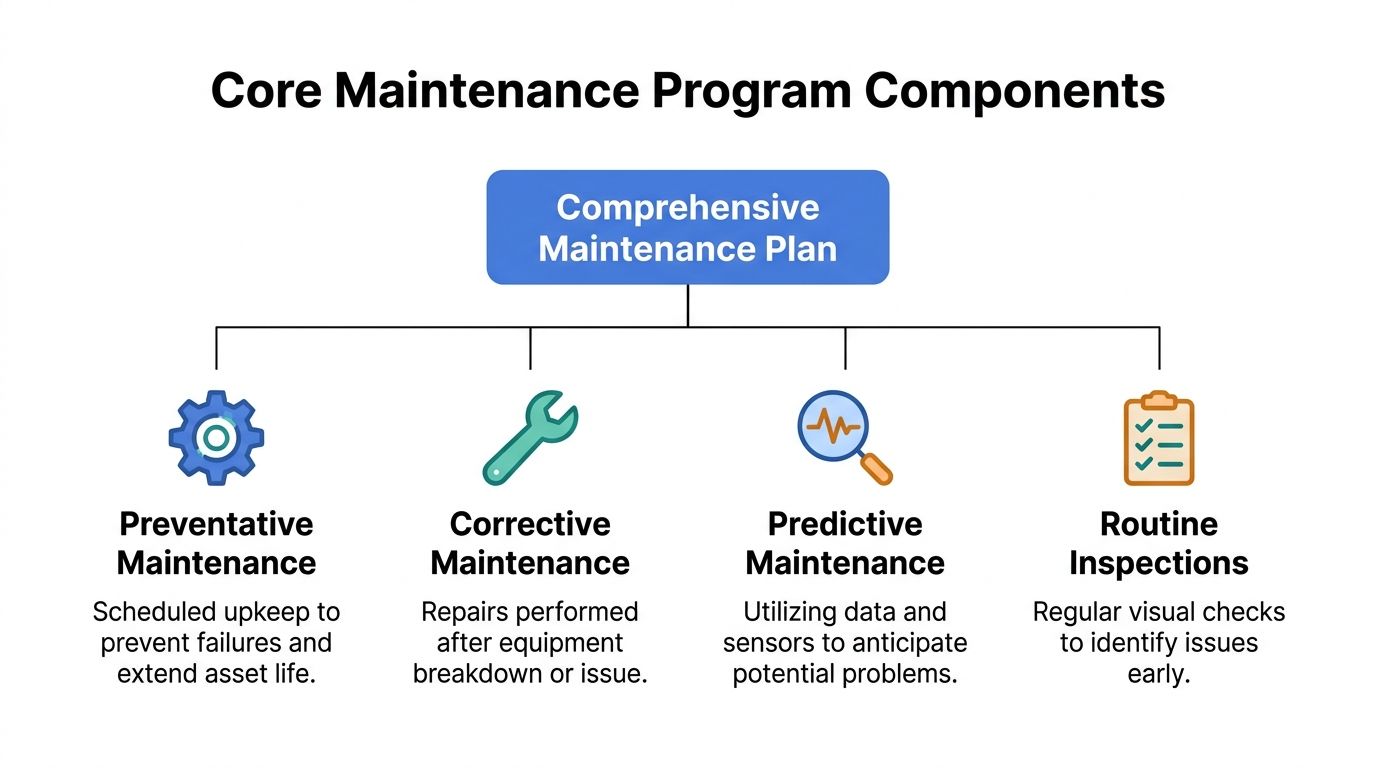
A useful way to think about the work is this. HVAC is the building's lungs. Plumbing and electrical are its circulation and nervous system. Janitorial work is daily hygiene. Exterior and grounds maintenance protect the shell and the reputation of the property.
If occupants are too hot, too cold, or dealing with stale air, you'll hear about it fast. HVAC maintenance covers air handlers, rooftop units, filters, thermostatic controls, and the inspections that keep airflow and temperature stable.
Good HVAC maintenance isn't glamorous. It's routine filter checks, coil condition review, drain observation, and early response to strange noise, vibration, or comfort complaints. Neglect shows up as uneven temperatures, rising complaints, and heavier wear on equipment.
These systems usually get attention only when they fail. That's a mistake.
Plumbing maintenance includes fixture function, leak detection, drainage behavior, shutoff accessibility, and water-related compliance tasks. Electrical maintenance includes panel checks, lighting reliability, device testing, and identifying signs of overheating or damaged components.
A property manager doesn't need to be an engineer, but they do need to know which symptoms mean “schedule it” and which mean “act today.”
Janitorial work is often undervalued because it looks routine. In practice, it shapes tenant perception every day. Dirty common areas, poorly maintained restrooms, and inconsistent waste removal make the whole building feel unmanaged, even if the mechanical systems are running fine.
Strong janitorial service does more than clean. It supports health, protects surfaces from premature wear, and helps staff spot problems early, such as leaks, damaged fixtures, odors, or pest activity.
Exterior work covers the envelope and the site. That means roofs, drainage paths, facades, entries, sidewalks, parking areas, landscaping, and windows. This category has a direct effect on curb appeal, water management, and long-term asset protection.
Some exterior issues stay hidden until they become expensive. Failed sealants, blocked drainage, neglected joints, and dirty glazing don't just hurt appearance. They can point to moisture risk and deferred repairs.
The work itself usually falls into four operating modes:
If you're refining workflows and accountability, this guide to elevate facilities operations is useful alongside a practical review of facility management best practices.
No single category carries the whole building. The building performs well only when these pieces are managed as one system instead of separate chores handed to separate vendors.
A maintenance schedule works best when it matches the pace of the building. Some tasks are daily because occupants notice them immediately. Others are weekly or annual because the risk builds more slowly but carries bigger consequences if ignored.
The structure matters. Effective maintenance requires adherence to standards such as SFG20, with daily tasks like waste disposal, weekly HVAC filter checks, annual structural assessments, and software-based task automation as a critical best practice. That combination of fixed frequency and condition-based action keeps the plan grounded in both compliance and reality.
Start with the tasks that keep the building usable every day. Then layer in inspection and servicing intervals for systems that degrade over time.
| Frequency | Task Area | Example Tasks |
|---|---|---|
| Daily | Janitorial and occupant-facing areas | Waste disposal, restroom cleaning, restocking paper goods and soap, lobby appearance checks |
| Daily | Safety and access | Walk common areas, note spills or trip hazards, confirm key access points function properly |
| Weekly | HVAC and indoor environment | Verify filter condition, inspect mechanical areas, review comfort complaints and recurring hot or cold zones |
| Weekly | Exterior and site | Walk entrances, sidewalks, parking areas, and drainage points for debris or visible damage |
| Monthly | Plumbing and electrical review | Check for leaks, fixture issues, lighting failures, unusual odors, or signs of wear in service areas |
| Monthly | Window and facade planning | Review glass condition, schedule cleaning cycles, and log any visible cracks, caulking issues, or water intrusion signs |
| Quarterly | Building envelope | Inspect roofs, joints, sealants, penetrations, and perimeter drainage with vendors as needed |
| Quarterly | Vendor performance and documentation | Confirm completed work, update records, and close unresolved items |
| Annually | Structural and major equipment assessments | Roof review, major equipment servicing, fire safety documentation, and broader asset condition review |
A checklist in someone's head isn't a system. Assign each recurring task to a named person or vendor, set deadlines, and require written completion records. If the building has multiple suites or service zones, break the schedule by area so nothing disappears into a general work order queue.
Use software if you can. The benefit isn't only convenience. It's accountability. When a system creates tasks based on real conditions, logs completion, and shows what's overdue, you stop relying on memory and hallway conversations.
Missed maintenance is often a tracking failure before it becomes a building failure.
Documentation isn't administrative fluff. It's proof that work happened, that inspections were completed, and that you acted when issues were found.
At minimum, keep records for:
A schedule should be easy to follow under pressure. If a new team member can't understand what has to happen this week, who owns it, and what good completion looks like, the schedule needs work.
Most maintenance budgets fail for one reason. They're built around expected service, but buildings don't always fail on schedule. A realistic budget accounts for routine work, known risk points, and a buffer for things you can't time perfectly.
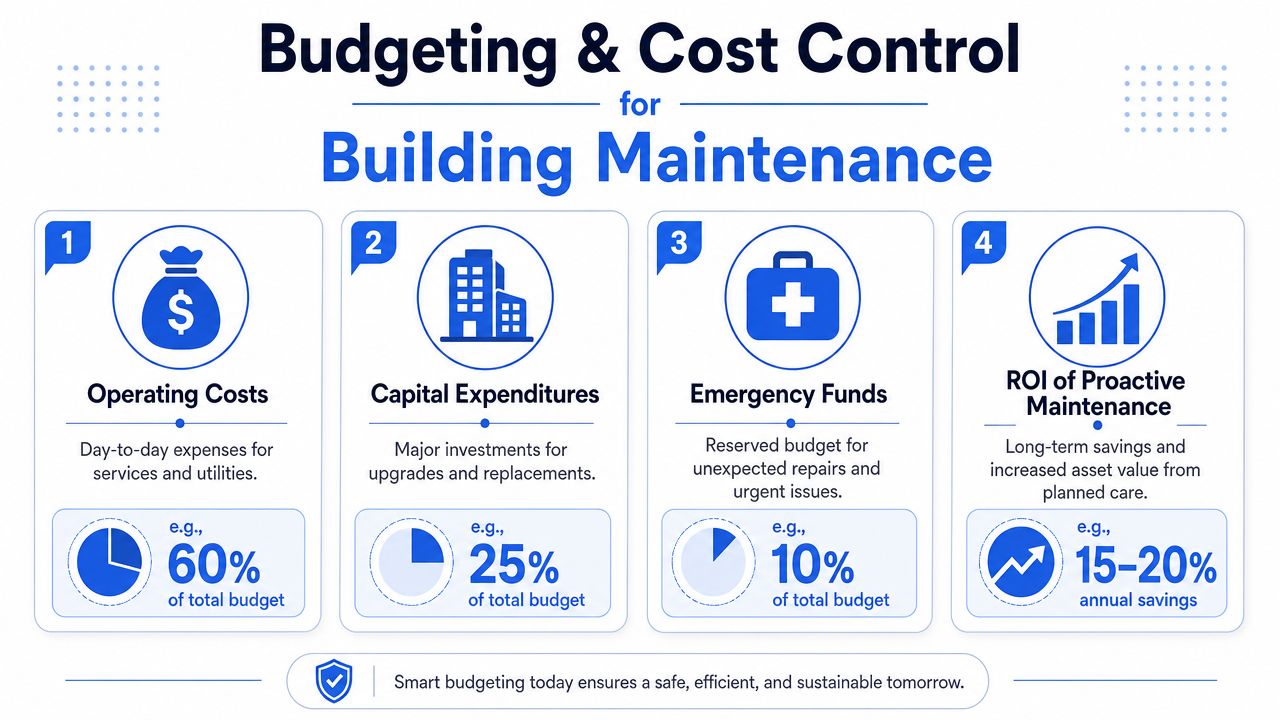
The useful benchmark is this. Average annual maintenance costs for commercial properties range from $2.00 to $2.50 per square foot, office buildings average around $2.15 per square foot, and total maintenance can account for 15% to 40% of operational costs. That's why maintenance budgets get so much scrutiny from ownership.
Two buildings with similar square footage can have very different maintenance costs. The main drivers are usually operational, not theoretical.
Reactive maintenance creates budget volatility. One ignored leak becomes drywall work, ceiling replacement, tenant disruption, and an emergency vendor call. The same logic applies to roofs, HVAC units, and facade details.
Planned work doesn't remove surprises completely, but it shifts more spending into categories you can anticipate. It also gives you time to compare vendor scopes instead of approving the first available emergency response.
Budget for maintenance like an operator, not a gambler. Predictable service beats expensive urgency.
Dynamic markets also matter. If you manage buildings in Phoenix or Denver, labor scheduling, weather exposure, and vendor availability can affect timing and pricing. That doesn't change the principles. It means you should review assumptions more often and avoid underfunding exterior care during heavy seasonal demand.
A property manager approves window cleaning to keep the building presentable. Six months later, a leak shows up at the perimeter of a storefront system, and the underlying problem turns out to be failed sealant that no one caught early. That is why professional window cleaning belongs in the maintenance program as a required inspection point, not a cosmetic add-on.
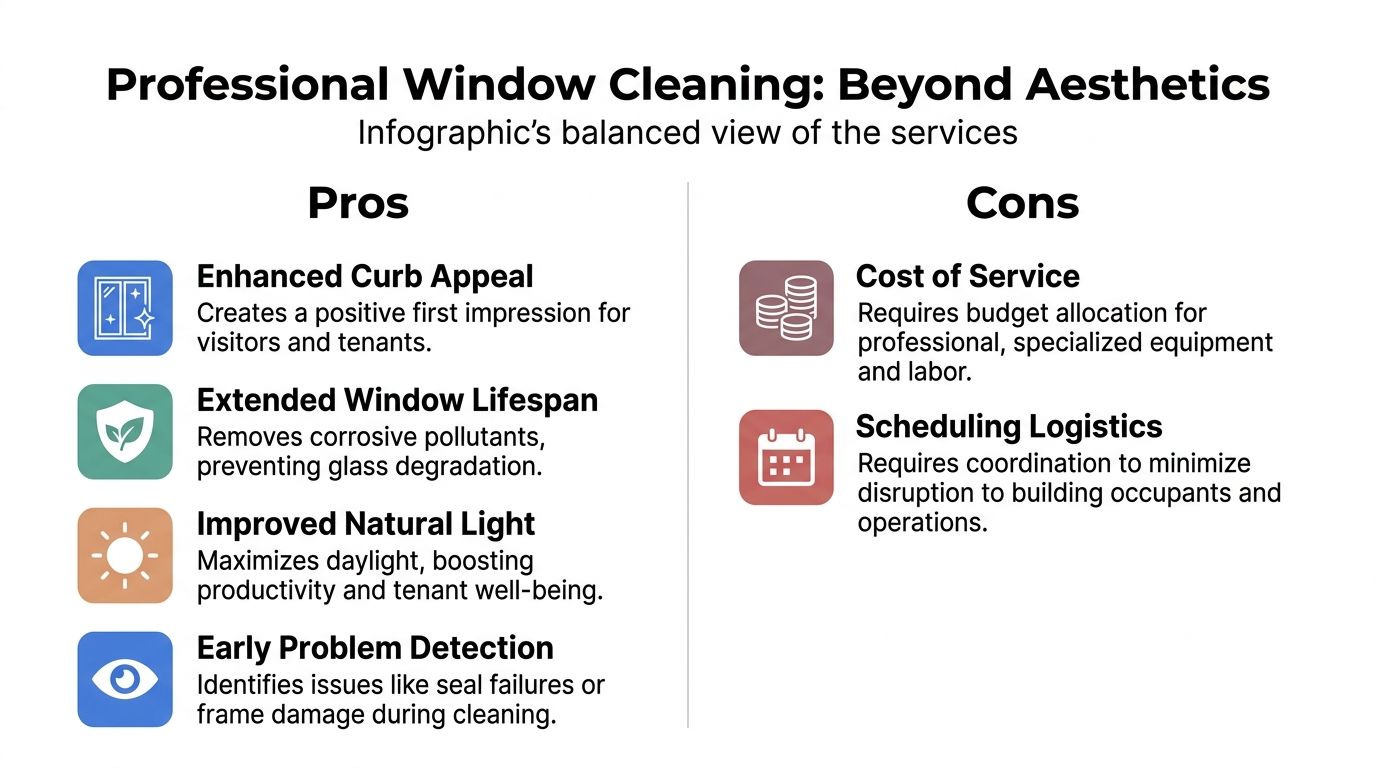
Clean glass improves appearance. The bigger maintenance value is access. Window cleaning crews work directly at glass edges, frames, mullions, joints, and facade transitions that building staff rarely see up close from the ground. If the crew is trained properly, every service visit becomes a chance to spot shrinking sealant, split caulk, movement at frame connections, staining below joints, and other early signs of water entry.
That matters most on multi-story buildings, curtain wall systems, and older storefront assemblies. Sealant rarely fails all at once. It dries out, pulls away, cracks, or loses adhesion in isolated sections first. Miss those early warnings, and a simple sealant repair can turn into interior drywall damage, stained finishes, tenant complaints, and harder-to-trace leak investigations.
Professional window cleaning should be treated as recurring exterior inspection work with a cleaning scope attached. Managers who separate the two usually miss problems in the exact areas where water gets in first.
This is one of the few routine services that puts trained eyes directly on vulnerable envelope details at a predictable interval. Roof inspections cover the top of the building. Window cleaning helps cover the vertical envelope.
There are two primary methods crews use in the field, and the right choice depends on access, finish expectations, and the condition of the glass and frames.
The trade-off is practical. Pure-water cleaning is efficient, but it is not automatically the right answer for every facade. Residue from past soaps, heavy oxidation, hydrophobic glass behavior, and frame condition can all affect the result. Good crews choose the method based on the building, not on what is fastest for them.
Here's a closer look at the work in action:
If you are comparing scopes or setting service standards, review what is typically included in commercial window cleaning services.
A useful service report does more than confirm the glass was cleaned. It should give you actionable notes on condition.
Crews should document:
Long experience matters here because the work is partly observational. Experienced technicians can usually tell the difference between surface dirt, mineral buildup, UV wear, and signs that a joint or perimeter seal is starting to fail. For properties in Las Vegas and Scottsdale, that judgment is especially useful because intense sun, dust, and heat speed up wear on exterior materials.
The practical standard is simple. If your window cleaning vendor is only washing glass and leaving, you are missing one of the best recurring opportunities to catch envelope problems early.
A vendor can have a polished proposal and still be the wrong fit for your building. What matters is whether they can perform safely, document clearly, and handle your property type without creating more management work for you.
Before you compare rates, verify the basics. The vendor should carry appropriate insurance, provide current documentation when asked, and understand the access, safety, and operational requirements of commercial properties like yours.
Ask direct questions. Have they worked on occupied office buildings, medical sites, retail centers, or high-rise properties like yours? Do they have a clear escalation process if they find something unsafe or outside their contracted scope?
Use a practical checklist:
The best maintenance vendors reduce uncertainty. They don't make you guess what happened, what they found, or what needs approval next.
Most buildings need a mix of providers. One vendor may handle janitorial work well but not exterior envelope observation. Another may be strong on HVAC service but weak on reporting. Don't force a single-provider model if it lowers quality in critical categories.
For managers overseeing assets in Arizona, Colorado, and Nevada, the strongest approach is usually a stable bench of specialists with clear roles, service standards, and reporting expectations. When vendors know what “done right” looks like on your property, the building gets easier to manage every quarter after that.
Start with this assumption. The building needs attention every day, but each system runs on a different cycle.
Restrooms, trash rooms, entries, and other occupant-facing areas need frequent service because small misses turn into complaints quickly. HVAC, roofs, life safety systems, lighting, drainage, and exterior surfaces should follow a written schedule based on building use, code requirements, manufacturer guidance, and failure risk. A busy medical office, for example, should not use the same maintenance cadence as a lightly occupied suburban office building.
Set the frequency by exposure, not preference. Traffic film, hard water, sprinklers, coastal air, dust, and public visibility all change the schedule.
Street-level retail may need monthly or even more frequent service. A mid-rise office in a cleaner environment may do well on a quarterly cycle. On taller buildings, I recommend treating window cleaning as part of exterior condition review, because each service visit gives you a chance to spot failing sealant, cracked glazing, blocked weeps, and early facade wear before those issues spread.
Property management focuses on the asset as a business. That usually includes tenant relations, leases, budgets, and overall financial performance.
Facility management focuses on building operations. It covers maintenance coordination, service delivery, work order follow-through, and keeping systems reliable for the people using the property. In smaller organizations, one person may handle both roles. The important part is making sure operational responsibility is clearly assigned.
Choose the structure that gives you better control, not just fewer phone calls.
One full-service provider can simplify scheduling and invoicing. Specialized vendors are often better for technical trades such as HVAC, fire protection, elevators, roofing, and exterior glass and facade work. The trade-off is coordination. If you use several vendors, you need clear scopes, reporting standards, and one person who owns follow-up across all of them.
Because it does more than keep the glass clean.
A good window cleaning program creates recurring access to the building envelope, which is where early warning signs often show up first. Crews can flag deteriorating sealant, failed joints, frame movement, drainage issues, and visible facade defects during routine service. That is one of the most overlooked parts of preventive maintenance. If no one is looking closely at those conditions on a regular basis, small exterior defects stay in place until they become leaks, staining, interior damage, or more expensive repairs.
If you need a partner that understands both appearance and asset protection, Professional Window Cleaning can help. Their team provides residential, commercial, and high-rise window cleaning, and brings decades of field experience to properties that need clean glass, sharper curb appeal, and better visibility into facade and sealant issues before they become bigger problems.
Walk the property and document what you see.
Start with life safety items, deferred maintenance, recurring tenant complaints, and any exterior conditions that could lead to water intrusion or access issues. Then build a basic maintenance calendar, assign responsibility for each task, and require written documentation from the start. A simple program that gets followed beats an ambitious program that never becomes routine.
Read our blog posts regularly and keep learning.