
Care and Maintenance
Best Squeegee for Cleaning Windows: Expert Comparison
Find the best squeegee for cleaning windows with our expert buying guide. Compare blade materials, handle types, and sizes


You can wash a pane, step back, and still watch the sun expose every streak you missed. That's the part homeowners and property managers hate most, the glass looks fine in the shade, then the light moves and suddenly the window reads as smudged, hazy, or spotted. Real sparkling clean windows come from a process that controls dirt, water, and drying, not from a quick spray and a paper towel.
That gap explains why window cleaning became a real professional trade. The industry has grown into a measurable market, with the U.S. window-washing market estimated at $2.9 billion and 35,344 businesses in a 2026 analysis, while the UK window-cleaning services market was valued at £467.0 million with 2,475 businesses in another 2026 report (IBISWorld U.S. window-washing industry analysis). That scale supports specialized labor, recurring service, and the two methods that hold up in the field, squeegee work and pure-water cleaning.
A lot of homeowners assume the answer is more effort. They wipe harder, spray more cleaner, and keep chasing the same streaks until the glass looks worse than when they started. The problem is usually a thin film of liquid, soap residue, or mineral spotting, and direct sun makes every flaw stand out.
Paper towels shed lint. Generic sprays can leave residue. Circular wiping tends to move dirt around instead of removing it cleanly. Windows also fail as a system, because screens, tracks, and frame edges hold dust and grit, so every wet pass can drag that contamination back onto the pane.
Practical rule: if the frame, screen, and track are dirty, the glass will not stay clean for long.
That is why professional cleaning starts before the glass gets wet. Loose grit gets removed first, then the glass is cleaned with a method that lifts soil off the surface instead of pushing it around. On older homes, storefronts, and high-rise work, that difference is what separates a quick shine from a finish that stays clear.
Dry, sunny, and mineral-rich regions make the problem worse. Water flashes off the glass too quickly and leaves spots behind, especially where hard water is common. That is why windows in places like Arizona, Colorado, and Nevada can look dirty again almost immediately after a casual wash.
The phrase sparkling clean windows sounds simple, but the result depends on four things working together, the right method, proper pre-cleaning, controlled drying, and careful attention to the edges. Industry history shows why the trade developed this way. Window cleaning became more necessary during the construction boom of 1860, the squeegee was invented in the early 1900s, Windex arrived in 1936, and the water-fed pole system changed the trade in the 1990s by making higher glass safer and easier to service.
That history still matters on real properties. A one-story ranch house, a storefront, and a glass-clad condo tower do not fail for the same reasons, but all three still need soil removal, proper finishing, and respect for how fast water dries on the pane.
The squeegee method is still the standard for accessible glass because it removes water in a controlled pass instead of waiting for it to dry. It works best when the process is disciplined. Skip the discipline, and you get chatter marks, edge lines, and puddles that dry into streaks.
Start with loose grit. A pre-rinse matters because dust and sand are what scratch glass and leave drag marks when you pull a blade through them. Then wash with a mild detergent solution, enough to loosen the film on the pane without flooding the whole surface.
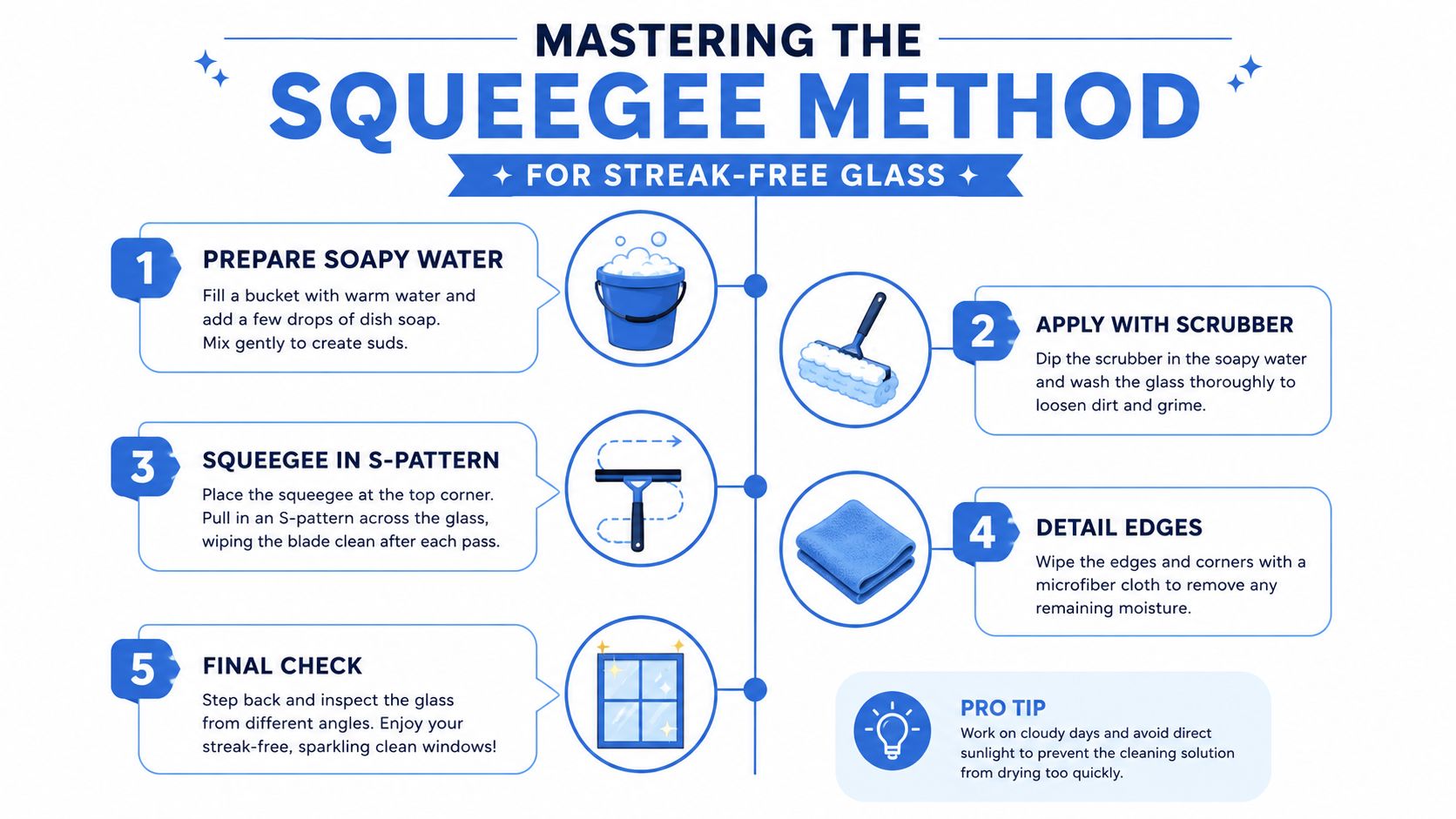
This Old House specifies a squeegee angle of about 30 degrees to the glass, and pro guides recommend overlapping each pass by roughly 1 to 1.5 inches so you don't leave visible bands or dry lines (This Old House pro window-washing guide). That small overlap is what keeps the finish even across wide panes.
Wipe the rubber edge after every pass. That habit is simple, but it's one of the biggest streak-killers in the trade because dirty rubber redeposits moisture and fine grit on the next pull. When the blade starts to drag or chatter, clean or replace it before you blame the glass.
Final detailing still matters. A lint-free microfiber towel takes care of corners and edges where water likes to hide, and that's where streaks usually show up last. One useful companion read is the two-towel method for windows, which reinforces the same idea, one towel handles the work, another finishes the edge.
Common mistakes are easy to spot. Too much liquid on the pane leaves extra drying time, and over-soaking makes streaking more likely. Pressing harder doesn't fix either problem, and aggressive pressure washing can damage or break glass.
Clean the glass, then dry the edge. Don't try to force the streak out with more soap.
For a fuller breakdown of hand technique, this internal guide on how to squeegee a window fits well with the field process described here.
On a high storefront, a wide commercial façade, or a house with stubborn hard-water spotting, the old bucket-and-rag routine starts to lose ground fast. The second core method is the pure-water system, and it belongs on exterior glass that would take too long, or be too risky, to finish by hand. It sends purified water through a water-fed pole, so the rinse dries without leaving mineral residue on the pane.
The practical benefit is straightforward. Regular tap water can leave dissolved minerals behind, which is why spots keep showing up on glass in hard-water regions. Purified or demineralized water removes that problem at the source, so the dry-down stays cleaner and more even, especially on upper floors and broad commercial fronts.
The trade-off is reach versus finish control. A squeegee gives tighter finishing on accessible windows. A pure-water system makes more sense when the glass is high, access is awkward, or the property needs efficient exterior maintenance across a large façade. That is why the trade has settled on two main methods instead of trying to force one tool to do every job.
For a closer look at the equipment side, the guide to pure-water window cleaning is a solid technical companion.
Pure-water poles became a common field tool in the 1990s, and they changed how much high glass a crew can handle safely in a day. That matters on commercial properties, because a tower, a dealership, or a multi-story office building often needs a method that reaches high panes without turning the job into a ladder-heavy operation.
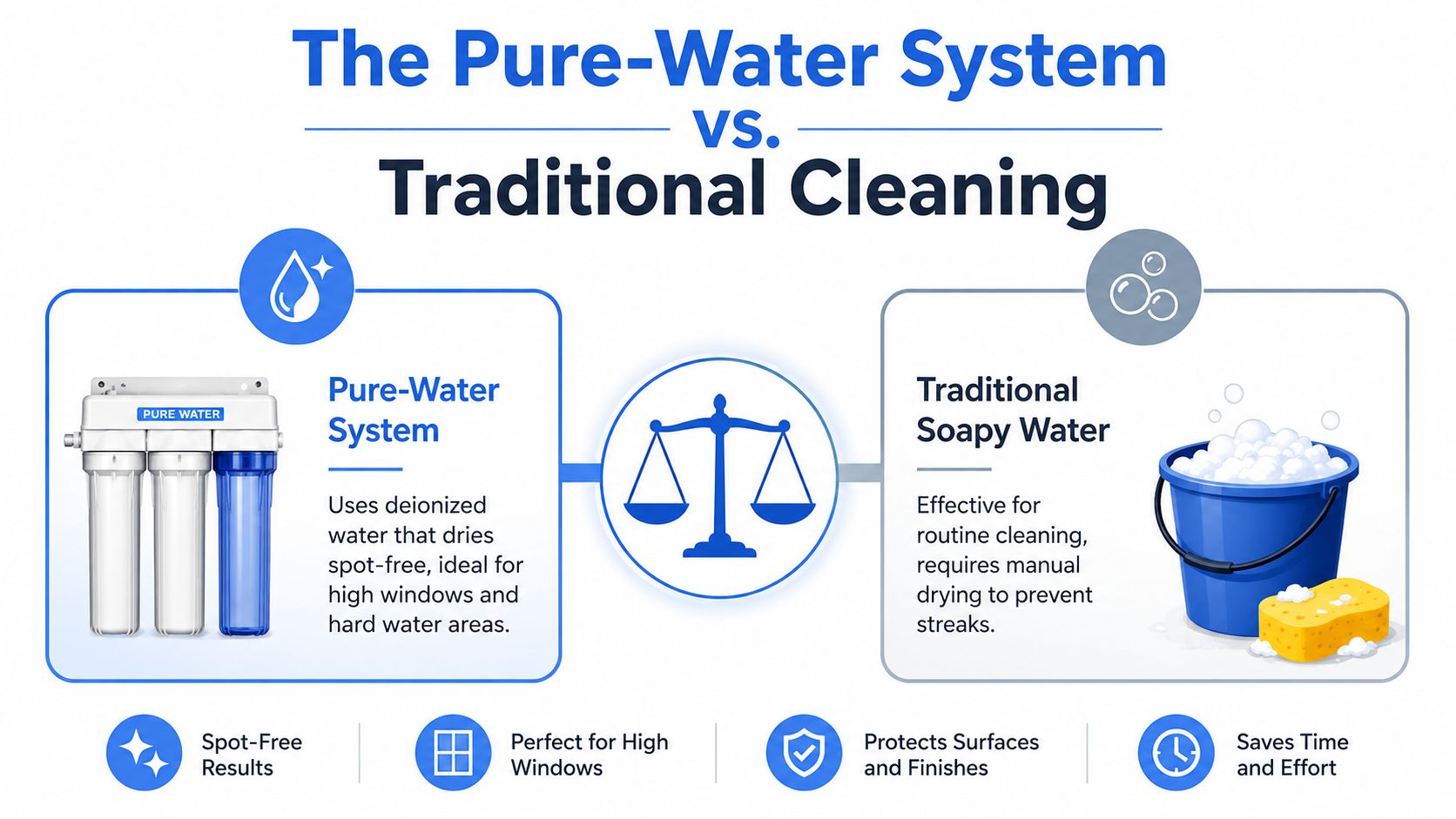
The right choice is not about loyalty to one tool. It comes down to the property, the access, and the finish you need. Pure water wins when reach, speed, and spot-free drying matter more than hand-finishing every inch.
Arizona, Colorado, and Nevada punish lazy window cleaning. The sun dries solution too fast, irrigation spray leaves mineral marks, and fine dust keeps coming back to the frame, track, and screen even after the glass itself looks clean. That's why a routine that works in a humid or overcast market can fail badly in Scottsdale, Tempe, Chandler, Gilbert, Las Vegas, or Denver.
Direct sun is the enemy of a clean finish because heat speeds up evaporation. Both The Spruce's pro cleaning guidance and Marvin's care advice say to avoid direct sunlight so the solution doesn't dry too fast and leave streaks. In practice, early morning or cloudy conditions are safer bets.
For exterior rinsing, distilled or demineralized water can make a real difference when mineral spotting keeps coming back. That matters most where hard water or sprinkler overspray hits the lower panes. If the glass is already loaded with residue, a standard spray-and-wipe mix often just moves the spot around instead of removing it.
Dust, pollen, and screen debris should come off before the glass gets wet. Good Housekeeping and The Spruce both note that contamination on screens and tracks can redeposit onto the pane and leave haze or drag lines (Good Housekeeping window cleaning tip). I've seen that happen on plenty of properties, the glass gets polished, then the next rain or rinse pulls grime back down from the frame.
That's why the order matters:
Outside glass usually needs more work than inside glass because bonded grime and mineral residue are heavier outdoors.
That's also where many DIY jobs go wrong. A homeowner sees the pane first and starts there. A professional sees the contamination path first and breaks it at the frame, screen, and track before touching the blade or towel.
There isn't one clean-looking calendar rule that works for every property. Window frequency depends on exposure, use, and how noticeable the glass is to customers, tenants, or guests. A street-facing storefront and a protected interior office window don't age at the same pace.
Windows that face traffic, dust, irrigation spray, or active landscaping need attention more often than sheltered glass. Interior panes in low-exposure spaces can go longer between cleanings, especially when the goal is presentation rather than removing outdoor buildup. The point is to match service to contamination, not just the month on the calendar.
For commercial sites, that usually means checking the glass from the outside first. If the lower panes are collecting dust, pollen, or spots, the visible impression goes downhill fast. A building may feel clean inside and still look neglected from the curb.
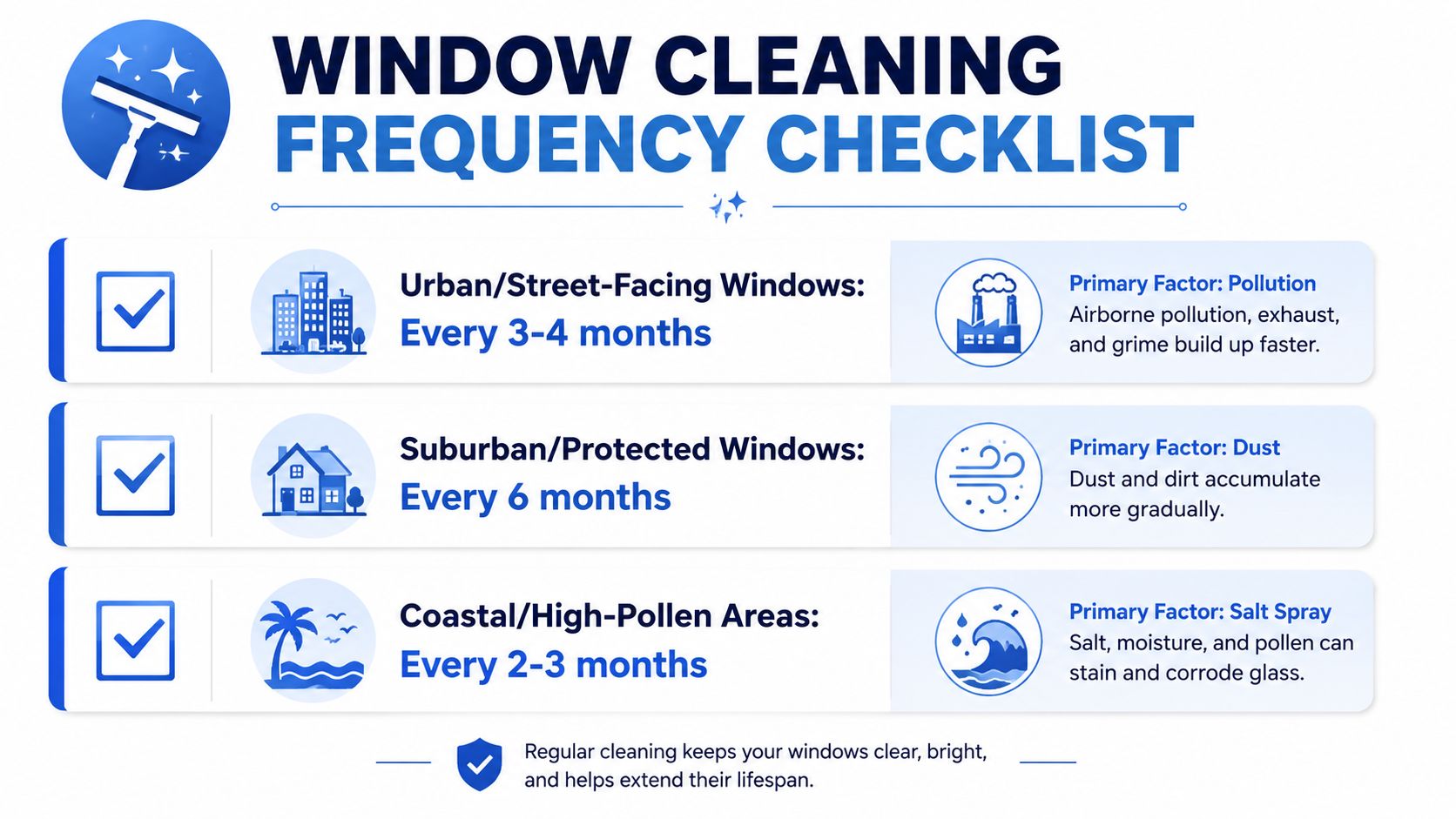
The right schedule is often a compromise between appearance and budget. Property managers in Las Vegas, Phoenix, Denver, and Scottsdale usually get the best results when they track where dirt appears first, then build the service rhythm around those problem areas instead of the entire building at once.
DIY is fine when the glass is reachable, the frame is simple, and the result only needs to look decent from a few feet away. Once height, scale, or image become part of the job, professional service starts making more sense. High-rise buildings, car dealerships, stadiums, and medical offices all fall into that category.
A single-story home with a few easy windows is one thing. A property with tall façades, specialty glass, or public-facing entrances is another. The bigger the glass surface, the more likely a crew needs water-fed poles, suspension gear, or a pure-water setup to do the job safely and efficiently.
Safety matters as much as appearance. Working at height creates real risk, and a professional crew is there to handle that risk with the right equipment and workflow. For commercial properties, that also protects operations, because clean glass is part of the customer's first impression and the tenant's daily experience.
If you're also maintaining painted or coated frames, the guide by Newline Painting is useful background on how frame condition affects the whole window system.

For property managers overseeing locations in Flagstaff, Las Vegas, Denver, Scottsdale, Tempe, Chandler, and Gilbert, recurring service is often the cleaner business decision. It keeps the glass consistent, reduces emergency cleanup, and removes the guesswork from scheduling.
If you want better DIY results, start with the squeegee, not another spray bottle. Clean the screens and tracks first, work out of direct sun, and finish the edges before the pane dries. If the building is tall, the access is awkward, or the climate keeps leaving spots behind, the pure-water method is the better fit.
Professional Window Cleaning has spent over 26 years in the field, and that kind of experience teaches one simple lesson. Sparkling clean windows come from matching the method to the property, the weather, and the glass itself. Get those three things right, and the results stop being a surprise.
If you're ready to get your windows cleaned the right way, Professional Window Cleaning can help with residential, commercial, and high-rise service across Arizona, Colorado, and Nevada. Reach out when you want a cleaner finish, safer access, and a maintenance plan built around real field conditions, not guesswork.
Read our blog posts regularly and keep learning.