Care and Maintenance
Soft Rubber Squeegee: What It Is and When to Use It
Learn what a soft rubber squeegee is, how it compares to other blades, and when pros choose it for streak-free window cleaning in homes and high-rises.


You're standing in front of a window with grit packed into the track, pollen on the frame, and a stiff utility brush in your hand. It looks like the fastest way to clean everything at once. It's also how coated glass gets hairline marks and how dirt from a sill ends up smeared across a pane. A hand held brush is useful on a window job, but only when you match the bristle, shape, and handle to the surface directly under it and know where brushing should stop.
| Brush type | Bristle material | Stiffness | Shape | Handle | Best job |
|---|---|---|---|---|---|
| Soft nylon scrub brush | Soft nylon | Soft | Flat block | Short fixed | Frames, screens and sills on coated glass |
| Horsehair dusting brush | Natural horsehair | Soft | Flat or round | Short fixed | Cobwebs and loose dust before washing |
| Polypropylene utility brush | Polypropylene | Medium | Flat block | Short fixed or telescoping | Detergent-heavy frame cleaning |
| Tampico fiber scrub brush | Natural agave fiber | Firm | Flat block | Short fixed | Heavy grime on exterior frames and masonry edges |
| Stiff nylon track brush | Stiff nylon | Stiff | Narrow track head | Short fixed | Aluminum tracks and sill channels |
| Water-fed pole brush | Nylon head | Medium | Round or flat head | Threaded pole | Exterior glass in the pure-water method |
Start at the soft end. A soft nylon scrub brush handles routine frame, screen, and sill work without treating every surface like concrete. A horsehair dusting brush is even more limited, and that's the point. Use it before washing to lift cobwebs and loose dust so that debris doesn't turn into mud once water hits it.
Move up only when the surface allows it. Polypropylene suits detergent-heavy frame cleaning because the bristle tolerates cleaning solution well. Tampico fiber gives you more scrubbing force for heavy exterior grime and masonry edges, while a stiff nylon track brush belongs in aluminum tracks and narrow sill channels where packed grit resists softer bristles.
Five rows are true hand held brushes for preparation, frames, tracks, and screens. The sixth is different. A water-fed pole brush is the cleaning head of the pure-water method, not just a brush on a longer handle.
Professional work uses two primary operating methods, traditional hand cleaning with a scrubber and squeegee, and pure-water cleaning with a water-fed brush, as explained in this overview of squeegee and pure-water window cleaning methods. In the squeegee method, solution loosens soil and the blade pulls dirty water off before it dries. In the pure-water method, water is stripped of dissolved minerals, pumped through a pole to the brush, agitated across the glass, and rinsed so it can air-dry without mineral spots. That's why squeegees suit interior and detailed glass, while water-fed systems suit exterior glass that's harder to reach safely.
Practical rule: Choose the bristle for the surface under the brush, not for how dirty the frame looks.
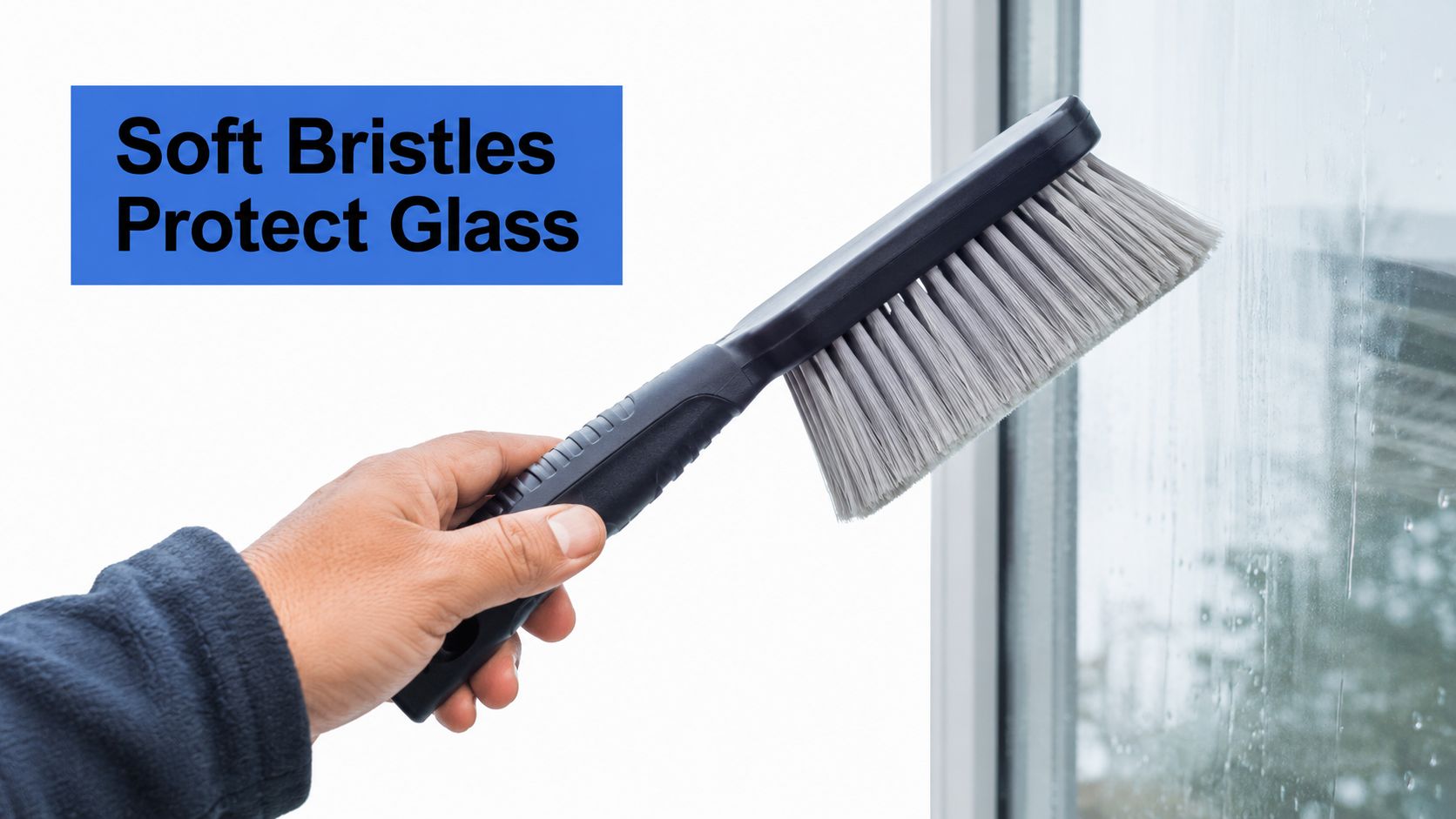
Coated low-E glass is where the most avoidable damage happens. The glass looks dirty, so someone reaches for a firmer brush and presses harder. If grit is trapped under those bristles, each stroke can drag it across the coating and leave hairline marks that only show up later in angled light.
| Surface | Recommended stiffness | Bristle type | Caution |
|---|---|---|---|
| Coated low-E glass | Soft | Soft nylon or horsehair | Trapped grit under firm bristles can leave hairline marks |
| Tinted or film-covered glass | Soft | Soft nylon | Avoid abrasive pads and firm bristles |
| Acrylic or polycarbonate panels and skylights | Soft | Soft nylon | Plastic scratches more easily than glass |
| Painted or powder-coated frames | Medium | Medium nylon | Rinse before scrubbing to avoid dragging grit |
| Vinyl frames | Medium | Medium nylon or polypropylene | Stiff bristles can scuff the finish |
| Aluminum tracks with embedded grit | Stiff | Stiff nylon or polypropylene | Use only on tracks, never on glass |
Treat stiffness as a dial, not a measure of quality. Coated, tinted, and film-covered glass all stay at the soft end. A firm brush doesn't clean a delicate surface better. It concentrates pressure through fewer bending bristles and gives trapped particles more force against the surface.
Acrylic and polycarbonate need the same restraint. They're plastic, not glass, and they scratch more easily. A brush that feels harmless on a frame can haze a skylight panel quickly, especially if you scrub a dry surface or reuse a brush that just came out of a gritty track. Keep a separate soft brush for these panels if you clean them often.
Painted and powder-coated frames tolerate medium nylon, provided you rinse loose grit away first. Vinyl also handles medium nylon or polypropylene, but stiff bristles can scuff its finish. Aluminum tracks are the exception that justifies stiffness. Packed soil, sand, and oxidized debris sit in narrow channels, and a stiff track brush can break that material loose without needing excessive downward pressure.
Material changes how stiffness behaves when wet. Nylon keeps its shape well around water. Polypropylene is a practical choice where detergent exposure is frequent. Natural fibers soften when wet, which makes them better for dusting and light agitation than forceful scrubbing. A natural brush that feels firm in the store may feel noticeably different after it's soaked.
Don't test your choice across the center of a pane. Pick a small hidden area and use the lightest pressure that moves the soil. Rinse the spot, let it dry, then inspect it under raking light from the side. Look for haze, fine lines, or a patch that reflects differently from the surrounding surface.
If the test spot stays clear, work the rest with the same brush, pressure, and stroke direction. Softer is safer on any glazed surface. Reserve stiffness for tracks and durable frame areas only.
A good bristle on the wrong head still makes the job harder. Shape determines whether bristles reach the soil or bridge over it, and handle design determines whether your wrist stays neutral or bends for every stroke.
Handles need the same job-by-job thinking. A short fixed handle under about 30 cm gives control for detail work. Telescoping poles from roughly 1.5 to 3 m let you reach upper frames from the ground. Threaded adapters connect suitable heads to poles, while contoured grips help when your hands are wet or the work repeats across many windows.
Check grip diameter first. About 30 to 40 mm is a common comfortable range, but hand size matters more than the printed claim. Next, look for balanced weight rather than a heavy head, because a head-heavy brush makes you grip harder. Keep your wrist as neutral as the surface allows, and notice whether the task really suits one hand or needs two for control.
Water-fed work adds another requirement. The head has to agitate while water moves through it, so an open-packed head generally rinses more freely on a pole than a dense block that traps loosened soil. That sequence matters because the brush first agitates dirt, purified water rinses it away, and the final rinse evaporates naturally, a process described in this explanation of pure-water agitation and mineral-free rinsing. Ordinary tap water can leave dissolved solids behind, while demineralized water dries with substantially less residue.
Before buying, measure three things: the reach you need, the grip diameter that fits your hand, and the loaded weight with water in the head. If you're comparing pole equipment, this guide to a water-fed pole window cleaning brush is the relevant starting point.
| Setting | Typical reach | Brush focus | Handle | Main risk |
|---|---|---|---|---|
| Ground-floor residential | Under 3 m | Soft nylon and horsehair for frames, sills and screens | Short fixed plus short telescoping | Dragging grit across glass |
| Two-storey home or condo | 3 to 6 m | Frame brush at height | Telescoping pole | Overreaching a ladder |
| Commercial storefront | 2 to 4 m | Heavy frame and track brush | Short pole plus fixed handle | High volume pushes crews toward the wrong tool |
| Office or medical building | 3 to 6 m | Low-shedding nylon for hygiene | Pole with threaded adapter | Fibers and residue left on glass |
| High-rise | Beyond 6 m | Frame and track brushes only | Crew equipment | Height and access |
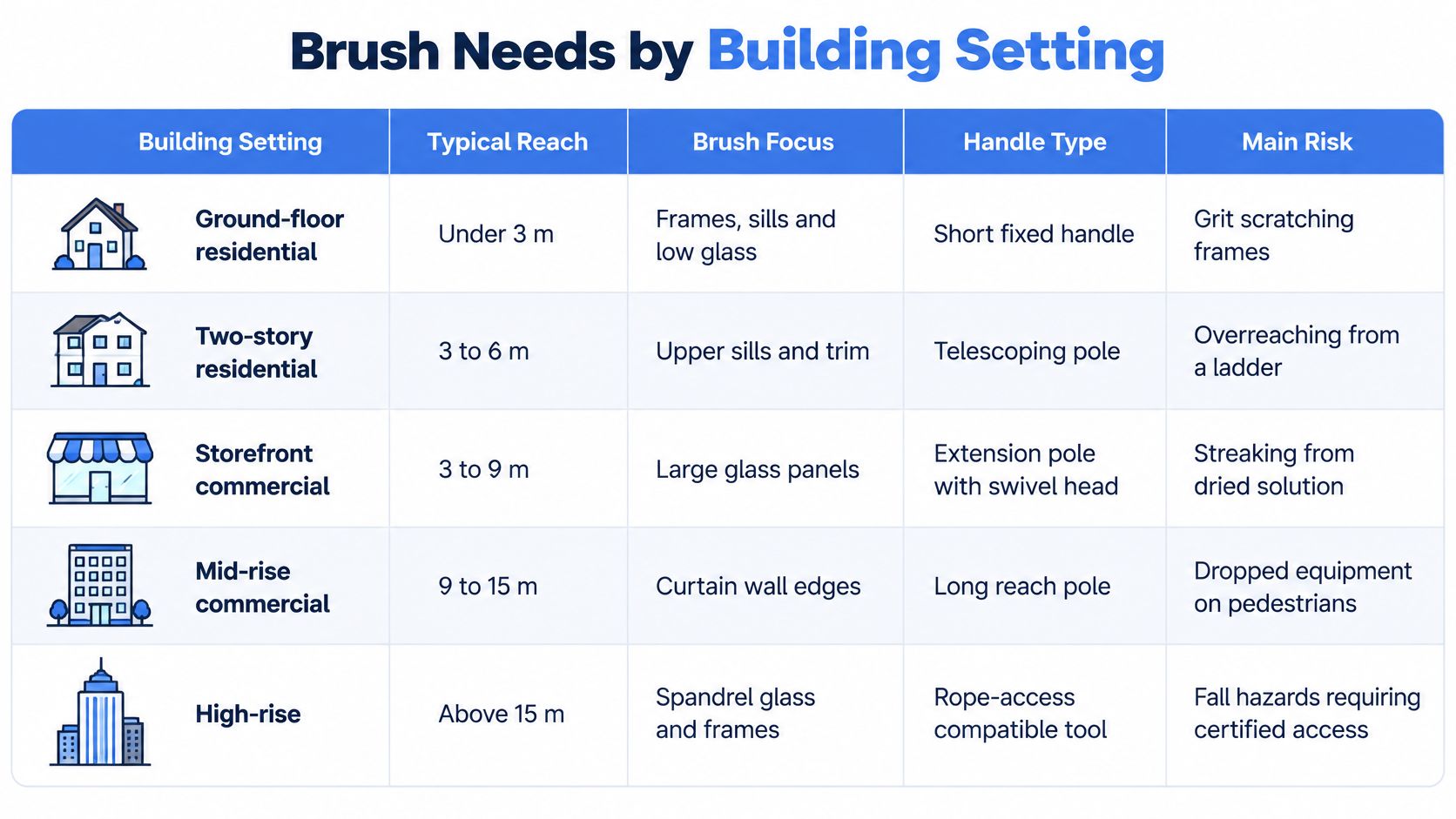
At ground level, most brush work is preparation. You're clearing screens, sills, frames, and tracks so the final glass cleaning doesn't pull that debris back onto the pane. A short fixed handle gives feedback through your fingers, which helps you notice grit before you press into it. A short telescoping handle is enough for slightly higher frames without turning a simple job into pole work.
Two-storey homes change the risk. The brush itself may be the same, but your position isn't. People lean from ladders to finish one last corner, angle the head poorly, and compensate with pressure. A telescoping pole used from stable ground gives less tactile control, yet it's safer than overreaching. Reduce pressure, rinse more often, and don't use pole length as an excuse to scrub surfaces you can't inspect.
Desert conditions alter frequency as much as technique. In Las Vegas, dust and hard-water residue build heavily around exterior frames, so frames and tracks often need brushing before glass work can stay clean. The answer isn't a stiffer brush everywhere. It's earlier dry removal, better rinsing, and keeping track tools away from coated panes.
Storefronts collect handprints near doors, grit at thresholds, and heavy soil along low frames. Crews moving quickly reach for one familiar brush and use it everywhere. That habit causes trouble when a track brush migrates onto tinted glass or a frame brush carries grit to the next pane. Separate heads by task and rinse them between zones.
Office and medical buildings favor low-shedding nylon because loose fibers and residue are unacceptable around finished interiors and sensitive settings. A threaded pole adapter helps reach higher frames, but hygiene depends on cleaning and drying the brush, not merely choosing a synthetic bristle.
Professional Window Cleaning reports operations since 1999 and describes residential, commercial, and high-rise work in its company profile covering its service footprint and property types. Across those settings, reach and access decide whether a technician uses a squeegee or a pure-water system. The hand held brush supports that choice, but it doesn't replace it.
For high-rise work in Denver, a brush is mainly a frame and track tool in the hands of a properly positioned crew, while the glass receives its proper finish through professional access and technique. Height, wind, anchor points, and dropped-object risk matter more than bristle preference.
Set the practical ground-pole limit at 6 m for this guide. Above that point, working a telescoping or water-fed pole from the ground stops being the safe default, and a trained crew with suitable access equipment should take over.
Scrubbing harder doesn't automatically make glass cleaner. On a pane carrying sand or fine grit, a brush can spread abrasive particles over a wider area and increase scratch risk. The brush has a job, but it isn't the final glass pass in the squeegee method.

The squeegee method uses cleaning solution to loosen and suspend soil. The squeegee then drags contaminated liquid off the glass before it dries. A brush supports this method by scrubbing frames, breaking loose stubborn deposits, and preparing tracks and edges. It doesn't remove dirty water from the pane.
The pure-water method works differently. A water-fed brush agitates the surface while purified water flows through the head, then the mineral-free rinse carries soil away and dries without the spots ordinary water can leave. Here, the brush is the cleaning head of the system, not a preliminary accessory.
Dry brushing is narrower still. It's effective for cobwebs, loose dust, and pollen on frames, tracks, and screens. It doesn't wash bonded soil from glass and shouldn't be treated as a finish. If dry debris remains in a corner, remove it before wet work turns it into slurry.
Damp microfiber can outperform paper towels and newspaper for streak-free finishing because it attracts dust electrostatically and absorbs more solution, as noted in this testing-based guide to cleaning windows glass and mirrors. That doesn't create a third professional method. Within the squeegee method, microfiber is a detailing and finishing tool for edges, drips, and suitable glass surfaces after the main liquid removal.
I've seen the opposite sequence cause needless work. Someone brushes the entire pane, pushes gritty water into the edges, then tries to fix the result with extra wiping. Remove loose abrasive particles first. Rinse or dust the frame and track, test an inconspicuous area on coated, tinted, or acrylic material, and only then apply pressure where the surface allows it.
That order matters more in Arizona, Nevada, and Colorado, where windblown dust, pollen, grit, and hard-water residue create different problems from ordinary indoor dirt. Hard-water deposits may need targeted treatment, while dry grit needs removal before friction. Treating both as generic dirt leads people to scrub longer and press harder.
Choosing the blade matters as much as choosing the brush, which is why this breakdown of the best squeegee for cleaning windows belongs in the same decision. The rule stays simple, the brush loosens soil, and the squeegee or pure-water rinse finishes the glass.
A dirty brush doesn't stay neutral. It carries grit from the last track into the next frame, holds moisture at the ferrule, and slowly loses the shape that made it useful. Maintenance takes minutes, but it has to happen in the right order.
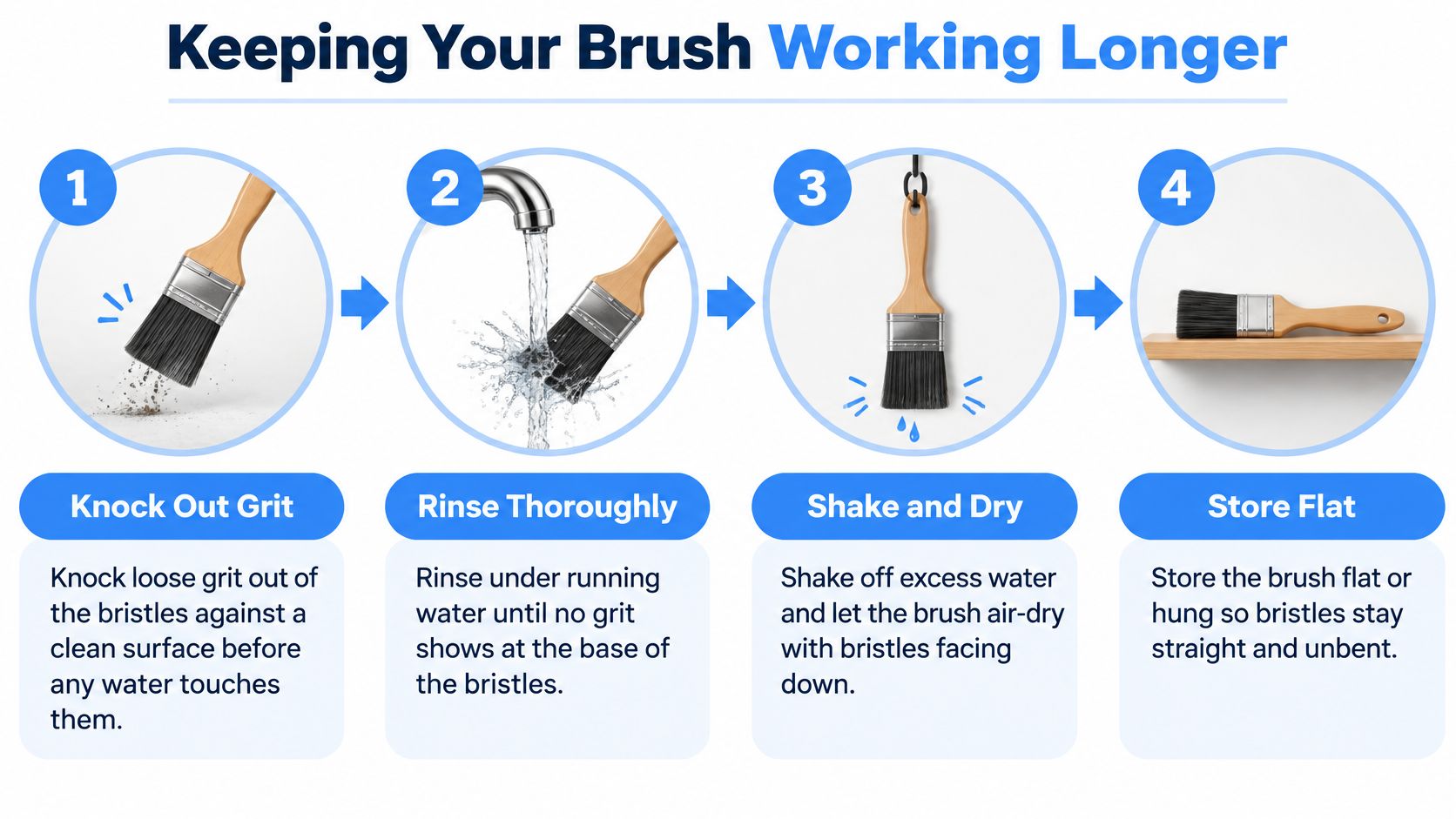
Antimicrobial bristle claims don't replace this routine. Rinsing, removing trapped debris, rapid drying, and ventilated storage do the operational work. A brush stored wet in a closed bucket stays dirty no matter what the packaging promises.
Retire a hand held brush when splayed bristles don't recover after rinsing, tufts are missing or permanently bent, the ferrule or handle joint moves, or the head collapses unevenly under light pressure. At that point you're compensating with force, and the surface pays for it.
Wear shows up in your arm before it shows up on the glass. The same checks that matter when choosing a brush apply when deciding to retire one: a grip diameter your hand closes around without squeezing, a head that stays balanced once it's loaded with water, and a wrist that holds a neutral angle through the stroke. A loosened joint or warped handle defeats all three. I've scrapped brushes whose bristles still looked acceptable because a wobble at the ferrule forced me to grip harder and push my wrist forward on every pass. The brush kept cleaning. My forearm paid the difference.
Rinse and dry the brush at the end of each job, not at the end of the week.
The wrong brush usually looks harmless until the frame starts scratching or the glass dries with haze in the corners. Run this check before water, detergent, or pressure touches the surface. It takes less time than correcting damage across a full wall of windows.
A homeowner cleaning ground-floor windows usually needs a soft nylon brush, a separate track brush if the channels are packed, and a short telescoping pole for upper edges within safe reach. Adding a stiff all-purpose brush creates more risk than capability.
A property manager handling a storefront needs at least two heads, one for frames and one for tracks, plus a daily rinse and drying routine. Volume makes cross-contamination likely, so separation matters more than owning premium handles.
A high-rise or large exterior job calls for a professional crew once reach or height passes the safe limit. Professional Window Cleaning is one next step in that situation. The question is whether the operator can control pressure, inspect the result, and work without creating a fall or dropped-tool hazard.
Finish with the one-window test. Clean a single window using the chosen brush and full finishing method, then inspect the dry glass under raking light. Check the corners, track edges, and any coated area before repeating the setup across the building. If that first window shows haze or fine lines, stop and change the brush. One pane is a test. Twenty panes are a pattern you will have to explain.
If reach, coated glass, or heavy desert grit makes the brush decision risky, Professional Window Cleaning can handle the frames, tracks, and glass with the appropriate squeegee or pure-water method for your property. Visit Professional Window Cleaning to request service for your home or building and get the work finished without turning a prep tool into a source of damage.
Read our blog posts regularly and keep learning.