
Care and Maintenance
High Rise Windows Explained for Building Owners
Learn what high rise windows are, how they work, and how to hire pros to clean and maintain high rise windows safely and efficiently.


You've scrubbed the glass, wiped the frames, and pulled the blade across the pane. Then the sunlight catches the window and exposes a trail of fine streaks, dirty corners, and water left behind at the edges. Repeating the same passes usually doesn't solve the problem. The wrong blade, a bent channel, or a handle that forces your wrist into an awkward position may be responsible.
The best squeegee for cleaning windows depends on the glass, the size of the pane, the working height, and how long you'll hold the tool. Professionals use only two main window-cleaning methods, the traditional squeegee method and a pure-water system. The right squeegee remains central to the first method, from residential panes to storefronts and high-rise work.
| Use case | Strong starting choice | Main advantage | Main compromise |
|---|---|---|---|
| Small residential panes | Ettore 8-inch all-purpose squeegee | Maneuverability and ease of use | Lower durability for intensive daily work |
| General professional work | Unger Pro 12-inch stainless steel squeegee | Balanced performance, comfort, and durability | Less coverage than a wide commercial channel |
| Storefronts and broad flat glass | Midrange 12- to 18-inch professional model | Faster coverage | More effort in tight frames and divided panes |
| Mixed routes | Adjustable premium channel above about $30 | One tool can adapt to different pane sizes | Higher purchase price |
| High or awkward windows | Pole-compatible squeegee or combo system | Greater reach and fewer ladder moves | Added balance and technique demands |
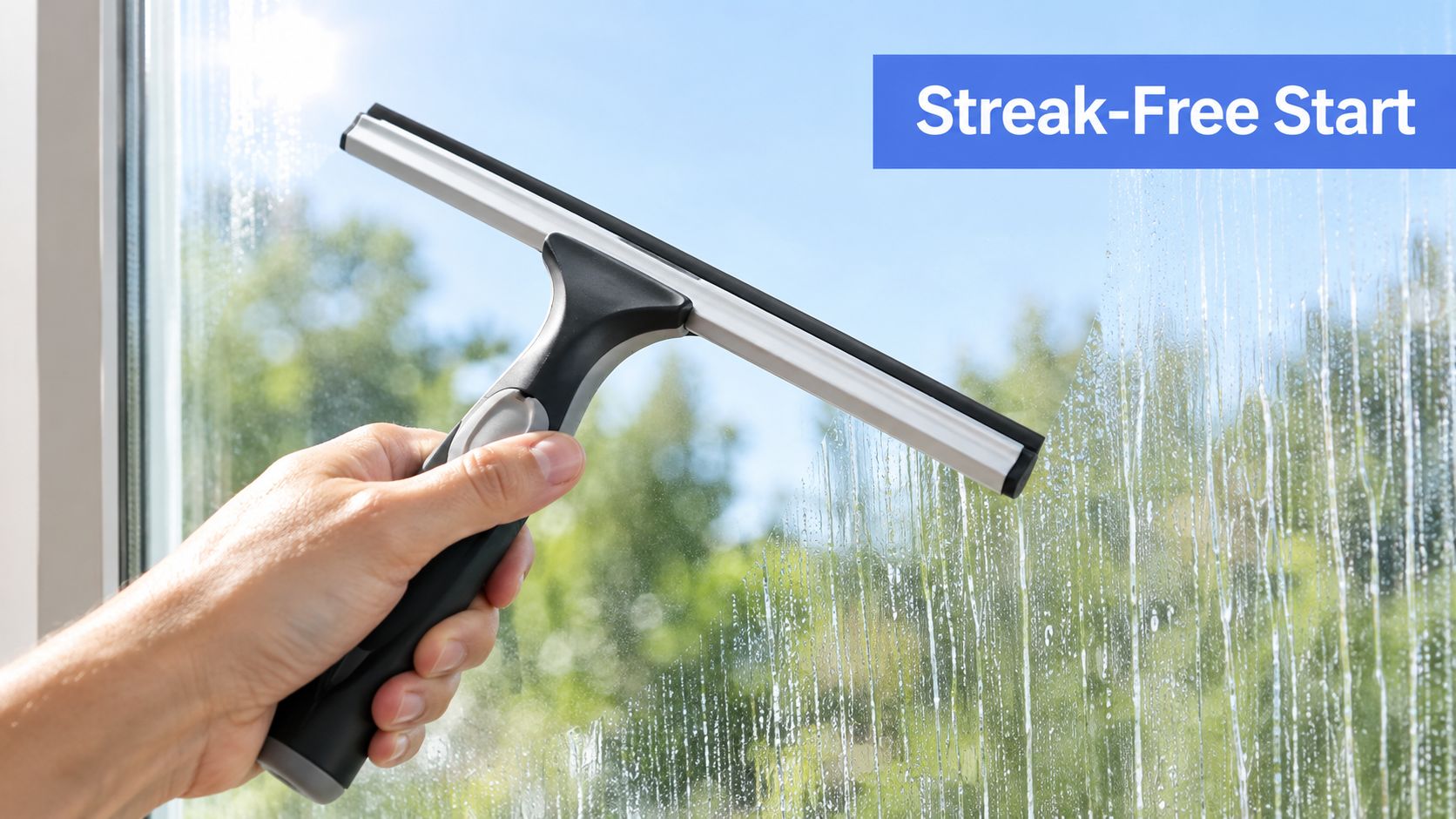
A homeowner once showed me a large living-room window that had taken most of an afternoon to clean. The glass looked worse than before. A short household squeegee dragged across the pane with uneven pressure, the handle twisted in the hand, and the blade left narrow lines wherever the rubber failed to stay flat. The cleaner had worked hard. The tool had made the work harder.
That distinction matters on a professional route. Window cleaning has two established approaches: the traditional squeegee method, which uses a cleaning solution and rubber blade, and the pure-water system, which filters tap water and sends mineral-free water through a hose and water-fed pole to a brush. Professional window-cleaning guidance describes both methods and their different equipment needs.
A dedicated squeegee still earns its place when you need immediate control, sharp detailing, and a dry finish on the glass. A pure-water pole can be more practical for exterior windows that are high, awkward, or difficult to access, but it doesn't replace the close control of a blade on every interior pane or frame.
The blade must remain in continuous contact with the glass. The channel must hold it straight while distributing pressure. The handle should let you change direction without bending the wrist sharply or clamping down harder than necessary.
Professional Window Cleaning has been cleaning windows for over 26 years, serving residential, commercial, and high-rise clients. Across that kind of work, the useful test isn't whether a squeegee looks advanced in a product photograph. It's whether the tool clears water consistently, stays controllable around frames, and remains comfortable after repeated passes.
Practical rule: Buy the squeegee that matches the work you actually do, not the largest or most heavily marketed model on the shelf.
A homeowner cleaning a few divided panes needs precision more than maximum coverage. A property manager maintaining broad storefront glass needs speed, replaceable parts, and pole compatibility. A high-rise crew needs a system designed around reach, balance, and safe access. The best choice changes with the job.
The modern window-cleaning squeegee dates to 1936, when Italian immigrant Ettore Steccone patented a lightweight, single-blade design that replaced bulkier tools such as the Chicago squeegee. Historical accounts also describe squeegees being used for window cleaning by 1918, giving the tool at least a century of documented use. The documented history of the squeegee helps explain why today's professional models still look mechanically simple.
The design has been refined around one task, removing water cleanly from glass. That long development is why professional tools generally prioritize a flexible blade, a balanced handle, a straight channel, and replaceable rubber rather than unnecessary features.
The blade makes contact with the glass. Its edge needs enough flexibility to follow the pane while remaining firm enough to push water in a controlled sheet. A nick, rounded edge, or hardened section can create a repeated streak even when the operator's technique is sound.
The channel supports the blade and keeps pressure distributed across its length. Stainless steel, brass, and aluminum are common choices. A rigid channel can feel more predictable on broad glass, while a lighter channel may be easier to handle during detailed residential work.
The handle transfers your hand movement to the channel. Its angle affects how naturally the blade sits against the pane and how much the wrist must rotate during fanning or pull strokes.
A good tool won't rescue dry glass or a dirty blade. Professionals wet the pane, create a dry edge or “cut-in” strip about one inch wide, then use smooth overlapping strokes before detailing the edges with a lint-free towel. This practical guide to using a squeegee covers the blade angle, overlapping movement, and edge work that turn a decent tool into a clean result.
The mechanical advantage is straightforward. A fresh blade maintains contact, the channel keeps it aligned, and the handle allows the operator to apply even pressure without fighting the tool. That combination is what you're paying for.
Blade choice and handle design work together. A flexible blade may perform beautifully on older or slightly uneven residential glass, but the handle still has to let you guide it without excessive wrist deviation. A durable blade may last longer in demanding conditions, but a rigid or poorly balanced grip can make repeated work uncomfortable.
Traditional rubber offers a familiar combination of flexibility and responsiveness. It can conform well to smooth glass and is often appreciated for precise work, but it generally wears faster than tougher synthetic alternatives. Synthetic compounds tend to offer more consistent performance over repeated use and can be a sensible choice for professional routes or surfaces that challenge ordinary rubber.
| Blade option | Where it works well | Trade-off |
|---|---|---|
| Traditional rubber | Smooth glass, detailed residential work, responsive hand technique | Can wear sooner |
| Synthetic rubber | Frequent professional use and demanding conditions | May feel less forgiving to some users |
| Softer compound | Irregular panes and cooler working conditions | Can feel less stable on broad, hot glass |
| Firmer compound | Large, flat commercial panes and warm conditions | Less adaptable on uneven surfaces |
The blade edge matters more than branding. If it chatters, skips, or leaves a line in the same place, inspect it rather than pressing harder. More force rarely compensates for damaged rubber.
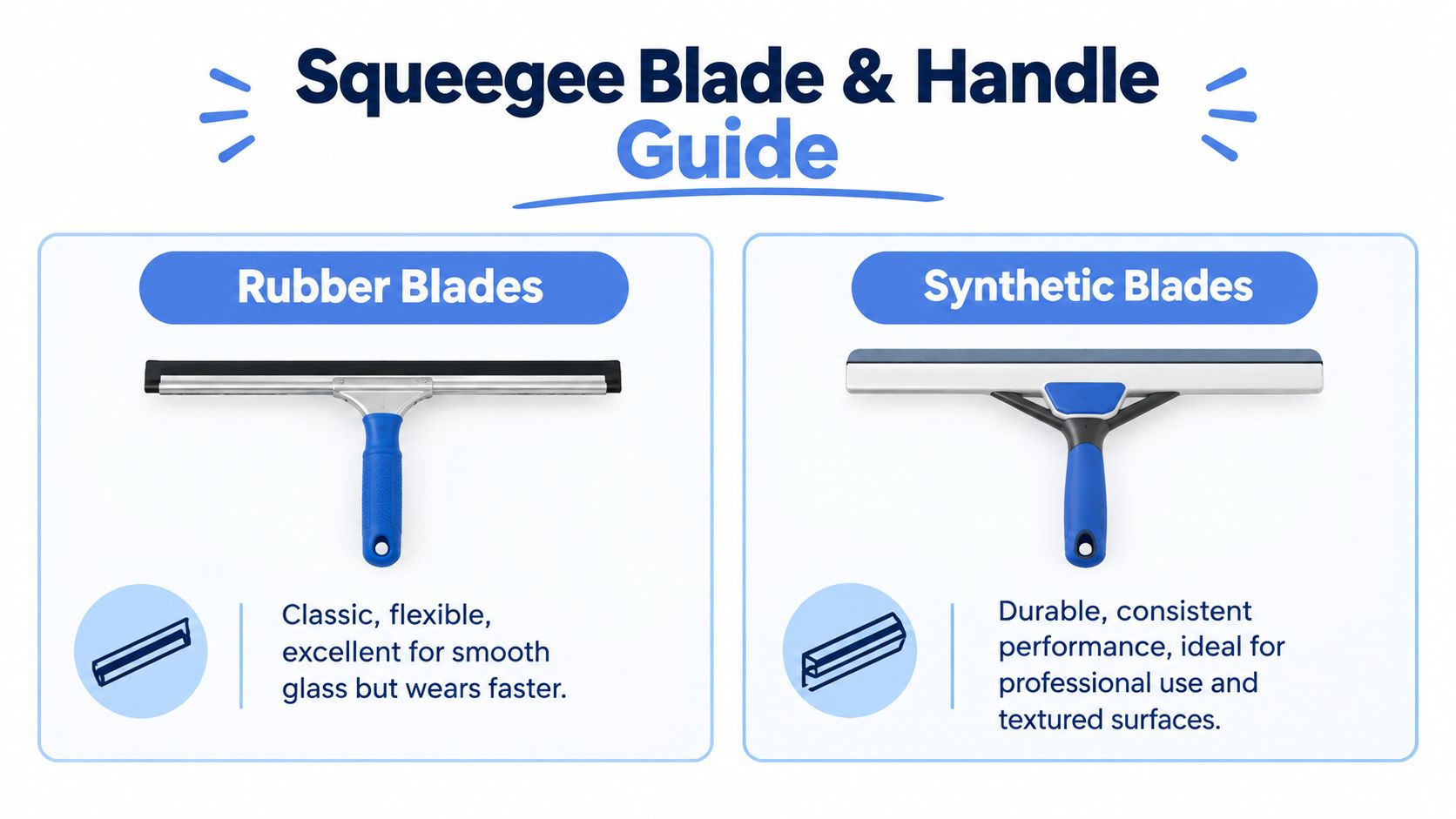
A handle should provide a secure grip without encouraging a tight fist. Non-slip surfaces help when the tool or gloves are wet, while a balanced shape reduces the need to compensate for a channel that feels front-heavy. Quick-release designs are useful when you change channels or blades frequently.
Extension-pole compatibility deserves attention before purchase. A threaded handle can make exterior and second-story work more practical, but adding a pole changes control and balance. A tool that feels effortless in the hand may require more shoulder control when used at distance.
The strongest setup is usually the one that lets you keep the forearm and squeegee moving together. If the wrist bends sharply while the blade changes direction, the design or technique needs adjustment. Ergonomic claims on packaging should be treated as prompts to test the grip, not as proof of reduced strain.
Size should follow the pane, not personal pride. A wide channel covers more glass per pass, but it also needs room to turn and maintain contact. A narrow channel sacrifices coverage in exchange for control around muntins, corners, handles, and tight frames.
Use the window itself as the decision guide.
Start with divided or narrow panes. Choose a compact tool when the glass is broken into small sections or surrounded by delicate frame details. The Ettore 8-inch all-purpose model is a practical example of a maneuverable option, especially where a longer channel would strike the frame before completing the stroke.
Move to a general-purpose width for ordinary residential work. A 12-inch tool gives a useful balance between coverage and control. It can handle common house windows without becoming awkward around edges.
Use wider channels on open commercial glass. Midrange professional models commonly sit in the $15 to $20 range, with blade widths often expanding to 12 to 18 inches and channels made from brass, stainless steel, or aluminum, according to independent professional tool guidance. Wider channels make sense on storefronts and broad panes where the blade can travel without constant stops.
Consider adjustability for mixed routes. Premium models priced above about $30 should offer adjustable channels, allowing one tool to adapt to different pane sizes, according to the same comparison source. That feature is useful when a crew moves between small residential glass and larger commercial surfaces.
A long channel isn't automatically faster. If you must shorten every stroke to avoid frames, or if the extra width forces awkward shoulder movement, the theoretical coverage disappears. Keep at least one narrow tool available even if most of your work is commercial.
For detailed technique, this guide to window-cleaning squeegees is a useful reference for matching the tool and stroke to the glass.
A squeegee can leave flawless glass and still be the wrong tool for a full day's work. Frequent cleaning involves repeated gripping, directional changes, reaching, and wrist rotation. If the handle forces the wrist into an extreme angle relative to the forearm, discomfort can build before the operator notices the cause.
Wagtail's ergonomic report warns that window cleaning can place the wrist in harmful positions when it's forced away from a neutral relationship with the forearm. That guidance deserves more attention than another generic claim about streak-free performance.

Hold the tool as you would on the glass, not upright like a shop display. Check whether the handle lets you keep the wrist reasonably straight during the stroke. Then test the direction changes that your work requires, especially fanning, detailing tight corners, and working across a pane at shoulder height.
A useful handle should support these habits:
The fastest stroke is the one you can repeat without fighting the handle.
Comfort and performance aren't opposing goals. A tool that reduces awkward wrist angles can make pressure more consistent, which may improve the finish as well as the operator's endurance. For awkward commercial glass, tall ladders, and extension-pole work, prioritize balance and reach control over an impressive blade width.
Test the tool during representative movements before committing to a full kit. If your wrist collapses sideways whenever you change direction, choose a different handle angle or channel configuration. No product label can make that posture safe.
The strongest recommendation depends on workload. A compact tool that feels nimble in a bathroom or divided-light window may not survive a demanding commercial route, while a durable stainless model can feel unnecessarily heavy for occasional home use.
The Unger Pro 12-inch stainless steel window squeegee is the most balanced option in the available professional testing. It scored 5/5 for effectiveness, 4.5/5 for ease of use, 5/5 for comfort, 5/5 for durability, and 5/5 for value in professional review testing by Bob Vila. Those results point to a tool that handles streak control, comfort, longevity, and practical value without one category dragging down the overall package.
Its 12-inch format also suits general residential and smaller commercial work. It won't cover broad storefront glass as quickly as a wider channel, but it should be easier to control around frames and varied pane sizes.
The Ettore 8-inch all-purpose squeegee matched the Unger's 5/5 effectiveness score and led the same evaluation with 5/5 for ease of use. Its durability score was 3/5, which suggests a more sensible role in lighter-duty work, compact panes, and situations where turning the tool matters more than surviving heavy daily use.
That isn't a criticism of the design. A short channel is often the right answer for divided glass, narrow bathroom windows, and detailed residential work. The mistake is expecting a maneuverable tool optimized for control to perform like a high-volume commercial channel.
| Product | Effectiveness | Ease of use | Comfort | Durability | Value |
|---|---|---|---|---|---|
| Unger Pro 12-inch stainless steel | 5/5 | 4.5/5 | 5/5 | 5/5 | 5/5 |
| Ettore 8-inch all-purpose | 5/5 | 5/5 | Not specified | 3/5 | Not specified |
An adjustable channel is worth considering when one operator moves between different pane sizes. Market guidance indicates that premium models above about $30 should provide adjustability, allowing the same tool to adapt to smaller and larger glass. That convenience can reduce kit changes, but it doesn't eliminate the need for a compact option when frames and corners become tight.
Combo tools and extension-pole-friendly designs are also gaining attention. Recent roundup coverage emphasizes 2-in-1 wash-and-squeegee tools, pivot systems, and long-reach designs, which can help on exterior or second-story glass. They aren't automatically superior to a separate washer and dedicated squeegee. A combo can reduce equipment changes, while separate tools usually provide more specialized control.
For clients in Las Vegas, Phoenix, Denver, and Scottsdale, the sensible choice still comes down to pane size, access, climate, and cleaning frequency. Bright conditions make missed water and edge residue easy to see, so a fresh blade and controlled technique matter more than a fashionable accessory.
A squeegee doesn't become unreliable all at once. Performance usually declines through small defects, grit caught in the channel, a blade left damp in storage, or a nick that gets dragged across every pane. Maintenance is simple, but it has to happen consistently.
Rinse the blade and channel to remove loosened dirt and cleaning solution. Run a clean finger or cloth along the rubber edge only when the tool is safely positioned and free of sharp debris, then dry the parts before storing them.
Use this short routine:
The traditional method also depends on sequence. Wet the pane thoroughly, remove heavy contamination before the final pull, wipe the blade between passes, and detail the edges with a lint-free towel. Professional window-cleaning technique guidance emphasizes the dry-edge setup, overlapping strokes, and edge detailing that prevent frame runoff from becoming a streak.
Cleaning won't repair a nick or restore a blade that has lost its working edge. Replace the rubber when the tool leaves the same line repeatedly, chatters across clean glass, or skips despite proper wetting and pressure. Keeping spare blades is more practical than carrying on with a defective edge and then redoing the work.
Inspect quick-release mechanisms and pole connections as well. Loose fittings can change the blade angle unexpectedly, particularly when the tool is extended. A well-maintained squeegee should feel predictable in the hand, because predictability protects both the finish and the operator.
Professional Window Cleaning provides residential window cleaning, commercial window cleaning, and high-rise window cleaning for properties that need the right method and equipment for the glass. If you'd rather leave the blade selection, access, and detailing to an experienced crew, visit Professional Window Cleaning to arrange service.
Read our blog posts regularly and keep learning.