Care and Maintenance
Window Cleaning with Pure Water: A Practical Guide
Learn how window cleaning with pure water works, the equipment behind it, real benefits and limits, and what to expect on cost for homes and high-rises.


You're standing in front of a glass door or a living room window with a spray bottle in one hand and a rag in the other, and the streaks are already showing in the light. That's the point where the problem becomes clear: it isn't the cleaner, it's the tool and the hand behind it. A window cleaning squeegee looks simple, but on real job sites it's the difference between chasing haze and leaving clean glass behind.
Professionals have leaned on the squeegee for decades because it works. The modern form is widely traced to Ettore Steccone's 1936 patent, and historical references show the tool's window-cleaning role was already noted in 1918, at least 18 years earlier than that patent (SPM). That long run isn't an accident. In professional window cleaning, there are really only 2 methods, a squeegee or a pure-water system, and each one demands control, not guesswork.
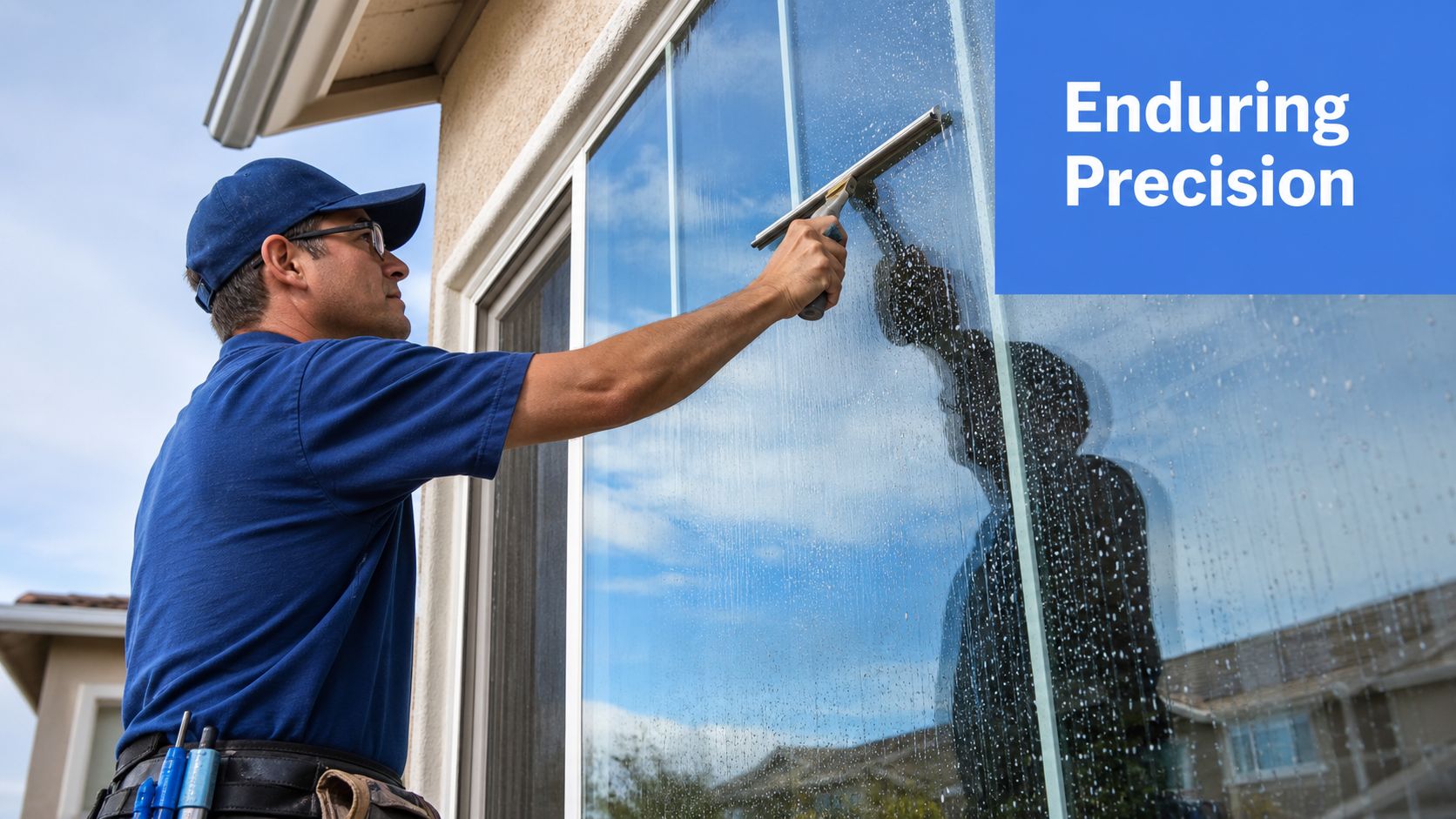
A homeowner can scrub a pane until it looks wet and clean, then walk away and find streaks as soon as daylight hits it. That usually happens because paper towels smear residue around instead of pulling the liquid off the glass. A squeegee removes the cleaning solution and the dirt it loosened, which is why it stays central to professional work (Window Genie).
The modern window-cleaning squeegee didn't appear out of nowhere. Its roots are traced to a deck-cleaning tool that was already known in 1918, when a Navy jargon book noted that a squeegee was “used in civil life to clean windows” (SPM). Then in 1936, Ettore Steccone patented the lighter brass-handled design that became the basis for the professional version still recognized today (SPM).
That matters because the tool survived not by being flashy, but by being dependable. One later history notes that Steccone's family company has produced more than 75% of the squeegees used by professional window cleaners and 60% of consumer sales, which tells you how much that design shaped the trade (SPM).
Practical rule: if glass is clean but still looks hazy, the problem is often not the detergent. It's the wipe-off step.
A squeegee also fits the rhythm of real exterior work. You scrub, you pull, you detail the edges. That sequence is why the tool remains the first choice for standard glass, storefronts, doors, mirrors, and a lot of the windows that people try to “just wipe down” with a rag.
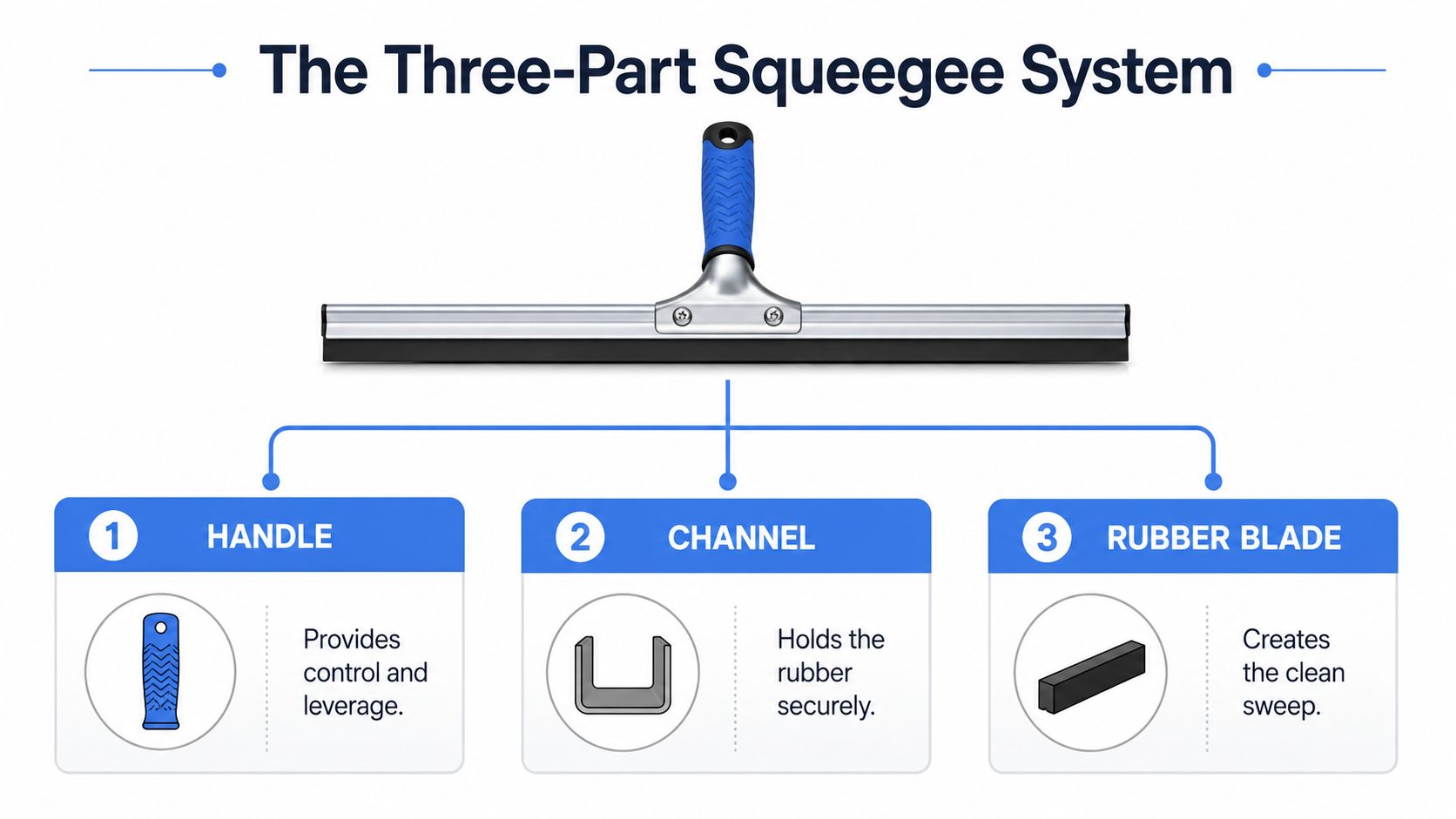
Many shoppers buy a squeegee like they're buying a kitchen gadget, then wonder why one model feels effortless and another feels clumsy. A professional window cleaning squeegee is really a three-part system. The handle, channel, and rubber have to work together, or the blade will not carry pressure evenly across the glass.
The handle is your grip and control point. The channel is the frame that keeps the rubber straight. The rubber is the edge that strips the water film from the pane. If one part is weak, the whole tool feels off.
Channel material changes the feel in real use. Brass channels are extra-stiff and warmer to the touch, which helps when you want firm pressure transfer. Stainless steel models are lightweight and often paired with spring or clip systems. Aluminum channels cut weight and help on repetitive, all-day storefront or commercial work (WindowCleaner.com).
Rigid channels help the blade stay honest on the glass. Lighter channels help your forearm survive the route.
That trade-off matters more than brand stickers. A stiff setup can feel better on flat panes and in cold conditions. A lighter setup can feel better when you're moving fast across a long run of glass, especially overhead or on a pole.
The other piece people miss is size. Professional squeegees range from 6 inches for detail work to 36 inches for large panes, with 14 to 18 inches commonly serving as the workhorse range for standard residential and commercial glass (WindowCleaner.com). For a broader look at how tools are usually grouped and sold, the supply breakdown at window cleaning supplies is a useful reference point, but the choice depends on the glass in front of you.
A lot of guides stop at brand names. On real job sites, rubber hardness and channel feel matter more than the label on the handle. Softer rubber gives you more forgiveness on uneven glass and in cooler weather. Harder rubber holds its line better in warmer conditions and on demanding commercial work.
That is the part DIY guides usually flatten. The setup that looks simplest on paper can be the one that fights you on a hot storefront, a cold residential pane, or a pole job where you need the blade to stay consistent through the whole pull.
Size and rubber hardness should be chosen together, not separately. A wide blade that feels perfect on a storefront can be awkward on divided residential glass, while a narrow blade that feels precise can slow down larger panes. For general shopping guidance, a good reference point is the supply breakdown at window cleaning supplies, but the decision comes down to the glass, the weather, and the pace of the job.
For detail work around muntins, trim, and tight panes, smaller sizes make sense. For broad uninterrupted glass, larger channels cover more area and reduce the number of pulls. The sweet spot for a lot of everyday work sits in the middle, which is why 14 to 18 inches gets used so often in residential and standard commercial cleaning (WindowCleaner.com).
Rubber hardness matters just as much. Training guidance says softer rubber is typically around 50 to 60 durometer and works better in cooler weather or on variable glass, while harder rubber around 65 to 75 durometer is preferred for warmer climates and demanding commercial work (J. Racenstein). In plain terms, softer rubber gives you more forgiveness, and harder rubber gives you more bite when conditions are tougher.
| Application | Recommended Size | Rubber Durometer | Best Channel Material |
|---|---|---|---|
| Detailed residential panes | 6 to 10 inches | 50 to 60 | Brass or aluminum |
| Standard home windows | 14 to 18 inches | 50 to 60 or 65 to 75 | Brass, stainless steel, or aluminum |
| Storefront glass | 14 to 18 inches | 65 to 75 | Stainless steel or aluminum |
| Large commercial panes | 18 to 36 inches | 65 to 75 | Stainless steel or aluminum |
A blade can also look “fine” and still perform badly. The sharp edge is what matters, and a rounded rubber lip will start to leave film even when the glass was scrubbed properly. That's why seasoned cleaners carry different channels and rubber types instead of betting on one setup for every job.
Field truth: the wrong durometer won't always fail loudly. It usually fails by making you work twice.
The glass has to be wet before the squeegee can do its job. A neutral cleaning guide from Window Genie lays out the sequence plainly, scrub the pane with soapy water first, then use the squeegee to remove the waterborne dirt, then detail the edges dry (Window Genie). Skip the wet scrubbing step and you're not cleaning glass, you're dragging grit around.
Professional-style technique is built around steady pressure, controlled angle, and overlapping strokes. One guide recommends keeping the blade at about a 45° angle and overlapping each pull by about an inch so you don't leave water lines behind (Unger). That same approach is echoed in training material that says a 45° angle helps the blade shear water cleanly instead of chattering or skipping (J. Racenstein).
The tricky part is that not every training source agrees on one perfect number. Some cleaners prefer roughly 30°, some prefer 40°, and some adjust based on glass size and movement pattern rather than chase a single universal angle. The useful rule is simple, lower angles usually help on certain straight pulls, while slightly steeper control can help on awkward panes or when the glass geometry forces a different hand path.
Use the stroke that keeps the edge loaded and the water moving. A straight pull is often safer when the pane is simple and the frame is deep. Fanning or an S-pattern can be faster on large glass, but it takes more blade control and more experience to avoid drag at the turn.
The goal isn't to look smooth. The goal is to leave no missed trail and no corner residue.
A final detail matters: the blade has to stay clean during the job. If the rubber edge picks up grit, the next pull will show it. That's why professionals wipe the blade often, especially when moving across dirty exterior glass or job sites with windblown dust.
Tall glass changes the job fast. The blade itself still works, but the challenge becomes control, balance, and cleanup at height. Guidance aimed at unreachable windows emphasizes extendable poles, angled heads, and microfiber sleeves because those tools let cleaners reach glass without treating every pane like a ladder job (Cozy Home Club).
On big interior glass, the mistake is assuming the same hand motion that works at eye level will work overhead. It usually won't. Pole work asks for lighter pressure, cleaner line choice, and a more deliberate finish because the longer the reach, the easier it is to drag residue back across the pane.
That's why experienced cleaners rely on long-reach systems and finish-in-one-motion methods. The point is to reduce drag, limit edge residue, and avoid repeat passes that only rewet the glass. For awkward storefronts, condo interiors, and medical-office glass, that method matters more than the brand of pole attached to the head.
This is also where DIY advice falls short. A squeegee can still be the right tool, but tall windows add safety, body position, and access planning to the job. If you're trying to work from a chair, over a stair landing, or across a deep interior frame, the glass is only part of the problem.
For cleaners comparing hardware, a dedicated long-handle setup can help, and this long handle squeegee guide is useful if the task involves awkward reach or repeated overhead work. The tool choice should match the access problem, not just the pane size.
High glass punishes sloppy technique faster than ground-level glass does.
That's especially true in places with a lot of architectural glass. In cities like Las Vegas, Phoenix, and Denver, tall windows show up in dealerships, offices, modern homes, and condo work, and those panes often need more than a quick wipe from the inside.
A clean-looking blade can still be a bad blade. The edge is the entire game, and once the rubber gets nicked, rounded, or contaminated, streaks show up even when the glass was scrubbed well. Training guidance says a sharp rubber edge minimizes streaks and recommends replacing rubber after about 15 hours of use, or sooner if performance drops (J. Racenstein).
The easiest habit is also the one skipped most often, check the blade before the job starts. A nick on the corner will telegraph straight into a water line. A rounded lip won't hold angle cleanly, which means the blade starts skating instead of cutting.
I've seen plenty of good technique ruined by a tired blade. The cleaner keeps their hand steady, the angle looks right, and the window still dries with a faint streak because the rubber can't hold its edge anymore.
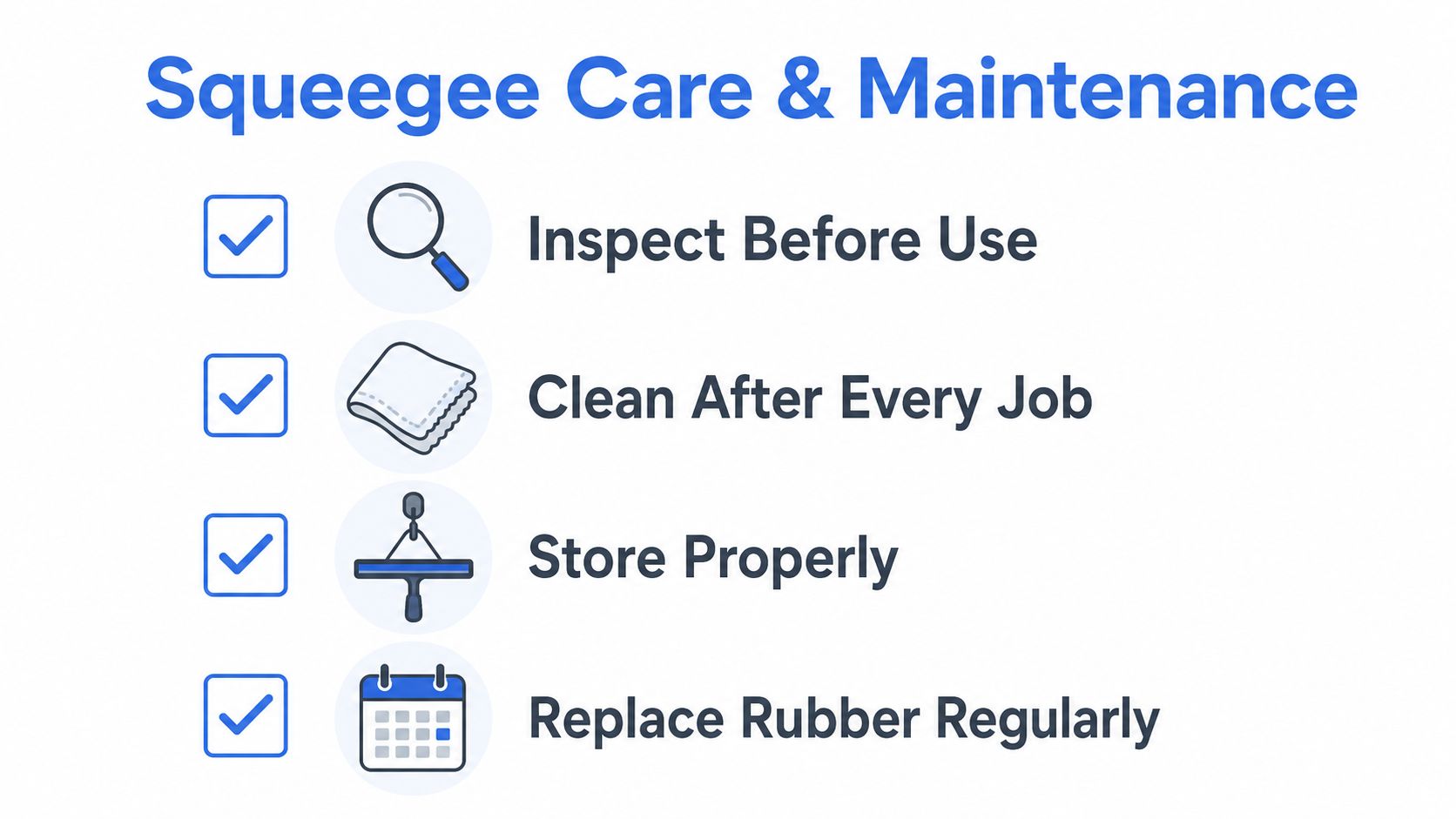
A practical care routine stays simple:
The point of maintenance is consistency. A sharp edge holds the angle you set, and that makes streak-free work repeatable. Carrying replacement rubber on the truck is standard for a reason, because no one wants to troubleshoot a tired blade halfway through a glass-heavy route.
DIY squeegee work can look sharp on reachable windows with simple geometry, and that is where many homeowners do fine. The line shifts when the glass gets large, high, awkward, dirty, or time-consuming enough that the project turns into a long weekend and the finish still falls short of professional standards.
Multi-story homes are one clear cutoff. Ladders and scaffolding change the risk immediately, and the room for error shrinks fast. Commercial glass brings a different pressure. If those windows shape first impressions for customers, tenants, or patients, haze, missed edges, and uneven detailing carry more weight than they do on a side window at home.
High-rise buildings sit in a different category altogether. They call for specialized access and safety planning that goes far beyond basic tool skill. Even on less extreme properties, a large amount of glass can take hours that most owners would rather spend elsewhere, especially when the result still will not match polished professional execution.
Local conditions matter too. Dust in Arizona, seasonal weather in Colorado, and the mix of sun, wind, and elevation all make glass maintenance harder in different ways. That is why professional service stays relevant across markets like Las Vegas, Phoenix, Denver, Scottsdale, Tempe, Chandler, and Gilbert.
For property managers and owners thinking about the service side of the business, marketing strategies for home service pros offers a useful look at how window cleaning is positioned when appearance and reliability matter. The larger point stays simple, glass maintenance works better when the method fits the property, the access, and the finish the job demands.
Professional Window Cleaning has been in business since 1999, and that experience matters on jobs where tool choice, access, and finish quality all intersect. If your windows need more than a quick pass with a bottle and rag, professional execution is the cleaner answer.
If you want glass that looks finished, not just wiped, Professional Window Cleaning can handle the details that a basic DIY setup misses. Visit Professional Window Cleaning to explore service for residential, commercial, and high-rise glass, and get the right approach for windows that need more than a quick pass.
Read our blog posts regularly and keep learning.