Care and Maintenance
How to Clean Double Glass Windows Safely
Learn how to clean double glass windows without damaging seals. Two professional methods, step-by-step instructions, and seal care tips included.


You're probably looking at glass that's just out of reach. Maybe it's a second-story window over landscaping, a tall foyer pane, or a bank of patio glass that seems easy until the first pull leaves lines, drips, and a wet frame.
That's where a long handle squeegee stops being a convenience and starts being the right tool. After over 26 years in professional window cleaning, one thing is clear. Most bad results on high glass don't come from effort. They come from using short-tool technique on long-reach work.
Window cleaning pros really use only two methods. We use a squeegee, or we use a pure-water system. Both have their place. But when the job calls for controlled water removal on glass, a long handle squeegee is still one of the most useful tools in the trade.
That isn't a niche observation. The global squeegee market was valued at $2.8 billion in 2025, and window squeegees held 32.4% of that market, according to Dataintelo's squeegee market report. For anyone cleaning glass at home or on commercial buildings, that tells you this tool still sits at the center of real-world window work.
High windows expose every weakness in your technique. A handheld squeegee lets you cheat a little. You can feel the blade angle, see the water line closely, and adjust pressure instantly. Add a pole, and those little corrections disappear.
That's why a long handle squeegee matters. While it offers reach, its primary advantage is letting you work glass from the ground or from a safer position with a repeatable motion. The problem isn't getting the blade to the window. The problem is keeping the rubber in clean, even contact from the top of the stroke to the finish.
Most streaking on upper windows comes from three things:
Those problems get worse when the window is above eye level. You can't rely on instinct alone. You need a setup that stays stable and a technique that doesn't fight the pole.
Practical rule: On high windows, consistency beats force. A clean, light pass almost always outperforms a heavy one.
If you're working around tall interior glass, vaulted spaces, or upper-story windows with decorative treatments, even the room design changes how you approach the job. Homeowners planning access around oversized windows may also get useful ideas from The Drapery Company's ceiling window ideas, especially where high glass and interior layout affect cleaning access.
There's a lot of DIY advice online, but in the field it's simpler than people think. Professionals use one of two systems.
First is the traditional mop-and-squeegee method. You scrub the glass, loosen soil, and remove the water mechanically with rubber. Second is the pure-water system, which cleans with filtered water and leaves the glass to dry spot-free when the workflow is done correctly.
For a lot of high residential glass, especially where detail matters, the long handle squeegee remains the precision tool. It's still the fastest way to leave glass dry on the spot, control edge detail, and see the finish immediately.
A professional setup looks simple, but every part of it changes how the tool behaves on glass. If one component is wrong, the whole system feels sloppy.
The modern window squeegee was invented over 80 years ago by Ettore Steccone in Oakland, California, and his T-shaped brass tool with a precision rubber blade set the design standard that still drives the trade, as noted in this Ettore history reference. That longevity makes sense. The basic design works because it solves one job extremely well. Pull water off glass cleanly.
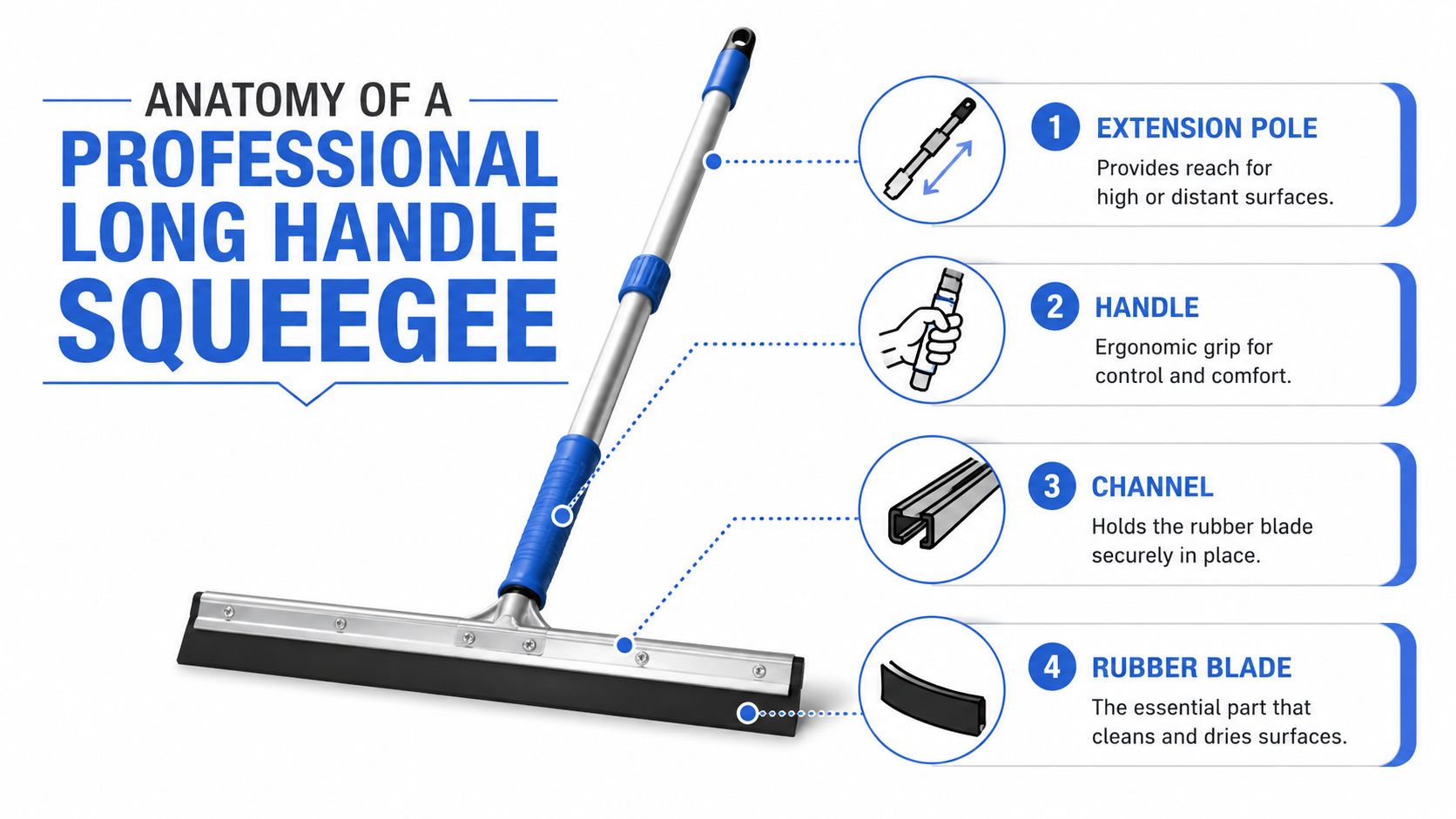
The pole gives you reach, but reach is only half the story. It also acts like a lever. The longer it gets, the more any wrist movement becomes a larger movement at the blade.
Good poles feel rigid enough that the head doesn't wobble under light pressure. A flexible pole can still work, but it asks for better timing and softer hands. On interior windows, a lighter telescopic pole usually makes sense. On larger exterior panes, stiffness becomes more important.
The handle is where control lives. Fixed handles feel predictable and are easier for newer users to understand. Swivel handles are more versatile, especially when you need to work around frames, pull from awkward positions, or maintain contact during pole work.
A bad handle makes you fight the glass. A good one lets the blade stay planted while your hands guide the motion.
The channel is the metal track that holds the rubber. Straight channels suit standard work. Wider channels can cover more glass in one pass, but they punish sloppy pressure.
For pole work, channel stability matters more than people expect. If the channel flexes too much or doesn't seat firmly, you'll see it in the finish long before you notice it in your hands.
This is the business end. If the rubber is nicked, rounded over, hardened, or dirty, the rest of the setup won't save you.
The blade doesn't need brute force. It needs a clean edge and even contact.
A proper long handle squeegee should feel calm. It shouldn't chatter across the pane or require a death grip to keep the edge on the glass.
Look for these signs during use:
That basic design has lasted for decades because it still does the job better than gimmicks. Pole, handle, channel, rubber. Get those four right, and the tool starts working with you instead of against you.
You feel the difference on the first pull. Put a wide channel on a long pole and aim it at a small second-story pane, and the tool starts fighting back. The rubber drags unevenly, the far edge lifts, and every correction travels down the pole a half-second late. Use that same setup on a big sheet of storefront glass, and it suddenly makes sense.
That is why I choose the squeegee by glass size, frame layout, and working height before I worry about anything else. With a handheld tool, you can rescue a poor match with wrist control. On a pole, the wrong channel size exposes every weakness in pressure and angle control.
For most homes, the 18-inch channel is the standard workhorse because it gives a good balance of coverage and control, according to JRacenstein's guide to choosing the best squeegee. Larger commercial panes can justify a wider channel because fewer pulls mean less detailing and faster water removal. The trade-off is simple. Wider channels cover more glass, but they demand steadier contact across the full blade.
The best long handle squeegee depends on the pane in front of you.
A divided-light window over a staircase calls for a smaller channel that you can place accurately without clipping muntins or frame edges. A broad patio door gives you room to use more rubber and finish in fewer passes. Narrow transoms, sidelights, and cut-up residential windows usually reward control more than reach.
If you want a closer look at common pro setups, this guide to a professional window squeegee pairs well with long-pole work.
| Job Type | Recommended Channel Size | Handle Type | Example Use Case |
|---|---|---|---|
| Small divided windows | Smaller channel | Fixed handle | French panes or narrow upper inserts |
| Standard residential windows | 18-inch | Fixed or swivel | Second-story home windows and common exterior panes |
| Large patio doors | 18-inch to larger channel | Swivel handle | Broad glass where longer horizontal coverage helps |
| Storefront glass | Larger channel | Swivel handle | Expansive single panes that reward fewer pulls |
| High-rise or broad commercial glass | Up to 22-inch | Swivel handle | Large surface glass where coverage per stroke matters |
Pole work changes what “right size” means. A channel that feels perfect in your hand can feel clumsy once you add eight or twelve feet of extension. The longer the pole, the more any extra width asks from your pressure control.
A telescopic pole suits residential work where heights change from window to window. A fixed-length pole usually gives better feedback and less flex if you are working one consistent height. That extra rigidity matters. It helps you feel whether the blade is staying planted or starting to roll off one edge.
Handle choice matters too.
A bigger channel only helps when the whole rubber edge stays in contact from start to finish.
On broad commercial panes, a wider channel often saves time. On chopped-up residential glass, it usually creates more cleanup. Good selection comes down to one question. Can you keep even pressure on the blade at the height and angle the job requires?
That is the setup to carry.
Long-pole work changes the physics. That's the part basic window cleaning tips usually miss.
With a handheld tool, people talk constantly about a 40° angle. That's useful at arm's length. On a pole, though, the bigger issue is pressure control. As noted in this video discussion of squeegee angle and pole use, professionals using long handles focus on consistent, light pressure because pole length naturally alters the angle and makes pressure control more important for a streak-free finish.

A pole amplifies small errors. If your top hand rotates a little too much, the blade edge can lift. If you push too hard in the middle of a pull, the rubber bows and leaves water at one side. If you hesitate at the bottom edge, the remaining line often turns into a drip.
That's why long handle squeegee technique is less about chasing a perfect fixed angle and more about managing contact.
Use these principles:
The straight pull is the best place to build skill. It works well on standard windows where the glass shape is simple and the frame is easy to follow.
For a clean straight pull:
This method is especially effective on narrow residential panes, interior foyer windows, and second-story exteriors where control matters more than covering maximum width.
If you want a separate step-by-step breakdown, this guide on how to use a squeegee pairs well with long-pole practice.
On a pole, your hands should guide the blade, not shove it.
Fanning is more advanced. It lets you keep the blade on the glass and redirect the stroke without lifting after every pass. Done well, it saves time and reduces detailing. Done poorly, it leaves crescents, lines, and edge misses.
The trick is to keep the rubber's leading edge active through the turn. That means your shoulders, elbows, and grip all work together. You're not drawing with your wrists alone.
A good fanning stroke on a pole feels smooth, not aggressive. If the blade chatters during the turn, you're probably using too much force or changing the blade angle too abruptly.
Here's a useful visual example of pro movement on glass:
Most failures with a long handle squeegee come from the same habits:
Good pole work looks easy because the operator stays disciplined. The motion is controlled, the pressure stays light, and every stroke has a clear finish.
A long handle squeegee is safe only when the user stays honest about limits. Reach can tempt people into bad footing, overextension, or blind work around corners and ledges. That's where routine jobs turn risky.
You don't need dramatic conditions for trouble. Wet ground, uneven landscaping, interior tile, overhead fixtures, and nearby power lines all change the safety picture. If you can't keep stable footing and a clear path for the pole, stop and reset before you touch the glass.
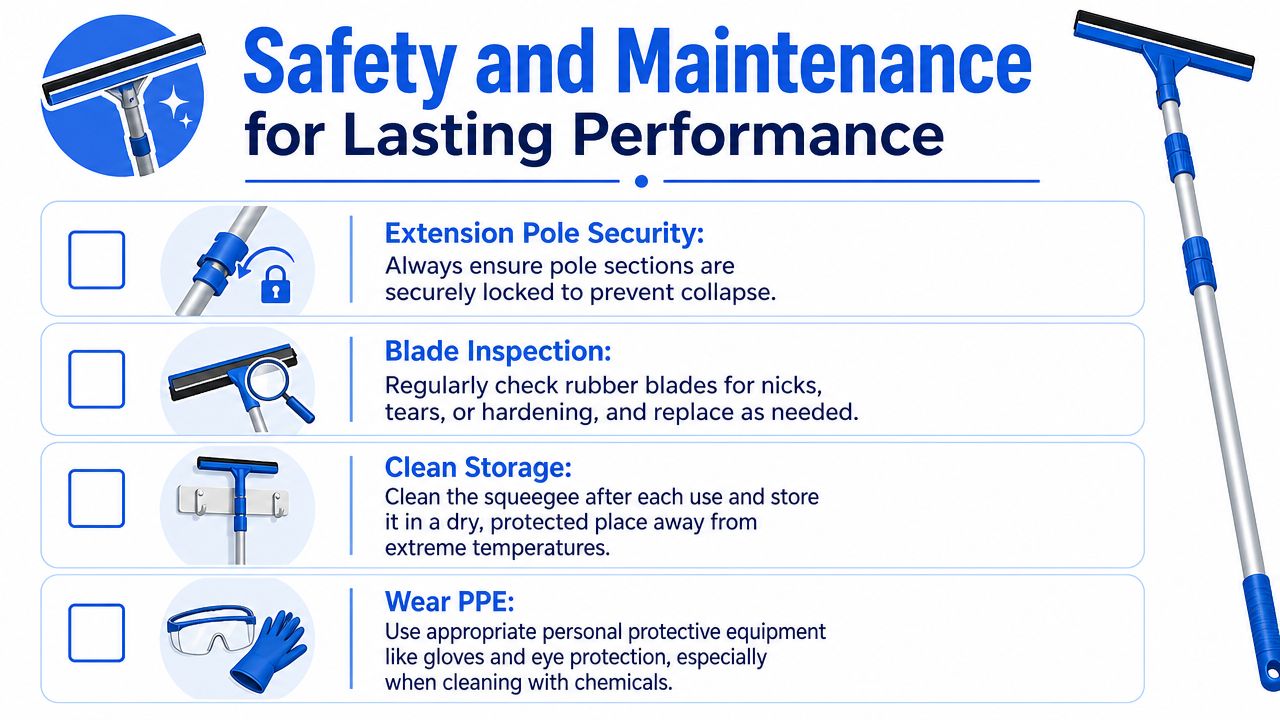
Skip the generic advice and stick to the habits that prevent problems:
The safest adjustment is usually the simple one. Move your feet, shorten the pole, or break the pane into smaller passes.
A neglected squeegee always tells on you. It leaves light lines, edge chatter, or random misses that look like technique problems. Often they're maintenance problems.
After each use:
A well-kept long handle squeegee performs predictably. That matters more than is generally understood. Consistency on glass starts long before the first pull.
You find out where a long handle squeegee stops being the right tool the moment the pole starts controlling you instead of the glass.
That usually happens on high work, awkward layouts, or windows with no margin for error. A second-story pane over a slope, glass tucked behind landscaping, and wide commercial panels that need a uniform finish all change the job. The longer the pole gets, the harder it becomes to keep pressure even, hold the blade angle, and control where the water goes. Those are the problems homeowners usually underestimate.
I've seen plenty of people handle ground-floor glass well, then struggle the second they add extension length. The 40-degree idea still matters, but on a long pole the main fight is biomechanics. Small wrist corrections turn into big angle changes at the head. Pressure gets uneven from side to side. Water left at the top edge starts running back into finished glass. At that point, the issue is no longer effort. It is control.
The industry relies on two main systems. There's traditional squeegee work, and there's the pure water-fed pole method, which uses filtered water that dries without spotting on many jobs, as explained in this overview of squeegee versus pure-water cleaning. Pure water can solve access problems, but only when the filtration, brush technique, rinse pattern, and drying conditions are handled correctly.
Some jobs are better handed to a trained crew:
Hiring a professional also makes sense when the environment works against you. Hard water, dust, intense sun, and oversized glass create finish problems that show up fast in places like Las Vegas, NV and Phoenix, AZ. Earlier sections noted similar challenges in Scottsdale and Denver. The point is simple. Local conditions change the method, the timing, and sometimes the equipment choice.
A long handle squeegee is a serious tool. It is not a cure-all.
Knowing when to stop and bring in help is part of professional judgment. Professional Window Cleaning has served customers for over 26 years and handles everything from traditional squeegee work to pure-water cleaning across Arizona, Colorado, and Nevada.
Read our blog posts regularly and keep learning.