Care and Maintenance
Rubber for Squeegees: Materials, Hardness, and Fit
Choose the right rubber for squeegees with our pro reference on materials, durometer hardness, widths, compatibility, replacement, and care.


A property manager can look up at a 20-story façade and ask for a high rise window cleaning kit as if it were a product order. The more important question is whether the building needs a kit at all, or a complete access and cleaning system that fits its anchors, façade, workers, and local rules. A pole, rope, brush, and harness bought separately can still create an unsafe or ineffective setup.
Professional crews use only two window-cleaning methods: the squeegee method and the pure-water system. The squeegee method applies cleaning solution and removes it with a professional-grade squeegee. The pure-water system sends highly filtered water through a long pole and brush, allowing the glass to dry spot-free without a squeegee, as explained by Professional Window Cleaning's method guide.
Professional Window Cleaning has been cleaning windows for over 26 years. That experience reflects a practical truth: high-rise work succeeds when the access method, cleaning tools, safety equipment, inspection process, and service plan all work together.
The first mistake is treating the kit as a shopping list. A property manager may start with a telescoping pole or a rope-descent package, but the correct specification begins with the building. Is the glass reachable from the ground? Does the roof have approved anchors? Is there a permanently installed suspended platform? Does the façade create wind, lateral-sweep, or obstruction problems?
The cleaning method comes next. A traditional crew carries a bucket, cleaning solution, applicator, channels, and squeegees. That setup gives an operator direct control over heavy soil, edges, frames, and detailed glasswork. A pure-water crew carries a filtration unit, hose, telescoping water-fed pole, brush, and fittings. The brush agitates the glass while purified water rinses away residue and dries without squeegee marks.
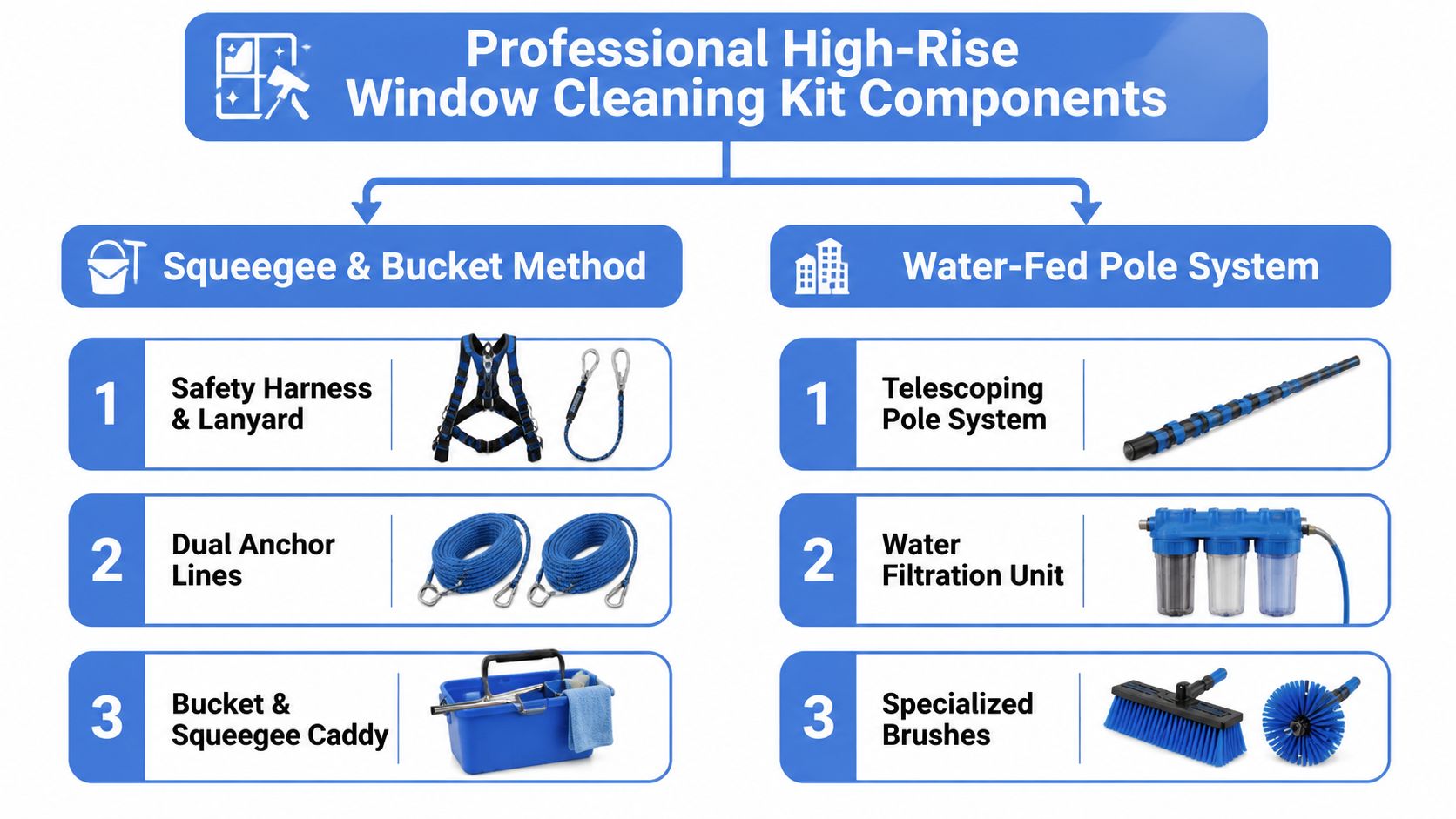
A workable high-rise package usually contains four connected layers:
The method changes the kit. A squeegee crew may need a bucket-and-caddy arrangement compatible with suspended access, while a pure-water crew may be able to clean selected elevations from the ground. Neither method automatically solves access, wind, façade geometry, or fall protection.
Practical rule: Specify the access system first, then choose the cleaning tools that can operate safely through it.
A 1955 car-and-home washer kit from inventor Irv Tucker used a 3- to 6-foot pole, an early precursor to modern high-reach equipment. By the 1970s, about 30% of Tucker poles were sold outside the United States, and Craig Mawlam later launched a telescopic water-fed pole in 1997 after meeting Tucker at an International Window Cleaning Association convention in 1993. This history of the water-fed pole movement shows how the industry moved from simple extension tools toward purified-water, ground-based cleaning.
Start at the glass, then work outward through the system. For traditional work, the applicator loosens soil and spreads solution, while the squeegee channel pulls water from the pane. Channel length, rubber condition, operator position, and the ability to control the bucket all affect the finish. A professional-grade squeegee is simple equipment, but it isn't forgiving of poor technique or unstable access.
A pure-water system operates differently. The filtration unit removes dissolved minerals, then the pump or supply sends water through a hose to the pole. The brush scrubs the surface, and the rinse water carries away loosened material. The operator must control flow, brush pressure, pole angle, and hose placement. Poorly maintained filtration can leave spotting, while an overly soft or flexible pole can make the brush difficult to control.
Think of a water-fed pole as a long lever. As the pole extends, the operator must manage more bending and more movement at the brush. Extra reach can reduce brush pressure and make lateral sweeps less precise, particularly in wind. A stiffer pole preserves control, but it can add weight and fatigue.
That trade-off is why a longer pole isn't automatically a better pole. Crews often use sectional planning, selecting the shortest practical reach for each elevation and moving the work zone rather than forcing one pole to cover everything. Carbon-fiber construction, rigid sections, balanced hose routing, and a brush suited to the glass can matter more than maximum advertised length.
A rope-descent package needs more than a harness. It commonly includes a rated harness, independent primary and backup lines, static kernmantle rope, rope-grab or fall-arrest equipment, controlled-descent devices, and ANSI-rated connectors. Industry guidance places static rope commonly in the 7/16-inch to 1/2-inch range, selected for strength, sheath abrasion resistance, and device compatibility, as described in high-rise safety-plan guidance from J. Racenstein.
The parts must interact correctly under load. A connector must fit the harness and anchor, the rope must match the descent device, and the anchor must support the approved load path. A property manager should reject a quote that lists “rope kit” without naming the rope, devices, anchors, independent fall-arrest arrangement, inspection records, and rescue plan.
The governing constraint for a suspended high-rise cleaning kit is the access system, not the height printed on a pole box. Under the OSHA 1910.27 framework, standard rope-descent operations are limited to 300 feet above grade, with exceptions when alternative access isn't feasible or would create a greater hazard, according to the Canadian regulation reference discussing window-cleaning requirements and related industry guidance.
For rope descent, each worker also needs a separate, independent personal fall-arrest system. Fall-protection guidance for window cleaners explains why a working line and an independent backup line aren't interchangeable. A cleaning tool cannot compensate for an unsuitable anchor, missing backup, or unplanned rescue.
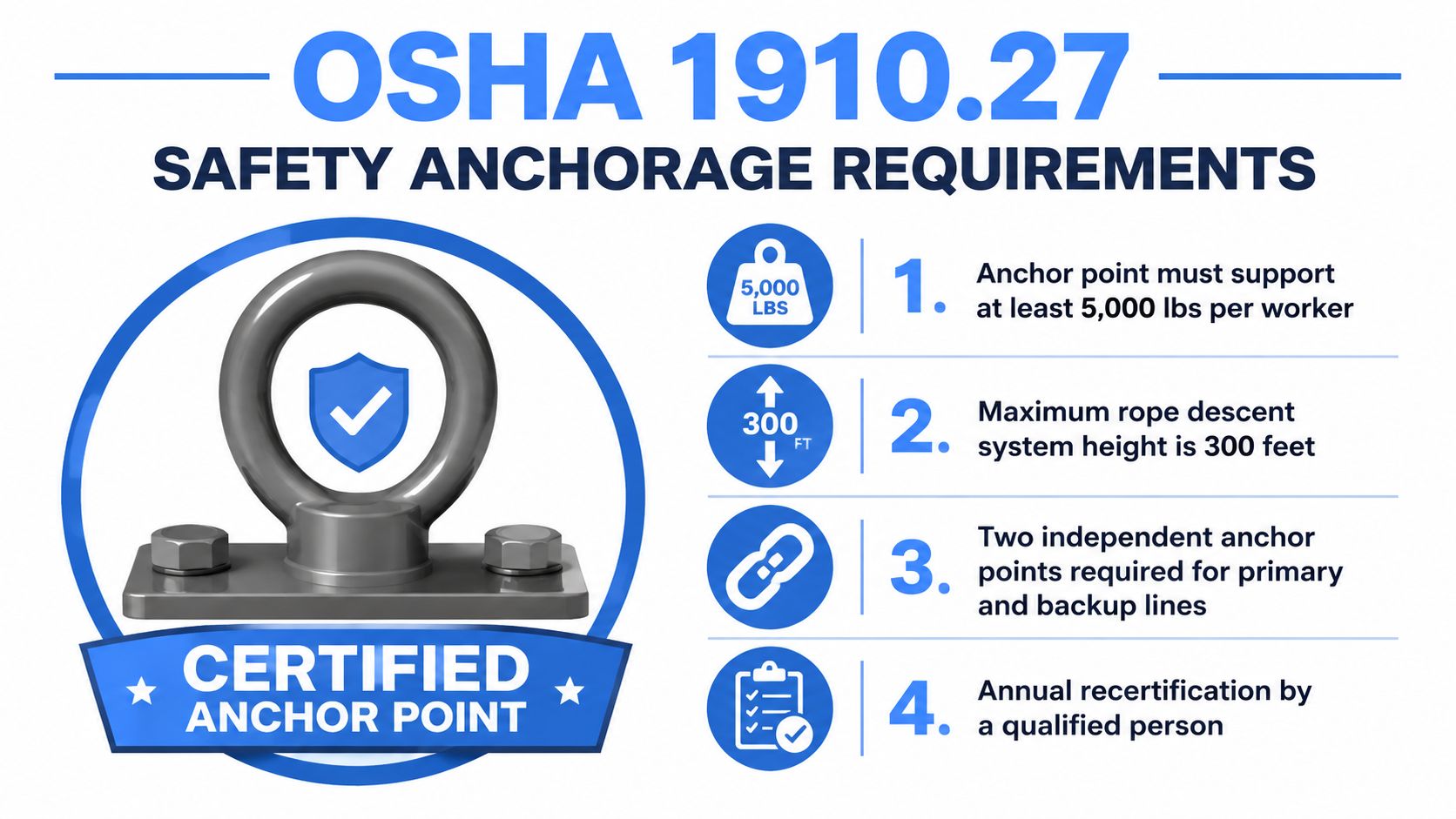
A property manager should require documentation for:
Canada adds CSA window-cleaning safety requirements, and existing buildings require qualified inspection of anchor points and permanently installed suspended platforms before use. Requirements also vary by jurisdiction. Some authorities require an approved window-washing plan before work starts, which makes the California requirements for planned window-cleaning operations useful context for owners and contractors.
The practical hierarchy is straightforward. Eliminate exposure with a ground-based method where the façade allows it. If work at height remains necessary, use engineered controls and approved access equipment before relying on personal protective equipment. A clear explanation of this approach appears in the control hierarchy for fall safety. For buildings using parapets, the contractor may also need to assess whether parapet wall clamps are appropriate and approved for the specific structure.
A short building exterior can tempt an owner to buy a pole, brush, and bucket for the maintenance team. That can work for reachable, low-risk glass when workers stay on the ground and the façade suits the method. The decision changes once ladders, roof edges, suspended access, public exposure, or irregular façades enter the job.
DIY cost extends beyond the equipment invoice. Training, insurance, anchor inspection, equipment records, replacement parts, supervision, site control, and planning all consume budget and staff time. A pole that flexes too much, an exhausted filter, or missing access equipment can also stop a job after purchase.
| Option | Works best when | Main limitation |
|---|---|---|
| In-house ground work | Glass is reachable without fall exposure and the team is trained on the selected tools | Reach, finish quality, and water control may limit the result |
| Hybrid service | Staff handle accessible areas while specialists manage elevated or difficult sections | Requires clear boundaries and coordinated scheduling |
| Full professional service | The building requires rope descent, suspended platforms, engineered anchors, or detailed façade planning | Requires a qualified contractor and documented scope |
We recommend professional service above three stories where fall exposure begins, or whenever the building's approved access method, fall-protection system, and rescue requirements exceed the maintenance team's training. The threshold is a practical screening point, not a rule that every pane needs rope access. A qualified crew can divide the façade, using pure-water poles on reachable sections and an approved suspended method for areas ground-based tools cannot reach.
The kit must match that work split. A pole system can improve speed and reduce exposure on suitable glass, but it needs enough stiffness, controlled water delivery, and a maintained purification system. Squeegees remain useful for heavy soil, detailing, and restoration work, while pure water suits routine exterior maintenance when the water system is properly maintained.
The final choice depends on the glass, frames, soil, weather, access method, and the owner's tolerance for operational risk. A low purchase price does not compensate for unsafe access, poor finish quality, or a method the building cannot support.
A high-rise kit is only as reliable as its inspection routine. New equipment can fail when a worker uses the wrong connector, a pole section develops a bend, or a rope sheath is damaged during transport. Maintenance records also give a property manager something concrete to review instead of accepting a verbal assurance that the equipment is “checked.”
The daily inspection should happen before the crew reaches the façade. The operator examines harness webbing for frays, checks ropes for cuts or sheath damage, tests buckles and connectors, and looks for bent or cracked pole sections. A brush with worn bristles can reduce agitation and force the worker to apply more pressure, while a damaged hose can affect water delivery.
A maintenance cadence should match actual exposure. Salt, dust, intense sun, moisture, chemical residue, and repeated loading can accelerate wear. A contractor who cannot show inspection dates, equipment identifiers, removal criteria, and corrective actions hasn't demonstrated control of the system.
Maintenance standard: If a worker has to guess whether a rope, connector, pole, or anchor is serviceable, that component isn't ready for use.
Replace brushes when bristles no longer clean effectively, replace pole sections when they bend, crack, or lose reliable locking action, and quarantine any rope with damaged sheath or uncertain history. Cleaning tools are replaceable. Fall-protection equipment requires a stricter response.
A kit that works on a Denver tower may be poorly suited to an Arizona or Nevada façade. Regional heat, dust, ultraviolet exposure, moisture, and weather affect the cleaning method, hose handling, storage, and access plan.
Arizona crews commonly deal with intense sun, airborne dust, and monsoon debris. Pure-water equipment can suit routine exterior glass, provided filtration remains effective and brushes are cleaned often. Grit trapped in a brush can scratch or spread soil across the pane. Squeegee work may still be faster for heavily soiled sections or detailed edges.
Phoenix, Scottsdale, Tempe, Chandler, Gilbert, and Flagstaff require different planning. A low-rise commercial property in Tempe may support ground-based water-fed work. A taller condominium in Scottsdale may require roof-access coordination and inspected anchors. Flagstaff brings a different weather profile, so scheduling, hose handling, and equipment storage need closer attention.
Colorado adds altitude, high ultraviolet exposure, rapid weather changes, and winter conditions. Denver properties may require tighter control of rope, harness, and connector inspections, especially when equipment is stored outdoors or exposed to moisture and temperature swings. Wind limits and sudden weather changes must be addressed before a crew begins suspended descent.
Las Vegas properties often combine large glass areas with hard-water deposits, dust, and heavy pedestrian traffic. Casino and resort façades may need coordinated pedestrian control, recurring service, and a method that removes mineral residue without creating new spotting. Maintained pure-water filtration can provide a clean rinse, while squeegee work may suit detailed or heavily soiled areas.
A regional specification should answer four questions:
Professional Window Cleaning operates in Arizona, Colorado, and Nevada, serving Phoenix, Scottsdale, Denver, Las Vegas, Tempe, Chandler, Gilbert, and Flagstaff. Its residential, commercial, and high-rise services allow property owners to compare the cleaning method with the building's access system instead of selecting equipment in isolation.
A property manager can make meaningful progress this week by gathering the building information before requesting equipment or service proposals. Start with façade height, glass type, obstructions, roof access, existing anchors, suspended platforms, and ground-level access. Include photographs and drawings when available. A contractor can't specify a safe system from elevation alone.
Next, identify the practical access method. Use a ground-based pure-water pole where the glass is reachable and the façade, water quality, and wind conditions support it. Use a squeegee system for detailed or heavily soiled work when the approved access arrangement supports it. Rope descent or a suspended platform requires the building's inspected anchors, compatible fall protection, trained workers, supervision, and rescue planning.
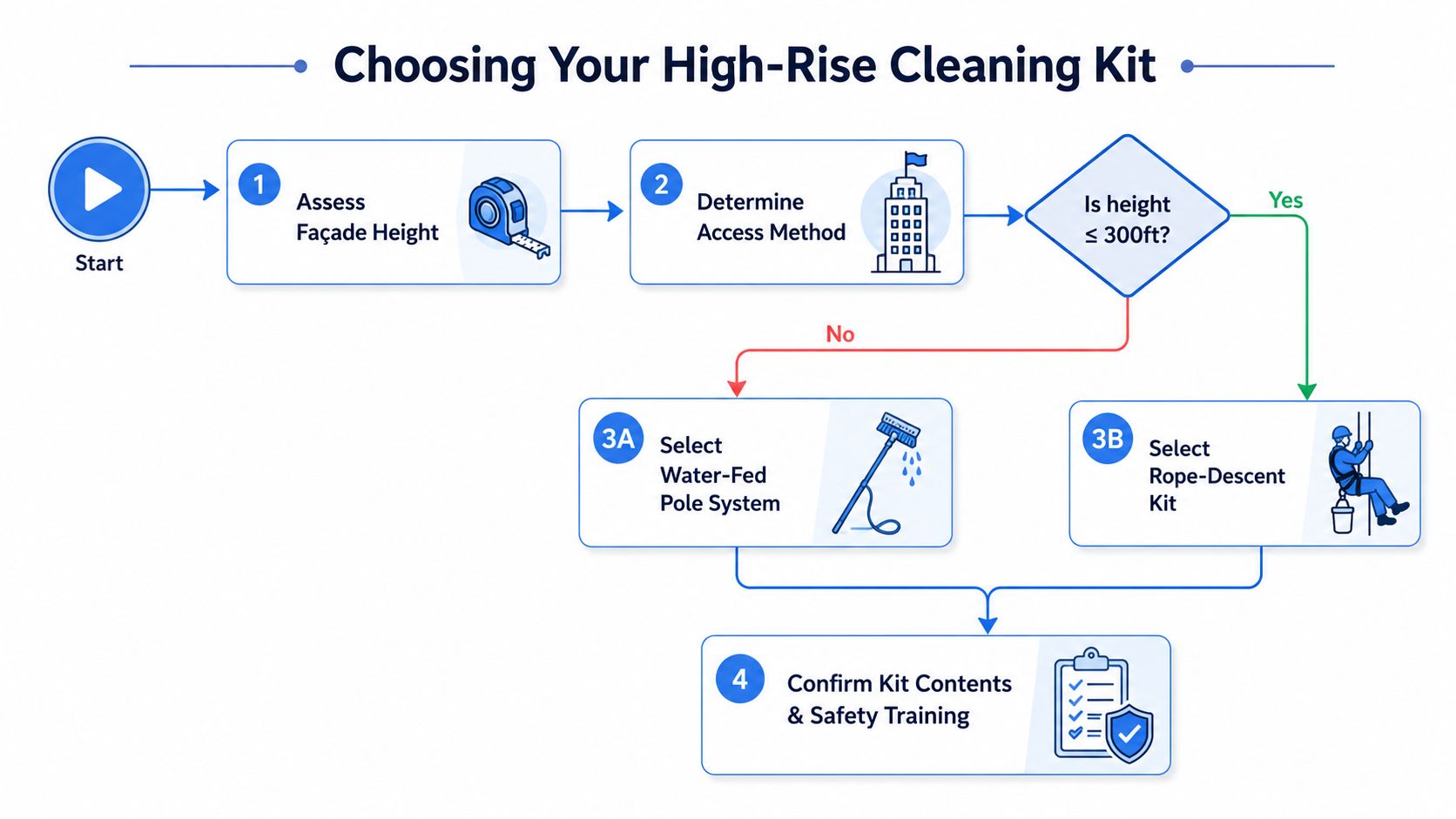
Ask each bidder to state:
For a practical equipment reference, review professional window-cleaning equipment guidance. The page can help owners understand terminology, but it shouldn't replace a site-specific assessment.
What training does a high-rise cleaner need?
Workers need training appropriate to the access system, including equipment use, fall protection, work-at-height procedures, site hazards, and emergency response. The building owner should verify competence rather than relying only on a product certificate.
How often should a kit be inspected?
Inspect equipment before use, perform scheduled functional and documented audits, and follow the applicable manufacturer, site, and regulatory requirements for qualified or third-party inspections. Life-safety equipment and anchors need stricter controls than ordinary brushes or squeegee rubber.
Can drones or robots replace traditional kits?
Automated, robotic, and smart building-maintenance systems can reduce human exposure in some applications. They don't automatically replace traditional systems because façade design, cleaning quality, water delivery, weather, regulation, and rescue obligations still determine the suitable method. Current market coverage discusses drones, predictive analytics, and automated approaches as emerging options, not universal substitutes, in building window-cleaning systems market analysis.
Professional Window Cleaning provides residential, commercial, and high-rise window washing services across Arizona, Colorado, and Nevada, including work for high-rise buildings and specialized facilities. Visit Professional Window Cleaning to discuss your façade, access method, and cleaning requirements before choosing a high rise window cleaning kit.
Read our blog posts regularly and keep learning.