Care and Maintenance
How to Keep Windows Clean Longer Between Pro Washes
Learn how to keep windows clean longer with source control, routine timing, hydrophobic treatments and quick checks for homes and offices.


The first mild Saturday of spring, the storm panels come off the front of the house, get hosed down on the driveway, and go back up streaked and spotted. A week later there's a band of fog between the storm panel and the inner sash that wasn't there before, and no amount of re-wiping touches it. That sequence, a wash that leaves the glass worse and a symptom that ignores more washing, is where most storm window cleaning goes wrong.
The work splits into two parts that people usually merge. One is reading what the window is telling you before a panel comes off. The other is cleaning without damaging the parts that make a storm window function, meaning the seals, the weep holes, the drainage channels, and the paint on the frame. Get the order right and the job moves fast. Skip it and a cosmetic wash becomes a glazing replacement, a fall risk, or a lead-dust problem inside the house.
Storm windows aren't one product. Glass and acrylic panels behave differently, fixed units can't come out at all, and access decides more about the job than the cleaner does. Match the window to the method before anything gets wet.
| Window type | Cleaning method | Access needed | Main risk |
|---|---|---|---|
| Removable ground-floor glass panel | Remove, wash flat on a padded surface | Ground level | Cracked glazing if forced in or out |
| Removable upper-floor panel | Professional access or ladder-safe removal | Ladder or lift | Falls from unstable footing |
| Fixed exterior storm window | Clean in place with mild soap and a soft brush | Reach or ladder | Scratched glass and water running into the frame |
| Acrylic storm panel | Mild soap, soft cloth, no abrasives | Ground level or ladder | Clouding and scratches from harsh cleaners |
| Screen insert | Vacuum loose debris, wash gently without stretching the mesh | Ground level | Distorted or torn mesh |
The method column is the easy half. The access column is the one that decides whether you're doing this yourself.
Exterior glass at height is dangerous work. An OSHA analysis summarized by HealthDay identified 88 window-cleaning accidents over a 15-year period, and 62 of them were fatal, which works out to roughly 70% of the recorded incidents. An upper-floor storm panel is that same job with fewer handholds, because you're often reaching around a sash rather than standing square to the glass.
If a panel can be lifted out and carried with both hands while you stand at ground level, DIY is reasonable. If reaching it needs a ladder, a lift, or leaning out of a window, stop and plan professional access instead.
Ladder placement is where good intentions fail. Portable ladders used to reach a roof or landing must extend 3 feet above that level, and the top step or the cap of a stepladder is never a standing step. Before you move on, walk the house and count your panels, noting which floor each one sits on. That list is the whole plan.
Cleaning is not automatically the harmless option. Plenty of homes built before 1978 have painted window components that may contain lead, and a wash that turns into scraping, sanding or pressure washing can release lead dust even when the glass in front of you is perfectly intact. The panel looks fine. The paint around it doesn't have to be.
The National Park Service guidance on historic exteriors is specific about method: keep the work damp to limit airborne particles, avoid high-pressure washing, use a mild vinegar-and-water solution or a non-alkaline cleaner on storm panels, and dry carefully around corners where water and residue collect.
Lead rule: damp, low-abrasion and controlled, with debris bagged and sealed before the first panel comes off, not swept up afterward.
Set the controls before you start:
Stop scraping or sanding the moment paint flakes or dust becomes visible, when frames are deteriorating under the coating, or when the job requires stripping old paint to get a clean surface. Those are the conditions that call for a certified lead-safe professional, not a stiffer brush.
It's worth separating cleaning from replacement. Lead paint alone doesn't mean historic windows have to come out. A wet wash, a fresh assessment, and a properly sealed frame keep most of these units in service for decades.
Work in order and each step protects the next one. Most panel damage traces back to skipping step four, or to reinstallation before the edges are dry.
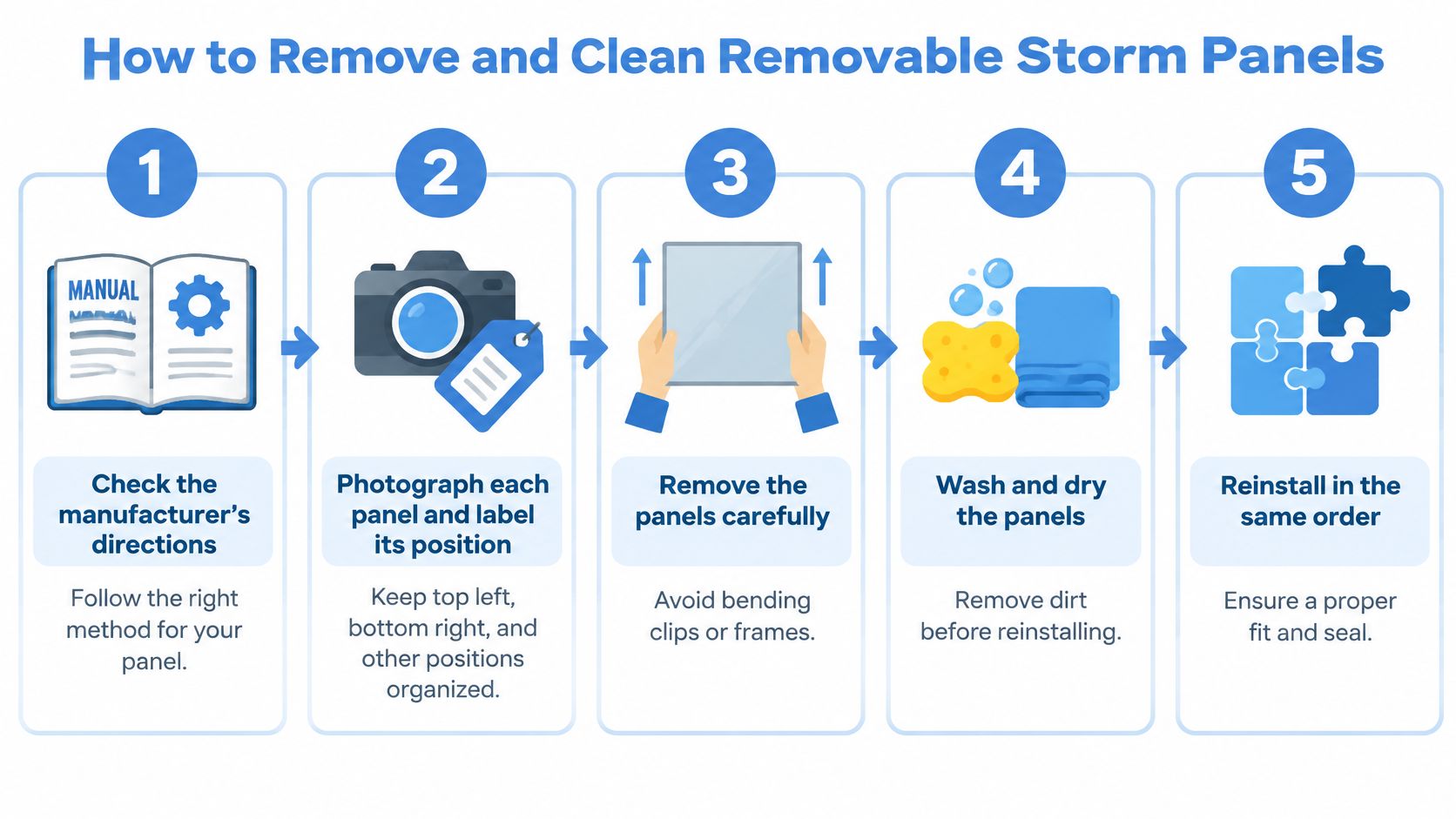
A finished panel gives you three things: a clear sightline, water that drains freely after a controlled rinse, and a snug fit with no lift at the corners. Anything less means something is out of alignment.
Most storm window damage isn't caused by dirt. It's caused by the wrong chemical or the wrong tool applied to a surface that can't take it.
| Surface | Use | Avoid |
|---|---|---|
| Glass | Lukewarm water, small amount of mild detergent, microfiber cloth | Ammonia, abrasive powders, razor blades |
| Acrylic panel | Mild soap, soft cloth, rinse well | Ammonia, abrasive pads, high-pressure spray |
| Screen mesh | Soft brush or low-pressure water, gentle wipe | Stretching the mesh, stiff brushes |
| Frame and sill | Soft brush with mild cleaner, dry fully | Pressure washing that forces water into joints |
| Tracks and weep holes | Vacuum first, then soft brush and clear water | Mixed cleaners, metal tools that gouge the channel |
| Suspected mold | Stiff brush, hot water, ammonia-free soap, scrub while wet | Dry scrubbing that spreads particles |
Read the label before the glass. University of Minnesota Extension guidance on hazardous household products notes that many household cleaners contain corrosive, toxic or flammable ingredients and directs users to follow label instructions for use, storage and disposal. Ammonia, abrasive powders, razor blades and high-pressure spray all attack coatings, seals or frames on storm units.
Match the cleaner to the panel material. Glass and acrylic don't tolerate the same products, and coated panels add another variable. Manufacturer cleaning guidance for storm windows recommends confirming the panel material and any coating first, clearing loose debris before wiping, and using a soft brush or vacuum attachment on accessible tracks, with the mesh washed without stretching.
Screens get their own treatment. Take them out, vacuum both faces, wash with mild soap and a soft brush, and rinse at low pressure. The full method is in our window screen cleaning guide.
For the squeegee finish, wet the glass with solution and pull controlled overlapping passes, wiping the blade clean after each one. In Las Vegas, dust re-deposits within days and strong sun bakes detergent film onto glass, so rinse twice and work in shade or early morning. The acceptance test is a clear sightline with no streaks under oblique light.
Fog on a storm window is a symptom, not a cleaning failure, and more wiping rarely fixes it.
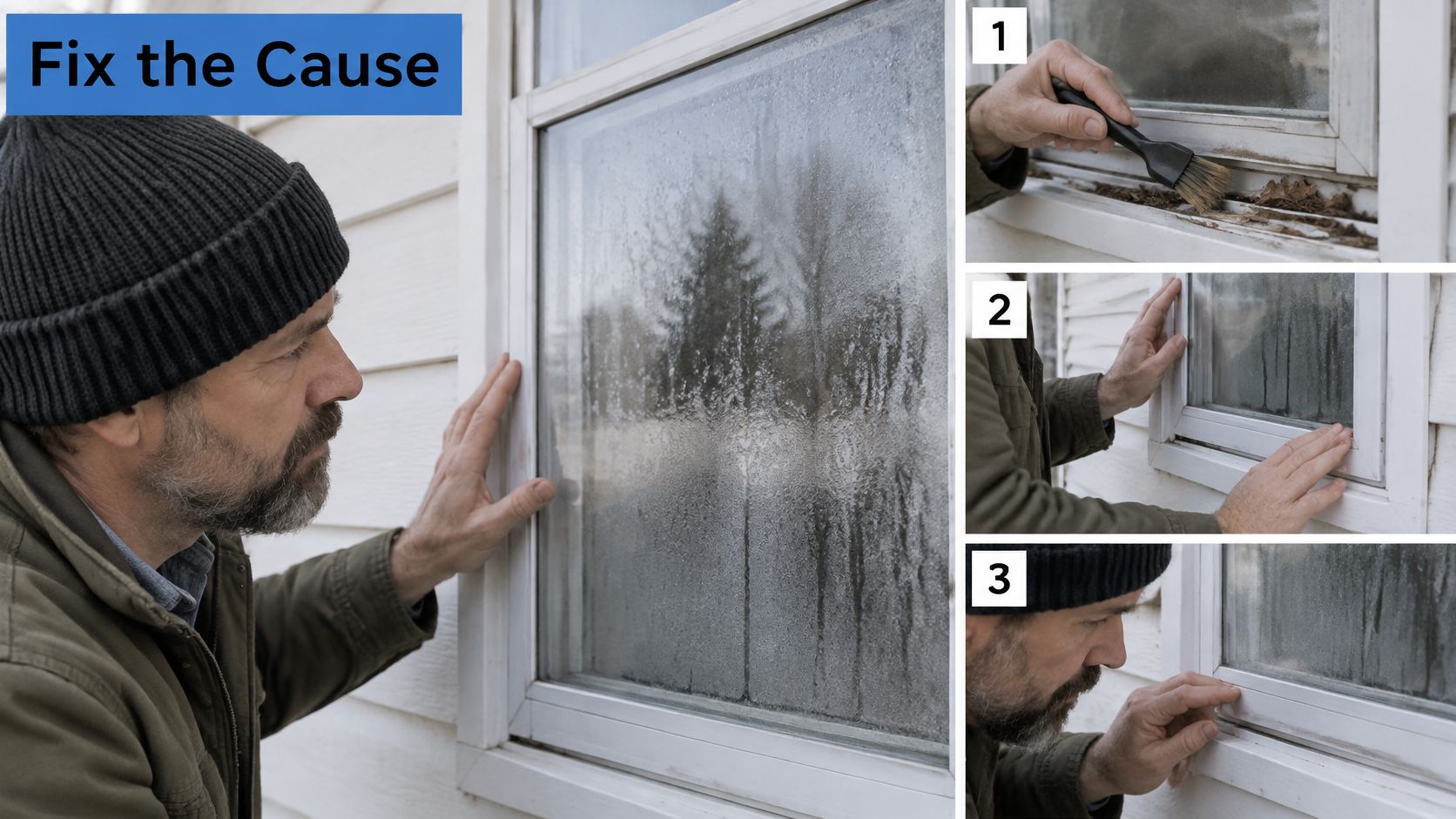
Storm units can create condensation when air movement and moisture management are inadequate, which is why the mechanical checks come before anything you do inside the house. ENERGY STAR's storm window criteria analysis notes that exterior units should have functional weep holes and that the primary window should be reasonably airtight.
| Symptom | Likely cause | Fix |
|---|---|---|
| Haze that shifts when the viewing angle changes | Residue or incomplete drying | Re-wash with fresh water and dry with microfiber |
| Fixed cloudiness between the panes | Failed insulating seal | Replace the glazing unit |
| Droplets between storm panel and window | Blocked weep holes or trapped moisture | Clear weep holes and check the panel seats |
| Water inside the frame | Blocked drainage path | Clear drainage slots and let the frame dry |
| Condensation that returns after the checks | Excess indoor humidity | Run exhaust fans, vent dryers, use a dehumidifier |
Work the sequence in order. Clear debris from the weep holes first. Confirm the panel is installed correctly and seated flat. Inspect seals, gaskets and drainage slots. Only then look at indoor humidity.
The angle test tells you which problem you have. Haze that moves as you shift your viewpoint is residue or incomplete drying, and it responds to a fresh-water rinse and a dry microfiber. Cloudiness that stays put between panes may be a failed insulating seal that no cleaner will reach. Fixed fog inside a sealed unit is covered in our guide to double-pane window fog.
Water sitting inside the frame usually means a blocked drainage path, not a cleaning problem. Clear the slots, let the frame dry, and watch whether it returns.
If condensation persists after the mechanical checks, the fixes are indoor ones: run bathroom and kitchen exhaust fans, vent dryers outdoors, correct basement or crawl-space moisture, and use a dehumidifier. Cold-weather condensation is the common version of this in Denver, where a warm, humid interior meets cold exterior glass, while tightly closed homes in Arizona and Nevada produce related problems in the cooling season.
Cracked glazing, hardened gaskets and blocked channels get replaced rather than scraped. Here's the maintenance side of the same job:
The rule is short. Clean ground-floor removable panels yourself if you can lift them safely and the paint is sound. Book professional access for anything above ground level, for any panel you'd have to reach by leaning out, and for older windows with questionable paint.
Five criteria settle it: panel count, story height, panel condition, lead risk, and how much time you have. Two panels at waist height on a Saturday morning is a DIY job. Sixteen panels across two stories, with half the frames chalky under the paint, is not.
Every professional window cleaning method comes down to two approaches. Squeegee cleaning wets the pane with solution and removes the liquid in controlled passes, so the glass dries without streaks. Pure-water cleaning treats the water first, and AXEON's explanation of pure-water systems confirms that deionized or reverse-osmosis water contains far fewer dissolved solids and is therefore less likely to leave deposits as it dries, with incoming total dissolved solids, water hardness and available pressure deciding which system suits a building.
Hard water and dusty air are the two conditions that make pure-water cleaning worth the setup on exterior glass.
Phoenix is a good example of where the choice matters. On Phoenix homes, mineral-heavy water and airborne dust mean a squeegee pass finished with a dry detail often beats a wet-and-walk-away approach on frames and sills.
Book one action before you decide anything. Photograph each panel with its location taped on, note the story height and whether a ladder is involved, and request a free estimate before attempting removal on upper floors or older windows.
Storm window washing at Professional Window Cleaning covers interior and exterior glass, screens, sills, frames and tracks, with a post-clean inspection and a streak-free guarantee, and we quote it free before anything is scheduled. If a panel sits above ground level, shows fixed cloudiness between panes, or the frame is old enough to carry lead paint, that's the point to hand the job over instead of working from a ladder. Visit Professional Window Cleaning to book an estimate in Las Vegas, Phoenix, Scottsdale, Denver, Flagstaff, Tempe, Chandler or Gilbert.
Read our blog posts regularly and keep learning.