
Care and Maintenance
How to Choose a Window Cleaner in Las Vegas, NV and Scottsdale, AZ
Hiring a window cleaner in Las Vegas, NV or Scottsdale, AZ? Use this trusted checklist covering insurance, safety, reviews and the questions to ask first.


Most of the advice about how to keep windows clean longer is backwards. It tells you to wash more often, switch to vinegar, buy a different squeegee. Frequency is the last lever you should pull. Glass that clouds over in five weeks will cloud over in five weeks whether you wash it monthly or quarterly, because something is still feeding it: a sprinkler head aimed at the pane, an open window beside a dusty road, a sill packed with grit that releases a puff of dust every time the wind shifts, a bathroom with no working exhaust fan.
Fix the feed and the interval stretches on its own. Treat re-soiling as a source and moisture problem rather than a washing-frequency problem, and timing matters as much as technique. In Arizona, Nevada and Colorado, the calendar that works is set by dust season, pollen, wildfire ash and irrigation, not by the first warm weekend of spring.
A single-family home on a quiet street, with no sprinkler heads hitting the glass, can usually go about six months between professional washes. A desert property where irrigation overspray lands on west-facing panes needs every three months, and sometimes tighter. The difference isn't the neighborhood's prestige. It's what is landing on the glass and how fast it bonds.
Use the table as a starting point and adjust from what you observe.
| Property and exposure | Glass wash interval | Sill and track check | Main re-soiling source |
|---|---|---|---|
| Single-family home, low-dust neighborhood | Every 6 months | Every 3 months | Pollen and rain spotting |
| Desert home with sprinklers near glass | Every 3 months | Monthly | Irrigation overspray and mineral spotting |
| Home near dirt road or construction | Every 2 to 3 months | Monthly | Fine dust and debris |
| High-rise condominium | Every 6 months, more on exposed floors | Quarterly | Wind-borne dust and roof runoff |
| Office or medical suite | Quarterly exterior, monthly interior wipe | Monthly | Foot traffic on sills and HVAC dust |
| Storefront on busy road | Every 1 to 2 months | Monthly | Vehicle exhaust and road grime |
Consumer advice treats window cleaning as a fixed calendar task. The better approach is to wash immediately after the dominant seasonal source ends, because washing at the peak means the next dust event erases the work in weeks. The EPA's page on sources of indoor particulate matter supports the same logic for indoor air: keep windows closed during high-pollen or high-pollution periods, remove dust often, and damp-clean rather than dry-dust so particles don't go back into the air. EPA guidance on post-wildfire ash cleanup goes further and recommends misting hard surfaces before sweeping, so ash doesn't become airborne in the first place.
That principle translates directly to glass. Remove the source, then clean.
Say a Phoenix homeowner has two west-facing windows sitting above a sprinkler zone. The heads hit the wall twice a week and the water is hard. Washing in June, at the height of the dust season, buys maybe three weeks of clarity. Redirecting the spray away from the wall and booking window cleaning in Phoenix for the week after the summer dust quiets down buys months.
Mineral deposits make this urgent rather than cosmetic. Once dissolved calcium and magnesium dry onto glass repeatedly, they bond, and ordinary washing stops lifting them.
Don't guess at your cycle. Note the week a faint film first appears after a wash, then note what the film looks like. A uniform grey haze is dust. A chalky ring pattern is water. If glass dulls in under eight weeks, either the interval is too short for the load or the source is still there, and adding washes just adds labor.
The rule I'd apply this week: find the single biggest thing depositing dirt on your glass, move it or fix it, and then schedule the next wash for the week that source goes quiet.
The dust that ruins a clean job is mostly airborne before it ever touches the pane. This is what a sill looks like when nothing upstream has been controlled.
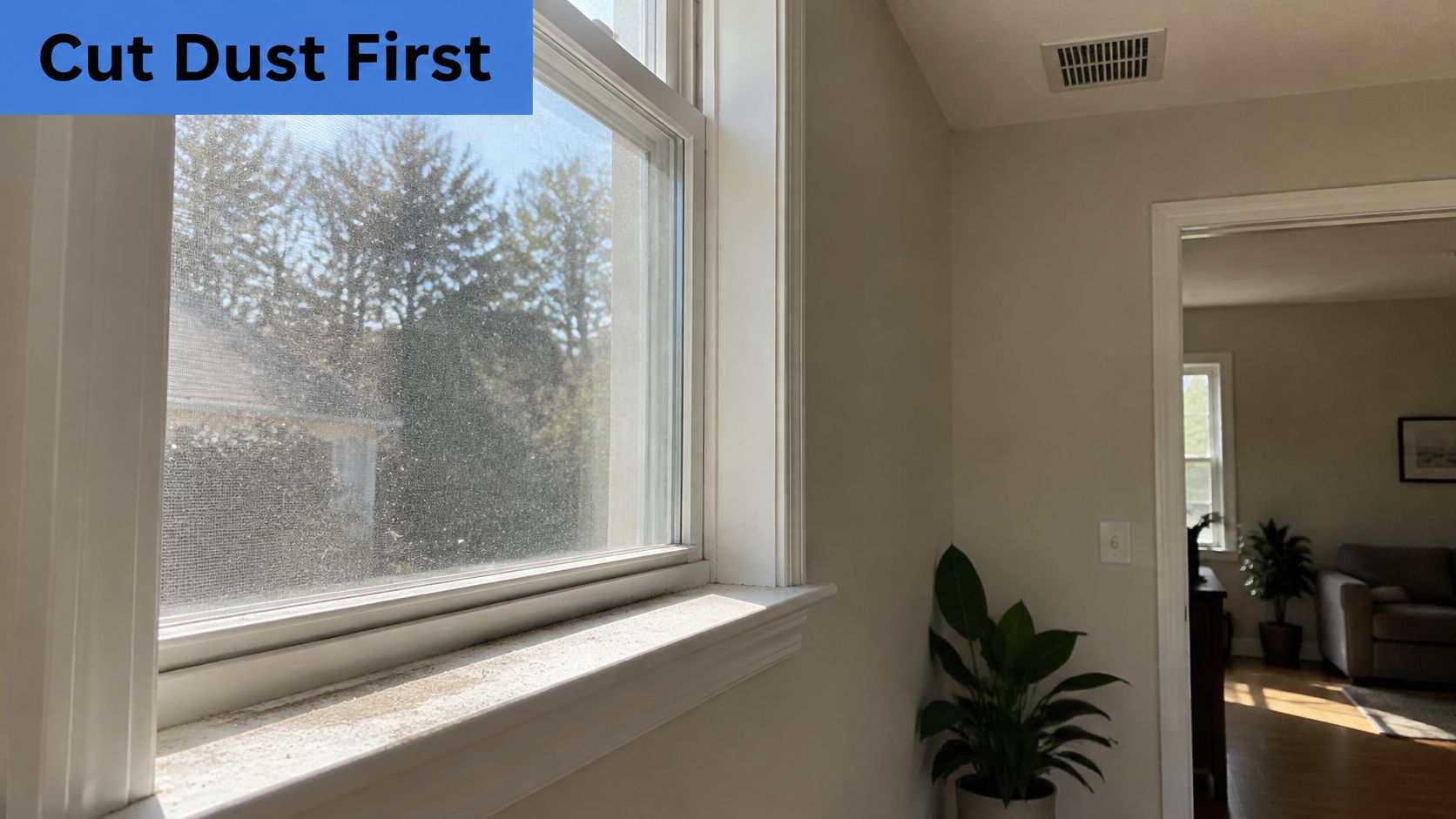
More washing doesn't solve that. Indoor dust is a major reason windows become visibly dirty again after cleaning, and much of it is generated inside the building. The EPA's technical summary on residential air cleaning explains that outdoor particles enter through windows, doors, cracks and other openings, while indoor sources include cooking, cleaning, smoking and ordinary movement through the home. The common indoor particle list is broad: pollen, fibers, fungal material, dust, pet dander, allergens, vehicle exhaust and combustion particles.
That list tells you where to intervene.
If dust keeps returning to the same rooms, the household's broader dust load is worth a look. This homeowner guide to reducing dust at home covers the HVAC and filtration side in more depth, and our own guide to preventing dust on windows covers the window-specific habits.
Say a restaurant on a dusty commercial street switches its front-of-house staff from dry dusting the sills to damp wiping with a microfiber cloth. The visible film on the interior glass starts returning more slowly within a couple of weeks, because settled dust is being removed instead of recirculated. Nothing about the cleaning product changed, only the method.
Pick the habit that matches your biggest source and start there this week. Sprinkler spray on glass? Redirect the heads and wipe the sills monthly. Cooking haze in an open-plan kitchen? Run the exhaust fan every time the burners are on. Road dust from a busy frontage? Close the street-facing windows during peak traffic and damp-dust the sills weekly.
Streaks and grit are two different failures, and both come from skipping a step rather than from a weak cleaner. Grit is abrasive dust wiped across dry glass, which is how fine scratches appear on panes that were not dirty enough to need scrubbing. Streaks are detergent or mineral residue left to dry, and that residue attracts new soil faster than bare glass does. The National Glass Association's procedures for cleaning architectural glass sets out the two-stage process that avoids both problems: water first to float loose abrasive material off the surface, then a mild, non-abrasive solution, removed with a clean rubber squeegee before it dries.
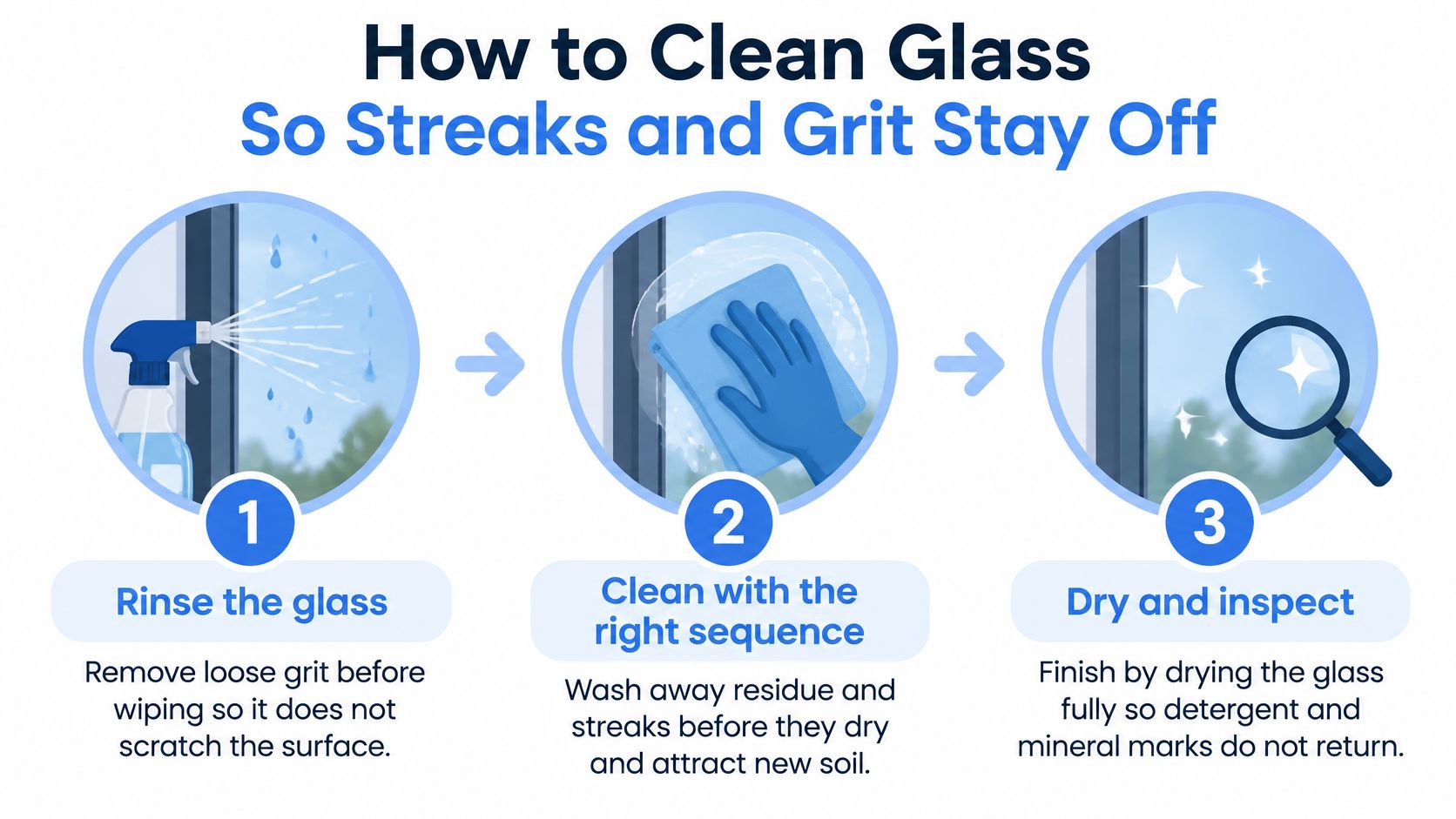
Every professional job comes down to one of two systems. The squeegee method combines rinsing, a controlled cleaning solution and blade work, and it remains the only way to finish interior glass properly. The pure-water system purifies water through reverse osmosis and deionization, then brushes and rinses exterior glass with water so mineral-free it can air-dry without spotting, no blade and no chemical film. That's why pure-water crews work so fast on exteriors and still send someone inside with a squeegee.
Here's the full process in motion.
Desert work adds two constraints: pre-wet the glass in dry heat and work in shade, because solution that flash-dries leaves exactly the residue you're trying to avoid. Avoid acids entirely. The National Glass Association advises against muriatic and hydrofluoric acid because they can damage glass and coatings. A clean finish holds longer than a merely wet one, since there's no residue left for new dust to bond to.
Ten minutes a month with a cloth and a flashlight tells you more than the last wash did. Run the cloth along each sill and look for the grey grit line that builds where glass meets frame. Shine the light down each track and into the corners of each screen. Then check the inner glass first thing in the morning, when any overnight condensation is still visible.
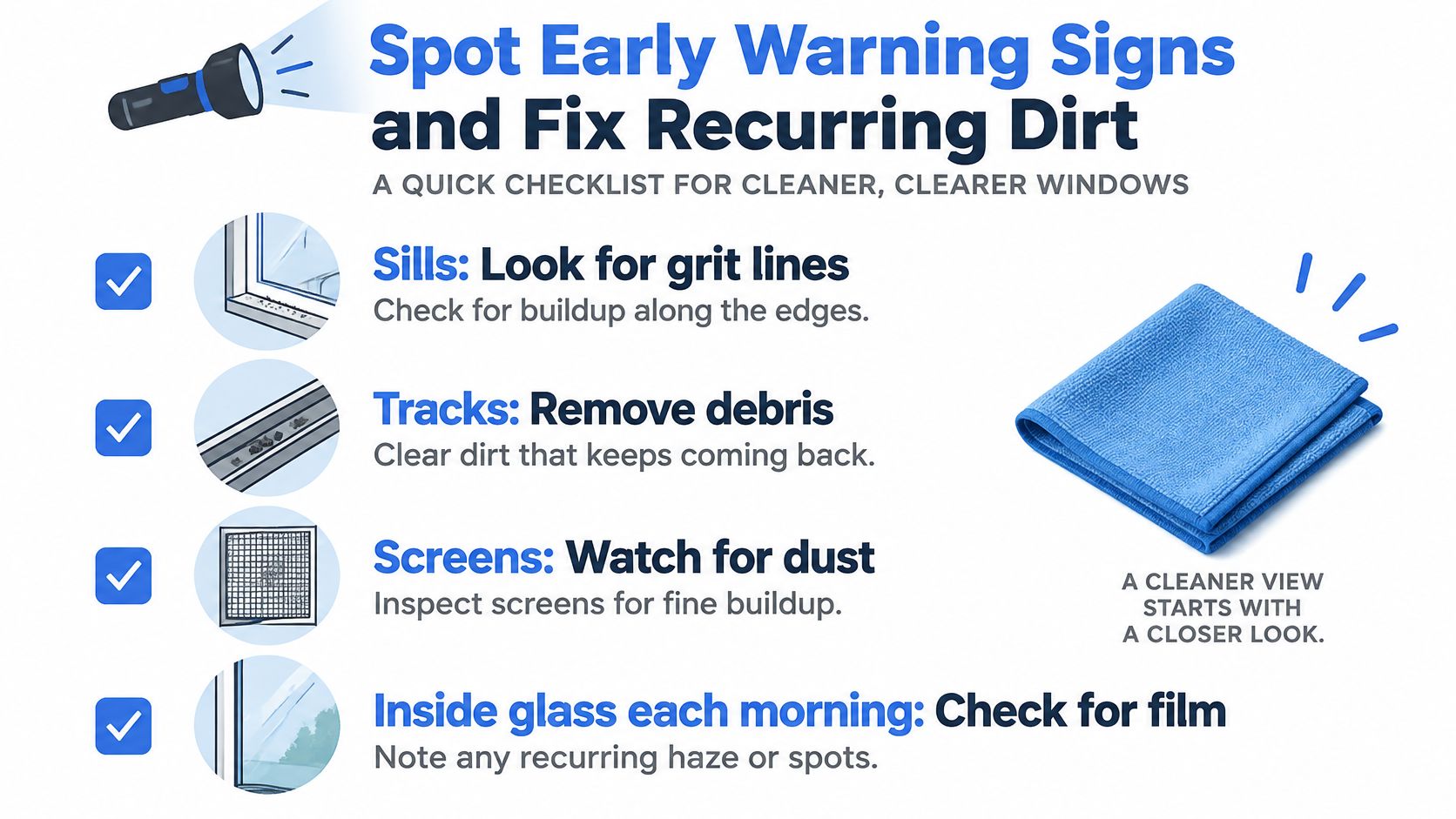
Fog on the inside of a pane is information, not just a smudge. The EPA's guidance on improving your indoor environment recommends keeping indoor relative humidity around 30 to 50%, addressing condensation quickly, and cleaning settled dust with a damp cloth. Condensation that returns morning after morning signals excess moisture to correct at the source, whether that's a bathroom fan that doesn't move air or a leak behind the trim. Wiping it away each day hides the symptom and leaves the cause running.
Surface dirt comes off with technique. Mineral spotting needs something that dissolves the deposit, not more friction. Moisture-driven recurrence doesn't respond to washing at all, because the water is arriving from inside or from a gap. Match your response to the problem and you stop paying for repeat visits that fix nothing.
Older housing and high-rise condominiums deserve a separate pass, room by room and floor by floor, because sills and troughs there can collect hazardous dust; when substantial dust is present, EPA guidance is to HEPA vacuum before damp cleaning rather than dry sweeping it loose.
| Symptom | Likely cause | Fix |
|---|---|---|
| Water spots return within days | Hard water or sprinkler overspray | Redirect spray, rinse before drying, consider a mineral treatment |
| Fog or condensation on inner glass each morning | Indoor humidity above 50% or a hidden leak | Lower humidity to 30–50%, ventilate, check for leaks |
| Dusty film on sills within a week | Settled indoor dust or open windows | Apply the dust habits from the dust section first, then damp wipe |
| Streaks right after cleaning | Dried solution or dirty squeegee blade | Squeegee sooner and wipe the blade after each pass |
| Haze or cloudiness on coated glass | Harsh cleaner or acid residue | Stop, test a small patch, then ask a pro about re-treatment |
Hard water is the one spot pattern worth reading closely, since a bonded mineral ring behaves differently from fresh spray. Our notes on preventing hard water stains cover what to do before a deposit etches in.
Diagnostic rule: if a fix doesn't change the symptom within two weeks, change the variable (humidity, spray direction or tools) instead of raising the wash frequency.
The choice is narrower than it looks. Stay DIY while the glass is reachable from the ground, exposure is low, and panes still look clear after each wipe. Book a professional when glass sits high, when mineral spotting survives two rounds of your own work, when coated or low-E glass needs careful handling, or when a commercial property runs on a fixed schedule. Quarterly is the sensible baseline for commercial properties, since foot traffic and HVAC dust never stop.
| Treatment | What it repels | Typical durability | Best fit | Limitation |
|---|---|---|---|---|
| Professionally applied hydrophobic glass coating | Water, mineral film and some grime | 6 to 12 months, reapply when water stops beading | Exterior glass in rain, hard water or sprinkler spray | Needs full prep and does not stop interior dust |
| DIY hydrophobic glass spray | Light water beading | A few weeks to a few months | Quick touch-ups between professional cleanings | Wears fast under sun and wiping |
| Professional sill and frame sealant | Water and dirt on sills | Reapply when the bead cracks or pulls away at the frame joint | Sills and frames exposed to rain or sprinklers | Protects sills and frames only, not the glass |
| No treatment, scheduled cleaning only | None | Ends at the next wash | Low-exposure homes with sheltered glass | Dirt and minerals bond faster between washes |
A hydrophobic coating makes water bead and sheet off, so grime rinses away more easily and spotting is reduced. It does not block dust, it does not stop interior film, and it does not replace cleaning. Judge it by your exposure: sprinkler spray, hard water and driving rain make it worth the prep, while shaded interior glass rarely justifies it. Test coated or low-e glass in a small area and follow the label.
The pure-water method explains why exterior work can outlast a hand wash. The National Window Cleaning Authority's explanation of pure-water cleaning describes water purified by reverse osmosis and then deionization, polished to approximately 0 to 5 parts per million of total dissolved solids, brushed and rinsed onto glass and left to air-dry without a squeegee or chemical film.
Before you call anyone, answer one question: how many weeks did clean glass last in the last cycle? If the answer is eight or more and the glass is safely reachable, keep doing it yourself. If it's four, you're paying for labor that a source fix or a coating would have handled instead.
We've been cleaning windows for over 26 years, and after every clean we apply high-quality sealants and protective treatments to sills and frames to guard against future dirt, water damage and wear. We also stand behind the work with a satisfaction guarantee, and any concern you raise gets addressed promptly.
If your glass keeps dulling weeks after a wash, the fix usually sits outside the glass itself, in a sprinkler head, a loaded filter, a humid room or a sill full of grit. Professional Window Cleaning has handled windows for more than 26 years across Phoenix, Scottsdale, Tempe, Chandler, Gilbert, Flagstaff, Las Vegas and Denver, including high-rise and commercial schedules built around each building's real exposure. We'll diagnose what's re-soiling your glass, set the right interval, and back the result with our satisfaction guarantee.
Read our blog posts regularly and keep learning.