Care and Maintenance
Commercial Window Cleaning Phoenix: Costs and Schedules
Commercial Window Cleaning Phoenix explained: services, squeegee vs pure-water methods, pricing factors, heat-safe scheduling and how to request a quote.


Dust control gets easier once you stop treating it like a wiping problem. About 80% of the dust in residential homes comes from outdoors, tracked in on shoes and clothing, according to the National Center for Healthy Housing. That single fact changes the whole approach. If most dust starts at the perimeter, the smartest fix isn't just dusting more often. It's stopping dust before it enters, cleaning the air that still circulates, and then removing what settles.
After more than 26 years around homes, offices, storefronts, and high-rise properties, I've seen the same pattern over and over. People clean hard, but they clean in the wrong order. They polish surfaces while entry doors leak dirt, while air systems recirculate particles, and while fabrics hold onto dust that keeps coming back onto sills, trim, and glass.
If you want to know how to prevent dust in a way that lasts, use a system. Not a random checklist. The most reliable system has three layers, and each one does a different job.
Dust doesn't appear out of nowhere. It follows traffic, airflow, and neglect. Once you understand those three routes, dust prevention becomes much more practical.
The first layer is source control. That's the gatekeeping layer. It covers entry mats, shoe removal, sealing gaps, and reducing the amount of dirt that crosses the threshold in the first place. The second layer is air filtration. That's what captures the fine material that stays airborne and eventually lands on shelves, ledges, blinds, and windows. The third is surface cleaning. That's the visible part commonly addressed first, even though it should usually come last.
Practical rule: If dust keeps returning fast, the problem usually isn't your cloth. It's what you're allowing in, or what your air is still carrying.
This framework works in houses, condos, medical offices, and commercial buildings because the logic stays the same even when the scale changes. A small home may need better matting and a tighter bedroom routine. A larger property may need stronger lobby controls and more disciplined HVAC maintenance. Either way, the sequence matters.
A lot of mainstream advice treats every dust tip as equal. It isn't. Some actions reduce the dust load coming into the building. Some reduce what floats around. Others only deal with what has already settled. That distinction matters if you're trying to cut repeat cleaning, protect finishes, and keep windows cleaner between service visits.
For a homeowner-friendly companion read, Buff & Coat's advice on home dust is a useful example of practical prevention habits that support the same goal from a flooring and interior care perspective.
| Layer | What it addresses | What it looks like in practice |
|---|---|---|
| Source control | Dirt and debris entering the building | Entry mats, shoe rules, sealing drafts, managing doorways |
| Air filtration | Fine particles that stay suspended | HVAC filter changes, air purifiers, HEPA-equipped vacuums, humidity control |
| Surface cleaning | Dust that's already landed | Microfiber dusting, top-to-bottom cleaning, vacuuming floors last |
The biggest mistake is skipping straight to layer three. You can dust every day and still feel behind if the first two layers aren't doing their job.
Most dust problems start at the door, not on the bookshelf. If you want less dust on furniture, baseboards, and window sills, the first place to work is the building envelope.
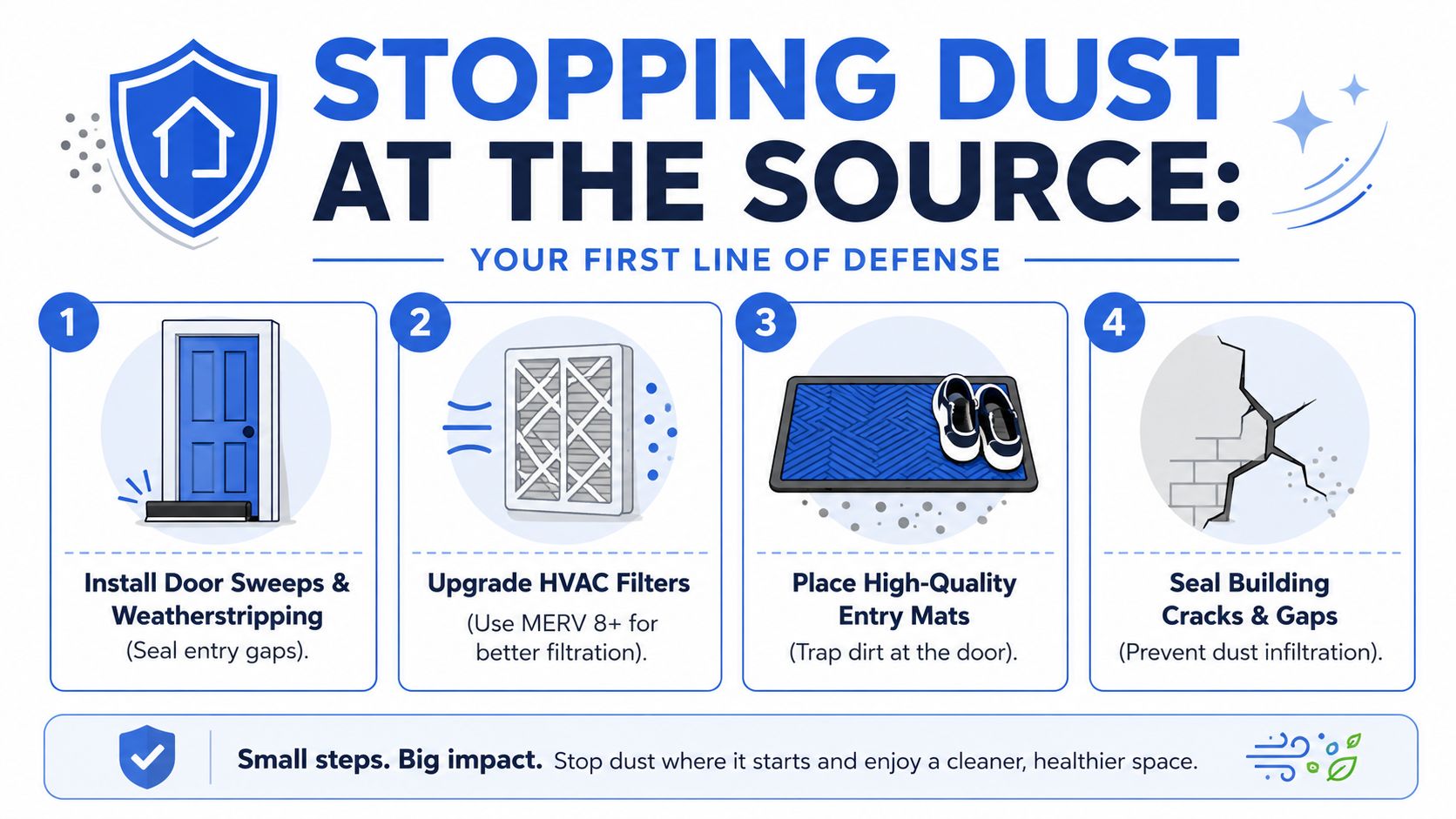
One thin decorative mat won't do much. The better setup is a two-part system.
This sounds simple because it is. But it's also one of the most impactful changes you can make. In busy homes and commercial entries, the doorway acts like a conveyor belt. If you don't intercept dirt there, you'll be cleaning it from every other surface later.
Tracked-in dust gets the attention, but infiltration matters too. Buildings pull dust through small openings around doors, windows, frames, utility penetrations, and worn weatherstripping. In dry climates and windy corridors, that leakage becomes obvious fast.
Check these areas first:
A building that leaks air usually leaks dust too.
For homes and properties in Phoenix and Scottsdale, this matters even more because fine outdoor dust doesn't need a large opening to become an indoor maintenance problem. The drier the environment, the less forgiving the building envelope tends to be.
Blinds, shades, and window treatments collect dust and then shed it back into the room whenever they're moved. That's one reason windows can haze up again sooner than expected, even after a thorough cleaning. If you're comparing treatments, Joey'z guide to energy-saving blinds is worth reviewing because window coverings affect both airflow behavior and how much dust they tend to hold.
Source control isn't glamorous, but it's where primary reduction starts. If the perimeter is sloppy, the rest of your routine turns into maintenance without progress.
Once you've reduced incoming dust, the next job is removing settled particles without throwing them back into the air. That's where technique matters.
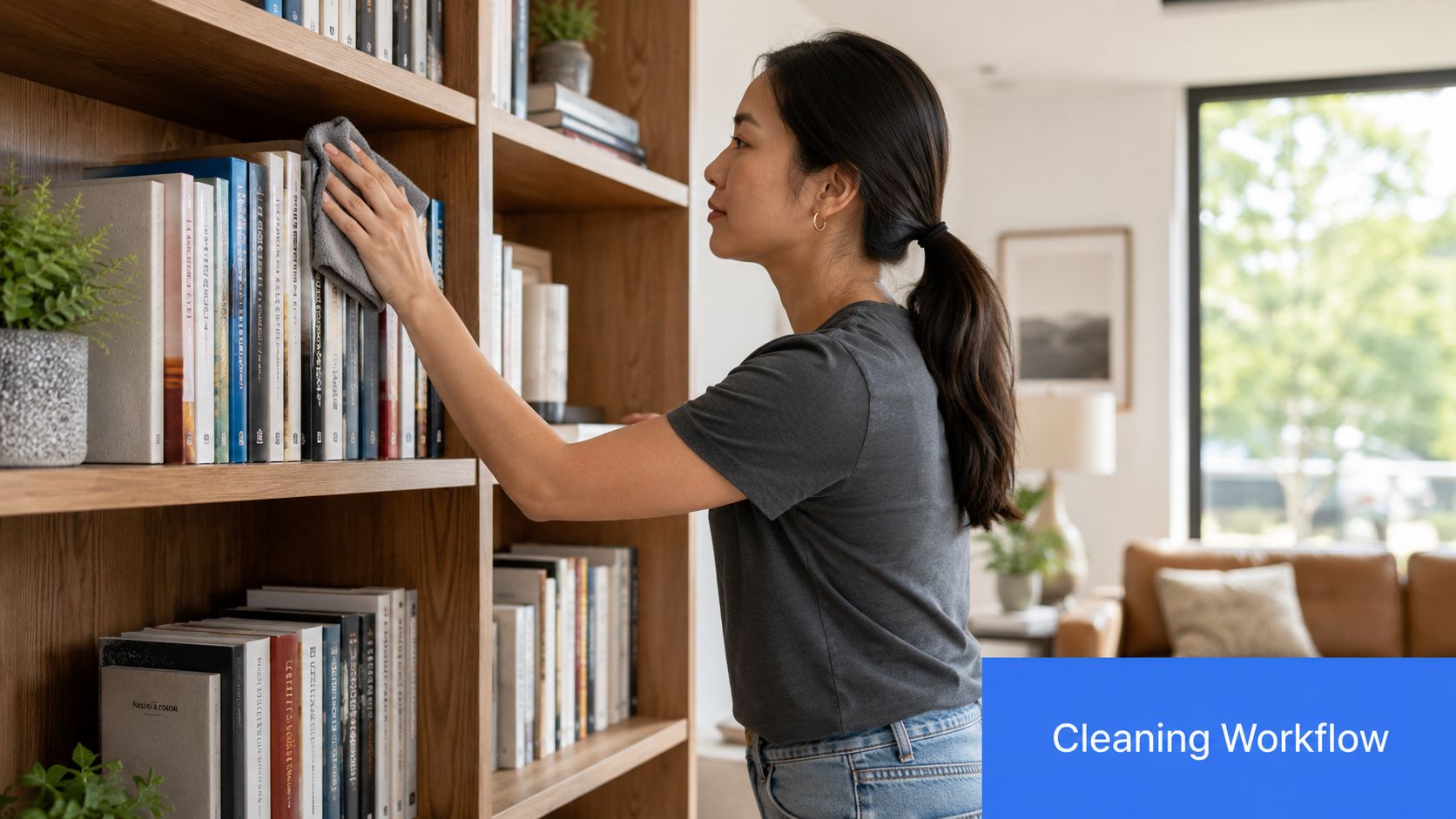
The most reliable method is a top-to-bottom, dry-then-damp workflow. Start by removing loose dust with a dry microfiber cloth, then make a second pass with a lightly misted microfiber cloth to lift the material that clings. Finish with floors so anything that falls during cleaning gets removed at the end, as outlined in this guide to dusting with a top-to-bottom dry-then-damp method.
People often clean what they see first. That usually means tabletops, counters, or glass. The better order is higher surfaces first, lower surfaces last.
If you reverse that order, falling dust lands on work you've already finished. That's why a room can still feel dusty right after a cleaning session.
Dry microfiber is ideal for the first pass because it grabs loose material instead of pushing it around. The second pass should be lightly damp, not wet. Oversaturating cloths can smear grime, leave residue on wood finishes, and create streaks on painted trim or window frames.
A few material-specific notes matter:
For cloth quality, dedicated microfiber makes a real difference. If you're sorting supplies, this guide to microfiber cleaning towels is a solid starting point for understanding why some towels trap dust better than others.
Cleaning works better when the cloth captures dust. It fails when the tool just relocates it.
A room can look clean and still release dust every time someone sits down, walks through, or opens curtains. Upholstery, bedding, rugs, and fabric window coverings are major reservoirs.
That's why dust control isn't just hard surfaces. It also includes laundering and vacuuming the items that hold fine particles and allergens. If you're updating sleep environments with that in mind, Australian hypoallergenic sleep solutions offers useful ideas for reducing fabric-related irritation and dust buildup around the bed.
This walkthrough shows the mechanics well:
Some common habits create more work than they solve:
A good routine feels methodical, not frantic. Done right, you don't just make the room look cleaner. You reduce how much loose dust is available to settle on glass, trim, and everything else tomorrow.
A dusty room isn't only a housekeeping issue. It's often an airflow issue. Fine particles stay suspended, move through return paths, settle on supply grilles, and eventually land on every horizontal surface in the space.
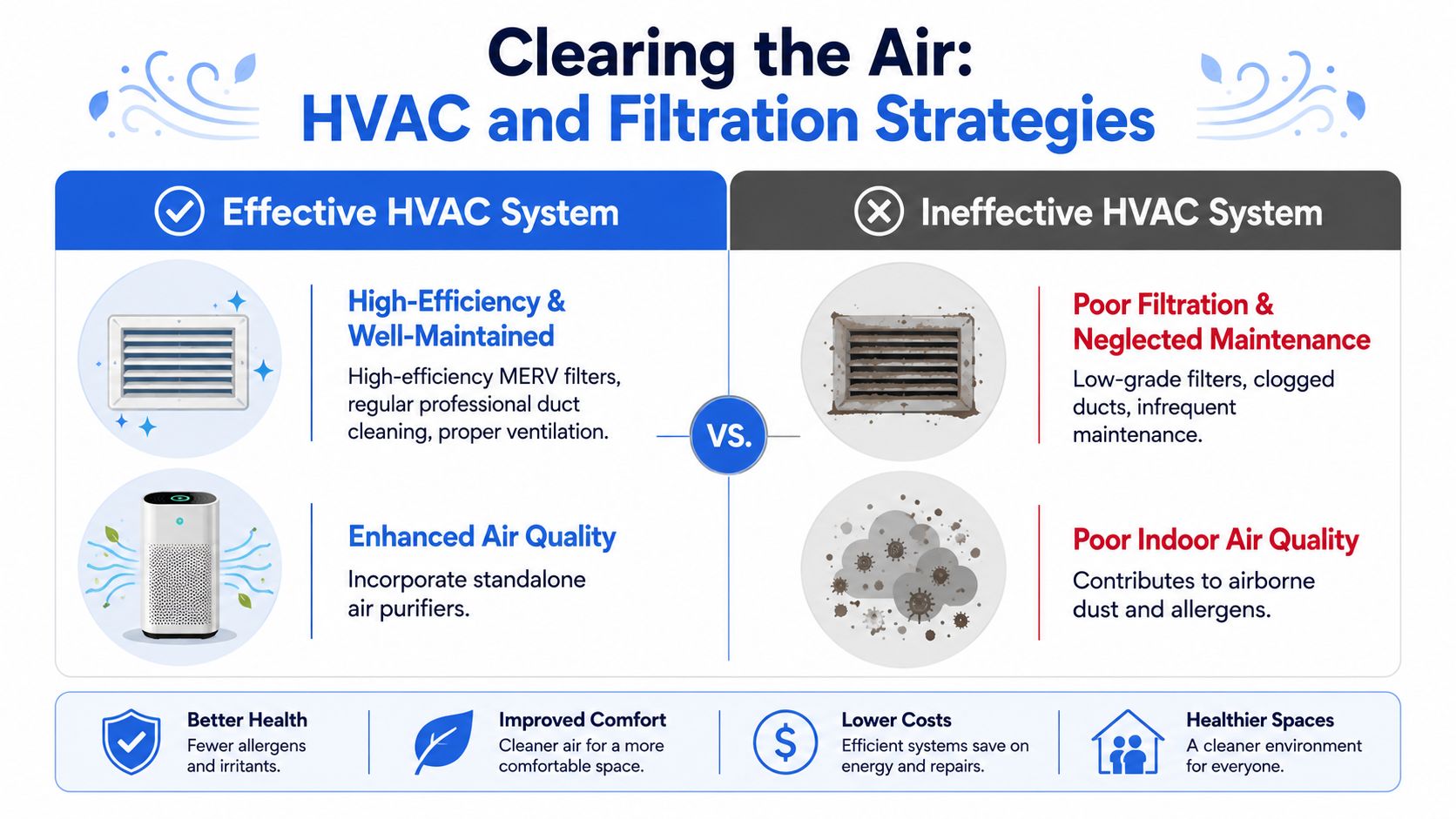
Air systems don't create dust, but they absolutely influence where it goes and how often it resettles. The baseline approach for long-term dust prevention is to combine source control with filtration. That means using HEPA-equipped vacuums and air purifiers, replacing HVAC filters on schedule, and keeping indoor relative humidity below 50% to reduce dust-mite growth and airborne settling, as noted in COIT's dust reduction guidance.
In practical terms, that means this:
| System element | Good outcome | Common failure |
|---|---|---|
| HVAC filter maintenance | Captures circulating particles more consistently | Loaded filters reduce effectiveness and allow more recirculation |
| Standalone air purifier | Helps clean air in problem rooms | Wrong placement limits coverage |
| HEPA-equipped vacuum | Removes dust instead of exhausting fine particles back out | Low-quality vacuums can stir up what they miss |
| Humidity control | Makes conditions less favorable for dust-mite growth | High humidity supports dust reservoirs in fabrics and bedding |
People hear "HEPA" and assume every application is automatic. It isn't. Portable air purifiers with HEPA filtration are often straightforward and helpful in bedrooms, living rooms, conference rooms, and other enclosed spaces where dust tends to linger. HEPA-equipped vacuums also make sense because they capture fine debris during removal.
HVAC filtration needs a little more judgment. A higher-efficiency filter can improve dust capture, but the system still has to move air properly. If airflow suffers, comfort and equipment performance can suffer with it. That's why filter upgrades should match the equipment, not just the marketing on the box.
Dust isn't only dirt and fibers. Biological material matters too, especially in bedding and upholstered spaces. Keeping humidity in check helps limit one of the most stubborn contributors to recurring indoor dust.
Field note: If a bedroom always seems dusty no matter how often it's cleaned, look beyond surfaces. Bedding, upholstery, and humidity are usually part of that pattern.
This is also where regular housekeeping and mechanical maintenance meet. If filters are neglected, returns are dirty, and rooms stay humid, dust settles faster and cleaning never seems to hold. If the air side of the building is under control, every other cleaning task gets easier.
Commercial dust control isn't just a scaled-up version of house cleaning. Different building traffic, larger air systems, loading areas, tenant movement, and maintenance work all create dust in different ways. That's why generic advice usually falls short.

A useful way to think about it is by category. Prudential Uniforms notes a key gap in business dust guidance because many checklists fail to distinguish between preventable household dust, tracked-in dust, and activity-generated dust. In real facilities work, that distinction drives the budget and the schedule.
Tracked-in dust is the lobby problem. It comes from shoes, wheels, deliveries, and frequent entry cycles. The answer is better matting, stronger entry cleaning, and close attention to vestibules, thresholds, and adjacent hard flooring.
Airborne recirculated dust is the office-floor problem. It shows up on diffusers, workstation surfaces, ledges, and glass partitions. That calls for disciplined filter maintenance, coordinated janitorial routines, and attention to textile-heavy zones like waiting rooms and conference spaces.
Activity-generated dust is the turnover and improvement problem. It comes from build-outs, repairs, tenant moves, storage disturbance, and maintenance work. You don't solve that by dusting more often. You solve it with containment, isolation, and cleanup protocols tied to the activity itself.
In a high-rise, dust doesn't stay local. Elevator traffic, shared corridors, mechanical floors, and pressure differences move particles farther than many managers expect. A residential-style plan usually breaks down because no one owns the whole sequence. Engineering handles filters. Janitorial handles surfaces. Tenants generate their own interior loads. Without coordination, everyone does part of the job and the building still looks dusty.
For owners and managers in Denver and Las Vegas, the best results usually come from treating dust control as an operations issue, not just a cleaning issue.
A workable commercial standard often includes:
Commercial spaces reward systems. They punish improvisation.
A dust plan only works if it repeats. Many don't need a perfect schedule. They need one they can maintain.
The practical version is simple. Keep the entry under control, keep the air side maintained, and use a disciplined cleaning routine before dust gets a chance to build up. In bedrooms, one task deserves special attention. Washing bedding weekly in hot water between 40°C and 60°C (104°F to 140°F) is critical for killing dust mites and removing their allergens, according to the Asthma and Allergy Foundation of America.
| Frequency | Task | Focus Area |
|---|---|---|
| Weekly | Shake out or vacuum entry mats, dust high-to-low with microfiber, vacuum floors last | Entry points and settled dust |
| Weekly | Wash bedding in hot water within the recommended temperature range | Bedrooms and fabric dust reservoirs |
| Monthly | Check door sweeps, weatherstripping, sill buildup, vents, and frequently used window coverings | Perimeter and airflow trouble spots |
| Seasonally | Review HVAC filters, inspect for gaps or draft points, deep-clean overlooked surfaces and storage areas | Filtration and building envelope |
| As needed | Use containment and specialized cleanup after remodels, tenant work, or heavy dust-producing activity | Activity-generated dust |
Some dust problems aren't routine cleaning problems at all. Post-renovation residue, tenant turnover debris, persistent sill buildup, and large commercial entries usually need a more specialized response. If you're dealing with that kind of situation, this guide on cleaning after construction helps explain why standard housekeeping often misses the mark.
The same goes for windows. Less ambient dust means cleaner glass for longer, but windows still collect residue on frames, tracks, and exterior surfaces that most owners don't fully remove on their own. For over 26 years, Professional Window Cleaning has handled that work for residential and commercial properties using the two methods window cleaning pros rely on: a squeegee or a pure-water system.
If your interior dust is under control but your views still look hazy, that usually means it's time to separate dust prevention from glass restoration. They're related, but they aren't the same task.
If you want help keeping your windows clear after you've done the hard work of reducing dust, Professional Window Cleaning serves homeowners and property managers across Arizona, Colorado, and Nevada, including Scottsdale and Las Vegas. A cleaner, lower-dust environment helps window cleaning results last longer, and the right service can take care of the glass, frames, and exterior buildup that routine dust control doesn't solve.
Read our blog posts regularly and keep learning.