Care and Maintenance
Commercial Window Cleaning Phoenix: Costs and Schedules
Commercial Window Cleaning Phoenix explained: services, squeegee vs pure-water methods, pricing factors, heat-safe scheduling and how to request a quote.


You can smell the job before you see the glass. The bucket's open in the service van, the microfiber towels are folded, and the next pane is already baking in the sun. On a commercial run, the wrong mix shows itself fast, because a storefront or high-rise window won't hide streaks, haze, or sloppy residue the way a bathroom mirror sometimes does.
A real commercial glass cleaner formula is built for that pressure. It has to loosen fingerprints, cut traffic film, and dry clean without leaving a film that the blade or towel will drag right back across the glass. That's why pros treat the formula as part chemistry, part field craft, and part judgment about the surface in front of them.
In a working truck, the glass mix doesn't live as a “cleaner,” it lives as a system. One tech tops off the bucket, another checks the blade, and the job starts only when both match the glass and the heat on the pane. The old myth is that a commercial cleaner is just vinegar in a spray bottle. That's not how the trade has worked for decades.
Commercial glass cleaner formulas became a distinct consumer product in the 1940s, tied to wartime demands for streak-free cleaning on plexiglass and other transparent surfaces during World War II, especially where aircraft visibility mattered commercial glass cleaner history and early formula development. By the late 1960s, the chemistry had already moved into a more standardized pattern, with a patent example using 4.0% isopropyl alcohol, 1% ethylene glycol monobutyl ether, 0.1% sodium lauryl sulfate, 0.05% of 28% ammonia, plus water, dye, perfume, and softening agents 1969 patent formula example. That combination still maps to the basic logic behind many commercial products today.
A good formula has to do three things at once. It must cut grease, lift soil, and evaporate without residue. If it fails on any one of those, the glass tells on you right away.
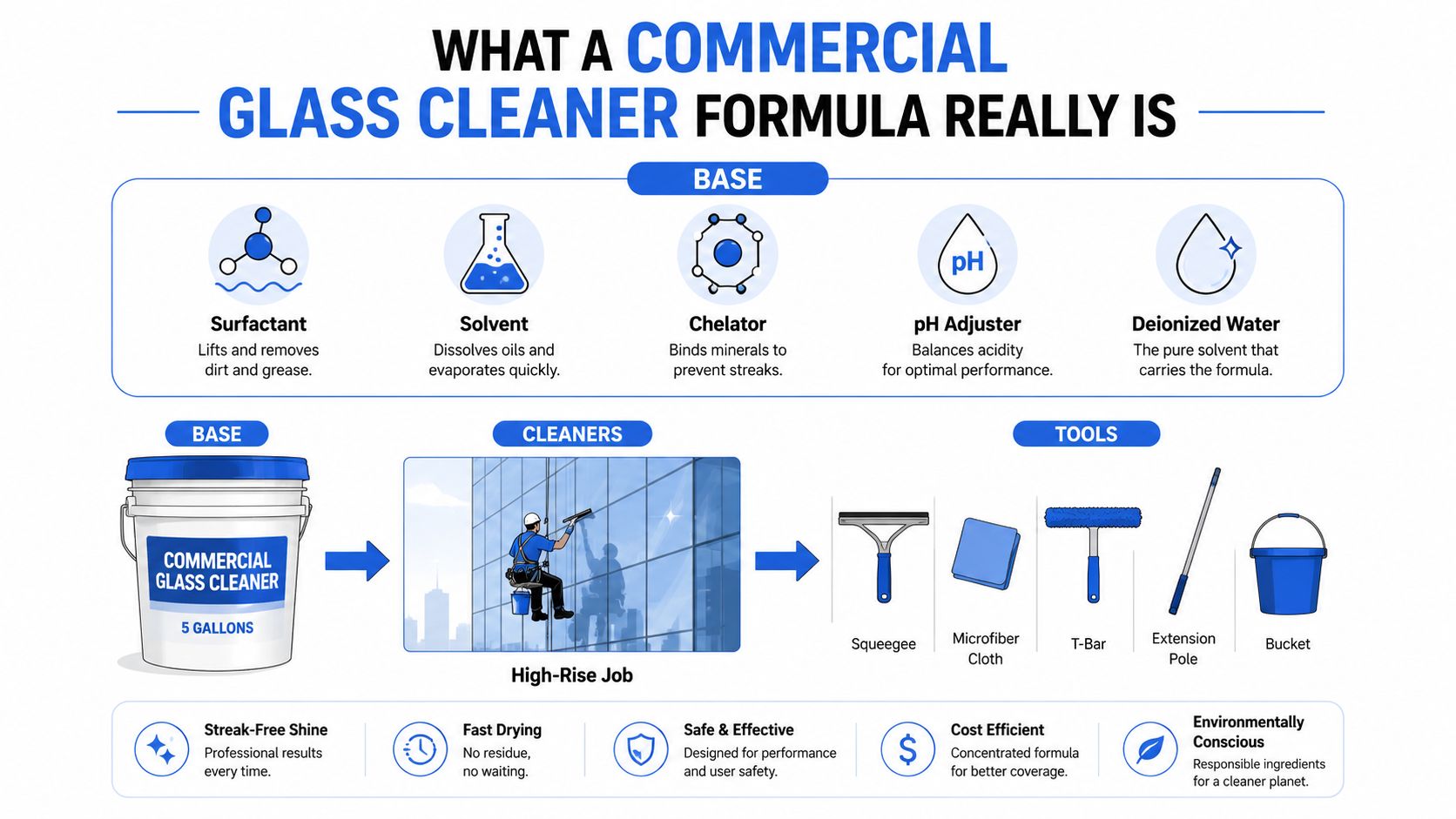
That's why the label matters more than most DIY guides admit. Solvents handle flash-off, surfactants handle soil release, and alkaline components help strip greasy film. If a formula has too much non-volatile material, the finish can go cloudy instead of clear, which is exactly the residue problem discussed in streak-control chemistry why residue forms on glass.
Practical rule: the best glass cleaner isn't the strongest one on paper, it's the one that leaves the least behind on the pane.
A commercial glass cleaner formula usually begins with purified water, then adds solvent, surfactant, and a mild pH driver. That base shows up across manufacturer guidance and ingredient disclosures because the goal is not to load glass with actives, it is to put down enough cleaning power to release soil and still wipe dry without haze typical ingredient disclosure example.
Deionized water is the backbone. It carries everything else and avoids mineral spots that tap water can leave behind. Alcohol or another fast-evaporating solvent helps the film flash off before it smears. Surfactants reduce surface tension so the cleaner spreads and picks up soil instead of beading. Ammonia or a related alkaline component helps with greasy film and fingerprints. Optional chelators bind minerals, and fragrance is there for user feel, not cleaning strength.
For window work, that chemistry is only half the story. The other half is how the solution behaves on the pane, on the sleeve, and under the squeegee. A mix that looks strong in the bucket can still leave drag lines if it dries too slowly or leaves too much surfactant behind. A cleaner with more ammonia can help on fingerprint-heavy glass, and the trade-off is sharper odor and a narrower comfort window, which is why some crews keep a separate mix for interior work and refer back to practical guidance on ammonia cleaning windows.
A manufacturer-oriented guide puts a typical commercial range at 3% to 5% butoxyethanol, 5% to 20% alcohol, 0.2% to 5% surfactant, 0.5% to 3% antistatic additives, 0.1% to 1% performance additives, 0.1% blue color, 0.2% lemon fragrance, with water as the balance and pH 6.5 to 10 manufacturer formula guide. Independent formulation guidance also places commercial cleaners in a diluted aqueous band, usually 70% to 90% distilled or deionized water, 1% to 5% surfactants, 5% to 20% alcohol, 1% to 5% ammonium hydroxide, and 0.1% to 1% fragrance commercial and industrial concentration ranges.
The first mix is a ready-to-use spray built around low residue:
That layout matches the low-residue pattern used in eco-oriented formulations, where high water content and a meaningful volatile solvent fraction help the glass dry clean eco glass-cleaner formulation example. On interior glass, this kind of mix gives enough slip for a microfiber or detailing towel, yet still clears fast enough for a clean squeegee pass when the pane is not overloaded.
The second mix is a higher-strength concentrate for heavier service work:
That type of concentrate leans hard on solvent pairing and only a modest surfactant load, which is the same performance logic described in heavy-duty glass-cleaning chemistry solvent pairing and pH control in stronger formulas. It is the sort of blend that makes sense when the job involves stubborn film, but it also demands tighter control in dilution and application, because too much residue will show up fast on clear glass and especially on polished storefronts.
| Ingredient | Ready-to-Use % | Concentrate % | Function |
|---|---|---|---|
| Deionized water | 89.5 | Balance in dilution | Carrier, no mineral residue |
| Ethanol | 10.0 | Not listed | Fast evaporation, dries clean |
| Mixed surfactants | 0.4 | 3.0 | Soil lift, wetting, release |
| Ammonia solution | 0.1 | Not listed | Mild alkalinity, grease cut |
| Isopropyl alcohol | Not listed | 70.0 | High flash-off, degreasing |
| Propylene glycol methyl ether | Not listed | 20.0 | Working time, soil solubilization |
That table is the part many DIY recipes skip, yet it is the part field crews feel most. More solvent helps the wipe dry cleaner, more surfactant helps the pad or sleeve hold soil, and too much of either can leave a film that forces extra passes. The best fit depends on the method, since a squeegee setup wants fast release while a pure-water or towel finish can tolerate a little more working time if the residue stays low.
The safest mix starts in a clean, labeled container, not a mystery jug with yesterday's residue still clinging to the sides. I've seen bad batches traced back to contaminated buckets, and the fix was never “more cleaner,” it was starting over with the right order. The sequence matters because surfactants foam, pH adjusters need time to dissolve, and the solvent has to be distributed evenly before the batch gets agitated.
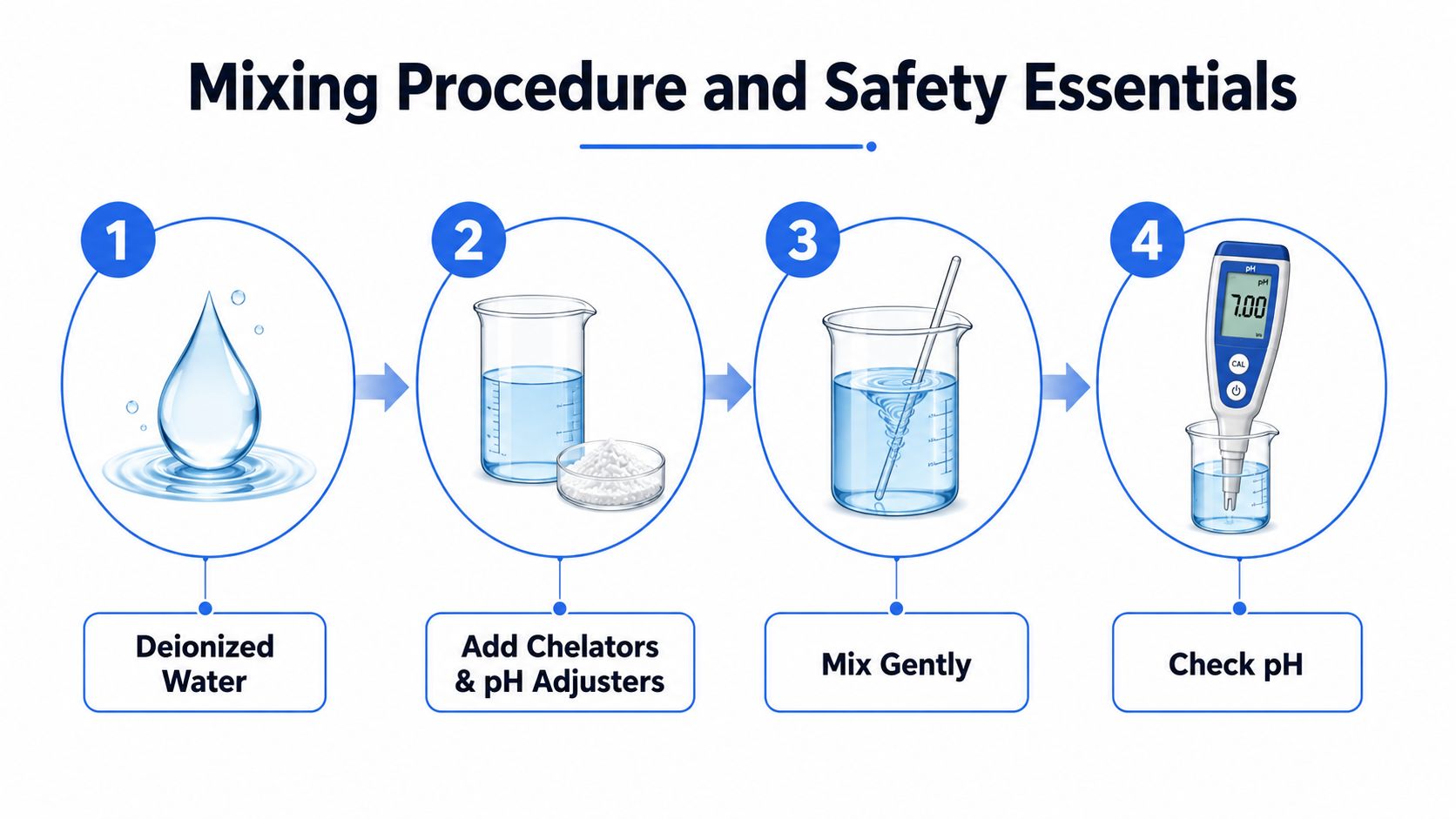
Start with deionized water. Add chelators or pH adjusters first, because they need to disperse into the water phase cleanly. Add the solvent next. Fold in surfactants last, and do it under low shear so you don't whip in foam that takes forever to settle. That sequence mirrors the multi-component approach seen in published commercial formulas, where water is the base and the rest is built around it multi-component commercial formulation example.
Add chemicals to water, not water to chemicals. It's the slower, safer move, and it gives you more control over heat, splash, and mixing behavior.
Protective gear matters even on a simple batch. Nitrile gloves, eye protection, and ventilation are the minimum. Label the jug clearly so a crew can tell concentrate from ready-to-use at a glance, because somebody under time pressure will absolutely grab the wrong container if the markings are vague.
A few practical notes keep crews out of trouble:
The chemistry guidance behind streak-free cleaners also warns that non-volatile builders and thickeners can crystallize as the solvent evaporates, which is why the mixing order and ingredient restraint matter as much as the ingredients themselves streak control and residue chemistry.
Field use decides the mix. A squeegee job and a pure-water system put different demands on the same commercial glass cleaner formula, so the blend has to match the method instead of trying to do everything at once.

On hand work, the cleaner needs controlled slip. The blade is removing the liquid from the pane, so the formula has to wet the glass evenly, release oily soil, and still clear fast enough that the rubber does not chatter or leave drag marks. Alcohol-heavy mixes show up often in that kind of work because they shorten the drying window and help the blade leave a cleaner edge. On hot exterior jobs, especially in places like Phoenix, that same fast flash can turn against you if the solution evaporates before the pass is finished.
A pure-water system works differently. Deionized water is doing the cleaning, and the brush agitation plus rinse quality are carrying the job, so soap-loaded mixes usually stay out of the pole system and get reserved for hand application. Residue matters more here than anything else. The cleaner the rinse, the cleaner the finish, because there is no squeegee pass to strip leftover film from the glass. The service logic behind that setup is covered in more detail in the internal guide on pure-water window cleaning.
| Method | Best Formula Profile | Why It Works |
|---|---|---|
| Squeegee | Alcohol-forward, low-residue mix | Good slip, fast pull-off, clean blade finish |
| Pure-water pole | Nearly residue-free water system | No soap film, no extra wipe step |
| Hot sun exteriors | Faster flash-off with restrained surfactant | Less drag and less re-wetting |
| Interior detail work | Mild, low-odor mix | Easier control near occupants |
Practical rule: if the glass is going to be wiped and pulled, the formula can carry a little more chemistry. If it's going to air-dry after a pole rinse, keep the residue as close to zero as possible.
Most weak DIY formulas fail for the same reason, they chase cleaning power by adding more stuff. More surfactant, more fragrance, more “boosters,” then the pane dries with a film that looks worse than the dirt did. That trade-off is the part most recipe videos skip, but on glass it's the whole story.

Chemistry sources are clear that non-volatile builders and thickeners can crystallize on glass as the solvent evaporates, leaving white residue or streaks why glass cleaner residue appears. That means the best formula is not the one with the most visible cleaning power in the bucket. It's the one that leaves the least behind on the pane.
The common mistakes are predictable:
The pH target matters too. Published commercial guidance places glass-cleaner pH in the 6.5 to 10 range commercial manufacturer guide. Push alkalinity past that comfort zone and you can get haze, surface compatibility issues, or a finish that looks “clean” until the sun hits it.
Vinegar gets a lot of credit it hasn't earned. It can help in some light-duty situations, especially where mild acid is useful against mineral buildup, but it's not a universal answer for commercial glass. It can also be a poor fit around seals, tinted film, or sensitive coatings, where the safer choice is usually a controlled commercial blend rather than an all-purpose acid rinse.
A mixed batch doesn't last forever, even when it's made well. In sealed, opaque storage, a working commercial glass cleaner formula is often treated as a 6 to 12 month solution, but only if the container stays clean and the environment is reasonable. Heat, sunlight, and repeated contamination from dirty cloths shorten that window fast.
The safest storage is simple. Keep it sealed, keep it out of direct sun, and don't park it near extremes of heat or freeze exposure. If a crew in Las Vegas, Phoenix, Denver, or Scottsdale is pulling the same formula across very different weather and elevation conditions, the batch still has to behave predictably. That broader Arizona and Colorado footprint rewards consistency, especially on storefronts, offices, and high-access glass where the finish has to look the same from pane to pane.
Some materials deserve a quick compatibility check before the full wipe:
| Symptom | Likely Cause | Fast Fix |
|---|---|---|
| Hazy film | Hard water or too much surfactant | Switch water source, cut surfactant |
| Persistent streaks | Dirty applicator or rubber | Wash the sleeve, replace the blade |
| Smearing after drying | Residue on squeegee rubber | Clean or flip the rubber edge |
| White specks | Mineral carryover | Use deionized water only |
If the problem looks like chemistry but the tools are dirty, the tools are probably the issue. A good formula can't compensate for loaded rubber, contaminated sleeves, or a bucket that wasn't rinsed from the last batch. The cleaner the tool path, the less you have to blame the liquid.
A service van runs better when the checklist is boring. Deionized water on hand, concentrate mixed in a labeled HDPE jug, dilution ratio marked clearly, pH checked with a strip before the first job, storage kept between 40 and 80°F, and applicators rinsed weekly to prevent biofilm. That's the kind of routine that keeps the batch consistent when the day gets busy and the glass changes from interior doors to sunlit exterior panes.
For 2026, the direction is pretty clear. Commercial formulas are moving toward lower-VOC glycol ethers, more plant-derived surfactants, and tighter residue expectations as new commercial builds use more coated glass and more demanding architectural finishes. The market keeps asking for faster dry-down, lower odor, and less leave-behind, which means the chemistry keeps getting more precise, not less.
A working tech doesn't need a lab coat to respect that. You need a stable mix, a clean tool path, and a method that fits the glass. That's what separates a decent wipe from a finish that survives daylight.
If you've got complex storefronts, high-rise panels, or glass that needs the right mix and the right hands, Professional Window Cleaning handles the work with the same field-tested standards discussed here. Visit Professional Window Cleaning to schedule service and get a cleaner finish on the windows that matter most.
Read our blog posts regularly and keep learning.