Care and Maintenance
8 Home Window Cleaning Tips for a Clearer View
Use these home window cleaning tips for better tools, timing, seasonal care, DIY methods, and knowing when professional help makes sense.


A clean glass tower says a lot about a building. It signals order, care, and professionalism before a tenant or visitor ever steps inside. But the part often overlooked is the safety planning that makes high-rise window cleaning possible in the first place.
If you manage a mid-rise office, a hospital, a condo tower, or a hotel, you may already know the uneasy question that comes up before any rooftop work begins. How do technicians reach the edge safely, protect the building envelope, and still get the job done efficiently in places with heat, wind, and harsh seasonal shifts?
For window cleaning, professionals rely on only two methods. They use a squeegee or a pure-water system. Both methods can be used on complex buildings, but neither should begin until the roof edge is properly protected.
That's where parapet wall clamps come in. They aren't glamorous, and tenants rarely notice them, but they solve a very practical problem. They create a secure way to mount guardrails on an existing parapet wall without drilling into the roof edge. That matters to safety managers, and it also matters to building owners who don't want leak risks introduced into a finished structure.
Professional window cleaning was established in 1999 and has operated for over 26 years, providing residential, commercial, and high-rise window cleaning services across Arizona, Colorado, and Nevada, with documented expertise in both squeegee and pure-water cleaning methodologies, as noted in this background on squeegee and pure-water cleaning.
A property manager stands on the roof before sunrise. The glass below shows yesterday's dust, weather streaks, and hard-water spotting. The building needs attention, but the key question isn't how to make the windows shine. It's how to let crews work near the roof edge without turning routine maintenance into a safety gamble.
That concern is legitimate. High-rise window cleaning always starts with access and edge protection. A technician can be highly skilled with a squeegee or highly efficient with a pure-water pole system, but none of that matters if the work zone at the roofline isn't controlled.
Parapet wall clamps fit into that moment. They give crews a way to create guarded roof edges on buildings that already have parapet walls, without cutting, drilling, or punching holes into the roof perimeter. For owners, that means safety can improve without inviting unnecessary damage to waterproofing.
A roof edge is a sensitive part of the building. Once someone starts adding penetrations, the discussion quickly shifts from safety equipment to warranty concerns, water intrusion, and long-term maintenance. Non-penetrating systems reduce that tension because they work with the existing parapet rather than through it.
This matters on facilities where operations can't stop. Hospitals, schools, offices, and large commercial properties often need work completed with minimal disruption. A guardrail system secured by parapet wall clamps can be a practical answer because it preserves usable roof space and avoids avoidable alterations.
Practical rule: The safest window cleaning setup isn't just the one that protects workers. It's the one that also respects the building envelope.
When owners focus only on the finished result, they miss the most important decision point. The best cleaning outcome starts with safe staging, safe movement, and a roof edge that has been prepared correctly for the specific structure.
That's why parapet wall clamps deserve attention. They're one of the quiet pieces of equipment that make visible results possible.
Think of a parapet wall clamp as a heavy-duty clamp built for the roof edge of a building. Its job is simple in concept. It grips a structural parapet so a compliant guardrail system can be mounted without penetrating the surface.
According to Power Climber's parapet clamp product details, parapet wall clamps are engineered devices with specific load capacities of 1,000 lb (453.6 kg) or 1,500 lb (680.4 kg), designed to secure guardrails on structural parapets without penetrating the surface. That same source notes they must be used on structural parapets, such as reinforced concrete, to withstand the moment, or twisting, loads involved.
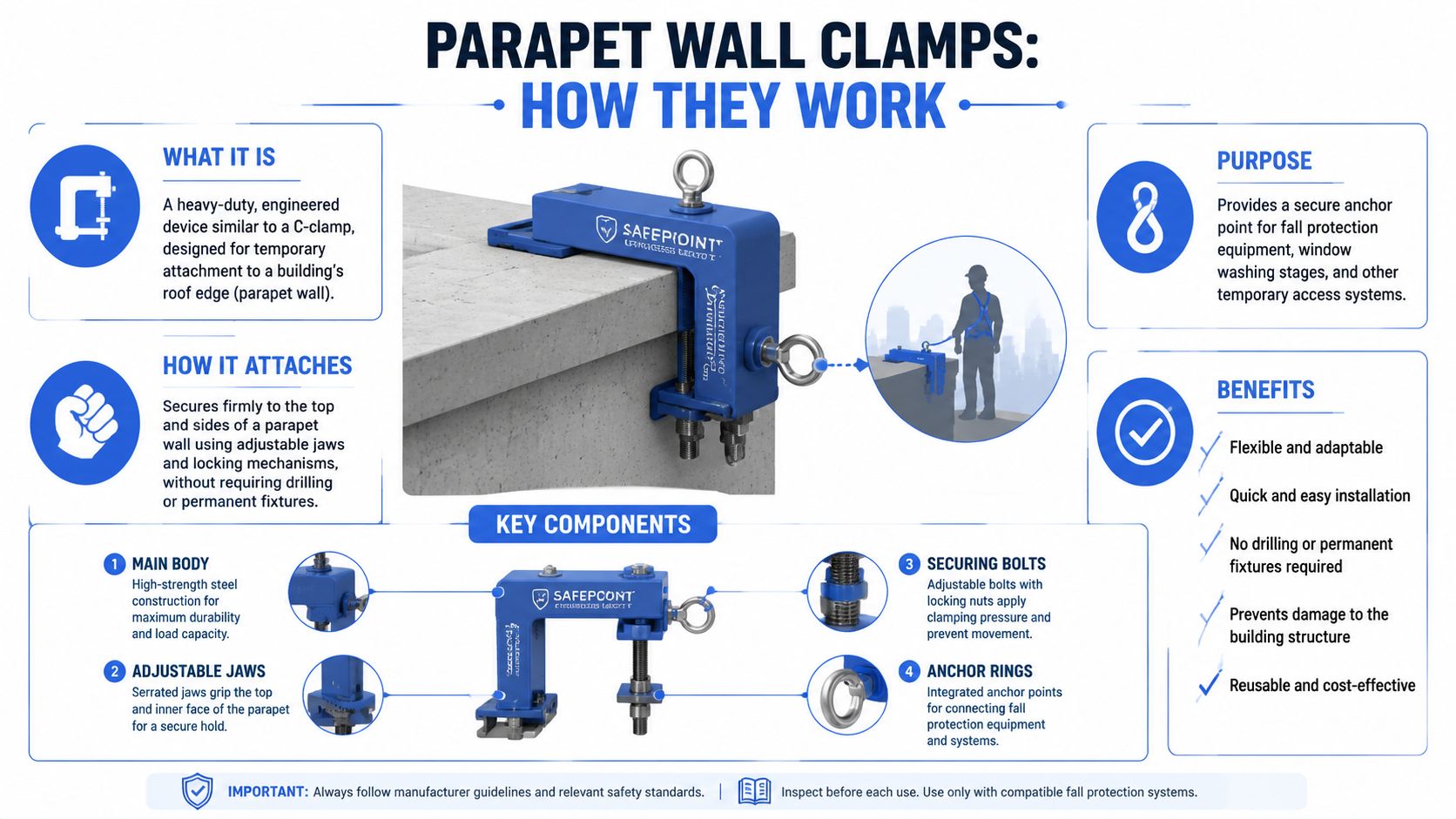
A clamp grips the parapet wall from the top and side surfaces. Once positioned correctly, the tightening mechanism applies pressure so the device stays stable under the loads it was designed to resist.
In plain language, the clamp turns the parapet into the mounting location for a temporary or longer-term guardrail assembly. That's the key benefit. Instead of building a separate base system that consumes roof space, the wall itself becomes part of the setup.
People who aren't in safety or access work want to know what the hardware is doing. The answer is easier to understand when you break it down:
What often confuses building managers is the difference between a clamp that supports a guardrail system and an anchor point for a worker's personal fall protection. Those are not automatically the same thing. A parapet clamp may be part of edge protection, but that doesn't mean it should be treated as a universal tie-off point.
Later in the process, installers also need to think about the wall itself. A strong-looking parapet isn't always a structurally suitable parapet. Age, construction type, and condition matter.
For a quick visual explanation, this demonstration helps show the equipment in context.
A parapet wall clamp works only when the wall is truly structural and the installation matches the manufacturer's intended use.
Drilling into a roof edge can create downstream problems. A non-penetrating clamp reduces the chance of disturbing waterproofing layers and avoids turning a safety upgrade into a building-envelope repair issue.
That's one reason these systems are common on rooftops where preserving the finished surface matters just as much as worker access.
At 6:30 a.m., a window cleaning crew steps onto a high-rise roof with hoses, poles, drop cloths, and a day's work already mapped out. Before the first pane is cleaned, one question has to be settled. Can the team move, stage equipment, and reach the roof edge without turning routine work into a fall hazard? Parapet wall clamps help answer that question by supporting temporary guardrail systems that create a controlled rooftop perimeter.
For building owners and property managers, that matters because window cleaning quality starts with access quality. If technicians have to spend their attention managing edge exposure, they have less attention for the glass, the facade details, and the equipment setup. A guarded roofline gives crews a defined work zone for staging tools, shifting positions, and coordinating the next step of the job.
That support carries over to the two cleaning approaches many commercial crews use.
With traditional squeegee work, technicians often make repeated position changes to detail edges, corners, and frames. The pace can be careful and methodical, especially on facades with recessed glass or architectural features that interrupt a straight pass.
With pure-water cleaning, crews work differently. They use purified water and extension poles, which changes how hoses are managed and how technicians travel along the perimeter. This overview of pure water cleaning gives helpful background on why purified water can dry without leaving mineral spotting.
The safety principle is the same in both cases. A protected edge reduces the need for constant defensive movement near the parapet.
Here is the practical effect on real jobs:
Regional conditions make this even more important. In Phoenix, long periods of heat and intense sun can affect worker pacing, material handling, and the timing of rooftop tasks. In Denver, changing temperatures and wind can alter conditions over the course of a single shift. The clamp itself does not replace training or site planning, but it does give crews a more controlled perimeter to work within when weather adds another layer of risk.
That is one reason experienced contractors treat rooftop protection and cleaning method as part of the same decision. A building with broad glass expanses, frequent wind exposure, or limited roof staging room may require a different access plan than a mid-rise with a simpler edge condition. If you want a clearer picture of how suspended work fits into that planning, this guide to rope access window cleaning explains the method in practical terms.
Good window cleaning crews treat safe access as part of the cleaning process, because controlled setup supports better work on the glass.
Property managers usually see the shine first. The safer perimeter, the orderly staging, and the reduced exposure at the roof edge are what helped produce that result.
Choosing parapet wall clamps starts with the building, not the catalog. A clamp may be well made and still be the wrong choice if it doesn't match the parapet dimensions, material, and intended application.
A good selection process is less about shopping and more about screening. You're trying to rule out equipment that doesn't fit the wall geometry, the exposure conditions, or the way the system will be used.
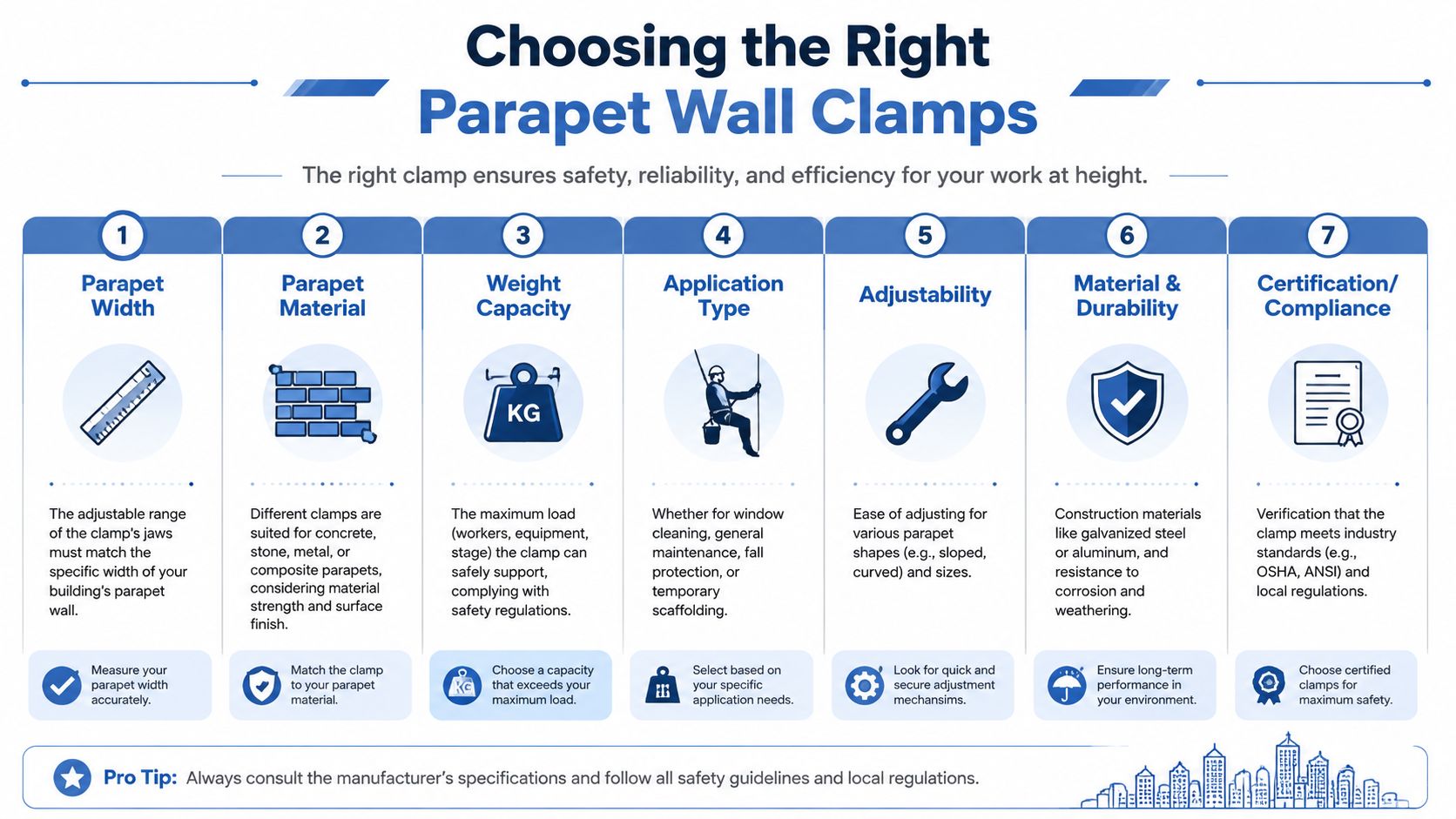
According to Bee Access clamp specifications, parapet wall clamps feature adjustable throat openings up to 33″ to fit parapet widths from 4.25″ to 14″, while maintaining a 42-inch top rail and 21-inch mid-rail height per OSHA standards. Those numbers matter because many installation problems start with bad assumptions about wall width and shape.
Before anyone selects a model, confirm:
| Building question | Why it matters |
|---|---|
| What is the actual parapet width? | The clamp must fall within its designed adjustment range. |
| Is the wall straight, sloped, capped, or irregular? | Surface geometry affects how the clamp seats and bears load. |
| What is the wall made of? | Material condition and strength influence suitability. |
A parapet that looks uniform from the ground may have caps, coping details, patched surfaces, or width changes that affect fit. Those details can decide whether a clamp sits correctly or becomes a poor match.
The roof environment matters more than many buyers expect. Heat, moisture, and exposure can shorten the service life of poorly matched hardware. On buildings in climates with strong sun, seasonal variation, or harsher rooftop conditions, the clamp's material and finish deserve close attention.
Some buyers prefer lighter systems for handling. Others prioritize tougher finishes for demanding environments. The right answer depends on site conditions and the maintenance plan.
A practical review should include:
For a broader look at the gear that supports work at elevation, this overview of high-rise window washing equipment is worth reviewing.
Some clamps are intended around guardrail systems. Others may be used in applications involving suspended scaffolds or vertical loading, which brings different requirements and a tighter need for procedural control. Buyers and managers should ask exactly how the equipment will be used on their building.
Selection note: A clamp that fits the wall but doesn't fit the work plan is still the wrong clamp.
That's why experienced teams ask more than, “Will this attach?” They ask whether the selected system suits the building, the environment, the access method, and the people who'll install and inspect it.
Safety rules around parapet wall clamps aren't fine print. They define whether the roof edge is protected or only looks protected.
The most important baseline comes from guardrail criteria. According to this SAIA guidance on when to use a parapet clamp, OSHA regulations mandate that top rails for fall protection systems secured by parapet clamps must be 42 inches (106.7 cm) tall, plus or minus 3 inches (7.6 cm). That same guidance states that parapet clamps are designed for guardrails, not as anchorage points for personal fall protection.
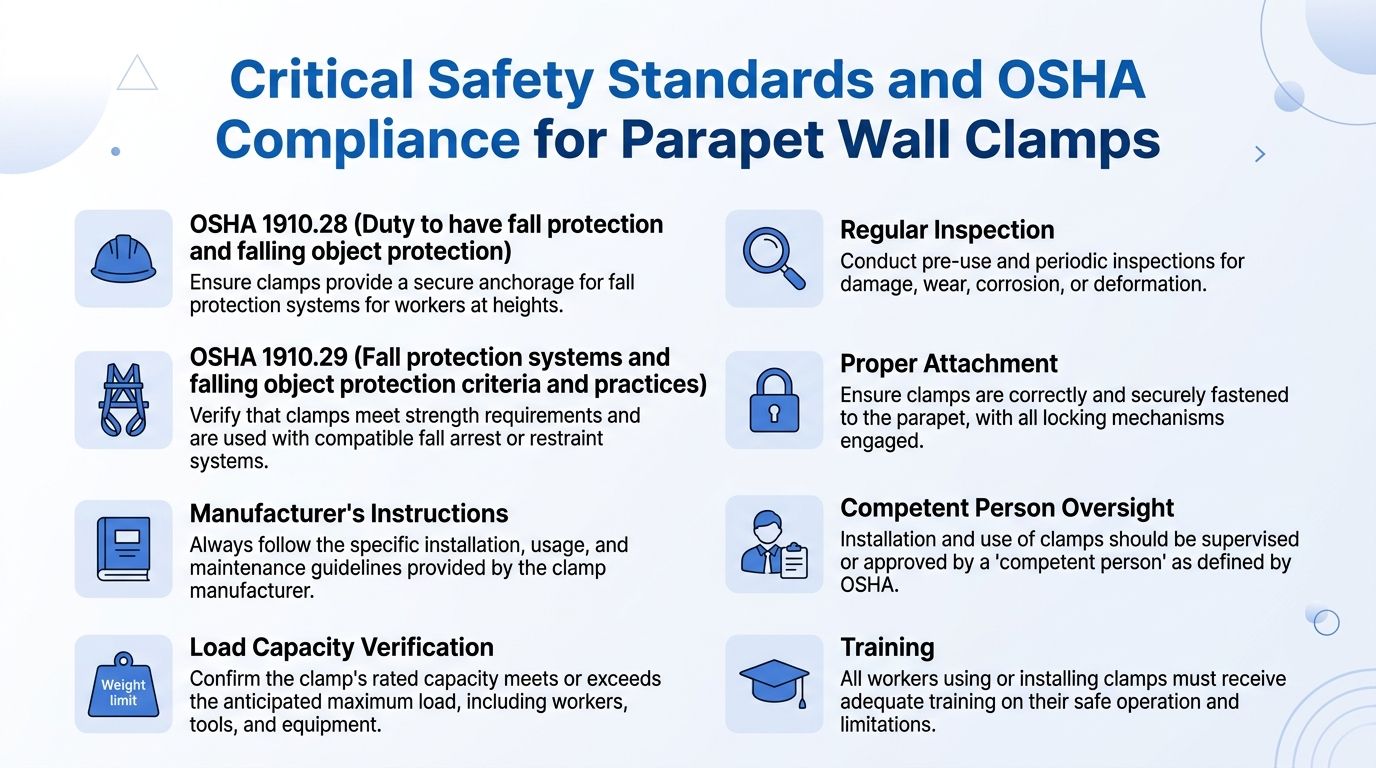
Owners and managers should slow down. A parapet wall and a parapet clamp system may contribute to edge protection, but that does not mean a worker can clip personal fall arrest gear directly to the clamp unless the equipment is specifically designed and approved for that purpose.
The same SAIA guidance also notes that a parapet wall shorter than 39 inches (99.1 cm) is not high enough to count as sufficient fall protection without guardrails. That detail matters because many existing parapets look protective from a distance but don't meet the rule on their own.
If you hire a contractor for rooftop or facade work, ask direct questions:
If you manage a property in Phoenix, these questions are just as important as the cleaning plan itself. Dry heat, rooftop exposure, and busy maintenance schedules don't reduce the obligation to follow the standard.
Many property managers first become OSHA-aware through roof-edge issues, but the larger lesson is that at-height work hazards often overlap. For example, owners reviewing general access risks may also benefit from this breakdown of construction site ladder risks from Mattiacci Law, because ladder misuse and poor edge protection often show up in the same broader safety culture problems.
Compliance isn't paperwork after the job. It's the set of decisions that determines whether the job should start at all.
That's why experienced safety professionals insist on clear roles, proper equipment use, and verified installation conditions before a crew goes anywhere near the edge.
A well-chosen clamp can still become a hazard if it's installed carelessly, tightened improperly, or left in service after damage appears. Roof-edge systems need disciplined handling from the first setup through every inspection cycle.
For building managers, it helps to separate what the crew does from what you can reasonably verify. You don't need to become the installer. You do need to know what competent installation and maintenance should look like.
The first rule is simple. Follow the manufacturer's instructions exactly. That includes the proper mounting location, the intended wall type, the adjustment range, and the specified setup sequence.
The SAIA guidance referenced earlier also warns against over-tightening the adjustment screw, because doing so can damage the clamp or the parapet wall. That's one of those details that sounds minor until you've seen hardware distorted by excessive force or coping surfaces crushed by bad installation habits.
A sensible installation process usually includes:
Owners and managers aren't expected to certify the installation, but they can spot warning signs. A quick rooftop walk with the supervisor can reveal whether the setup looks orderly and intentional or improvised and rushed.
Look for the following:
Some judgments can't be made from appearance alone. Structural suitability, compatibility with the application, and continued serviceability after repeated use require trained review.
That's especially true on older buildings, unusual parapet shapes, or sites with patched masonry, coping repairs, or uncertain structural history. If the wall condition is questionable, the correct answer isn't optimism. It's escalation to a qualified person.
If a crew has to “make it work,” the setup probably shouldn't proceed until the equipment and wall condition are reviewed properly.
Storage and handling affect safety equipment. Clamps that are dropped, dragged, exposed unnecessarily, or mixed with damaged parts can slowly become unreliable. Good teams keep equipment clean, track condition, and remove suspect components from service instead of hoping they'll last one more job.
That kind of discipline rarely gets attention from tenants, but it's one of the strongest signs that a contractor takes roof-edge work seriously.
A property manager approves a window cleaning job for Monday morning. By 8 a.m., the crew is on the roof, the glass schedule is tight, and one question determines whether the work proceeds safely or stops cold. Is this parapet suitable for the clamp system selected for the job?
That decision should never rest on guesswork. Parapet wall clamps may look simple from a distance, but safe use depends on trained judgment. Someone has to evaluate the wall condition, confirm the equipment matches the parapet dimensions, install the system correctly, and verify that the setup protects workers without creating new risks for the building.
Regional weather adds another layer. In Phoenix and Scottsdale, intense sun and prolonged heat can age pads, coatings, and exposed components faster than many owners expect. In Denver, freeze-thaw cycles, snow moisture, and wider temperature swings can affect metal condition, masonry surfaces, and inspection needs over time. Two roofs can have similar drawings and still require different equipment choices and maintenance habits because the environment acts on the system every day.
Experienced contractors treat parapet clamp selection the way a skilled mechanic treats brake parts. The part has to fit, but it also has to perform under the conditions it will face. For roof-edge safety, that means accounting for wall shape, coping details, surface condition, wind exposure, and the type of work the crew will perform at the edge.
That level of care protects more than the crew. It helps prevent cracked coping, damaged waterproofing, and wear to finished surfaces caused by poor placement or rushed setup. Building owners and managers should want a contractor who knows when a roof edge is ready for safe access, and when the right answer is to pause and get another set of qualified eyes on the building.
On older properties, recently repaired roofs, or buildings with uncertain edge conditions, it often makes sense to pair access planning with a broader envelope review. A professional roof inspection can add useful due diligence before rooftop work begins.
Parapet wall clamps are one part of a larger safety process. The equipment matters. The person judging where, when, and how to use it matters just as much.
If you need a team that understands both spotless glass and the safety systems behind high-rise access, Professional Window Cleaning brings decades of experience to residential, commercial, and high-rise work across Arizona, Colorado, and Nevada. Whether your property relies on traditional squeegee work or a pure-water system, the right partner helps protect your building, your tenants, and the technicians on the roof.
Read our blog posts regularly and keep learning.