Care and Maintenance
Window Cleaner for Tinted Windows: Safe Methods
Find the best window cleaner for tinted windows and learn safe cleaning methods that protect film, prevent streaks, and extend tint life.


The most popular advice about concrete efflorescence cleaner is also the most incomplete: spray on an acid, scrub until the white residue disappears, and move on. That approach can leave you with etched concrete, discolored decorative surfaces, contaminated runoff, and the same deposit returning after the next wet period.
Efflorescence isn't just a stain. It's evidence that water is moving through the concrete and carrying soluble mineral salts toward the surface. Cleaning has a place, but the lasting fix usually starts with finding where the water comes from, how it travels, and why it keeps reaching the same area.
Efflorescence forms through a simple cycle. Soluble salts inside the concrete dissolve when moisture enters the pores. The water carries those salts toward an evaporation path, and once the water disappears, the minerals remain as a white, powdery or crystalline deposit. Concrete and masonry literature recognizes efflorescence as especially common in new or recent construction, while the deposits themselves are associated with leached lime compounds and calcium carbonate on concrete surfaces. The U.S. General Services Administration's preservation guidance treats removal as a controlled construction-maintenance process, not an ordinary washing task.
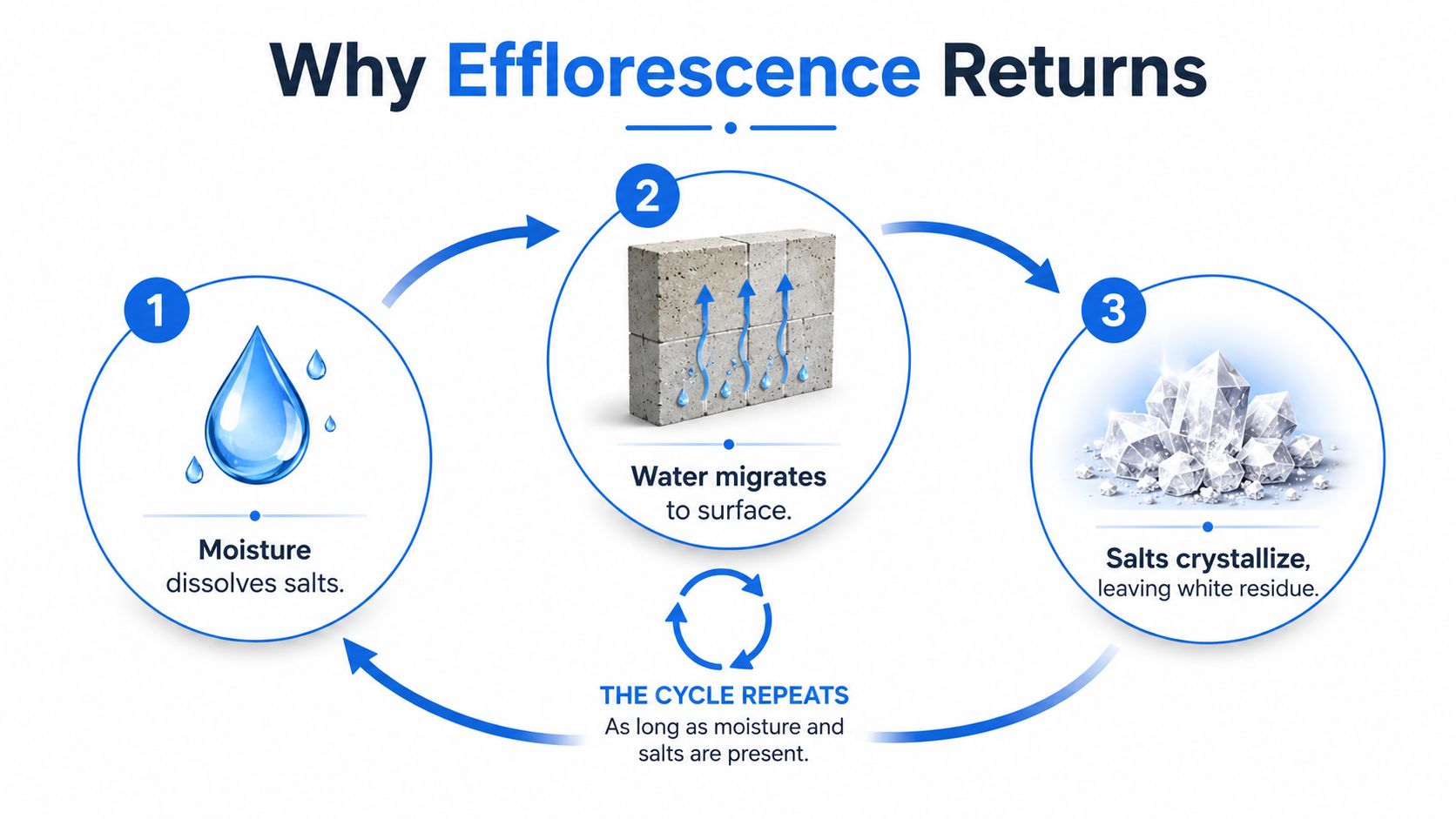
You need three conditions for recurring efflorescence:
Remove the visible residue without interrupting that sequence, and you've only reset the clock. A patio may look clean after treatment, yet overspray from a nearby irrigation zone can keep feeding the same salts. A basement slab may show fresh deposits because groundwater or an unseen leak continues moving beneath it.
Arid climates create a misleading maintenance pattern. Concrete can stay visually dry for long periods, then receive concentrated moisture from irrigation, storms, drainage failures, or cleaning. High evaporation makes the white residue easy to notice, while mineral-rich water and soil can add to the visible buildup. New concrete is particularly vulnerable because moisture and soluble compounds are still moving through the material during early service life.
Practical rule: If efflorescence returns in the same place, stop shopping for a stronger cleaner and investigate the water path first.
The National Institutes guidance on masonry efflorescence notes that all masonry can show some efflorescence after construction, but persistent or excessive deposits generally point toward internal moisture conditions. That's why a successful job evaluates downspouts, slopes, joints, irrigation, plumbing, and adjacent walls before selecting chemistry.
Concrete should earn the mildest treatment that will do the job. Loose crystals don't need acid, and applying water too early can dissolve salts and move them back into the pores. Start dry, observe the surface, and increase force or chemical strength only when the deposit demands it.
Use a stiff, non-metallic brush, preferably nylon, on a dry surface. Work the powder loose, then collect it with a suitable vacuum or remove it from the area without washing it across adjacent concrete. A metal brush can scratch decorative concrete, expose rust-prone fragments, or change the appearance of a finished surface.
Dry brushing is appropriate when the residue is loose, chalky, and limited to the surface. It won't remove bonded mineral scale, but that isn't a reason to skip it. Removing loose material first reduces the amount of chemical or water needed later.
For moderate deposits, pre-wet the concrete and use a light rinse with a hose or carefully controlled pressure-washing equipment. Avoid flooding the surface. The U.S. General Services Administration procedure calls for pre-wetting, brushing with a stiff non-metallic brush, and thorough rinsing. That sequence limits uneven absorption and helps carry loosened material away.
If the deposit resembles a mineral water stain rather than loose efflorescence, the concrete water-stain cleaning method using a mild solution, stiff nylon brushing, and rinsing can offer a gentler starting point. Test any solution in an inconspicuous area first, especially on colored, stamped, or sealed concrete.
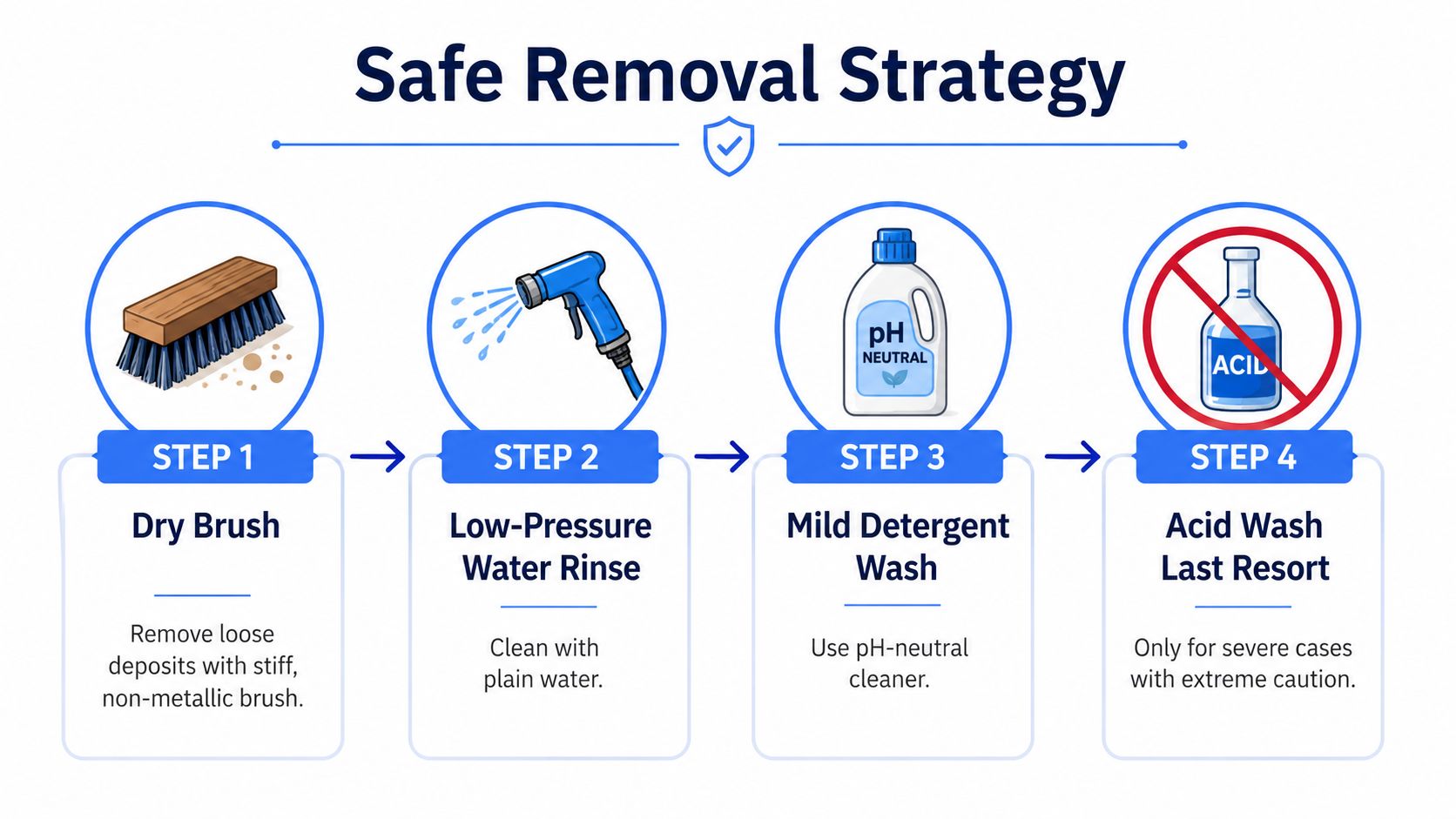
When salts resist brushing and plain water, a dilute acid cleaner may be appropriate on compatible, unsealed concrete. Pre-wet the area first, apply the solution to a small work zone, agitate with a non-metallic brush, and rinse thoroughly before the product dries. The Canadian Masonry Handbook guidance describes dilute muriatic acid treatments in the 5% to 10% range, with concentrations around 2% for integrally colored masonry, and recommends limiting work to patches of about 4 square feet before scrubbing and immediate rinsing.
Stop if the concrete changes color, develops a rougher texture, reacts violently, or shows streaking. Those signs suggest the treatment is attacking the surface rather than just the deposit.
Acid-based products dissolve mineral deposits efficiently, but efficiency isn't the same as suitability. Muriatic and phosphoric acid treatments can work on stubborn, unsealed concrete, yet they bring a higher risk of etching, discoloration, plant damage, and unsafe runoff. The GSA describes hydrochloric acid mixtures such as 1 part acid to 9–19 parts water, or phosphoric acid at 1 part acid to 9 parts water, while also warning through its prescribed workflow that repeated treatment may be necessary on heavily affected surfaces. See the practical discussion of acid washing from Titan Coatings for broader context on why surface compatibility matters.
Non-acid removers offer a different trade-off. Products in this category are formulated for white salt deposits, mortar haze, hard-water stains, and related mineral buildup. One documented product description specifically presents a concrete efflorescence cleaner that works without harsh acids, showing that acid-free chemistry is an established option rather than a marketing oddity. A non-acid product may be the safer first choice for sensitive finishes, though the label still needs to identify compatible substrates and required rinsing.
| Factor | Acid-Based Cleaners | Non-Acid Cleaners |
|---|---|---|
| Effectiveness | Strong option for bonded mineral deposits on compatible concrete | Useful for lighter deposits, haze, and surfaces where aggressive chemistry is undesirable |
| Surface compatibility | Best considered for unsealed, ordinary concrete after testing | Often better suited to colored, stamped, sealed, or delicate finishes, subject to label directions |
| Safety requirements | Requires chemical-resistant protection, controlled dilution, ventilation, and careful runoff management | Still requires gloves, eye protection, testing, and thorough rinsing |
| Typical cost range | No reliable general cost range applies because product strength, labor, access, and surface condition vary | No reliable general cost range applies for the same reasons |
Integrally colored concrete deserves special caution. Guidance places the acid concentration around 2% for this type of masonry, because stronger chemistry can alter the color or surface appearance. Stamped and sealed concrete can react poorly to acids even when the residue looks severe. On those surfaces, dry removal, a compatible specialty remover, or a neutral cleaning process usually deserves consideration before acid.
Industrial slabs with thick, bonded deposits may justify stronger chemistry, but the decision should follow a test patch and a moisture diagnosis. The Foundation Armor guidance on efflorescence remediation provides a concrete-specific workflow using pre-wetting, controlled application, agitation, and flushing. Its published instructions specify an application rate of 100–200 square feet per gallon, work areas no larger than 200 square feet, a dwell period of about 5–10 minutes, and final flushing with a pressure washer or high-pressure hose.
Acid cleaning is a chemical operation, not ordinary patio washing. Wear acid-resistant gloves, eye protection, protective clothing, and suitable respiratory protection when ventilation is poor. Keep people, pets, metals, painted surfaces, and plants away from the work area until the surface has been rinsed and the runoff is controlled.
Use a measured container and follow the product label. When dilution instructions require adding acid to water, never reverse that order. The GSA's workflow emphasizes pre-wetting, mechanical brushing, and thorough rinsing because the process must keep the chemistry at the surface and stop the reaction before concrete etches.
Masonry guidance limits treatment to patches of about 4 square feet at a time before scrubbing and immediate rinsing, as summarized by the Canadian Masonry Handbook. Small sections let you watch the reaction, prevent a partially dried solution from creating uneven marks, and make it easier to stop when the finish begins to change.
Stop immediately if the surface becomes lighter, rougher, streaked, or visibly damaged. More dwell time won't repair an incompatible treatment.
Acid runoff can injure landscaping, damage metal, and enter storm drainage. Wet nearby plants with clean water before work, block pathways into drains where lawful and practical, collect or redirect contaminated water, and follow local disposal requirements. Don't assume a large rinse volume makes the discharge harmless.
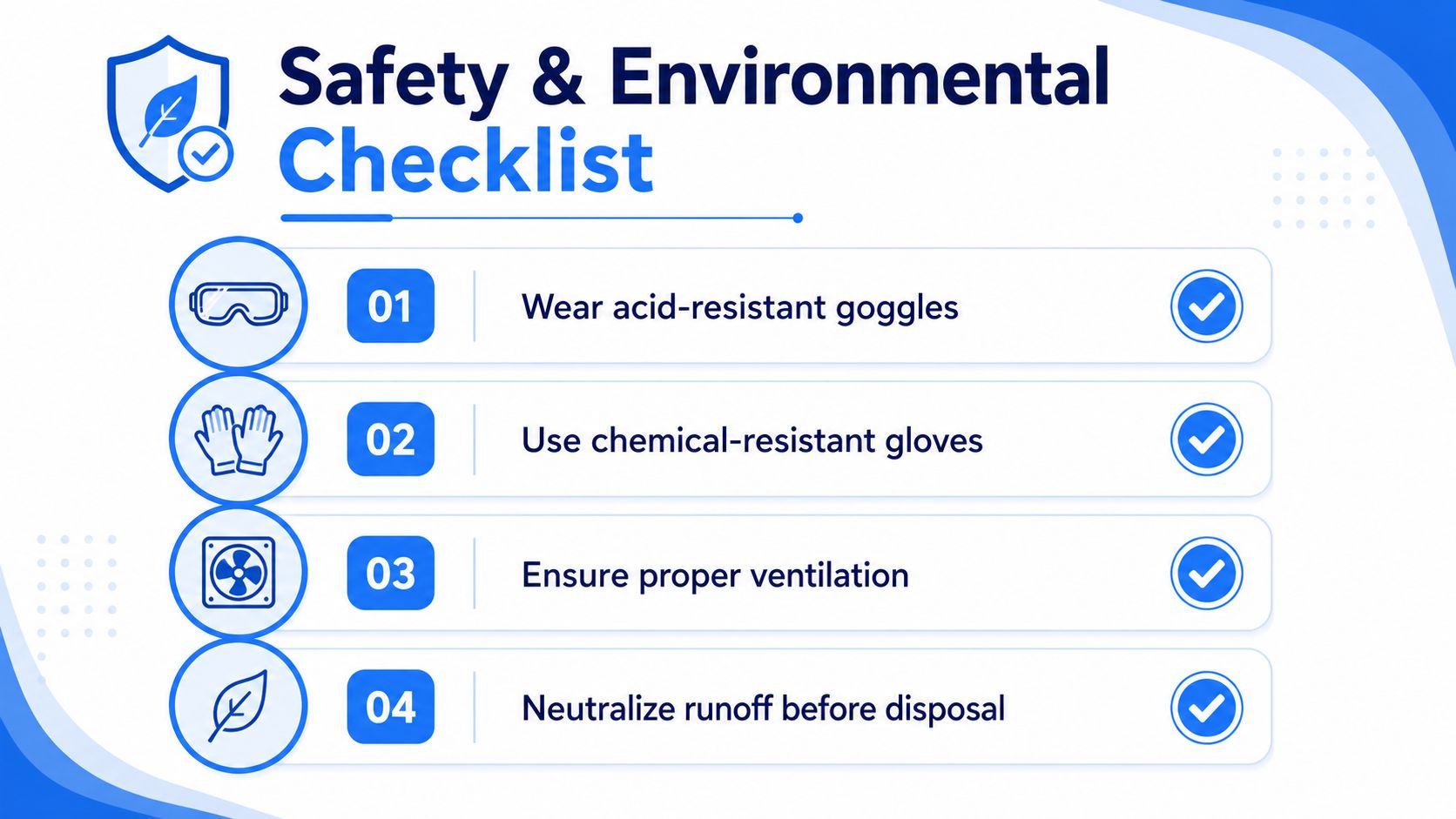
Never mix acid with bleach, ammonia, or another cleaner. Keep the original container available, read the safety data, and avoid enclosed work unless you can provide proper ventilation and understand the product's respiratory hazards. If you can't control the water, protect adjacent materials, or identify the concrete finish, don't proceed with an acid treatment.
The most effective concrete efflorescence cleaner is the one you don't need to apply again. Once the visible residue is removed, inspect the conditions that supply moisture. Redirect downspouts, correct grading that sends water toward foundations, repair failed joints, check plumbing near slabs, and stop irrigation from repeatedly soaking walls or patios.
A vapor barrier beneath a slab can help limit groundwater movement in new construction, while a breathable penetrating sealer may reduce liquid-water entry without trapping moisture vapor inside. The sealer only makes sense after the concrete is clean, sufficiently dry, and free from an unresolved leak. Applying a coating over active moisture can conceal the symptom while leaving the cause in place.
In Tempe, Chandler, and Gilbert, irrigation overspray deserves a routine inspection because it can repeatedly wet otherwise dry concrete. Monsoon moisture and drainage changes can expose weak points that stayed unnoticed during dry weather. The exact same principle applies to foundations, retaining walls, walkways, and commercial slabs.
A practical maintenance routine includes:
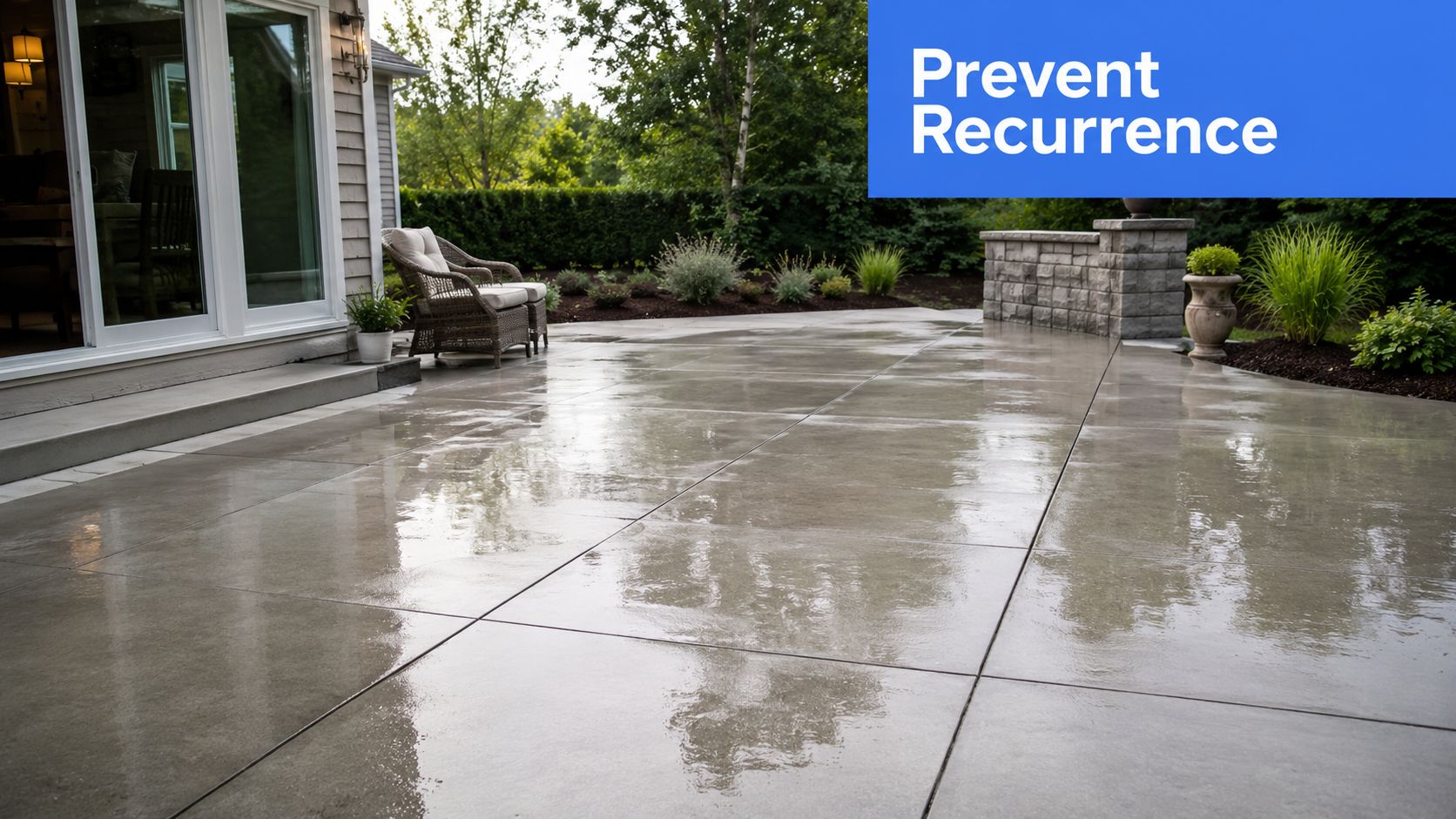
New construction may show temporary deposits as moisture leaves the material, but persistent buildup on mature concrete deserves more attention. If the same line, joint, wall base, or slab edge keeps blooming white, document it after drying and trace the moisture before buying a stronger remover.
DIY cleaning makes sense for a small, accessible patch with loose deposits and an easily identified cause. It becomes a poor bargain when efflorescence covers a broad area, returns after repeated cleaning, appears on a high-rise or difficult-to-reach surface, or sits on colored, stamped, coated, or otherwise delicate concrete.
Professionals can separate loose salts from bonded mineral scale, control water use, protect adjacent materials, and select chemistry after testing. They also bring a safer process for work at height and commercial properties, where a damaged finish, uncontrolled runoff, or worker exposure can create liability beyond the cleaning itself.
Recurring efflorescence is a building-maintenance clue. A cleaner can improve the appearance, but diagnosis determines whether the result lasts.
Property managers overseeing high-rise condominiums, medical offices, car dealerships, stadiums, and commercial buildings across Phoenix, Las Vegas, Denver, and Scottsdale should treat widespread deposits as an envelope or drainage concern, not just a janitorial task. Resources such as the services from Atlanta Concrete Solutions can also help property owners compare concrete-focused repair and maintenance options when cleaning alone won't resolve the condition.
Professional Window Cleaning has served its communities since 1999 and has more than 26 years of experience in professional cleaning work. Its broader building exterior cleaning services are relevant when concrete deposits appear alongside dirty glass, facade buildup, or other exterior-maintenance needs.
If recurring efflorescence is affecting your property, contact Professional Window Cleaning for exterior cleaning support that considers the surrounding surfaces and moisture conditions, not just the visible residue. Visit Professional Window Cleaning to discuss your building, patio, commercial property, or hard-to-reach exterior with the team.
Read our blog posts regularly and keep learning.