Care and Maintenance
Water Stain Remover from Glass: What Works in 2026
The best water stain remover from glass starts with a 1:1 vinegar soak. Get exact steps, etching checks and prevention tips for clear glass.


The upstairs windows are the ones that cause the most hesitation. A ladder needs level footing, and the lawn slopes, the flower bed is soft, and the porch roof sits exactly where the ladder's feet want to go. So the question turns to the pole: can a long-handled tool reach that glass from the ground and take the balancing act out of the job?
Sometimes yes. Often no, or not safely. Reach is the easiest part to measure and the least interesting part of the decision. What separates a job a homeowner can finish with a pole from a job that belongs to a crew is everything else: what the glass is made of, what hangs above it, what's under your feet, and how much force the dirt needs to come off.
Extension reach does not equal safe access. That single distinction drives every choice below, from the tool you pick to the moment you put the pole down and call someone.
Say you have a two-story house with a run of four windows above a planted border and a lawn you can stand on. The top of the glass is high, but it's visible, the frames are sound and nothing crosses the space overhead. That's the best case for pole work, and it's worth understanding why before you spend a dollar.
Professional window cleaning comes down to two methods: a traditional squeegee or a pure-water system, as this overview of the two cleaning approaches explains. The squeegee method suits interior glass and exterior windows you can reach directly. Pure-water cleaning suits exterior elevations where the access assessment supports it. An extension pole doesn't add a third method. It carries one of those two up to glass you can't touch, which is why the pole and the method have to be chosen together.
Three tools cover almost everything a homeowner asks about, and each carries a different method up the glass:
| Tool | Typical reach | Cleaning method | Works best for |
|---|---|---|---|
| Telescopic squeegee pole | 18 ft (5.4 m) in common aluminum sizes | Squeegee with brush | Accessible ground-floor and low upper-floor glass |
| Water-fed pole | Up to 80 ft (24 m) from ground level | Pure-water system | Upper floors cleaned from the ground |
| Ladder | Set by ladder height and set-up | Squeegee or water-fed head | Small windows and close-up detail |
A telescopic squeegee pole is the tool for glass you can face from the ground and work with two hands low down, and it's also the sensible choice for anything you can reach from a step stool inside. A water-fed pole earns its length on upper floors, where the whole point is that the operator stays on the ground. A ladder still wins on a handful of small panes at first-floor height, where setting up a pole and a water line takes longer than climbing three rungs.
Height figures describe the upper reference of the tool, not a guarantee for your building. A pole rated to a given height still has to be positioned, controlled and kept clear of everything between the ground and the glass.
Here's the check worth running this afternoon, before you buy anything:
Pure-water cleaning is the method most homeowners have never seen up close, and it's the one that makes very long poles practical. Water is filtered through resin until it holds almost no dissolved minerals, then pumped up the pole and fed through a brush head. The brush loosens the dirt, the pure water rinses it away, and the glass dries on its own with nothing left behind.
Wiping is what causes most streaks. A squeegee blade that's slightly worn, a cloth that's slightly dirty, a chamois that's picked up grit from a sill, all of them drag a film across the pane. Pure water sidesteps that by leaving no residue to drag. The minerals that would normally dry into white spots have been stripped out before the water ever leaves the tank.
The tell: if a rinsed pane dries with faint white spotting, the water wasn't pure enough, not the pole. Check the resin before you blame your technique.
The method has real limits, and they're practical rather than theoretical. It needs a water supply, which for a homeowner means a hose and a filter, and for a crew means a tank in the van. It needs frames and sills that tolerate running water: old timber with cracked putty, unsealed window reveals and stone sills that stain all deserve a closer look before you flood them. Weep holes in uPVC frames do their job, but they'll send water somewhere, and that somewhere shouldn't be the inside of a wall cavity. Heavy bonded debris, such as paint overspray or construction cement, also needs mechanical action first. A brush on a long pole can't apply the pressure a scraper can.
An extension pole will carry either method, so the window and its conditions pick the method, not the pole. Run this three-point check before you commit:
None of those checks replaces an access assessment. A squeegee and a pure-water system are different methods, not two sizes of the same tool, and choosing wrong shows up as streaks, water where it shouldn't be, or a second visit.
A second-story pane looks reachable from the lawn until the pole is up and a gust takes the brush head sideways. Touching the glass only proves the pole is long enough. Safe access depends on what the pole has to travel past, what you stand on, and how much control remains at full extension.
The top of a stated range is a working reference, not a promise. The HSE best practice guide for window cleaners reports that modern water-fed pole systems can clean windows up to 80 feet, or 24 meters, high while the operator stays on the ground. It then sets the conditions that decide whether a given building is one of them: the building itself, the glass position, terrain, weather, pole design, and the clearance needed to work safely. Actual reach is whatever those factors allow on the day.
Those same conditions end pole work when they turn bad.
Wind makes a long pole a lever. A gust at the brush head travels all the way down to your shoulders and your footing. Overhead lines are worse. Contact is not required for injury. An OSHA enforcement record on extension pole work covers the electrical hazard of extension poles near live overhead lines, including arcing without the pole touching the wire. Look up before you extend.
Sections, locks, and clamps take the load. HSE guidance calls for poles to be regularly extended, cleaned, and inspected in accordance with manufacturer instructions. A wet walkway under a water-fed pole is its own hazard for whoever crosses it, including you. Sloped, soft, gravel, or moss-covered ground undercuts every control above it.
One trade-off rarely gets mentioned. A pole keeps you off a ladder and raises lateral force and fatigue on large panes, because you are holding a long lever against the glass instead of working a blade at chest height. If the glass needs heavy pressure, full extension is the wrong tool. I treat that combination, height plus force, as a stop.
The stop test: if the pole has to be fully extended to touch the glass, the ground beneath you is uneven, or the frame looks fragile, the job has moved past comfortable DIY reach. Put it down.
Recognised window-cleaning safety standards cover training, inspection, assembly, and safe use of extension poles. They apply to pole work the same way they apply to any other access method. Run this before the first pane:
The hierarchy of controls explains why the pole matters more than the harness. Eliminating a climb outranks any personal protective equipment worn while climbing, so a pole that keeps a worker on the ground is a stronger control than a fall arrest system worn on a ladder. Equipment condition gets its own treatment in this guide to window cleaning safety equipment, and it belongs in the pre-job check rather than the post-job report.
Write it down before you start: glass height, obstacles, wind forecast, and glass and frame condition. A job that looks routine from the lawn often looks different once those four lines are on paper.
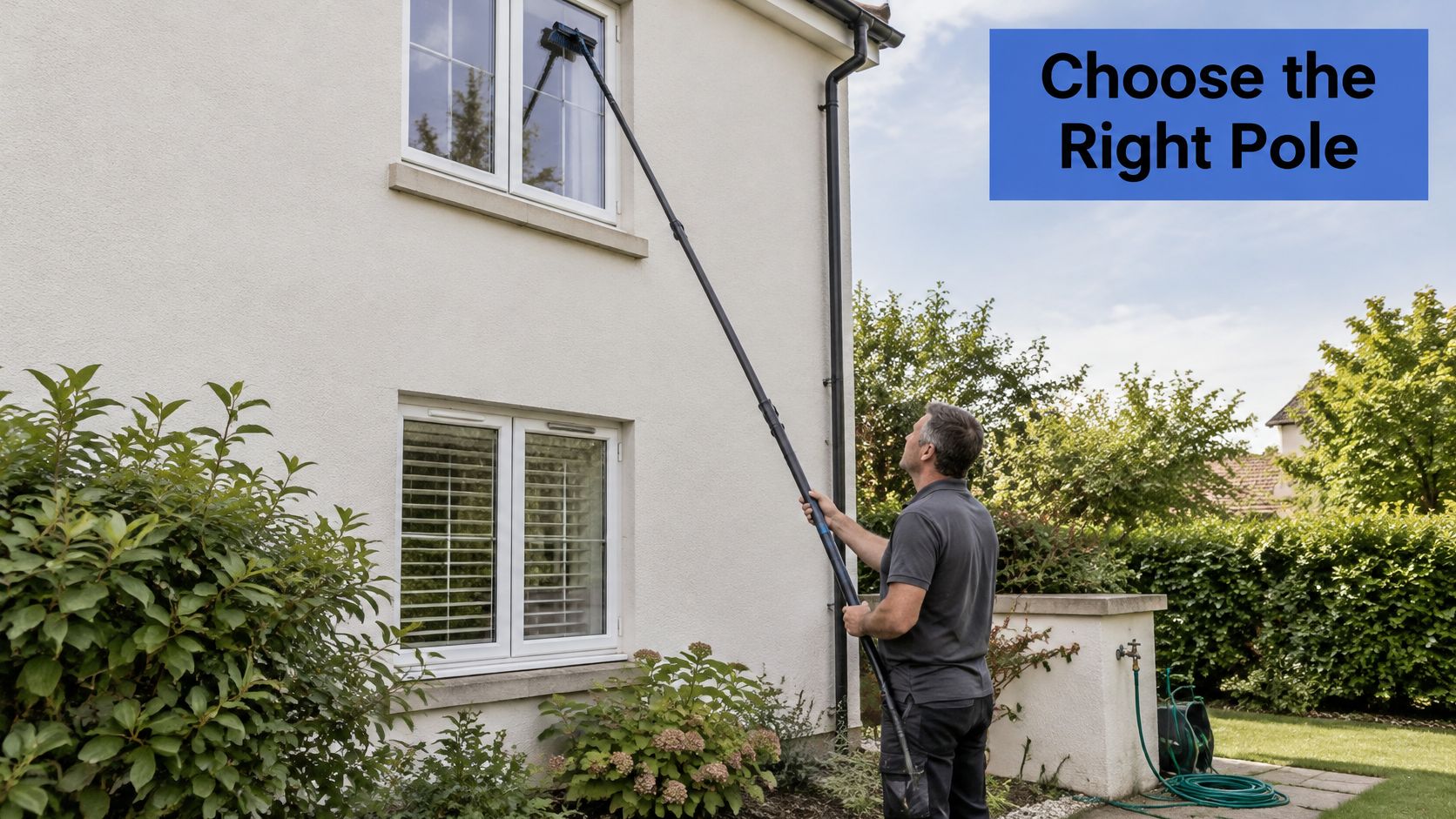
The purchase decision looks like a choice between poles. It's really a choice between six facts about your building, and the pole is whatever those facts leave you with.
Frames, sills and tracks need as much attention as the glass, and they're the first thing a long pole misses. When the dirt is bonded rather than loose, the job moves toward a crew with the right equipment, not toward a stiffer brush.
Cost is the last criterion, not the first. A 2025 manufacturer listing on Made-in-China's glass pole price page priced an 18-foot (5.4-meter) aluminum telescopic window-cleaning pole at $34.50 to $38.50 per unit. That's the entry ticket for the simplest tool in the set, which tells you the decision was never really about money. What costs you is a pole that reaches a window it can't clean safely.
| Window situation | Better choice | Why |
|---|---|---|
| Ground-floor glass within arm reach | Telescopic squeegee pole | Simple set-up and no water tank needed |
| Upper-floor glass up to about 80 ft from ground | Water-fed pole | Operator stays on the ground |
| Fragile frames, sloped ground or overhead lines | Professional crew with access equipment | Hazards outweigh the reach of a pole |
| Large commercial façade or high-rise glass | Professional crew | Reach and risk assessment required before work |
Large façades, high-rise glass and fragile frames are the three cases where a bigger pole isn't an upgrade, it's a different job. Those need access equipment, restraint systems and someone trained to read the site.
Pre-job checks done, pole inspected, glass confirmed reachable. The procedure from there is short, and almost every streak traces back to one skipped step.
Here's the sequence laid out end to end:
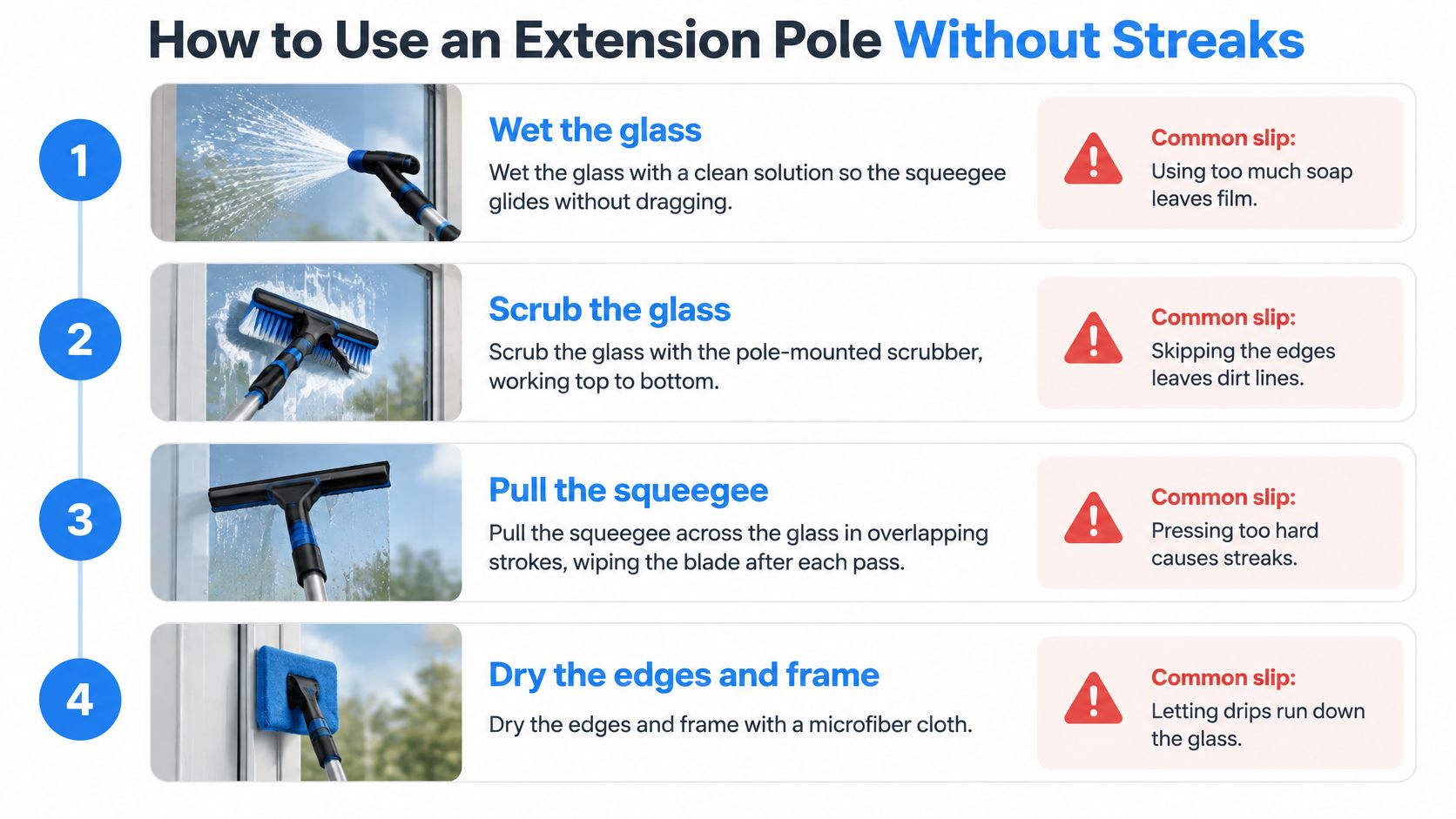
A clean pane has no streaks, no standing water sitting on the sill and no drip trail running down the frame or the render below. Check it from an angle rather than straight on, since a raking view shows the missed edges that a face-on look hides. Sills and tracks hold water longer than glass does, so dry them rather than letting the drips find the wall.
If you want to see the stroke pattern in motion before you start, this runs through it:
A second-story pane sits just inside a fully run-out pole. The frame is old wood, the sash opens outward, and a light wind keeps shifting the brush. Touching the glass is not the same as cleaning it safely. Height, glass condition, obstacles, weather, and the pressure you can hold on the blade all have to work at once.
Three questions settle this, and they are the same three a site assessment answers.
I treat a no on any one of them as the point to hire. Two or more, and the spend belongs on an assessment, not on another length of pole.
A pole is worth buying when it lets you finish a job you could already do safely, only faster. It is not a substitute for work you would never climb to.
Professional Window Cleaning has cleaned windows since 1999, according to Professional Window Cleaning's company history, and works in Arizona, Colorado, and Nevada. Washing covers interior and exterior glass and runs past the pane to frames, sills, and tracks, with a free estimate and a streak-free guarantee. Office window cleaning includes a post-cleaning inspection of all windows, and a satisfaction guarantee means concerns you raise get addressed promptly.
Call around and notice how the office handles the phone. Ten minutes on how cleaning businesses compare answering options is a separate check from reach and weather on site. If cost is the sticking point, this breakdown of whether professional window cleaning is worth it covers the trade-offs.
Ask for a site assessment before any work starts. A pole reaches the glass. Hire when frames, sills, and tracks also have to come back clean, or when height, weather, or the glass makes ground-level work unsafe. Professional Window Cleaning offers residential, commercial, and high-rise cleaning, including storefronts. Visit Professional Window Cleaning to book an assessment and see whether your highest windows are a pole job or a crew job.
Read our blog posts regularly and keep learning.