Care and Maintenance
How Often Should You Seal Your Driveway? a 2026 Guide
How often should you seal your driveway? Most asphalt needs resealing every 2–3 years, sooner with harsh sun, heavy traffic or freeze-thaw cycles.


Is professional window cleaning worth it if the risk isn't the price of the service, but the height of your windows, the type of glass, and the damage a wrong tool can cause?
The candid answer is yes for difficult, tall, coated, commercial, and repeatedly serviced windows, and no for some simple ground-floor jobs. Professional Window Cleaning has been cleaning windows for over 26 years, and the practical lesson is straightforward: the cleaning itself is rarely complicated, but safe access, correct technique, and consistent results can be.
Professional service sits inside a substantial market. One industry estimate places the U.S. window cleaning services market at about $2.9 billion in 2024, with more than 35,000 businesses operating nationwide and a projected market size of roughly $3.0 billion in 2026. The same source estimates an average residential visit at about $221. Industry market estimates and residential pricing context help explain why homeowners and building owners continue to pay for the service.
Ask, “Is professional window cleaning worth it?” as though the answer depends only on the invoice. That's the wrong starting point. The useful question is whether your window type, access conditions, cleaning frequency, and property class make professional skill more valuable than a weekend of do-it-yourself work.
Four factors usually settle the decision:
The pro-versus-DIY debate misses that middle ground. DIY is reasonable when the glass is standard, reachable, and limited in quantity. Professional cleaning earns its price when the job combines difficult access, delicate surfaces, large panes, or a schedule you won't maintain yourself.
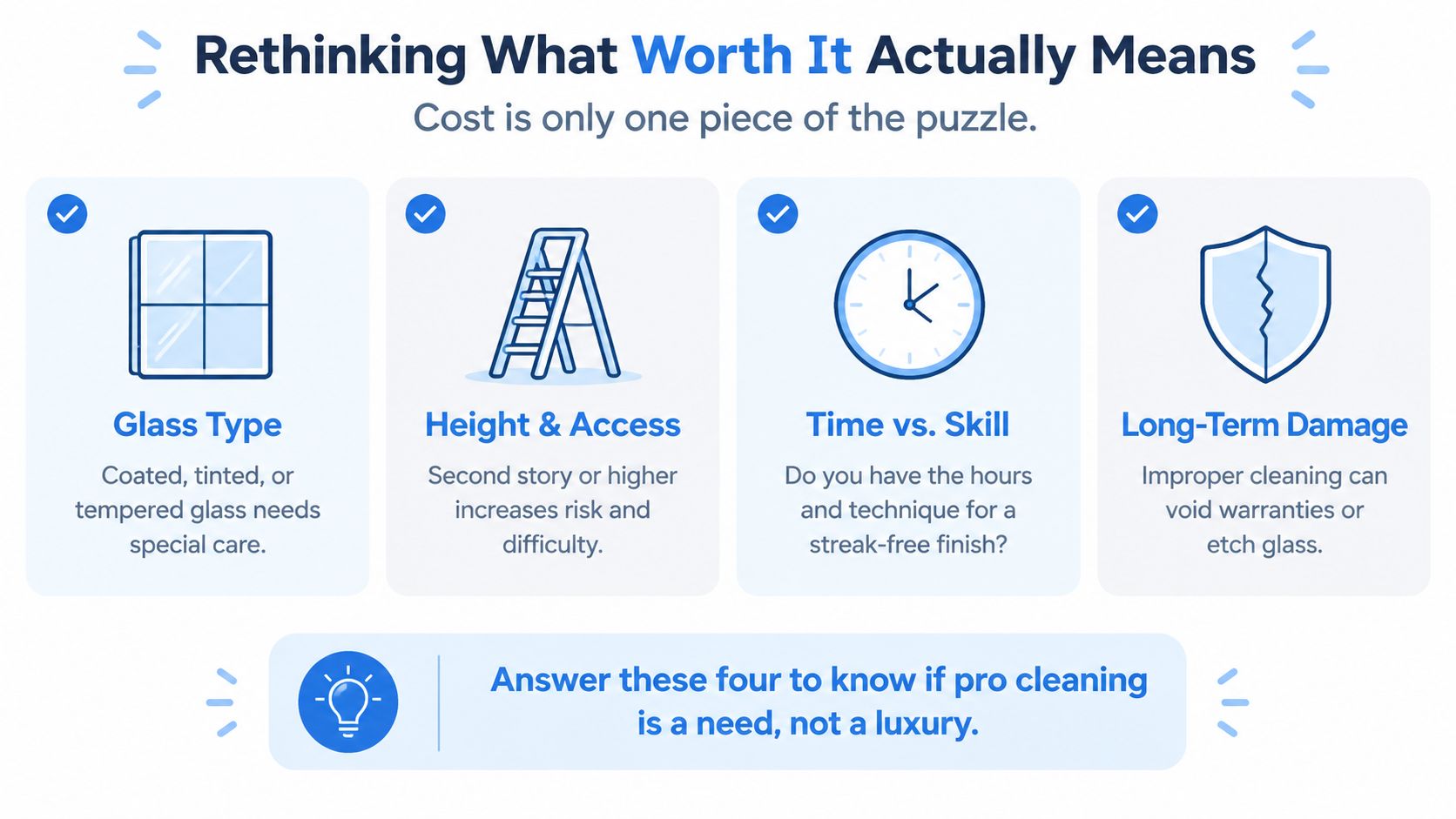
My rule: If you can safely reach the glass, identify the surface, clean it without stretching, and repeat the job consistently, DIY may be fine. Remove any one of those conditions, and a professional quote deserves serious consideration.
The industry relies mainly on two methods, not a confusing menu of secret techniques: the traditional squeegee method and the pure-water system. The squeegee provides the controlled, detailed finish many interiors require. Pure water lets crews scrub and rinse exterior glass from the ground with specialized poles. Cost matters, but safety, surface protection, finish quality, and building performance matter just as much.
Professional window cleaning comes down to two systems. The first is the familiar squeegee, refined into a precise trade tool. The second is pure water delivered through a water-fed pole, a rinse-and-let-dry approach designed mainly for exterior glass.
A technician applies a cleaning solution with a T-bar or washer sleeve, loosens the film, and pulls a flexible rubber blade across the pane. The blade gathers water and residue into a controlled channel, while microfiber cloths handle edges, corners, frames, and sills.
The modern squeegee dates to 1936, when Italian immigrant Ettore Steccone designed and patented a lightweight brass model with a single flexible rubber blade. The history of the modern window-cleaning squeegee shows why this basic-looking tool remains central: it gives a cleaner direct control over pressure, angle, and finishing detail.
Squeegee work is especially useful for interiors, divided panes, smaller windows, and glass that needs close inspection. It also works well when a technician must manage a specific detergent or carefully avoid seals, gaskets, and surrounding finishes.
Pure-water cleaning uses water stripped of dissolved minerals. The water reaches 0 total dissolved solids, so it can dry without leaving the mineral residue associated with ordinary tap water. How pure-water window cleaning works explains why crews can scrub, rinse, and allow the glass to dry without soap, towels, or squeegee marks.
The system typically connects to a water-fed pole with a soft brush. A technician agitates the glass and frames, then rinses with purified water. The pole can reach several storeys from the ground, which reduces ladder use and makes exterior façades more efficient to maintain. It isn't an interior replacement. A comparison of water-fed poles and traditional squeegees notes that interiors still require conventional hand cleaning.
| Factor | Squeegee Method | Pure-Water Method |
|---|---|---|
| Best use | Interior detail, smaller panes, divided glass | Exterior glass, frames, façades |
| Finish | Direct control with a rubber blade and microfiber detailing | Mineral-free rinse that dries clear |
| Access | Requires closer hand access | Water-fed pole reaches several storeys from the ground |
| Main strength | Precision and edge control | Safer, efficient exterior coverage |
| Limitation | More hands-on setup and movement | Not a complete interior-cleaning method |
The equipment explains why DIY rarely reproduces a professional result. A good squeegee is only one part of the setup. Crews also need channels in suitable sizes, washer sleeves, extension poles, purified-water equipment, brushes, hoses, safe access gear, and the experience to choose the right method for each pane. Professional Window Cleaning's window washing system provides additional context on the tools used in modern service work.
What should you budget for professional window cleaning? The answer depends on pane count, access, glass type, condition, and service frequency. A company that quotes complex work without asking about those details is guessing.
For ordinary residential work, use $8 to $12 per pane as a planning range, supported by this guide to window cleaning service cost guidance. A single-story visit may cost $150 to $300, while a two-story home may run $250 to $500. These are starting points, not fixed promises. Oversized panes, storm windows, screens, hard-water buildup, construction residue, and difficult interior access can raise the quote.
Commercial pricing follows a different structure. Monthly contracts may run $3 to $8 per pane, while storefronts and offices may use rates of $0.05 to $0.20 per square foot. High-rise work can reach $1 to $3 per square foot, and rope-access visits may cost $500 to $5,000 or more, depending on height and complexity. The market separates residential, commercial, and high-rise work, which explains the wide spread in pricing. Review pricing window cleaning estimates before comparing quotes.
| Property Type | Typical Price Range | Hidden DIY Costs |
|---|---|---|
| Single-story residential | $150 to $300 per visit | Consumables, time, equipment, missed edges |
| Two-story residential | $250 to $500 per visit | Ladder rental, access risk, potential damage |
| Commercial storefront or office | $3 to $8 per pane monthly, or $0.05 to $0.20 per square foot | Staff time, inconsistent presentation, disruption |
| High-rise | $1 to $3 per square foot, or $500 to $5,000 or more per visit | Specialized access equipment, training, liability exposure |
DIY still carries a bill. Consumables may cost $30 to $80 per year, before ladder rental, replacement tools, travel, and the value of a weekend spent working. A careless scrape can damage a coating, while mineral deposits can etch the glass. Those mistakes can cost more than the original service.
The break-even point usually arrives when the home has enough windows to consume a full day, the work needs repeating, or access requires equipment you will not use again. DIY is reasonable for accessible, uncoated glass on a small job. Hire a professional for difficult access, coated glass, recurring commercial maintenance, or any project where one mistake could erase the savings.
A single-story house can make window cleaning look harmless. That assumption changes quickly when the ladder sits on soft soil, a pool deck, a stair landing, or against a gutter. Even a short reach can become unstable when you twist, extend sideways, carry a bucket, or try to hold a squeegee above shoulder height.
The U.S. Consumer Product Safety Commission records roughly 164,000 ladder-related emergency-room visits each year, and window and gutter work represents a meaningful part of that everyday exposure. A homeowner may save the service charge and still pay more through an injury, damaged siding, broken glass, or lost time.
Glass damage creates another risk. Replacing a single tempered or Low-E pane can cost $200 to $600 installed, while repairing a scratched coated surface may require a full insulated glass unit replacement costing $1,000 or more. Those amounts come from the practical cost assumptions in this decision framework, not from a universal price list. Local glass type, size, frame system, access, and labor determine the actual bill.
Falls from height remain a serious occupational hazard. In Great Britain, falls from height have been the leading cause of workplace death in almost every year since 2001/02, and 35 workers were killed by falls from height across all industries in 2024/25. Working-at-height and window-cleaning accident data also records a historical analysis of 88 window-cleaning accidents over 15 years, with 62 resulting in fatalities.
| Risk Factor | DIY Homeowner | Insured Professional |
|---|---|---|
| Ladder placement | Often limited by landscaping, stairs, soil, or gutters | Planned around access conditions and equipment |
| Fall protection | Usually minimal or absent | Trained crews use appropriate systems for the work |
| Glass breakage | Homeowner absorbs the repair | Insurance may address covered accidental damage |
| Injury exposure | Personal medical and lost-time consequences | Employer and insurance structures provide protection |
| Complex access | Improvised solutions are common | Specialized access planning and equipment |
No credible figure was provided for the percentage of professional window-cleaning claims involving ladder falls versus equipment failure, so I won't invent one. The practical conclusion doesn't need it. For work above the first floor, unstable access, or difficult commercial façades, professional coverage and controlled procedures are part of what you're paying for.
For a plain-language overview of fall prevention principles, master working on heights safety is a useful companion resource. The safest ladder is often the one you don't need to use.
Modern windows aren't always bare glass. Low-E coatings, ceramic tints, hydrophobic treatments, self-cleaning surfaces, and oversized panels each create different cleaning requirements. The manufacturer's maintenance instructions should control the method, not a household habit carried over from older windows.
Manufacturer guidance for glass products recommends pre-rinsing debris, using mild soap, squeegeeing dry, and keeping water and residue away from gaskets, sealants, and frames. It warns against scrapers and abrasives, and advises against cleaning coated or tinted glass in direct sunlight because heat and trapped residue can increase the risk of scratching, streaking, or coating damage. Glass cleaning and maintenance guidance from Hartung Glass Industries is a practical reference.
Three failure modes make professional work more valuable:
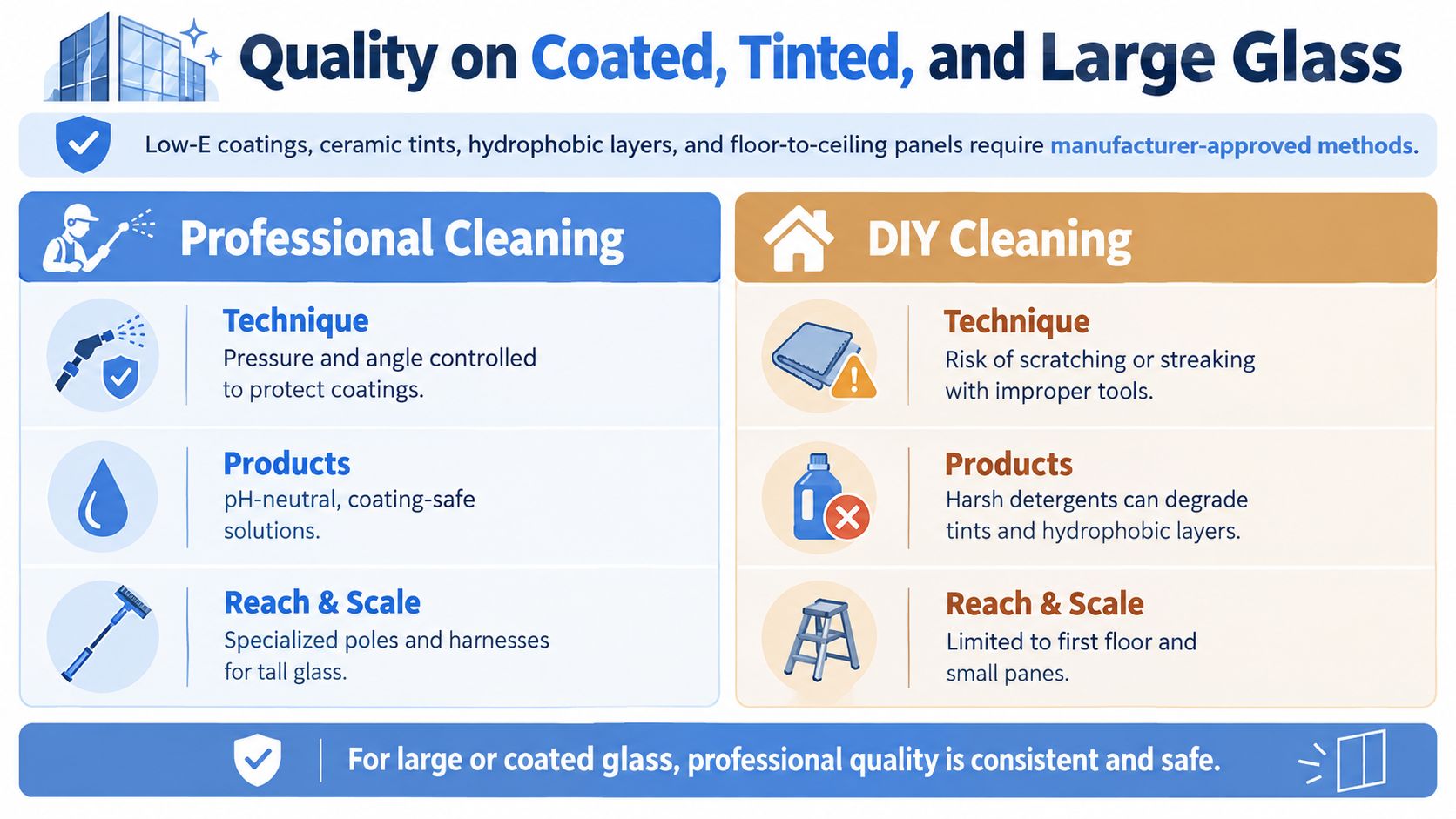
A professional doesn't automatically improve every job. The value comes from matching the method to the pane. Squeegee work offers control for interior and detail cleaning. Pure-water equipment offers a controlled scrub-and-rinse process for exterior surfaces where mineral-free water can dry clear. Both methods still require clean tools, appropriate pressure, correct access, and attention to the manufacturer's directions.
Glass-care rule: If you don't know whether the coating is on the interior or exterior surface, don't reach for a razor blade or abrasive pad. Identify the product first.
Clean windows can support more than appearance. They can help a building use daylight more effectively, improve the experience near exterior glass, and keep a maintained façade from becoming another visible sign of deferred care.
Research on self-cleaning and smart window coatings estimates that cleaner glazing can deliver up to 25% better daylight performance and that advanced coated windows may produce 5% to 15% annual HVAC energy savings. The same research indicates that self-cleaning surfaces may reduce cleaning frequency by 70% to 80%. Research on self-cleaning and smart window coatings makes the point most relevant to commercial owners: the coating, cleaning schedule, water use, and building systems should be considered together.
That doesn't mean every ordinary window will cut a building's energy bill by a fixed amount after one cleaning. The result depends on glazing, orientation, climate, shading, HVAC controls, occupancy, and the building's lighting strategy. The stronger argument is operational. A property manager can evaluate clean glazing alongside daylight access, tenant comfort, façade condition, and maintenance frequency instead of treating the service as decoration.
| Metric | Without Pro Cleaning | With Quarterly Pro Cleaning |
|---|---|---|
| Daylight transmission | More likely to be reduced by film and deposits | Maintained through regular surface care |
| HVAC interaction | Exterior contamination can increase maintenance concerns | Cleaner glazing supports consistent façade performance |
| Tenant experience | Cloudy or streaked glass affects perceived upkeep | Clearer views support a more maintained environment |
| Water and service planning | Reactive cleaning may require heavier restoration | Scheduled work makes labor and access more predictable |
| Asset presentation | Dirt remains visible between occasional cleans | Exterior condition receives ongoing attention |
Commercial owners should be careful with payback claims. The supplied evidence doesn't establish a universal dollar return for every office or storefront, so a responsible manager should compare utility records, lighting schedules, glazing specifications, tenant feedback, and cleaning invoices before assigning savings.
For a 20,000-square-foot office paying $0.12 per kilowatt-hour, a hypothetical model that saves 15% on daytime lighting can recover an annual cleaning contract in under twelve months, but only if those assumptions match the building's actual operating profile. Treat that as a calculation to test, not a guaranteed outcome.
The decision becomes simple when you stop asking whether window cleaning is worth paying for. Ask whether your specific job creates enough risk, effort, surface sensitivity, or recurring inconvenience to justify trained labor.
The same logic applies across the service areas of Las Vegas, Phoenix, Denver, and Scottsdale, where sun, dust, mineral residue, and large exterior panes can make inconsistent maintenance especially frustrating.
For commercial managers, recurring exterior cleaning every quarter, with monthly spot-cleaning on entry glass, is a sensible starting recommendation. Residential owners with two stories or coated glass generally get the best balance from professional inside-and-out service every 4 to 6 months, with a free interior touch-up between visits when that arrangement is available.
Frequency often matters more than the per-visit price. Regular service keeps each visit more controlled, while long gaps can turn routine cleaning into stain removal, coating-risk work, or a larger access job. Before approving a construction or turnover clean, use a resource such as avoid pitfalls in cleaning quotes to clarify scope, access, glass condition, and what the quoted price includes.
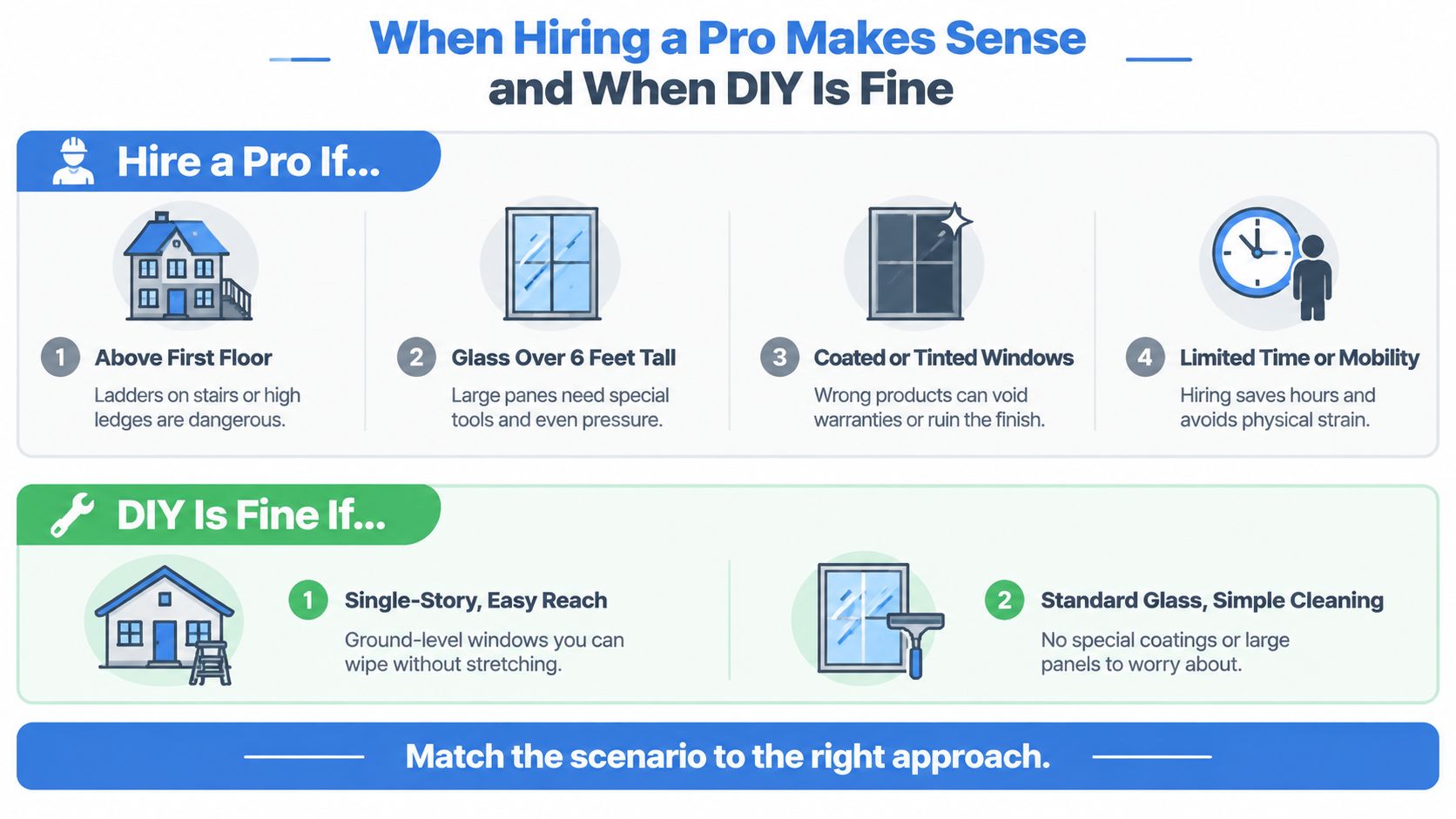
My recommendation: DIY easy ground-floor glass. Hire a pro for height, coatings, oversized panes, commercial presentation, construction residue, or any job you keep postponing.
Professional Window Cleaning offers residential, commercial, and high-rise window washing using the squeegee and pure-water approaches, with more than 26 years in the trade. If your windows are difficult to reach, coated, oversized, or overdue for consistent care, visit Professional Window Cleaning to request a quote, schedule service, or ask which method fits your glass.
Read our blog posts regularly and keep learning.