Care and Maintenance
Window Cleaning Mesa AZ: Methods, Pricing, and Booking Tips
Learn how Window Cleaning Mesa AZ services work for homes, offices, and high-rises, from squeegee vs pure-water methods to booking.


What should a blade do when the glass is hot, dusty, and slightly uneven? A soft rubber squeegee is a window-cleaning tool whose wiping edge is molded from a pliable rubber compound. Ettore Steccone's patent, granted on July 12, 1938, specified that wiping member as soft rubber so the edge could conform to uneven glass instead of staying rigid.
If a softer blade always meant a cleaner pane, every west-facing slider and every hot storefront would carry the same rubber. They do not. You will still see soft rubber sold as a universal streak fix. That advice holds on a cold morning with an older frame. It falls apart on sun-loaded glass in July, when the same edge turns grabby and you start pushing harder just to finish the pull. The job is to tell those conditions apart before the first stroke.
You finish the last pane, step back, and the glass looks fine in the shade. Then the sun slides across a south-facing slider and the story changes. A faint line near the corner, a skipped arc in the middle, and a dusty film the cloth never quite lifted. That is the moment a soft rubber squeegee earns its place, or shows you it was the wrong blade for that glass.
The tool's job is narrow. You wet the pane with a cleaning solution so soil lifts and stays suspended. Then one controlled pass gathers that liquid and the dirt into a removable edge. You are not hoping the water dries pretty. You are taking the dirty water off the glass.
Professionals work with only two methods. One is the squeegee method, where a rubber blade physically removes the cleaning liquid. The other is a pure-water system, where a brush and purified water do the work and the pane dries on its own. Soft rubber belongs to the first method. It is the edge that has to stay seated while you pull.
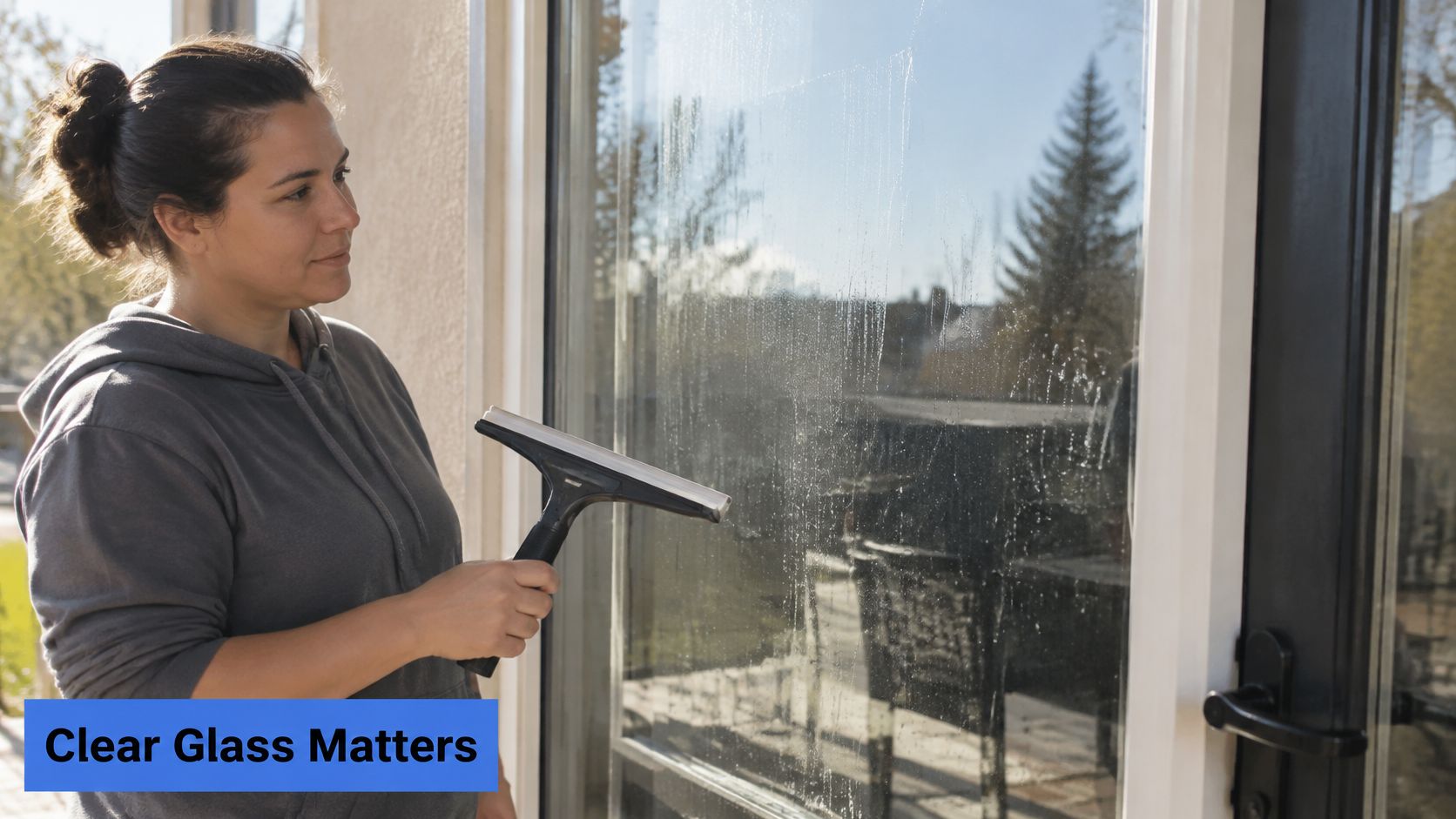
A streak is usually a break in contact, not a mystery film. A nick, a grain of grit, or an edge that folded under too much angle leaves a repeated path. The same habit shows up off the window. People who learn removing stains from marble showers already know that residue left to dry is harder to fix than soil you carry away while it is still wet.
Soft rubber is a condition-specific edge, not a free upgrade over every other blade.
Older residential glass with a slight wave rewards that flex. A flat commercial lite in direct sun may punish it. The rest of this walk-through is how to match the rubber to the pane, the season, and the way you pull.
Think of the blade the way you think of a windshield wiper, not a putty knife. A soft edge bends and follows the pane. A hard edge holds its line and scrapes. Both can clear water. They fail in different places.
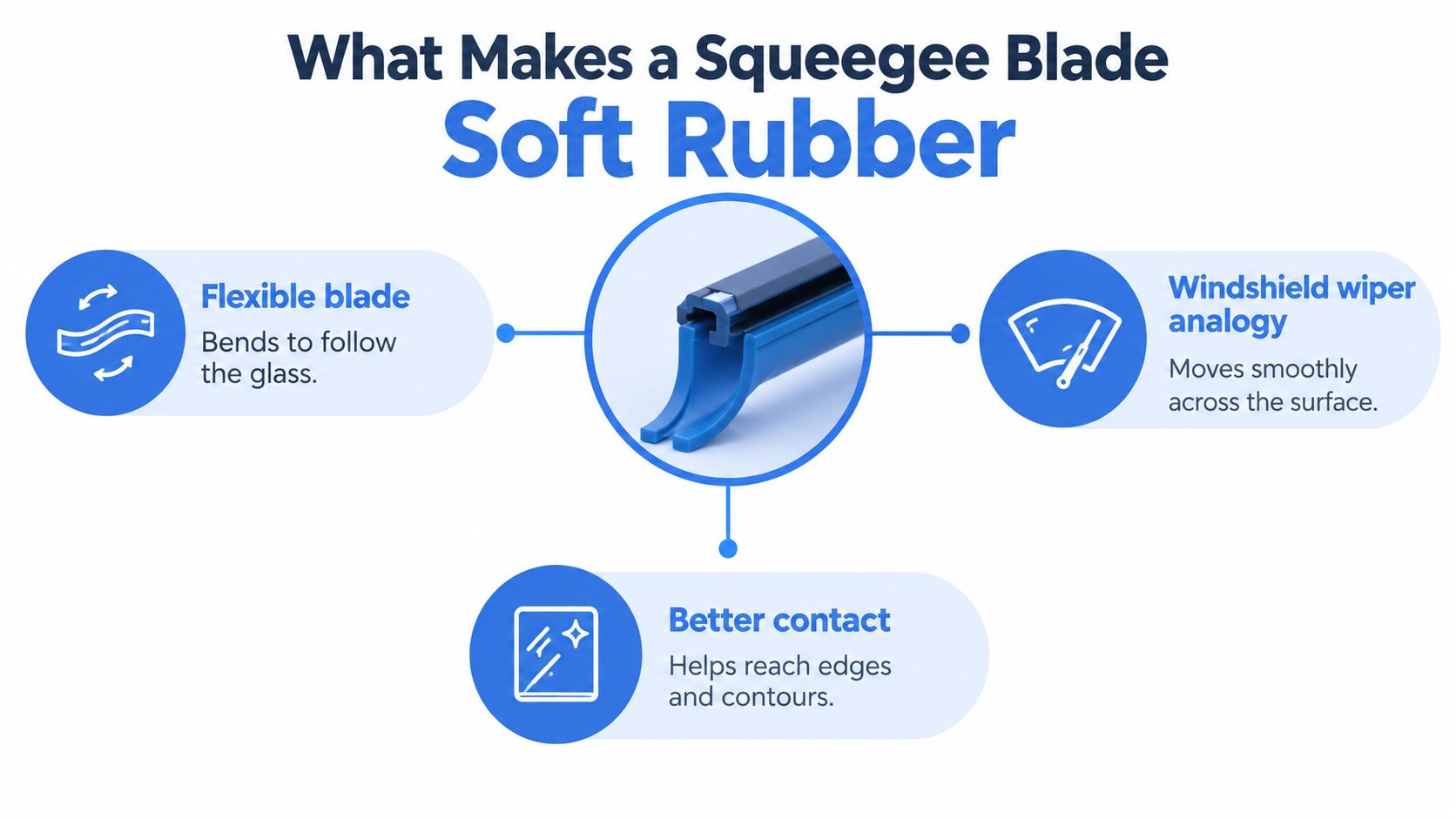
Softness is a measured hardness, not a vibe. A documented professional window-rubber spec lists about 53 ± 2 Shore, and that softer compound is the one recommended for uneven surfaces and colder temperatures, according to an Unger replacement-rubber listing. Lower hardness means more elastic conformity. When you pull, small dips in the pane or the frame get bridged, so the water-removal line stays continuous and skips drop.
The trade-off is real. A very soft edge loses dimensional stability and deforms faster under pressure, especially if you drag it at a steep angle or store it compressed. On a divided-lite cottage window that flex is helpful. On a long storefront pull it can round the wiping corner before the route is done.
The same spec calls out a double-sided blade you can flip, so the unused edge goes into service after the first one wears. That is the detail to look for in the channel, not a fancy handle color.
Use only enough hand pressure to keep the rubber seated. A clean, undamaged edge matters more than extra force, because grit or a nick breaks the water film and writes the same streak on every pane after it.
A sharp, clean edge removes water. A nicked edge draws a map of itself down the glass.
On an older casement window with a slight bow in the glass, a soft blade can keep contact where a firmer edge might leave a thin line of water. That can mean fewer skips and less hand pressure. The advantage depends on the pane and the way you work, especially in hot, sunny conditions where rubber can soften and wear faster.
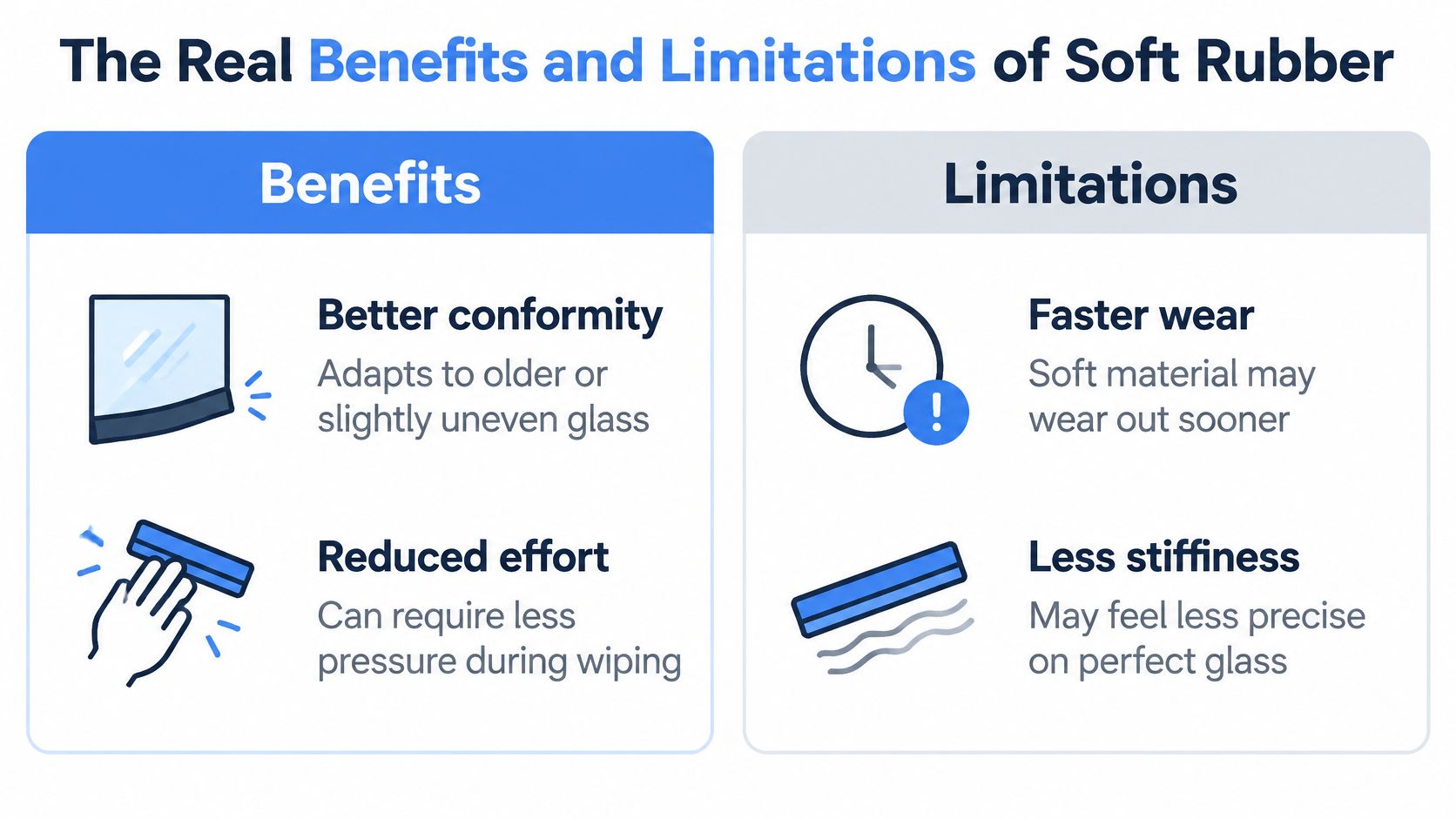
Window squeegee rubber commonly falls around 50–60 Shore A. That range describes hardness, not a guarantee of performance: a softer edge bends more readily over small variations, while a firmer one holds its shape better on broad, flat panes. The useful choice depends on the glass, temperature, and your pull angle.
Flex is helpful until it becomes too much. On uneven glass, a soft edge can maintain contact; on a long, smooth storefront pane, excess bending can add drag and make the wiping line less consistent. Heat and direct sun can make rubber feel more pliable, so a blade that works well on a cool morning may feel less controlled on a hot afternoon.
For crews in hot, dry areas, check the blade's working edge rather than judging it by appearance alone. Rinse away grit, and replace or reverse the rubber if it has a nick, a permanent bend, or a section that no longer contacts the glass evenly.
A detailer may build your first car detailing kit, but vehicle glass and window glass still call for a blade chosen for the surface and conditions at hand.
This short look at blade behavior is worth a minute before you buy a sleeve of rubber.
Soft rubber, firmer rubber, and a pure-water setup are three different answers. Mixing them up is how people buy the wrong tool and then blame the soap.
Traditional squeegee work pairs a wetting solution with a blade. The liquid loosens and suspends soil. The rubber makes a controlled pass and gathers that liquid into an edge you can wipe away. A commercial window-cleaning description draws the line clearly: squeegee technique for storefront and ground-floor glass, water-fed pole work where the reach changes. Neither method is generic wiping.
A pure-water system does not squeegee the last step. A brush on a telescoping pole agitates the dirt. Purified water carries it off. The pane dries in place because the minerals were removed before the water hit the glass. Typical flow through the brush runs about 2–4 gallons per minute, and small residential or light commercial systems often use carbon filtration, reverse osmosis, then deionization, per a pure-water systems guide.
That guide sets total dissolved solids below 10 ppm at the pole for general residential work, below 5 ppm for many coated or commercial surfaces, and below 1 ppm for high-end commercial glass. If TDS climbs past 10 ppm after the deionization stage, the resin is exhausted.
| Option | Hardness or Method | Best For | Main Trade-Off |
|---|---|---|---|
| Soft rubber blade | Pliable squeegee edge | Older, slightly uneven, or cold glass | Wears faster and can get grabby in heat |
| Firmer rubber blade | Stiffer squeegee edge | Flat glass and faster straight pulls | Skips if angle or pressure is off |
| Pure-water system | Brush, purified rinse, air dry | Upper exterior glass you can reach with a pole | Depends on TDS control, not on a blade |
Pick the method by access and glass, then pick the rubber by temperature and surface. Don't reverse that order.
Untreated tap water, often around 300 ppm TDS, leaves mineral specks as it dries, which is why a pure-water method overview treats the purity number as an operating rule. From the ground, a pole-mounted brush can scrub and rinse upper-storey exterior glass where a hand squeegee would mean a ladder.
Climate and glass condition pick the blade. A one-durometer pouch does not.
Industry guidance puts soft rubber around 50–60 Shore A. It conforms to older or uneven glass. In high heat and direct sun it can go overly soft, grabby, or streak-prone, which is the trade-off a squeegee selection guide spells out for hot, sunny markets such as Arizona, Nevada, and Colorado. South- and west-facing windows, vehicle-showroom glass, and high-rise façades under heavy solar load are the panes where this shows up first.
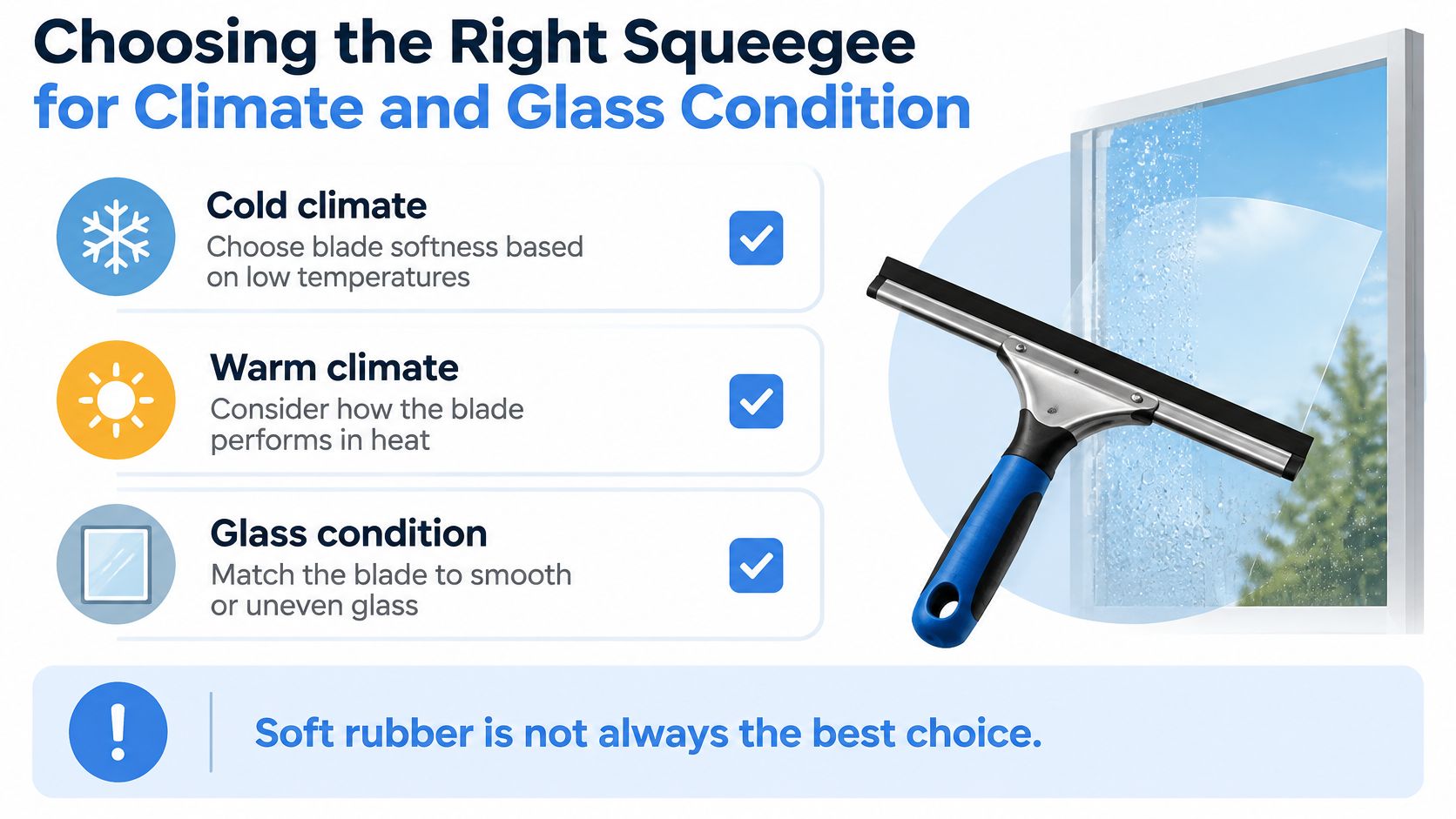
Should you switch off soft rubber in extreme summer heat? Yes, when the edge stops behaving. You don't need a durometer on the truck. You need eyes and a pull.
Test by season, by exposure, and by glass type. A north elevation in the morning can still like the soft edge while the west elevation at 3 p.m. wants something firmer so the geometry holds. Softer rubber can lower the pressure you need on imperfect glass. A firmer compound keeps the edge stable once the pane is hot.
Grit in a track causes the same kind of repeat mark people fight on shower doors. Straightforward non-toxic shower track cleaning tips are a useful parallel: clear the channel before you blame the glass.
Professional Window Cleaning matches squeegee and pure-water work to residential, commercial, and high-rise glass across Flagstaff, Las Vegas, Denver, Scottsdale, Tempe, Chandler, and Gilbert. Seasonal shifts in those markets are why a single rubber spec fails, which is also the point of planning window cleaning around the seasons.
A worn blade is an ergonomic problem, not only a cosmetic one. Force, grip, and posture are the risks that show up when squeegee work turns repetitive. A NIOSH-hosted ergonomics note reports that padding a handle with a compressible surface can significantly reduce hand pain and fatigue over time and may lower carpal-tunnel pressure.
A lightweight squeegee and a sharp rubber edge let you use a lighter grip and keep the wrist nearer neutral. That takes stress off the shoulder and the wrist. Soft rubber helps here when the glass is imperfect and the edge is still keen, because conformity replaces the extra push.
A nicked, rounded, hardened, or dragging edge does the opposite. You compensate. The grip tightens. The wrist cocks. The shoulder lifts. That is the moment a worn blade raises injury risk, on a high-rise drop, a stadium bowl, a dealership front, or a long commercial route.
Replace the rubber when you notice yourself pressing harder. Your wrist is giving you the inspection the edge already failed.
Soft rubber became foundational because the job demanded flex, not because a catalog called it premium. An 1892 U.S. patent by Anthony L. Lewis already used a soft-rubber water reservoir on a window cleaner. By 1918, naval terminology listed the squeegee as a civilian window tool too. On October 24, 1936, Italian-American inventor Ettore Steccone filed for a single-blade design. Patent No. 2,123,638 specified a wiping member preferably molded from soft rubber, aimed at clearing liquid and dirt across a wide range of angles and pressures. A later court record says manufacture started in late 1938 and more than 12,000 units sold in the next 10 months, as summarized in the squeegee history.
That history is a practice, not a DIY shortcut. Crews still match hardness to climate, glass condition, and access. High-rise, stadium, dealership, and large commercial work adds rope, poles, water quality, and fall protection that a single channel cannot cover. Hiring that out is how the result survives sunlight a week later, not how you avoid a Saturday chore.
Professional Window Cleaning has washed residential, commercial, and high-rise glass since 1999, when David Kaminski started the company, a span of more than 26 years noted in its company profile. If the blade choice, the height, or the solar load is past a hand squeegee on the back patio, professional window washing is the cleaner next step for homes and buildings in those same Arizona, Nevada, and Colorado markets.
Professional Window Cleaning handles residential, commercial, and high-rise glass with the squeegee method or a pure-water system, matched to the climate and the pane rather than to a single soft blade. If sun-loaded glass in your building keeps streaking no matter which rubber you try, visit Professional Window Cleaning and schedule a visit for your home or property.
Read our blog posts regularly and keep learning.