
Care and Maintenance
Window Cleaning Maricopa AZ: Local Homeowner's Guide
Window cleaning Maricopa AZ services keep your home bright and curb appeal high. Compare local pros, pricing, and scheduling options today.


You pull into the driveway after weeks without rain and the front windows look dull, even in bright sun. A light film covers the glass. Small spots catch the light on the patio door. Inside, the view looks hazy. That pattern is common in Mesa, and it's tied to three local facts. The air is dry for long stretches, the water is hard, and summer storms arrive in bursts. Window Cleaning in Mesa, AZ works best when you plan around those conditions, not around a generic calendar.
A typical case looks like this. A homeowner cleans the inside glass on a Saturday and still sees haze on Sunday morning. The haze is outside. Dust has settled on the glass, screens, and frames during a long dry spell. A hose rinse seems to help, then the sun dries the droplets and new spots appear.
That cycle repeats because dust keeps landing and rinse water leaves minerals behind. Professional cleaning breaks the cycle by removing the film and controlling what stays on the glass after drying. It's not just about shine. Clean screens let light through more evenly, and clear tracks help sliding windows and doors move without grinding grit.
Mesa is a large place for this kind of upkeep. The city counted 504,258 residents in the 2020 Census, and the Census Bureau profile reports a 64.4% owner-occupied housing rate for 2019 to 2023 with a median owner-occupied home value of $364,300 in the Census Bureau QuickFacts profile for Mesa. Owners handle exterior glass, screens, frames, and hard-to-reach windows themselves. They can't pass that work to a landlord.
Different owners hit the same wall for different reasons.
A renter in a managed apartment may never book this service. A homeowner almost certainly will at some point. Condos sit in between, since associations may handle some exterior work while owners handle interior glass and sliders.
Practical rule: If inside cleaning doesn't fix the haze, stop adding cleaner. The problem is on the outside surface.
Regular attention doesn't mean frequent full-service visits for every home. It means matching the visit to dust buildup, water spotting, and access. Once you know which of those is driving the dirty look, the method choice gets much simpler.
Professionals use only two core methods. They clean with a squeegee, or they clean with a pure-water system. Other tools support those methods, but they don't replace them. Like drying dishes: you can wipe a glass dry with a towel, or you can rinse it in water with nothing in it and let it air dry clean.
A squeegee has a handle, channel, and rubber blade that pull water, cleaning solution, and loosened dirt off the glass, as described in the IPC Eagle guide to professional window cleaning methods. The technician wets the pane, scrubs to loosen the film, then blades the liquid off in controlled passes. Edges get detailed by hand. This is the standard approach for interior glass, storefronts, and panes the technician can reach and see up close.
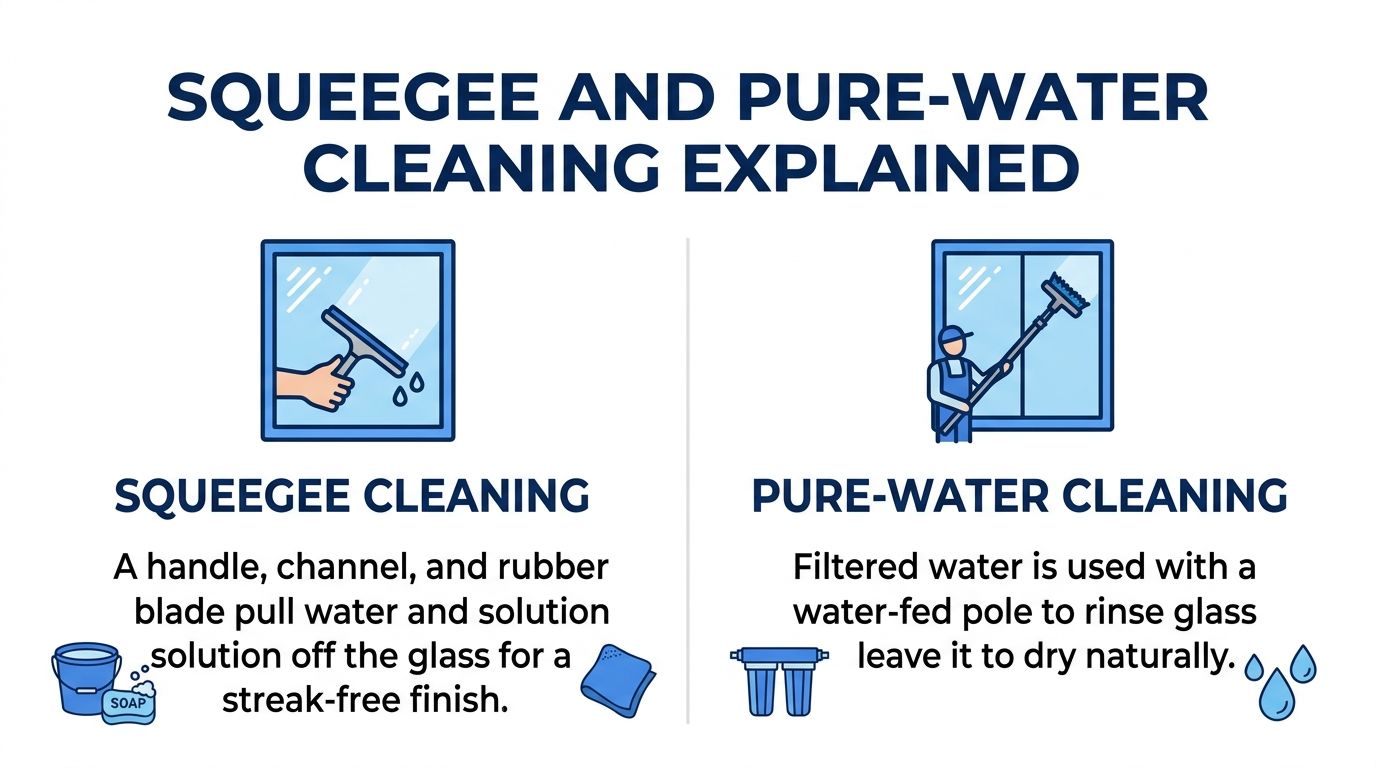
Pure-water cleaning removes minerals from tap water before the water touches your windows. A typical system runs water through carbon filtration, reverse osmosis, and deionization, then sends it through a hose to a water-fed pole with a brush, following the filtration sequence for purified water window cleaning. The brush scrubs the glass and frames. The purified rinse then dries on its own without mineral spots.
Technicians check that water with a TDS meter. Technical guidance puts an acceptable total dissolved solids reading at approximately 0 to 10 parts per million for window cleaning, according to the water-fed system manual on TDS thresholds. If the reading climbs, filters or resin need attention before the water goes back on glass.
Squeegee and Pure-Water Cleaning Compared
| Method | How It Works | Drying Result |
|---|---|---|
| Squeegee | Scrub with solution, then pull liquid off with a rubber blade | Dried by hand on the spot, so nothing is left to evaporate |
| Pure-water | Brush and rinse with filtered water through a pole | Air dries clean because minerals were removed first |
Height often decides the choice. A water-fed pole lets a technician wash upper exterior windows from the ground in many cases. Interior panes, by contrast, need squeegee work so water doesn't run onto floors and sills. Many homes use both methods in one visit, pure water outside and squeegee inside.
Hard water spots work like chalk in a kettle. You boil water, the water leaves, and white scale stays behind. The same thing happens on a window, just faster, because sun-heated glass dries droplets in minutes.
Mesa reports municipal water hardness of approximately 12 to 22 grains per gallon depending on service area and source water, and notes that dissolved calcium and magnesium cause that hardness in the City of Mesa water quality guidance. The U.S. Geological Survey classifies water above 10.5 grains per gallon as very hard. Every part of that Mesa range sits above the line.
Here's the sequence on a typical afternoon. You spray a dusty window to knock the dust off. The dust loosens, but now the pane is covered in untreated tap water. The sun heats the glass, droplets evaporate, and calcium and magnesium carbonate stay behind as white specks and rings.
Sprinklers cause the worst version of this. Overspray hits the same lower panes again and again. Each cycle adds a thin mineral layer. Over time the buildup turns rough and hazy, and routine cleaning takes longer because the technician now has to address deposits, not just surface dust.
More soap doesn't fix any of this. Detergent loosens dirt and oils, but it can't remove minerals dissolved in the rinse water itself. Extra detergent can add surfactant residue, which leaves its own film and attracts dust sooner.
Mineral control prevents spotting. Stronger soap does not.
Homeowners who want to reduce hardness at the tap for other household reasons can review water softener guidance from Water Filter Advisor to understand treatment options beyond window work. For glass, the practical controls are simpler. A squeegee removes the water before it evaporates. A pure-water system removes the minerals before rinsing. Both methods attack the same problem from opposite ends.
One caution matters here. Hardness varies by neighborhood and source blend, so a reading from a friend across town may not match your house. Ask your cleaner how they handle rinse water at your property. A clear answer about squeegee drying or purified water tells you more than any promise about special soap.
A house, a medical office, and a high-rise condo tower don't need the same visit. The glass may look similar, but access, timing, and what's included differ a lot. Matching the service to the building saves you from paying for the wrong scope.
For homes, a visit often covers exterior and interior glass, screens, tracks, and sills together. Exterior-only service is common for upkeep between deeper cleans. This photo shows the close-up squeegee work used on reachable residential panes.

Professional Window Cleaning states it has served residential and commercial customers since 1999, which supports its claim of cleaning windows for over 26 years, per the company history on its about page. In practical terms, a scoping conversation usually covers stories, window count, screens, access points, and any hard water staining.
Businesses care about the entrance first. Medical offices, dealerships, and retail fronts need scheduled cleaning so doors and display glass stay clear for customers. Work may happen before opening hours, and the scope often repeats on a set cycle rather than a one-time deep clean.
High-rise and condominium work adds height, specialized access, and stricter coordination with building management. Schedules, entry rules, and safety planning matter as much as the cleaning itself. Owners comparing options can review what's involved in high-rise window cleaning services before requesting a site visit.
This short video shows professional technique in action, which helps set expectations for pace and finish.
Ask any provider three things. Which method will you use on each surface? What's included for screens, frames, and tracks? How do you handle access for upper floors? Clear answers signal a scoped job, not a guess.
Two quotes for the same house can differ and both can be honest. They're often pricing different scopes. One includes screens and tracks. The other covers exterior glass only. Until you compare the written scope, the cheaper number tells you very little.
Several factors drive the price on any Window Cleaning in Mesa, AZ quote.
Ask for the scope in writing before you compare totals. A useful estimate states the method, which surfaces are included, and whether frame and sill rinsing is part of the job. That last point matters with hard water. A low quote that skips spot prevention can leave you with fresh spots days later, which erases the savings.
Before you accept a price: Ask what happens if spots appear after drying. The answer reveals whether mineral control is built into the quote.
Homeowners who want background on how service pricing is structured can read this overview of cleaning service costs and estimate factors before collecting quotes. It helps to gather your details first. Count stories, note sunscreens, flag any panes with white sprinkler buildup, and decide whether you want interior glass included.
Frequency changes value too. A recurring plan usually keeps each visit lighter because deposits don't build up as heavily. A one-time clean after years of neglect is a restoration job, and it should be priced that way. Neither is wrong. You just want the quote to match the condition of your glass, not an average house on a price sheet.
Mesa has a hot desert climate with about 10.76 inches of average annual precipitation spread across roughly 36.3 days with at least 0.01 inches of rain, according to the climate summary for Mesa, Arizona. Most days are dry. Dust settles undisturbed for weeks. Then a storm hits and the glass changes overnight.
That pattern explains a common frustration. Rain doesn't wash dusty windows clean. It wets the dust, moves it around, and leaves spotted residue as droplets dry. Clean windows handle light rain far better because there's little dust for the water to grab.

Mesa Monthly Rainfall Pattern
| Month | Average Rainfall | Cleaning Implication |
|---|---|---|
| June | 0.05 inches | Driest stretch, dust builds steadily on glass and screens |
| July | 1.18 inches | Monsoon storms begin leaving deposits on frames and tracks |
| August | 1.29 inches | Wettest month, post-storm spotting is most likely |
| September | 1.13 inches | Storms taper, a cleanup visit resets glass for fall |
You don't need a complex calendar. You need timing that respects the dry and storm cycles.
Commercial properties often keep a fixed cycle year-round because entrances can't wait for the season to change. Homeowners have more flexibility. The key point is that scheduling around monsoon deposits beats reacting after spots have hardened in the sun for months.
Booking goes faster when you gather a few details first. You don't need exact measurements. A provider mainly needs to picture your property, choose a method, and plan access. This checklist image reflects the kind of quick review that makes the first call productive.

Next, decide which type of visit fits. A one-time clean suits a sale, a move, or a long-overdue reset. A recurring plan keeps dust film and deposits from rebuilding, so each visit stays lighter. A post-storm visit targets the screens, frames, and tracks that catch wind-blown grit.
During the estimate conversation, ask about method and water. Will upper exterior panes get pure-water cleaning? Will interior glass be squeegeed by hand? How will the crew prevent hard water spotting as panes dry? You're not testing the provider. You're confirming the plan matches Mesa conditions.
A clear scope, a named method, and a set date. That's a booked visit you can feel good about.
Before the crew arrives, move fragile items off sills and open side gates if you've agreed to that. You don't need to pre-wash anything, and you shouldn't hose the windows down the day before. That just adds mineral spots for the technician to remove. Once the visit is done, check the glass in angled sunlight. That's when haze shows, and it's the best moment to confirm the finish and set your next date around the dry and monsoon cycle.
If your Mesa glass shows dust film, sprinkler spots, or post-storm grit, you don't have to sort out methods and scheduling alone. Professional Window Cleaning offers residential, commercial, and high-rise window cleaning using squeegee and pure-water methods matched to your property and Mesa's hard water. Visit Professional Window Cleaning to request an estimate and book a visit that fits your home or building.
Read our blog posts regularly and keep learning.