
Care and Maintenance
All Seasons Window Cleaning: A Complete Year-Round Guide
All seasons window cleaning explained: how weather affects glass, season-by-season scheduling, methods pros use, and the real benefits of regular service.


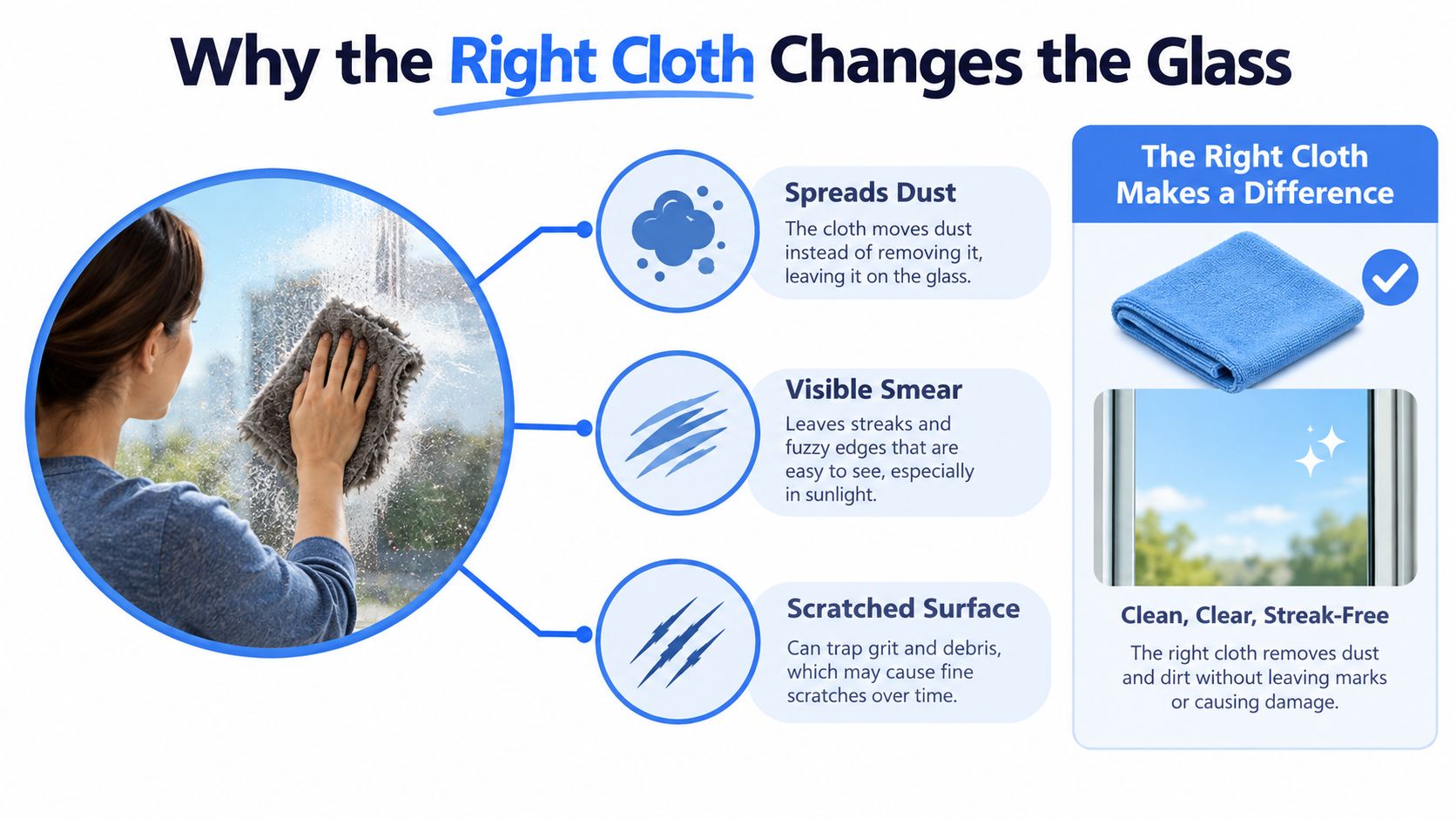
You wipe a sunny pane, step back, and watch the light reveal what your hand missed. There's a cloudy arc where dust moved instead of lifting, a fuzzy line along the edge, and a faint smear that follows every pass. The solution isn't always more spray or harder pressure. Often, you're asking one cloth for window cleaning to do jobs that require different tools.
A homeowner cleans a sliding door on Saturday morning. She wets a plush towel, scrubs the dusty lower track area, then uses the same damp side to polish the center of the glass. The grit she collected near the frame spreads across the pane, and loose fibers catch the sunlight at the edge. The glass looks worse in bright light than it did before she started.
That sequence shows the core problem. Wet wiping, drying, and final polishing aren't the same task. A cloth that's excellent when damp may leave residue once it's saturated, and a soft cloth can still shed or drag trapped particles. The same principle appears in vehicle glass care, where Nanak Car Wash streak-free windshield tips offer useful context on separating washing from finishing so residue is not pushed back across a clean surface.
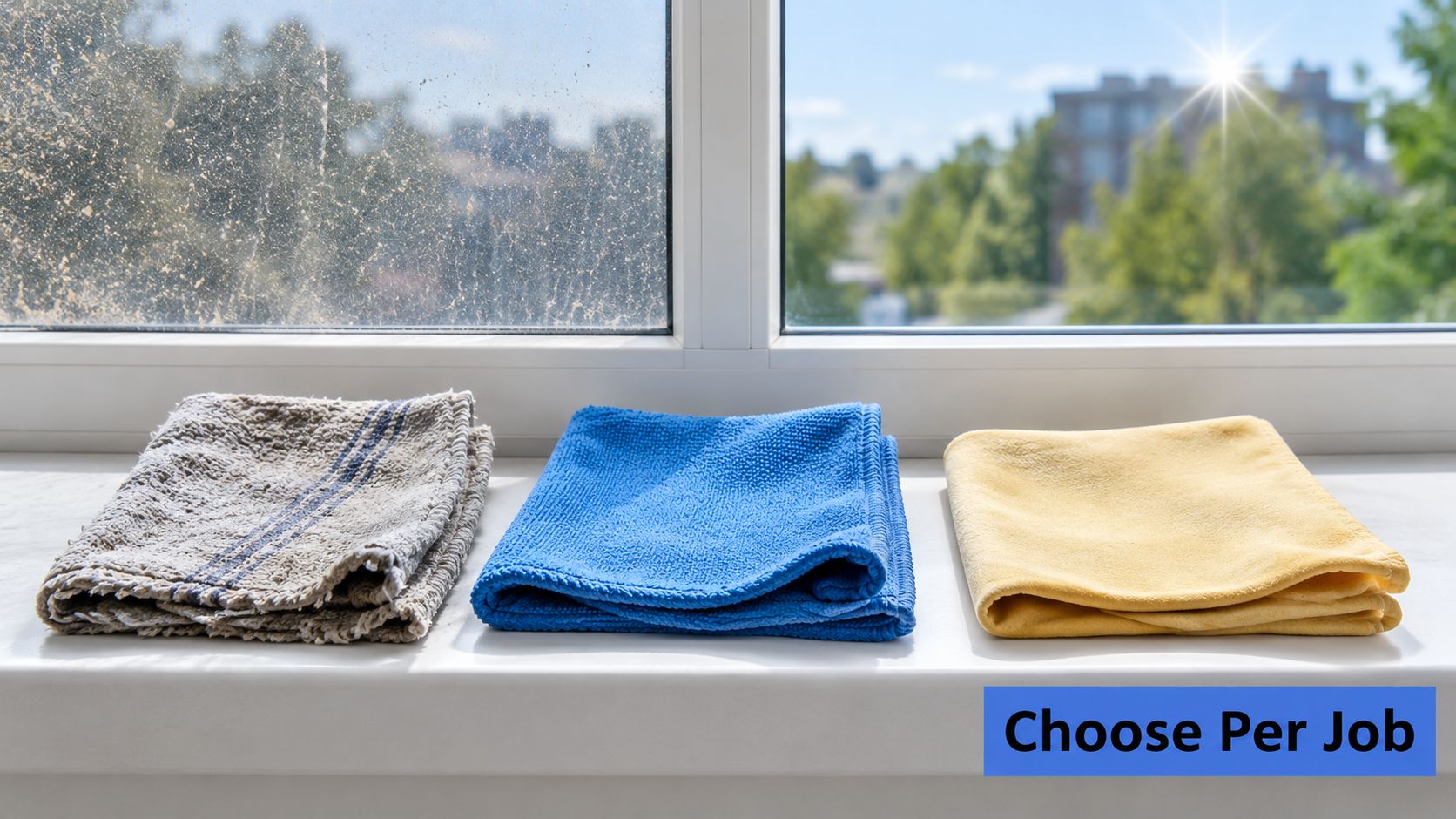
Microfiber usually handles fine finishing work. Cotton suits sturdy wet wiping. Lint-free describes a performance goal you'll need to verify, not a guarantee on a label. Chamois focuses on controlled drying. Your water quality, frame material, glass condition, and cleaning method influence which role matters most on a given job.
Professional work clarifies that choice. An industry guide to the two professional methods describes traditional squeegee cleaning, where a rubber blade removes water, solution, and loosened dirt, and pure-water cleaning, where filtered water and a brush replace detergent and that blade. Those are the only two professional methods, and cloths support each differently, from detailing edges after a squeegee pass to wiping frames after a pure-water rinse.
The Four Main Cloth Options at a Glance
| Cloth type | Best role | Main strength | Common limitation |
|---|---|---|---|
| Microfiber | Final glass finishing | Fine particle pickup | Performance drops when dirty or saturated |
| Cotton | General wet wiping | Durable and familiar | Can leave visible fibers on glass |
| Lint-free | Detail and edge work | Aims for clean release | Label alone doesn't prove low lint |
| Chamois | Controlled drying | Smooth, absorbent contact | Less suited to heavy soil removal |
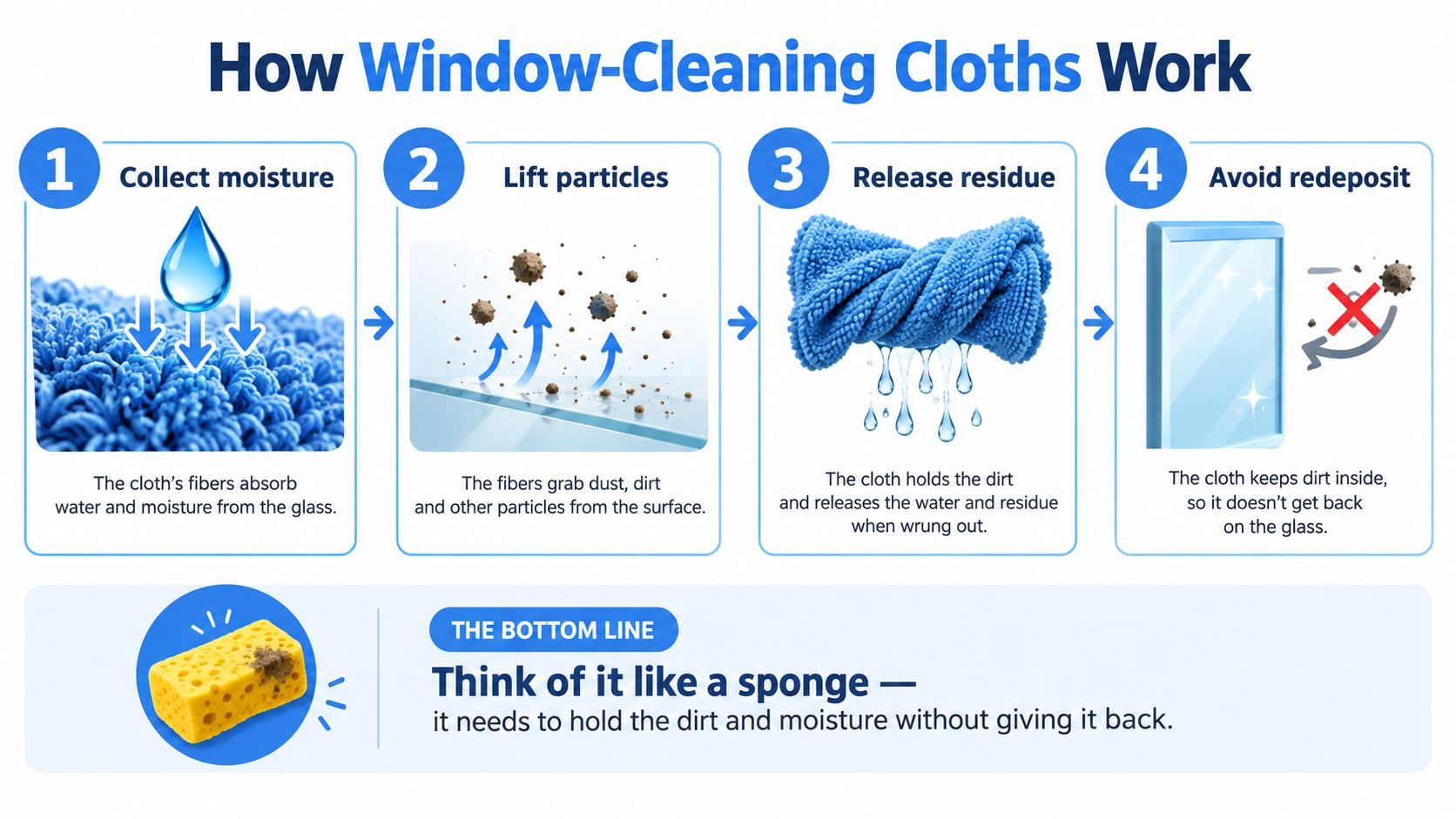
Think of a cloth as a small collection system, not a simple rag. It must take in moisture, lift particles off the surface, hold what it collects, and avoid handing that dirt back to the next section of glass. When any part of that cycle fails, you see streaks, haze, or specks that seem to move rather than disappear.
A good cloth doesn't just move water around. It captures the water and the soil suspended in it, then keeps both away from the finished surface.
A literature review of microfiber construction reports filaments below 1 denier, about one-hundredth the diameter of a human hair, giving the fabric roughly 40 times more surface area than cotton. That geometry creates many fine channels. Capillary action draws in the thin film of water and soil, while the fibers contact particles that larger yarns may pass over. That's why a clean, dry microfiber often makes a strong finishing cloth on streak-sensitive glass.
Wiping a frame, screen, or sill loads a cloth with grit. If you carry that same cloth straight to clean glass, you're polishing with contamination. Assign one cloth to dirty contact work and keep another clean and dry for the final pass. For a broader view of sequence and technique, this guide to cleaning glass effectively pairs well with the cloth roles below.
With a squeegee, the rubber blade removes most solution, then a detailing cloth dries edges and corners. With pure water, a brush loosens dirt and purified water rinses the pane, so cloths focus more on frames, sills, and interior touch-ups. Professional Window Cleaning has served residential and commercial properties since 1999, and that long field experience reinforces a simple lesson. Method determines how much finishing work the cloth must do.
Cloth Roles Across a Cleaning Sequence
| Stage | What the cloth must do | Risk to avoid |
|---|---|---|
| Wet wiping | Loosen and collect visible soil | Spreading grit onto clean areas |
| Frame and sill work | Remove heavy dust and debris | Carrying abrasives to the glass |
| Drying | Absorb remaining moisture evenly | Leaving a wet, mineral-laden film |
| Final polishing | Lift faint residue without adding lint | Smearing with a saturated cloth |
People often ask for one universal winner. You'll get better results by asking which material fits the surface, soil level, and finish you need. A cloth for window cleaning should be judged at the moment it touches glass, not only by the word printed on its package.
Split-fiber microfiber is the usual starting point for final glass finishing because its fine structure offers extensive contact with water and small particles. It can hold substantial moisture and reach into slight surface texture that bulkier fibers miss. In practice, that means a fresh microfiber picks up fingerprints and faint haze with light pressure instead of skating across them.
It isn't automatically lint-free or harmless. A loose, plush weave, rough edge, trapped sand, or poor laundering can release fibers or redeposit abrasives. Once the cloth is wet through, its remaining capacity falls and it may smear dissolved residue. Rotate to a dry section or a clean cloth when your strokes stop clearing the pane.
Cotton is durable, absorbent, and comfortable for general wet wiping. A cotton towel can wash a frame, wipe a sill, or handle a heavily soiled utility pane where a perfect optical finish isn't the immediate goal. Conventional terry is usually weaker for the last pass because its loops can leave fibers and push moisture into visible trails.
Natural doesn't mean shed-free. Testing summarized in the Ocean Conservancy microfiber toolkit found microfiber samples released 9.6 to 1,240 milligrams per kilogram per wash across five cycles, while cotton and wool averaged 165 ± 44 milligrams per kilogram per wash. The important lesson isn't that one category always wins. Fiber type, weave, finish, construction, and laundering can change release dramatically.
Treat lint-free as a claim to test. Some cloths sold under that description release very little visible fiber, while others shed after folding, washing, or contact with a rough frame. Inspect one against dark glass in strong light before trusting it on a storefront or sunlit living room window.
This category works best for detailing edges, drying corners after squeegee work, and small interior panes where a single fiber is obvious. Readers comparing cloth choices beyond residential glass may find top cloths for public facility hygiene helpful for understanding how task and contamination control shape selection in shared spaces.
A chamois gives you smooth contact and controlled absorption. It's best viewed as a drying and polishing tool for glass that's already washed, not as the cloth you use to scrub a dusty screen or muddy frame. Keep it clean and properly conditioned according to its material, because trapped grit defeats the smooth contact that makes it useful.
Choose a chamois when you need to remove a thin, even layer of moisture from a manageable pane. Choose microfiber when fine residue and fingerprints are the challenge. Keep cotton upstream for rougher work, and verify any lint-free cloth before assigning it to final inspection areas.
Cloth Selection Comparison
| Cloth | Glass finishing | Wet wiping | Lint and residue considerations | Best fit |
|---|---|---|---|---|
| Microfiber | Strong when clean and dry | Good until saturated | Varies by weave and laundering | Final polishing and fingerprints |
| Cotton | Limited for terry | Strong and durable | Can leave visible fibers | Frames, sills, heavy soil |
| Lint-free | Good after testing | Varies by construction | Must be inspected in real light | Edges and detailing |
| Chamois | Good for smooth drying | Focused, not heavy-duty | Trapped grit can mark glass | Thin moisture removal |
Don't buy the adjective. Buy the construction you can inspect. A label may say microfiber or lint-free, but your hands and a small test pane will tell you more about how that cloth behaves on glass.
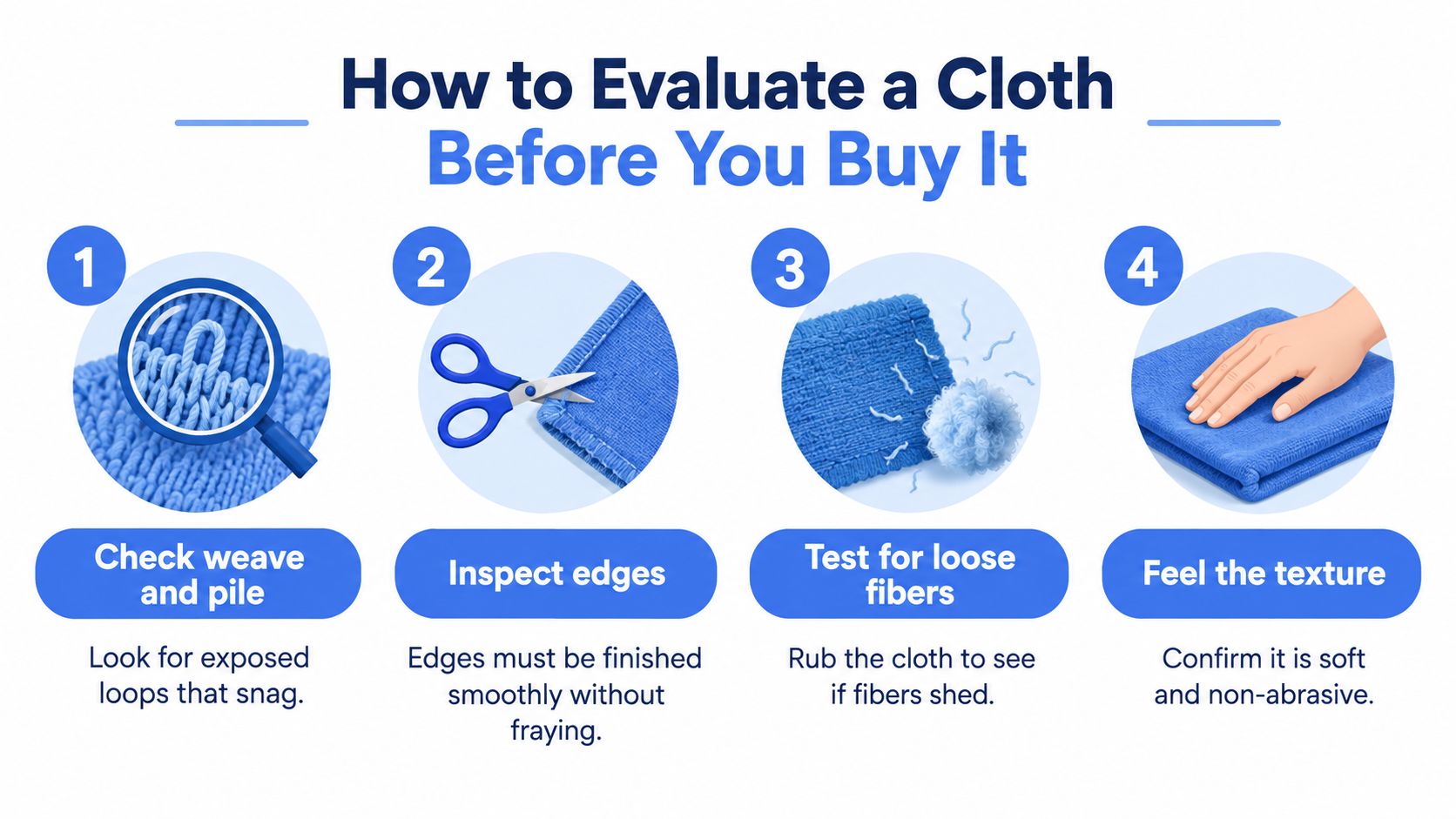
Hold the cloth under bright light and look across its surface. Exposed loops, uneven pile, and loose threads can snag on hardware or shed during finishing. Run your thumb along the edge. It should glide smoothly without a stiff ridge, frayed corner, or scratchy seam that could catch on seals.
Research summarized in an ACS study of textile fiber release indicates tightly woven fabrics made from continuous, highly twisted filaments release substantially fewer fibers than looser knits, short-staple yarns, and less-twisted structures. A 2025 pilot study cited in that research context measured airborne microfiber deposition inside homes at an average of 1,960 fibers per square meter per day. Those results measure release and deposition. They don't prove a specific disease hazard, but they support choosing construction carefully where lint control matters.
Dampen a corner and wipe an inconspicuous area. Watch whether the cloth lifts moisture evenly or pushes it into beads and trails. Then fold to a dry side and make one light pass. If the surface clears, the cloth can finish. If haze follows the stroke, it belongs in wet-work rotation or needs laundering.
Homeowners can compare two cloths on the same small pane. Professionals should test new stock against a known cloth, then recheck after several washes because age and contamination can change the result. A five-minute test protects a full day of rework.
Cloth Inspection Checklist
| Check | What to look for | Why it matters |
|---|---|---|
| Weave and pile | Tight, even, few loose loops | Supports pickup with less shedding |
| Edges | Smooth, intact, not scratchy | Protects seals and prevents snagging |
| Dry wipe | Clears haze in bright light | Confirms finishing ability |
| Damp wipe | Lifts moisture without trailing | Shows whether it smears residue |
| Post-wash feel | Still soft and consistent | Reveals early deterioration |
A dusty exterior pane and a freshly washed interior pane ask for different handling. Start by deciding whether you're removing loose soil, washing, drying, or making the final inspection pass. That sequence matters more than owning a large pile of identical towels.
On a home in Phoenix or Scottsdale, fine dust can collect on exterior glass, ledges, and screens. Remove loose debris before wetting the pane, and don't let the frame cloth become your finishing cloth. Abrasive particles trapped in the fibers can be redeposited during the last pass, exactly where sunlight makes defects obvious.
For a small interior window, wash with a lightly damp cloth, then switch to a clean, dry microfiber or a tested lint-free cloth. Work in manageable sections. If the dry side starts leaving arcs, refold it. A fresh face restores contact without adding cleaner.
Assign cotton or an older utility microfiber to frames and screens. Those surfaces hold grit, cobwebs, and oxidized residue that shouldn't travel to finished glass. Wash or replace that cloth before it becomes a source of contamination.
Mineral spots need patience and appropriate washing before polishing. A finishing cloth can remove the remaining film after the deposit is loosened, but dry rubbing alone usually spreads the mark. Water quality matters here. A water-fed system manual identifies 0 to 10 ppm total dissolved solids as an acceptable operating range for pure-water cleaning, while some guidance recommends 0 to 5 ppm for dependable spot-free drying.
In Denver offices or Las Vegas commercial properties, large panes magnify inconsistent finishing. Professionals separate cloths by assignment so a towel used on an entrance frame doesn't detail a conference room window. Medical offices and dealerships also benefit from that separation because visible lint and cross-contamination are easier to control when each cloth has a defined role.
High-rise work makes rework expensive in time and access. A cloth that sheds or smears isn't a minor inconvenience. It's a reason to revisit glass that should have passed inspection. Keep finishing cloths protected from site dust until the moment they're needed.
Cloth Choice by Cleaning Job
| Job | Recommended cloth role | Reason |
|---|---|---|
| Dusty exterior glass | Utility cloth first, clean microfiber last | Keeps grit out of final pass |
| Routine interior pane | Damp wash cloth, then dry finisher | Separates soil removal from polishing |
| Frames and screens | Cotton or utility microfiber | Handles heavy debris away from glass |
| Freshly washed window | Tested lint-free or dry microfiber | Details edges without adding fibers |
| Large commercial pane | Dedicated finishing rotation | Prevents saturation and uneven haze |
Good glass often starts in the laundry area. A cloth can look clean yet carry softener residue, lint from other fabrics, or grit trapped deep in its pile. Care protects absorbency, controls shedding, and keeps your finishing rotation trustworthy.
Sort cloths before washing by assignment. Keep frame and screen cloths, wet-work cloths, and finishing cloths apart. Wash microfiber separately from lint-producing fabrics, use an appropriate detergent, and avoid fabric softener that can coat fibers and change how the cloth picks up water.
Practical rule: If a cloth no longer clears a test pane after proper washing, don't rescue it with more pressure. Reassign or retire it.
There's no sound basis for assuming hotter always cleans microfiber better. Heat and harsh laundering can damage synthetic fibers, while fabric softener can alter release behavior. Compare air-drying and heat drying with your own cloths, then judge streaking, texture, and lint on glass.
A 2025 household laundering study reported an average release of 5,849,943 microfibers per liter across three wash trials in 30 households and found laundering conditions affected shedding. That supports testing a routine instead of treating one temperature or drying method as universally best. Lower shedding alone doesn't prove better glass cleaning either. Evaluate finish quality, durability, cleanliness, and fiber loss together.
Keep the health distinction clear. Fiber-release research documents emissions and deposition. It doesn't, by itself, establish a proven disease hazard from using a window cloth. Visible lint is a quality and housekeeping concern you can assess directly, so inspect cloths and adjust your routine based on observable performance.
Care Routine by Task
| Cloth assignment | Care action | Result to check |
|---|---|---|
| Finishing microfiber | Wash separately, no softener | Clears glass dry without haze |
| Lint-free detail cloth | Inspect edges after every wash | No fraying or visible shed |
| Cotton utility cloth | Wash apart from finishers | No lint transfer to clean cloths |
| Chamois | Clean and store by material needs | Smooth contact, no trapped grit |
| Worn cloth | Reassign or retire | No repeated streaking or roughness |
Start with the finish you need, then work backward. Is the cloth going onto wet or dry glass? Will it touch a frame first? Is the pane small enough for hand finishing or part of a large commercial sequence? Those questions turn cloth selection from guesswork into a repeatable system.
For most streak-sensitive glass, begin with a tightly constructed microfiber reserved for clean finishing. Use cotton or utility microfiber earlier in the sequence for frames, screens, and heavy soil. Select a chamois when your main job is smooth drying after washing. Keep a lint-free-labeled cloth for detailing only after it passes a bright-light test.
Homeowners who clean a few panes can manage with a wash cloth and one protected finishing cloth. Professionals need a deeper rotation because saturation and contamination arrive quickly across storefronts, offices, dealerships, medical spaces, and high-rise interiors. Reviewing essential window cleaning supplies can help you place each cloth beside the squeegee, brush, bucket, and pure-water equipment it supports.
Reuse also requires context. A market summary drawing on Ocean Conservancy estimates reports 5.6 million metric tons of synthetic microfibers were emitted from washing clothes between 1950 and 2016 and that one laundry load can release as many as 18 million microfibers, although those figures cover clothing and household textiles rather than window cloths alone. Durable cloths, sensible laundering, inspection, and timely retirement make reuse more responsible than just keeping a failing cloth in service.
Clean windows support curb appeal at home and a credible presentation at work. A reliable cloth for window cleaning system protects that result by matching material, task sequence, method, and care. Professional Window Cleaning has been in business since 1999 and serves customers across Arizona, Colorado, and Nevada, where dust, sun, and large glass areas make that system especially valuable.
Final Decision Path for Window-Cleaning Cloths
| If the task is... | Start with... | Then verify... |
|---|---|---|
| Final polishing | Clean, dry microfiber | It clears haze in bright light |
| Heavy frame soil | Cotton or utility cloth | No grit transfers to glass |
| Smooth drying | Clean chamois | Contact stays even and grit-free |
| Edge detailing | Tested lint-free cloth | No fibers appear along seals |
| Mixed heavy and fine work | Separate cloth roles | Finishers stay protected until use |
If your windows keep showing haze, lint, or missed edges despite careful cloth selection, Professional Window Cleaning can clean residential, commercial, and high-rise glass using the right method and detailing sequence for the property. Visit Professional Window Cleaning to request service and get windows that look clear in direct sunlight, not just from across the room.
Read our blog posts regularly and keep learning.