Care and Maintenance
Deck Wash Before Staining a Practical Guide That Works
Learn how to do a proper deck wash before staining, from cleaner choice to pressure setting and drying checks, so your stain holds longer and looks even.


You've scrubbed the window, wetted the pane, and made a steady pull. There's still a thin line of water running through the cleaned glass. Before you add more soap or change your technique, check the rubber. A worn edge, poor channel fit, or compound that's wrong for the glass temperature can turn an otherwise sound cleaning routine into repeated detailing.
Window squeegee rubbers are precision components, not interchangeable strips. Choosing them well means matching flexibility, fit, and condition to the pane in front of you, whether you're working on desert-heated storefront glass or a cold residential window.
A repeating wipe line is a useful clue. If it follows the same part of the blade through each pull, stop treating the entire cleaning process as the problem. Look at the contact edge before changing your detergent.
The rubber removes cleaning solution by maintaining continuous contact with the glass. A nick, distortion, or unevenly supported section interrupts that contact, leaving liquid behind. Consistent blade angle and full contact matter more than pushing harder, while overlapping passes prevent narrow missed lines between strokes, as explained in this professional guidance on cleaning building windows.
Pressing harder can disguise a contact problem during part of a stroke without fixing it. You might clear the center of the pane and still leave trails where the blade changes direction or crosses an imperfect surface. That's why a clean-looking strip deserves inspection when the result keeps repeating.
Practical rule: Diagnose a repeating line at the blade before changing the entire cleaning setup.
Think of the handle, channel, and rubber as a working assembly. The handle lets you control the angle, the channel supports the insert, and the rubber makes contact with the pane. Buying an expensive replacement won't help if it sits twisted or behaves poorly at the working temperature.
Professional window cleaning uses two primary methods: a squeegee or a pure-water system. Scrubbers, brushes, scrapers, and access equipment support those methods rather than creating separate ones. Kärcher's commercial window-cleaning explanation distinguishes purified-water cleaning from traditional equipment used when contamination requires it. For squeegee work, the rubber remains the final mechanical contact point.
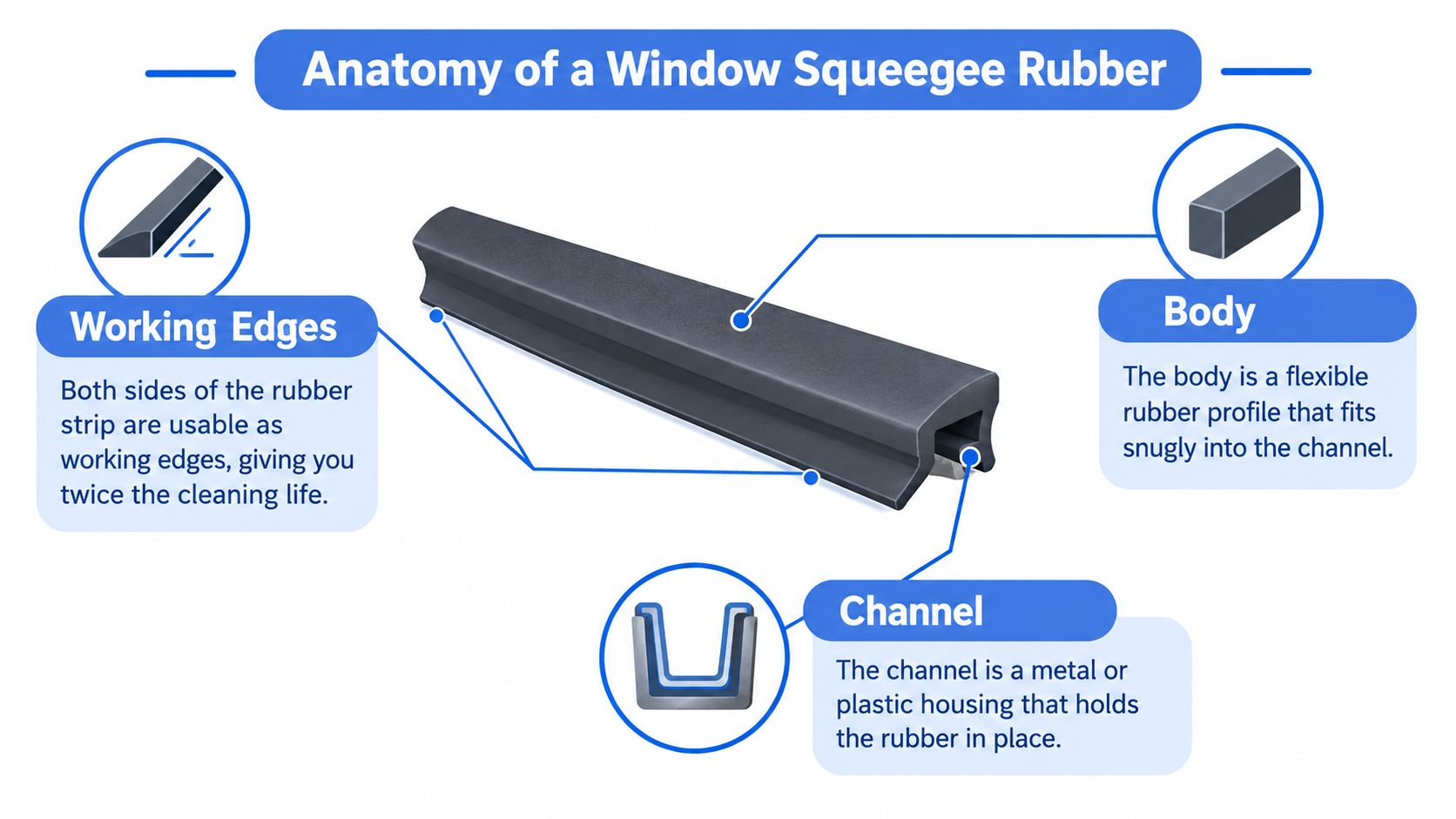
Start with the working edges, then examine the body that seats inside the channel. The exposed edge clears liquid; the seated portion needs consistent support. Inspect both edges, but don't assume turning an insert over will rescue rubber that has hardened, cracked, or distorted throughout its body.
The modern arrangement dates to 1936, when Italian immigrant and window washer Ettore Steccone developed his single-blade squeegee in Oakland, California. His lightweight brass channel held one flexible rubber blade with two clips, replacing the heavy Chicago design with two pink rubber blades and 12 replacement screws, according to this account of Steccone's squeegee invention.
The relationship between the edge, body, and supporting channel is shown below.
Steccone called the design the New Deal and initially manufactured it in his garage before moving production into a commercial factory during the 1950s. The same historical account describes a patent objective of efficient liquid and dirt removal across varied angles and pressures. Rubber flexibility wasn't a minor accessory feature; it was central to the improvement.
For replacement work, distinguish these parts:
A loose fit and an excessively tight fit are both reasons to stop installation. Don't stretch, force, or improvise retention just because the replacement has the hardness you wanted.
Natural rubber, synthetic compounds, and silicone give buyers different starting points, but material names don't settle the purchase. You still need suitable hardness, a compatible profile, and acceptable performance on wetted glass. Treat the material category as a screening question rather than a guarantee.
Natural rubber can provide strong wet-glass contact, making it a sensible candidate when conformity matters. Its trade-off is exposure: harsh chemical environments can shorten its useful life. Synthetic and silicone alternatives generally emphasize durability, while blade life also depends on water quality, cleaning chemicals, usage, storage, and composition, as described in the squeegee replacement rubber market overview.
| Material | Reason to consider it | What still needs checking |
|---|---|---|
| Natural rubber | Strong wet-glass contact and conformity | Chemical exposure and edge condition |
| Synthetic compound | Durability-oriented replacement | Actual formulation, hardness, and channel compatibility |
| Silicone | An alternative when durability is a priority | Fit and wiping behavior on the intended glass |
Don't turn those categories into an unsupported ranking. A synthetic insert isn't automatically the right desert blade, and silicone isn't automatically the right answer to sunlight. Composition and durometer answer different questions. One concerns the formulation; the other describes hardness.
For a crew changing detergents or cleaning heavily contaminated glass, review the replacement manufacturer's compatibility guidance before purchasing a large quantity. Then test the candidate under the same conditions the crew will encounter, rather than evaluating it only on a clean indoor pane.
The useful buying question is straightforward: does this material maintain a clean working edge under our chemicals, storage conditions, and glass temperatures? If the answer requires extra pressure or repeated corrective passes, its advertised durability isn't enough. A long-lasting strip that doesn't clear the pane cleanly is the wrong consumable for that job.
A blade that wipes cleanly on a cool morning can start chattering once the pane heats in direct sun. Rubber selection is a climate-aware adjustment, not a commodity choice: durometer, channel fit, glass temperature, and edge condition all affect the result.
Durometer measures hardness on the Shore A scale. Common window-cleaning formulations range roughly from the low-50s to about 60 Shore A. One documented soft replacement specification is 53 ± 2 Shore A, listed in this replacement-blade selection guidance. Softer rubber conforms more readily to uneven glass; firmer rubber is less likely to fold and can hold a flatter wiping line on smooth panes. Neither works well if it sits poorly in the channel.
On sun-heated, flat glass in Phoenix, Scottsdale, and Las Vegas, start with medium-to-firm rubber and test the edge on the actual pane. Crews in Tempe, Chandler, and Gilbert should distinguish shaded glass from glass exposed to strong sun. Cold work in Denver or Flagstaff may call for softer rubber to preserve conformity as the compound stiffens.
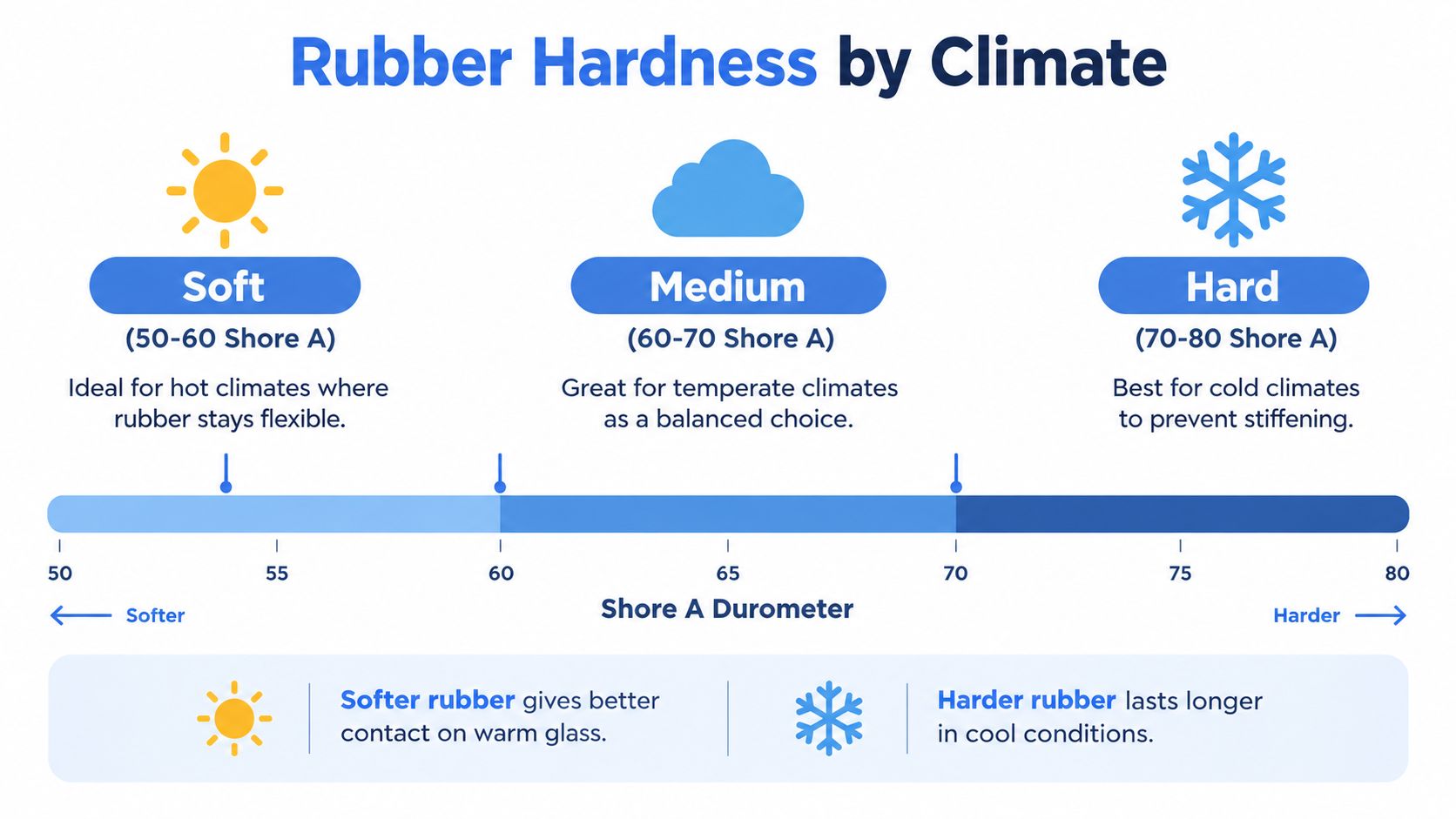
Soft rubber can become excessively pliable above 90°F, and direct sunlight accelerates deterioration, according to BestReviews' window-squeegee guidance. The glass itself may be hotter than the air. Check the working surface rather than relying on the forecast alone.
On smooth, sun-exposed glass, try a firmer edge. On cold or imperfect glass, test softer rubber if the blade fails to conform. For routes with changing exposure, carry labeled soft, medium, and firm options instead of forcing one choice across every pane.
Record the compound, hardness, weather, and glass condition during tests. Excessively firm rubber can skip imperfections; overly soft rubber may fold or chatter. The right choice clears the actual pane without repeated corrective passes.
Buy replacements by channel compatibility, not by the length printed most prominently on the package. Length matters, but the insert also has to match the seating profile and retention arrangement. A rubber that looks close on the workbench can still sit incorrectly in the tool.
One commonly listed professional format is approximately 2 inches wide by 3/8 inch thick, but those dimensions must be verified against the particular channel, as emphasized in this squeegee rubber replacement guide. Treat that listing as a product-specific reference, not a universal channel standard. Don't confuse a supplier's width description with the channel's internal seating width.
Common Squeegee Rubber Size Reference
| Channel Width | Rubber Width | Rubber Thickness | Typical Use |
|---|---|---|---|
| Narrow seating profile | Manufacturer-matched profile | Specified for that channel | Replacement for an identified narrow-profile tool |
| Wider seating profile | Approved matching insert | Verify before ordering | Replacement for an identified wider-profile tool |
| Unidentified channel | Don't assume compatibility | Measure and confirm | Equipment identification before purchase |
A trustworthy table can't assign universal dimensions to unidentified channels. Manufacturers' specifications take priority over a generic size chart.
Keep an approved spare with its packaging or product identifier. That gives the crew a reliable ordering reference and prevents someone from buying a visually similar strip that won't seat correctly.
Choose rubber for the glass and exposure, then account for the type of property. A residential label doesn't guarantee soft rubber is right, and a commercial label doesn't make firm rubber mandatory. A cold storefront and a hot residential picture window can reverse the usual starting choices.
For residential work, pay attention to uneven or wavy panes and changes between indoor and outdoor conditions. Conformity may matter more than the firmness that feels comfortable on a large, smooth test window. Carrying an alternative formulation is more useful than insisting that every pane should respond to the same setup.
| Work setting | Selection priority | Operational priority |
|---|---|---|
| Residential | Adaptability to varied glass | Check performance when moving between pane types |
| Commercial | Stable contact across large, smooth surfaces | Inspect during repetitive production work |
| High-rise | Suitable compound for exposed glass | Protect spares and verify the setup before production |
Commercial crews need a repeatable setup, not just a harder blade. Make the approved channel-and-rubber combination easy to identify, and use the same test-pull standard when a technician changes inserts. This squeegee-and-bucket resource provides a useful companion reference for the traditional equipment setup.
For owners comparing service arrangements, Clean Space SA's professional window cleaning company page is another resource to review when preparing questions about window-washing scope. Ask prospective providers how they match equipment to the property rather than assuming a particular blade material proves service quality.
High-rise work warrants particular attention to environmental exposure and spare-blade storage. Across Arizona, Nevada, and Colorado, crews should organize inventory around actual job conditions. Rotate by condition and suitability, not because a different building category appears on the schedule.
A replacement isn't ready for production just because it slides into the channel. Installation should leave the insert evenly supported, securely retained, and free of twist or unintended protrusion. The inspection standard applies to fresh stock as well as rubber already in service.
The blade-changing image illustrates the component being handled.
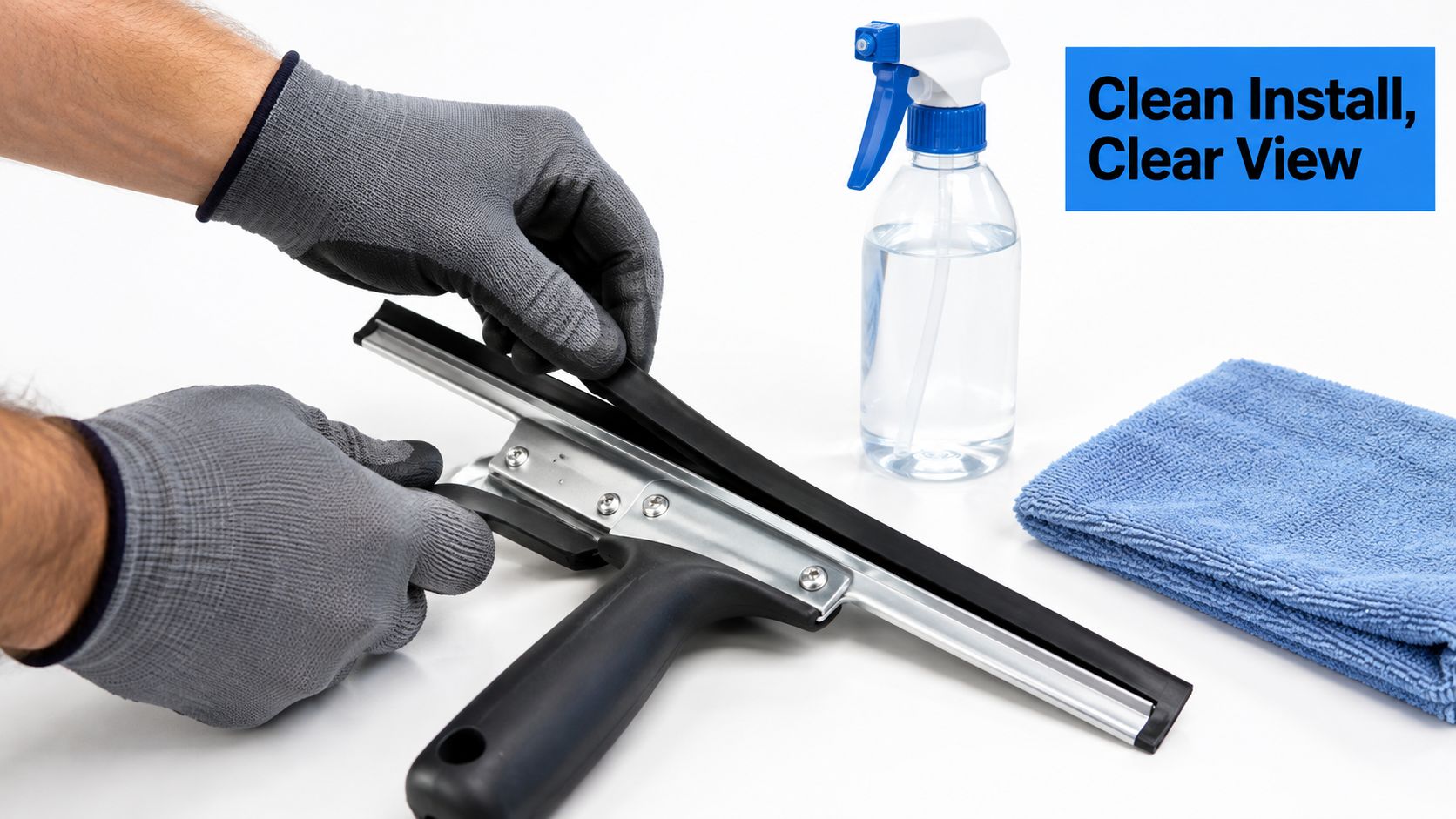
The replacement guidance cited earlier connects edge defects with localized contact loss and repeating streaks. A clean channel matters because the new insert needs consistent support; don't install it over trapped debris and then blame the compound.
For an additional blade-changing visual, the demonstration below can accompany the channel manufacturer's instructions.
Store spares flat, dark, and dry, away from direct sunlight, ozone, heat, and solvents. Don't leave loose inserts where tools can deform them or where vehicle storage exposes them to prolonged heat and sunlight.
A spare blade needs the same protection as a blade already in service. Unused doesn't necessarily mean undamaged.
Once fit and installation are correct, use the climate-selection rule to assess performance. Perfect seating can't make an unsuitable hardness behave properly on the pane.
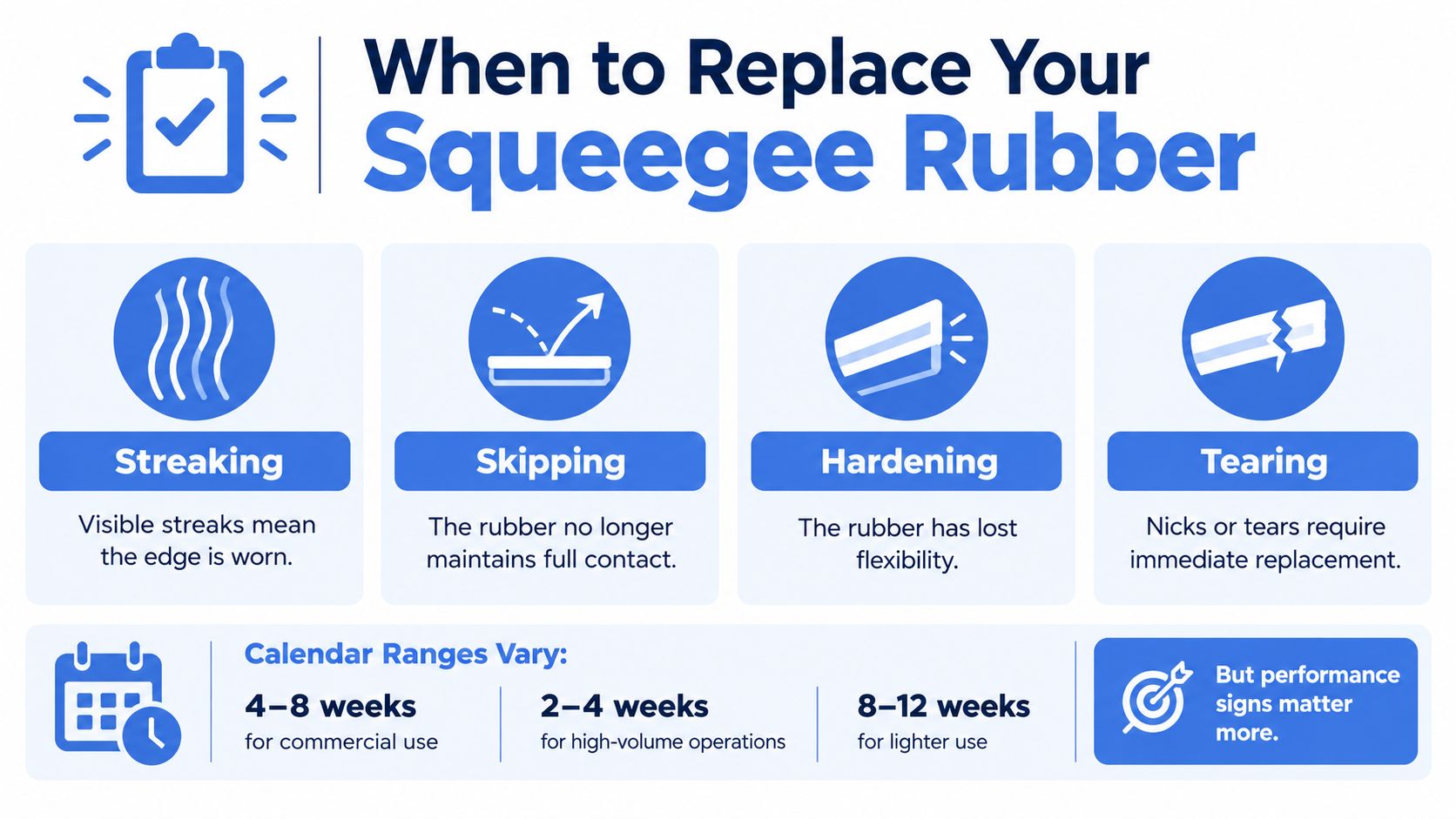
A rubber's condition is best judged on the glass, not by its age. Market-oriented estimates cited under materials range from roughly 4–8 weeks for commercial use, 2–4 weeks for high-volume operations, and 8–12 weeks for lighter use. Treat those as inventory reminders. Heat, chemicals, contamination, and storage can shorten or extend how long an edge performs reliably.
Before replacing a blade, check what the glass is telling you. Clean the rubber, inspect its edge under light, then make several controlled pulls on fully wetted glass. A damaged or permanently misshapen edge is ready to retire. If an intact blade chatters or leaves fine lines, check the setup before blaming wear. Poor seating, contaminated glass, and a hardness that does not suit the working conditions can produce similar symptoms.
Keep a short record when a problem recurs: hours in use, chemicals, water quality, glass contamination, storage exposure, and the exact symptom. A repeated line, drag, or chatter is more useful than “the blade felt bad.” The record can show whether hot, exposed work in Arizona or Nevada is shortening effective life, or whether cold Colorado conditions are affecting how the rubber tracks on glass. Replace based on the result under those actual conditions, not a fixed calendar interval.
There is a practical cost trade-off, too. Compare the rubber's price with labor spent correcting poor pulls, wasted solution, and callbacks. A cheaper strip can cost more overall if it causes repeated rework, but no material guarantees savings. In hot, exposed work, inspect more often and retire an edge once it loses stability. Visible cracking is not a prerequisite for replacement.
On a suitable exterior window, a water-fed brush loosens dirt and a purified rinse carries it off, leaving the glass to dry without a squeegee pass. That changes the job's final step: instead of wiping away solution, the cleaner relies on water with low mineral content to dry with little residue. The pure-water window-cleaning explanation describes a target of 10 parts per million or less TDS at the pole, with 0–5 ppm identified as optimal for preventing spots. TDS measures dissolved solids, including minerals, salts, and metals. Reverse osmosis and deionization remove dissolved ions.
The method depends on the rinse, not just the equipment. A hose and brush supplied with ordinary tap water can leave dissolved material behind as the water evaporates. Property managers should ask what water quality reaches the pole. A purification unit on the vehicle does not, by itself, confirm the final rinse is suitable.
The window-cleaning-with-pure-water resource can help frame a conversation with a provider. Choose the method based on access, the type of contamination, and whether the glass can be cleaned effectively by rinsing and air-drying.
Pure water suits exterior glass when the brush can loosen the soil and the rinse can carry it away. Stubborn contamination may need separate treatment before rinsing; purified water does not remove the need to address stuck-on dirt. Interior glass, or work that requires controlled removal of cleaning solution, still calls for a squeegee.
Telescoping poles can reduce the need for ladders or scaffolding, an access advantage also described in the commercial-cleaning guidance cited earlier. That benefit does not make the method right for every window. The deciding question is whether the job needs mechanical liquid removal or can finish with a purified rinse. In the latter case, rubber selection no longer determines the result.
A useful van checklist should help a technician make a decision without reopening a catalog. Keep the approved replacement specification beside the inventory, and distinguish rubber suitability from rubber condition. An intact blade can be wrong for the job; a correctly specified blade can be damaged.
Keep soft, medium, and firm stock separately labeled. Include product identifiers so another technician can reorder the same approved insert without guessing. When rotating stock, inspect the outgoing blade before returning it to usable inventory.
If a fresh rubber leaves streaks, don't immediately open another package. Check seating and retention, then examine your angle and pressure. Use a controlled pull to separate an installation problem from inconsistent handling.
Chatter deserves a closer look at the climate match. A blade that's too soft for heated glass can fold, while a blade that's too firm for cold or imperfect glass can lose conformity. The symptom alone doesn't identify the cause; compare it with the conditions you're working in.
Don't put a questionable blade back into the usable bin without identifying why it failed.
Protect spare stock rather than storing it loose in an exposed truck bed. Remove damaged rubber from circulation so the next technician doesn't inherit the same fault.
The most dependable purchasing habit is to order a known profile in a suitable formulation, then verify its performance on the job. Brand familiarity, low price, and durability claims can inform the shortlist, but none replaces fit, inspection, and a clean pull.
Professional Window Cleaning offers residential, commercial, and high-rise window washing and has been cleaning windows for over 26 years, having started in 1999, according to its company history. If your windows keep showing wipe lines or you're unsure whether squeegee cleaning or pure water suits your property, visit Professional Window Cleaning to discuss your glass, access needs, and local working conditions.
Read our blog posts regularly and keep learning.