Care and Maintenance
Medical Office Windows: Complete Care and Cleaning Guide
Learn how to keep medical office windows clean, safe, and code-compliant. Covers protocols, schedules, costs, and what to expect from professionals.


A property manager usually notices the problem at the worst possible time. A tenant is preparing for a client visit, sunlight is exposing every mineral mark on the lobby glass, and someone asks whether the exterior windows were cleaned or merely wiped from inside. The answer depends on access, glass condition, equipment, scheduling, and the building's safety file, not just on whether a crew arrives with buckets.
Window cleaning for business is a maintenance and risk-management decision. Storefronts, offices, medical facilities, dealerships, stadiums, condominiums, and high-rise towers all require different planning. A janitorial team may handle interior touchpoints and accessible glass, but exterior façades, suspended platforms, roof anchors, hard-water deposits, and post-construction debris require specialized work.
A clean lobby window is one thing. A commercial façade is another. The work changes fast once a building has tenants, public traffic, roof access, or glass that cannot be reached from the ground.
A retail manager may care about doors, frames, and display glass that stay clear during business hours. A medical office needs scheduling that avoids patients and limits disruption. A stadium or condominium often needs façade coordination, exclusion zones, and equipment that keeps people below protected while the work is underway.
High-rise work adds another layer of responsibility. Crews may need building-mounted platforms, suspended scaffolds, or other engineered access systems, and the property owner has to know whether roof anchors are available, inspected, and suitable for the job. That makes window cleaning part of the building's operating infrastructure, not a one-off cosmetic service.

A proper scope should identify glass surfaces, including interior and exterior panes, doors, sidelights, atriums, and difficult-to-reach areas. It should also cover adjacent components such as frames, sills, tracks, ledges, and the spots where soil collects.
Access and occupancy controls matter just as much. Crews may need ground-based poles, ladders where appropriate, suspended equipment, or powered platforms, along with tenant notices, work-hour restrictions, pedestrian routes, barricades, and emergency access.
Documentation is part of the job too. Insurance, training, equipment inspection records, safety procedures, and completion notes should all be in order before work starts.
Commercial window cleaning grew with large urban buildings, because broad façades created a need for organized maintenance. By 1931, New York had approximately 2,000 to 3,000 window cleaners, while the newly completed Empire State Building contained about 6,500 windows, according to this history of high-rise window cleaning.
Building operations also include commercial property access control. If a crew needs roof entry, loading-area access, tenant coordination, or a controlled pedestrian route, that belongs in the planning, not after the crew arrives. Professional Window Cleaning was founded in 1999 and has operated for more than 26 years as of 2026, serving commercial, residential, and high-rise clients across Arizona, Colorado, and Nevada, as identified in its company profile.
Professional window cleaners rely on two primary methods: the squeegee method and the pure-water method. The right choice depends on access, glass condition, frame design, and how much direct control the crew needs over the pane.
The squeegee method begins with a cleaning solution on the glass. The technician agitates the surface, then pulls the liquid off with a rubber blade. Pressure, blade angle, and overlapping passes have to stay consistent, because a poor stroke leaves lines, missed edges, or water trails. This method fits interior glass, lobby panels, doors, low-level windows, and panes with grease or heavier buildup.
The pure-water method uses a telescoping water-fed pole. Reverse osmosis and deionization remove minerals from ordinary water before it reaches the brush. Guidance commonly calls for total dissolved solids below 10 parts per million, with below 5 ppm preferred, because mineral-bearing water can leave deposits as it dries, as explained in this technical guide to pure-water systems.
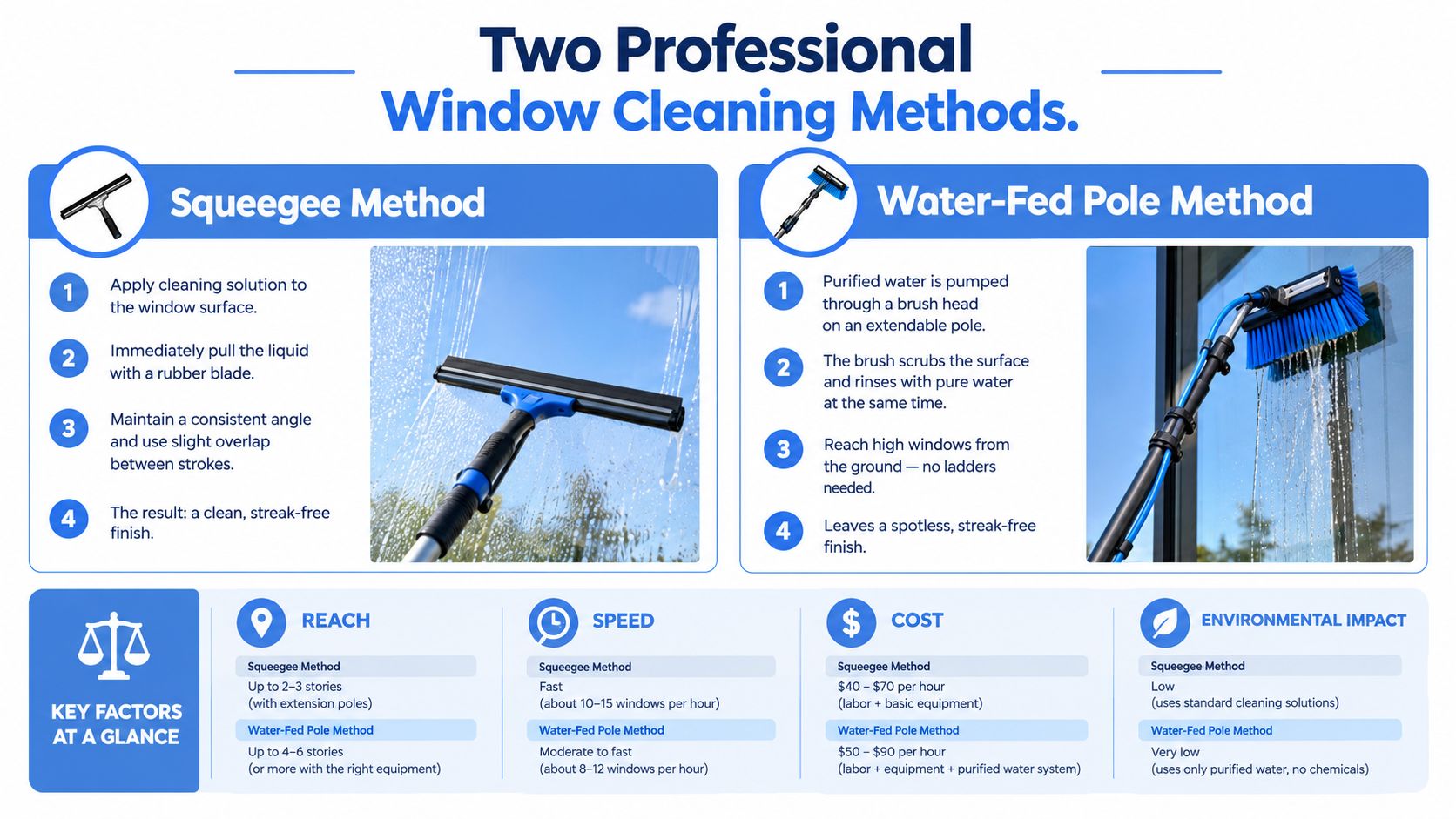
Pure water works well when a crew needs to reach upper-storey exterior glass from the ground. The brush agitates the glass, frames, and sills, then the operator rinses thoroughly and lets the mineral-free water dry without residue. It reduces ladder use, but it does not fit every pane.
Neglected glass with grease, paint flecks, construction residue, or heavy mineral buildup may need restoration or extra treatment. Squeegee work gives more direct control in those cases. A practical explanation of the water-fed process is available in this guide to water-fed pole window cleaning.
A vendor that offers only one method may be describing a limitation. Good crews match the technique to the building. They may use pure water for accessible exterior elevations, then squeegees for interiors, doors, lobby glass, or areas that need close inspection.
A quote becomes easier to compare once the property is classified by access rather than by window count alone. A storefront, a medical office, and a tower may have similar glass area but completely different labor, equipment, coordination, and risk requirements.
| Property situation | Typical access concern | Scope questions |
|---|---|---|
| Storefront or ground-floor glass | Customer traffic, fingerprints, doors, and displays | Are frames, sills, and entry doors included? |
| Mid-rise office | Upper elevations, landscaping, tenant schedules | Can exterior panes be reached from the ground, or is specialized access required? |
| High-rise tower or condominium | Roof anchors, suspended platforms, fall protection, and exclusion zones | Who verifies anchors, equipment, rescue planning, and pedestrian controls? |
| Medical facility | Patients, infection-control expectations, and restricted areas | What work hours and access procedures protect operations? |
| Dealership or stadium | Large glass areas, public circulation, and visual presentation | How will vehicles, guests, seating, or event schedules be protected? |
| Post-construction property | Paint, adhesive, dust, and mineral residue | Is restoration priced separately from routine cleaning? |
The U.S. Bureau of Labor Statistics classifies specialized roles under “Building Cleaning Workers, All Other.” In its May 2023 estimates, that category employed 13,740 people, with a mean hourly wage of $21.03 and a mean annual wage of $43,740. The same category ranged from $14.14 per hour at the 10th percentile to $29.25 at the 90th percentile, showing why specialized responsibility and experience affect labor planning. See the BLS occupational estimates.
A commercial proposal should separate routine maintenance from difficult-access work. Ask whether the price includes setup, access equipment, supervision, traffic control, water treatment, interior protection, and documentation. If those items appear only after the work begins, the initial quote wasn't comparable to a fully planned scope.
A fixed calendar can be convenient, but it often produces the wrong maintenance plan. A better schedule starts with the conditions affecting the glass: glazing type, orientation, direct sun, airborne dust, landscaping, nearby construction, hard-water exposure, and the importance of the building's appearance.
Phoenix, Scottsdale, and Las Vegas properties may face intense sun, dust, and mineral deposits. Denver and Flagstaff can bring different combinations of dust, temperature changes, and seasonal exposure. The right response isn't to assign every property the same recurring interval. It is to inspect how quickly the glass accumulates soil and whether deposits are becoming difficult to remove.
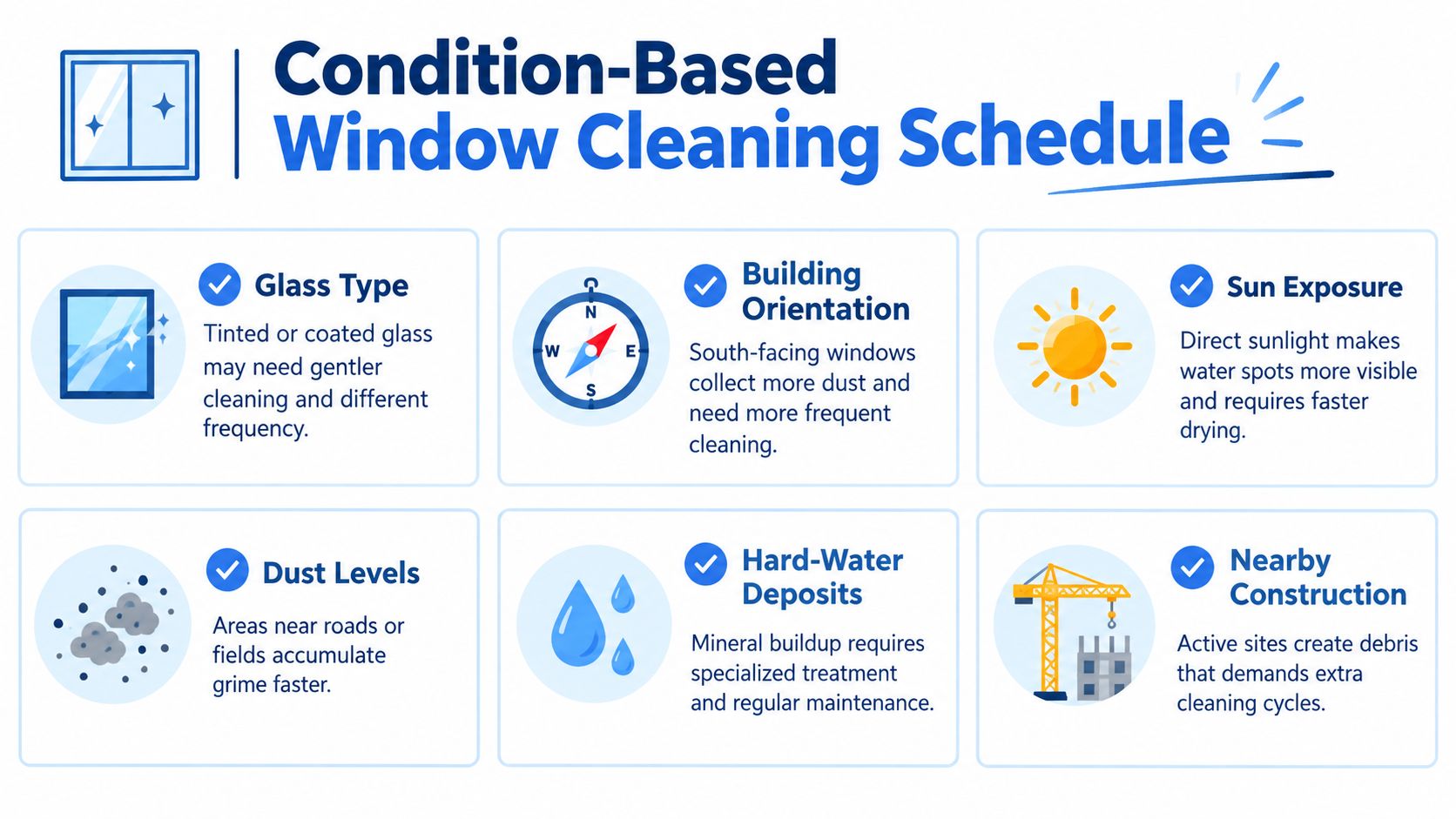
Glass specification matters because cleaning supports the building's appearance and preserves visibility into the condition of the façade. Research on commercial buildings found that standard float glass contributed 5.04% to 8.9% of total cooling load, depending on orientation, while tinted double-glazed glass reduced that contribution to roughly 2% to 3.01%. The same research reports that operational energy use in a fully glazed building can be reduced by up to 53% through lower-transmittance glass and high-performance glazing, as discussed in this commercial glazing research.
Cleaning won't correct poor glazing design or a failing seal. It can, however, help property teams distinguish dirt from coating damage, seal failure, mineral buildup, or frame deterioration. Cleaning products and tools should be compatible with the glass and coatings, especially when low-emissivity or solar-control surfaces are present.
Practical rule: Set the cadence after inspecting the building's exposure and glass condition. Don't let a generic monthly package decide what the façade needs.
A useful plan records where deposits appear first, which elevations receive direct sun, whether irrigation reaches the glass, and whether construction or landscaping changes the exposure. That record lets a manager increase attention where necessary without paying for identical treatment across every elevation.
A window-cleaning contractor controls the work, but the building owner controls much of the environment in which the work occurs. Roof access, anchors, tie-in guides, platform components, pedestrian routes, tenant notifications, and emergency coordination all sit close to the owner's operating responsibilities.
OSHA treats suspended scaffolds and powered platforms as engineered fall-protection systems, not ordinary access equipment. Its guidance requires structural supports, tie-in guides, anchoring devices, and affected building components to be designed or directed by a registered professional engineer experienced with the installation. Workers must use compliant personal fall-arrest systems, receive competent-person training, and follow a written emergency plan covering power failure, equipment failure, and other emergencies. The OSHA powered-platform and fall-protection guidance provides the governing reference.
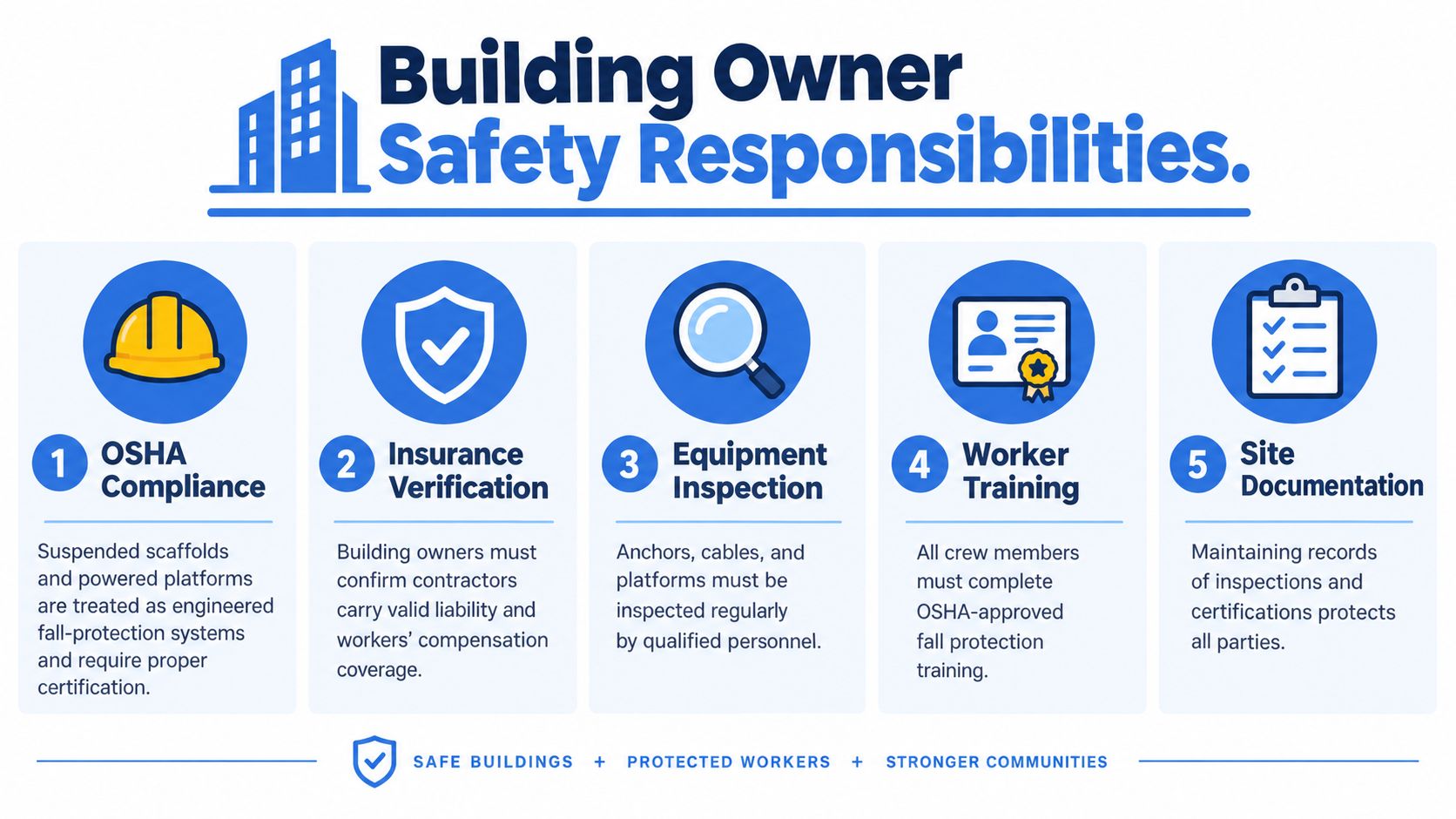
A property manager should request and review:
The building geometry matters as much as the pane count. Ontario requirements, used as an instructive benchmark for property operations, call for primary suspension lines and lifelines to run vertically to the worker's exit level and be protected from abrasion. They also require fall-arrest protection and specify that an arrest system limit peak force to 8 kN while allowing a suspended worker to remain safely supported for at least 30 minutes, as described in the Ontario window-cleaning requirements.
For owners reviewing broader exposure, a practical landlord guide to liability insurance can help frame the relationship between vendor work, premises responsibilities, and documentation. Insurance doesn't replace engineering, training, or rescue planning, but it belongs in the same pre-job review.
Start with documents, not promises. A contractor should be able to explain the proposed method, identify the access system, name the person responsible for site safety, and show how the crew will protect occupants and the public.
California requires owners to provide written assurance that window-cleaning safety devices and equipment comply with regulations, and requires safety equipment and related building support structures to be inspected at least every 12 months. New York also requires public-building owners, managers, and contractors to provide safe means for window cleaning and prohibits cleaning unless those means protect workers and the public, according to the California regulatory reference.
Two proposals can show the same apparent service while pricing very different levels of preparation. One may include roof-anchor review, supervision, barricading, tenant coordination, and visit documentation. Another may price only the time spent moving water and tools across the glass.
A building manager comparing vendors can also consult this security and sustainability guide for facilities management when integrating cleaning with wider site operations. For a broader overview of what to expect from a commercial window washing company, look for a scope that states the method, access plan, inclusions, exclusions, and escalation process.
The lowest quote may not be the lowest total cost. If it excludes a pre-job safety review, documentation, barricading, or coordination with building operations, the property absorbs that work later, often under greater time pressure.
A workable program begins with the building file. Confirm the anchor inventory, locate the latest inspection information, and identify any elevations that cannot be reached with the intended equipment. If anchors are missing, inaccessible, corroded, or undocumented, pause the cleaning scope until the access problem is resolved.
Next, classify each property by service tier. Separate storefront and lobby glass from mid-rise exterior work, high-rise access, medical operations, dealership displays, stadium circulation, and post-construction restoration. Then match the method to the conditions. Pure water may suit exterior glass reached from the ground, while squeegee work may provide better control on interiors, doors, and contaminated panes.
Set the schedule by observation. Record how quickly each elevation collects dust, spots, construction residue, or soil from the surrounding area. Keep glass condition, coatings, frames, seals, and visible defects in the same maintenance record so cleaning visits also support asset awareness.
Finally, evaluate vendors against the same written checklist every time. Professional Window Cleaning serves commercial and high-rise properties across Las Vegas, Phoenix, Scottsdale, Denver, Flagstaff, Tempe, Chandler, and Gilbert. A consistent process gives each building a clear next step, whether that means routine maintenance, restoration, access review, or a documented vendor comparison.
Pricing usually follows scope and access, not glass area alone. A vendor should break out labor, access equipment, interior and exterior surfaces, frames and sills, water treatment, restoration, traffic control, and recurring service. A storefront with easy ground access is a different job from a façade that needs lifts, rope work, or staged traffic control, even if the pane count looks similar.
There is no reliable universal duration. Time changes with the number and condition of panes, access points, weather, tenant activity, interior protection, equipment setup, and whether the crew uses squeegees, pure water, or both. A responsible vendor should inspect the site or review detailed building information before promising a completion window.
Ask for current liability and workers' compensation certificates, then confirm that the contractor has the training and equipment qualifications required for the planned access system. Request the written safety and emergency plan, anchor or platform records where relevant, and the name of the competent person supervising the work. Local licensing and building rules can differ, so check the property's jurisdiction instead of relying on a generic checklist.
Not always. Paint flecks, adhesive, concrete dust, and mineral buildup may need restoration methods beyond ordinary squeegee or pure-water maintenance. Have the vendor inspect a test area first, identify the residue, confirm that the treatment fits the glass and coatings, and price restoration separately from recurring cleaning.
Commercial window cleaning is tied to compliance, access control, and equipment inspection, not just appearance. Crews work around anchors, lifts, ladders, and fall-protection rules, so the job depends on documented procedures and trained supervision. Trade groups and certification bodies helped formalize that work by setting standards for access methods, safe handling, and equipment checks. That is why a business owner should treat the service as a building-infrastructure task, with clear records and qualified operators rather than casual labor.
Professional Window Cleaning provides commercial, residential, and high-rise window washing using the two professional methods, squeegee and pure water, with scopes that can include interior and exterior glass, frames, sills, and difficult-access areas. Review your building's access records, define the work clearly, and visit Professional Window Cleaning to request service for your property.
Read our blog posts regularly and keep learning.