Care and Maintenance
Window Cleaning and More: Expert Care for Homes and Offices
Window cleaning and more for homes and businesses: bundle exterior services that protect siding, glass, and gutters while keeping your property spotless all


You wipe the shower door until it looks clear, leave the bathroom, and come back the next morning to find the glass cloudy again. The usual glass cleaner didn't fail because you cleaned badly. It failed because hard-water scale isn't ordinary dirt, and a stronger scrub won't always solve the problem.
The right hard water stain remover shower routine starts with identifying the deposit, matching the product to the surface, and knowing when the haze has become permanent etching. That approach saves the glass, protects fixtures, and prevents you from turning a removable mineral film into a damaged surface.
A freshly wiped shower can look perfect at night and cloudy by morning because the water has evaporated, but its dissolved minerals stayed behind. Calcium and magnesium remain in the water while it's moving. Once droplets dry on hot glass, those minerals can form solid calcium-carbonate deposits.
That's why repeatedly wiping the door often produces disappointing results. The cloth removes the water, but it doesn't necessarily dissolve the minerals. Each shower adds another thin layer, and the film gradually becomes white, chalky, or cloudy.
The U.S. Geological Survey's explanation of water hardness classifies water by calcium-carbonate concentration. Water from 0–60 mg/L is soft, 61–120 mg/L is moderately hard, 121–180 mg/L is hard, and anything above 180 mg/L is very hard. Hard water is generally not a health concern, but it can create nuisance buildup and affect plumbing and water-heating equipment.
A new mineral film, baked-on scale, and etched glass can look nearly identical from across the bathroom. Their treatment is completely different.
Fresh scale can usually be loosened with a compatible descaler and gentle agitation. Heavy deposits may need repeated controlled passes. Etching is different. The glass surface itself has been chemically damaged, so applying a stronger acid may make the haze worse instead of restoring clarity.
This distinction matters in Phoenix, Las Vegas, Denver, and Scottsdale, where mineral-heavy water can make spotting a recurring maintenance issue. A local water-quality report or direct hardness measurement tells you more than appearance alone.

If you're planning a bathroom change rather than another cleaning battle, a resource such as NorCal Construction's conversion guide can help you think through shower surfaces and design choices before installation. Surface selection won't eliminate hard water, but it can affect how easily future deposits can be cleaned.
A shower can be damaged before the cleaner has time to loosen the deposit. An unknown acid in a closed bathroom, a rough scrub pad, or one product used on glass, chrome, grout, and stone is a recipe for scratches, discoloration, and failed finishes.
Open the bathroom window, run the exhaust fan, and put on nitrile gloves and eye protection. Place an old towel on the tub or shower floor to catch drips. Keep the label visible, and never pour cleaner into an unmarked bottle.
Glass, glazed ceramic tile, chrome, stainless steel, natural stone, grout, acrylic, fiberglass, and coated shower panels require different handling. Check the manufacturer's care instructions if they are available. If the material is uncertain, treat it as delicate until a hidden-area test shows otherwise.
Choose a small corner, lower edge, or spot behind a fixture. Apply the proposed hard water stain remover shower product according to its label, respect the stated contact time, rinse thoroughly, and inspect the area once it dries. Look for dulling, discoloration, whitening, softening, streaks, or any change in the finish.
NMSU's cleaner guidance supports a practical rule: use the mildest compatible product that can do the job. Match acid strength to the deposit, and never allow a strong product to contact a finish the label does not approve. Removable mineral scale may need controlled chemistry and gentle agitation. Etched glass will not become clear through harder scrubbing, and stronger acid can worsen the haze.
Safety rule: Never combine products during testing, application, rinsing, or disposal. A cleaner that seems mild on one surface can become dangerous when mixed with another product.
Let the test area dry completely before judging the result. Wet glass can temporarily hide dulling, streaks, or damage to a coating. If the surface changes, stop there rather than increasing dwell time or scrubbing pressure.
“Use vinegar on everything” is convenient advice, but it can damage the wrong finish. Choose a hard water stain remover shower product by surface compatibility first, then by deposit severity. A stronger acid will not repair etched glass, and it can make the haze worse.
| Surface | Safer remover type | Contact guidance | Avoid |
|---|---|---|---|
| Shower glass | Mild, label-approved acidic descaler | Follow the label | Abrasive pads, uncontrolled strong acid, dry scrubbing |
| Chrome | Mild descaler on a soft cloth | Use the shortest label-approved time | Long dwell times, rough sponges, harsh acids |
| Stainless steel | Compatible mild descaler, wiped with the grain | Follow the label and rinse promptly | Chlorine products, steel wool, circular abrasion |
| Ceramic tile | Mild acidic cleaner after a patch test | Follow the label | Letting product dry, abrasive grit |
| Grout | Product approved for its type | Short contact, then rinse | Treating sealed and unsealed grout alike |
| Natural stone | pH-neutral or stone-specific cleaner | Follow the label | Vinegar, citric acid, strong descalers |
| Acrylic or fiberglass | Non-abrasive bathroom cleaner | Minimal contact, never let it dry | Scouring powder, razor blades, aggressive pads |
| Coated shower panels | Manufacturer-approved cleaner | Use only the stated time | Unverified acids, abrasive polishing |
Glass and glazed tile often handle a mild acidic product, provided it is used briefly and rinsed well. Chrome and stainless steel need tighter control because their finishes can dull or spot. Natural stone, including marble, travertine, and limestone, should be cleaned with a stone-safe product rather than generic acid.
Acrylic and fiberglass need soft tools and non-abrasive chemistry. If the surface looks dull after cleaning, stop increasing pressure. Scratches scatter light and can resemble mineral haze, but more scrubbing will not remove them.
The patch test decides whether the product belongs on that surface. Apply it to a hidden area, follow the label, rinse, and let it dry before judging the finish. If the area changes, choose another product instead of extending the dwell time.
Keep disinfecting separate from descaling. Never mix bleach with acids or other cleaners. The EPA's cleaner safety guidance warns that the combination can produce hazardous gases. Finish descaling, rinse away the residue, and only then disinfect with a compatible product.
The reliable workflow is simple: apply, dwell, agitate, rinse, buff, inspect. The order matters more than brute force.
Apply the selected remover to a soft cloth, sponge, or non-scratch pad rather than flooding every nearby fixture. Keep the surface wet for the label-approved contact period, but don't let the product dry into a second residue. Dwell time gives the chemistry a chance to loosen the scale, which is more useful than pressing harder.
Agitate the worst areas with gentle circular movements. Work in small sections so you can see what has released. A razor scraper can help on stubborn deposits on suitable wet glass, but hold it flat and keep the surface lubricated. A blade held at an angle can mark the glass, and it should never be used on acrylic, fiberglass, coatings, or uncertain surfaces.
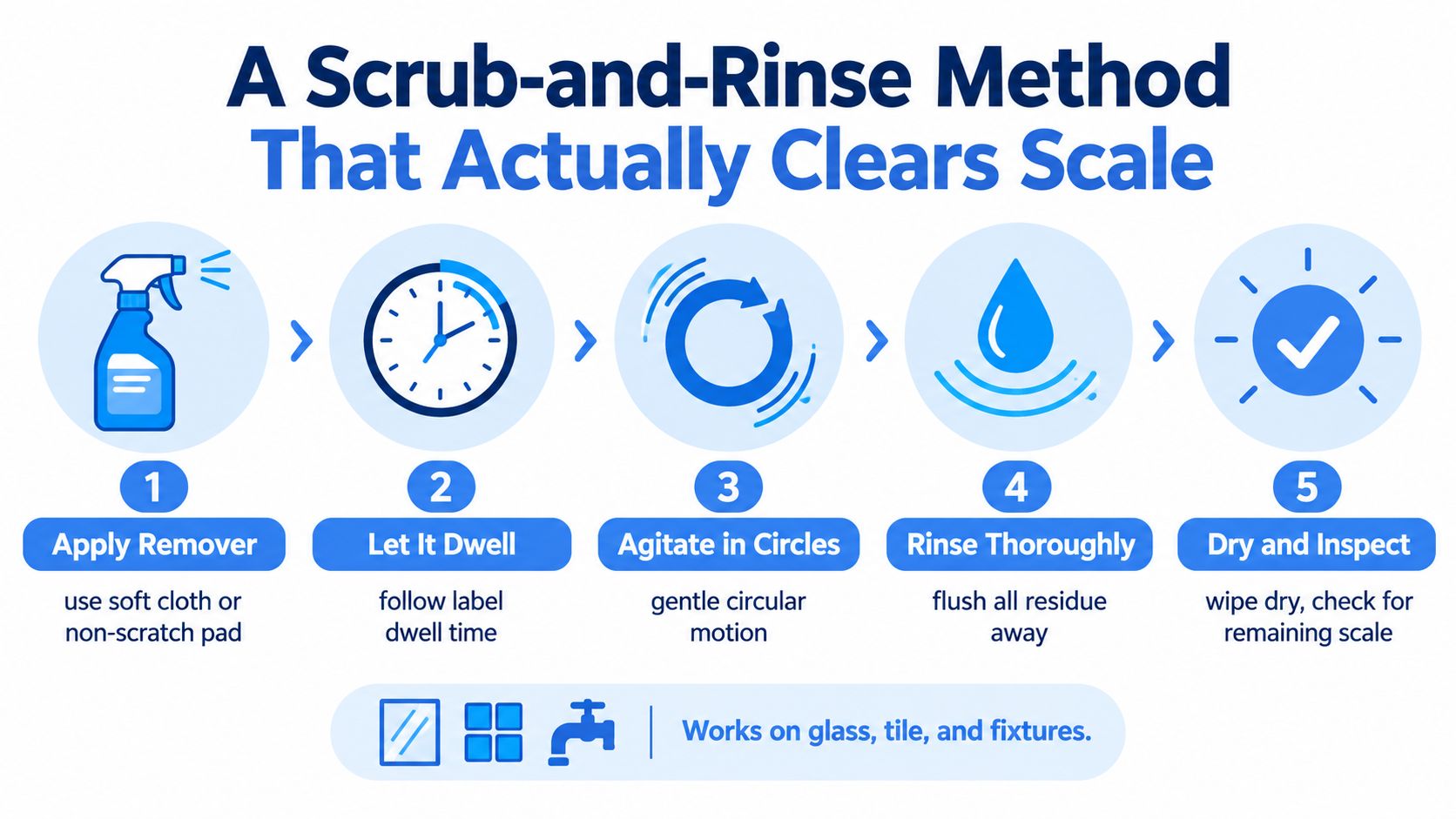
Rinse before the cleaner dries, and rinse more thoroughly than you think you need to. Residue left around hinges, seals, corners, and fixture bases can continue reacting with the finish. After the rinse, buff with a clean microfiber towel. Drying before rinsing only spreads the dissolved minerals into another film.
The rhythm is the result: loosen the deposit chemically, remove it with light agitation, flush the residue away, then inspect dry glass.
Water hardness gives you a useful maintenance clue. Illinois public-health guidance says water above 200 mg/L, or 200 parts per million, may cause plumbing and laundry staining problems, and three grains per gallon is approximately 50 parts per million. You can review that Illinois water-hardness guidance alongside your local water report.
For shower hardware, a removable showerhead and hose can make rinsing easier and improve access around fittings. The practical details in this showerhead and hose guide from Modern Bathrooms are useful when poor rinsing is part of the recurring problem.
For a surface-specific walkthrough, use Professional Window Cleaning's guide to cleaning glass shower doors. The same basics apply: non-abrasive handling, complete rinsing, and drying that doesn't leave fresh mineral spots.
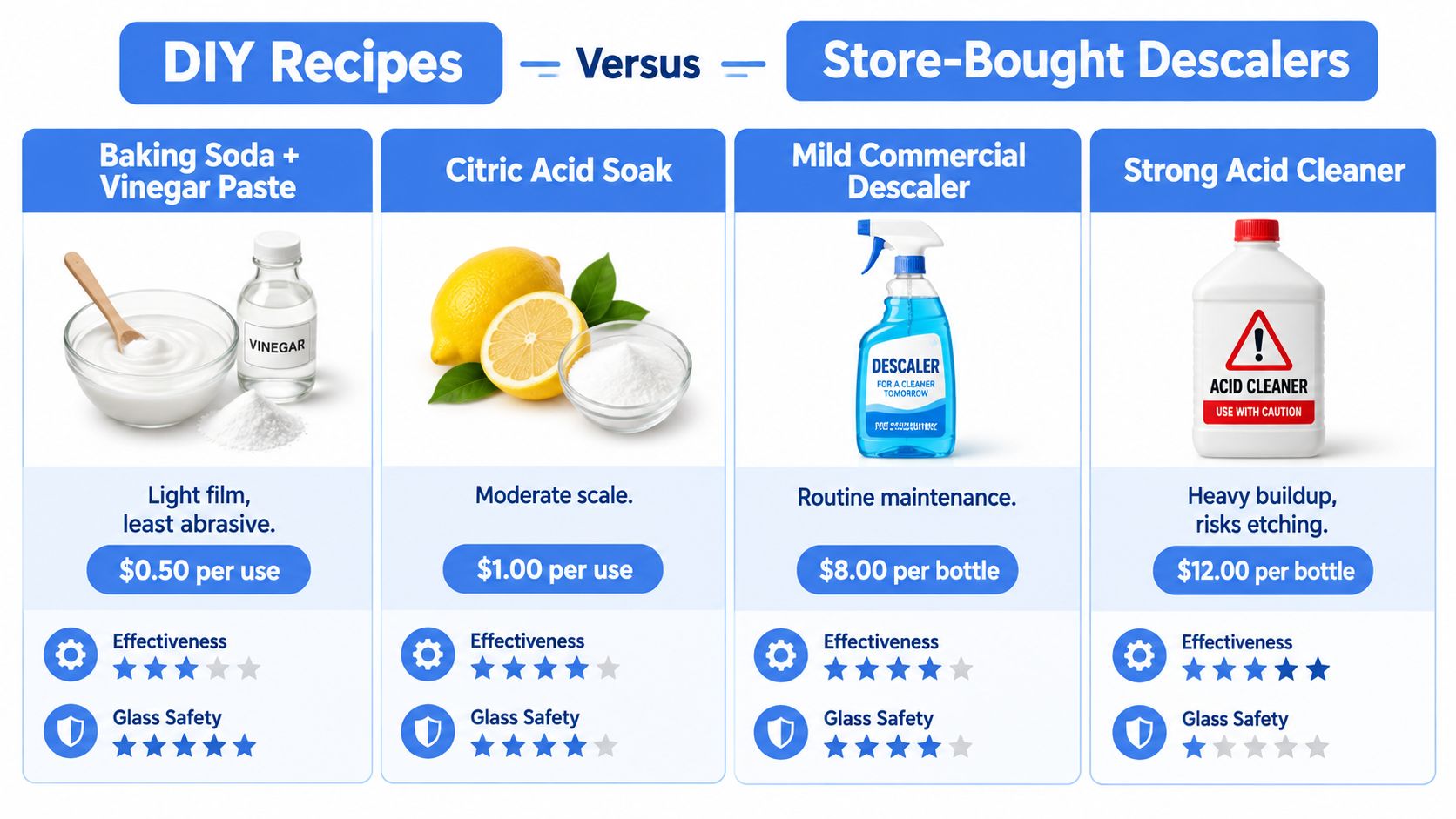
A homemade cleaner can handle a light film, but it is not interchangeable with a professional descaler. Choose based on the deposit, the surface, and how much buildup has accumulated. A recipe that works on bare glass may damage stone, coatings, grout, or metal finishes.
For a thin film on a compatible surface, a baking-soda and vinegar paste can be useful when applied gently. The reaction neutralizes much of the vinegar's acidity, so the mixture is a poor choice for thick calcium deposits. Baking soda can also scratch when rubbed with too much pressure.
Citric acid is more effective against moderate mineral scale, provided you patch-test first and rinse thoroughly. Keep it off natural stone and any finish excluded by the manufacturer. Its main advantage is controlled application. Its limitation is that neglected buildup may require more than one careful pass.
A mild commercial descaler is often the most predictable choice for routine maintenance. The label provides surface warnings, protective-equipment guidance, and a defined dwell period. That consistency matters when glass, chrome, grout, and coated fittings share one enclosure.
DIY mixing creates another avoidable risk. Vinegar and hydrogen peroxide can form an irritating mixture, while baking soda and bleach create a messy reaction without improving mineral removal. Keep each product in its original container and use one cleaning chemistry at a time.
Reserve stronger acid-based products for heavy buildup. They may loosen deposits that mild cleaners leave behind, but they also raise the risk of damage to chrome, coatings, grout, skin, eyes, and glass. Chemistry and exposure time both matter, so the product label controls the dwell period, protective equipment, and approved materials.
Use this hard-water spot cleaner guidance from Professional Window Cleaning to compare the approach with the surface before escalating. If one careful, compatible pass barely changes clean, dry glass, stop treating the problem as removable scale. Stronger acid will not restore etched glass.
If the bathroom also needs disinfection, finish descaling first, rinse completely, ventilate, and then use a separately labeled disinfectant. Hydrogen peroxide is also a separate disinfecting step, not a mineral remover. Treat every product as a specific tool rather than a universal bathroom solution.
A cloudy shower door does not always need a stronger acid. If the surface still has removable mineral scale, the right descaler can dissolve it. The wrong product, excessive dwell time, or repeated scrubbing can damage metal finishes, dull coatings, and chemically etch glass.
Etched glass is where many homeowners lose an afternoon. A stronger remover may strip loose residue and create a short-lived improvement, but the haze returns when the door dries. Chemically etched glass will not return to its original clarity, and a stronger acid will deepen the damage.

Use one careful, surface-compatible pass as a diagnostic. Clean the glass, rinse it completely, and let it dry before judging the result. A substantial improvement points to removable scale. Little or no change points toward etching, especially if the haze is uniform rather than made up of distinct deposits.
Stop escalating the acid at that point. A second acid pass on etched glass deepens the damage instead of restoring clarity. The mild-versus-strong distinction introduced earlier is the reason to stop treating every cloudy door as a mineral-removal problem.
A glass polish can improve limited surface damage, but it cannot guarantee restoration. Seek a professional assessment when haze covers most of the door, returns immediately after cleaning, or appears as broad dullness. Replacing the glass can make more sense than repeating chemical treatments that cannot reverse the etch.
Stop condition: If a matched remover does not improve clean, dry glass after one careful pass, treat the surface as potentially etched. Do not answer uncertainty with stronger acid.
Restoration does not remove the need to control future mineral exposure. Softer water, thorough rinsing, and prompt drying can reduce deposits on the glass. These measures preserve a clear surface, but they cannot repair existing etching.
A maintenance routine beats a heroic rescue clean. After each shower, use a squeegee on the door and the broad tile surfaces. The pass takes little effort, and it removes water before evaporation leaves another mineral deposit.
Professional window work follows the same basic choice between traditional squeegee cleaning and pure-water, water-fed pole cleaning. The industry explanation of these two window-cleaning methods connects the technique to access, glass type, and finish requirements. In a shower, the squeegee is the small version of that same water-removal principle.
If the haze is already etched, more home chemistry may not be the answer. Professional Window Cleaning has been cleaning windows for over 26 years, having started in 1999, according to its company business profile. Its stated service coverage includes Las Vegas, Phoenix, Denver, and Scottsdale, along with Flagstaff, Tempe, Chandler, and Gilbert.
The company's service information describes squeegee work for interior and detail-sensitive glass, while pure-water systems are commonly used for exterior surfaces. For shower glass, the relevant conversation is usually restoration assessment and careful hand detailing, not indiscriminate acid treatment.
Store descalers in their original containers, keep them away from children and pets, and follow the label. Never mix cleaning products in the same bucket or spray bottle, even if the previous product appears diluted or finished.
Professional Window Cleaning can assess hard-water haze, provide careful glass cleaning, and help separate removable scale from damage that needs restoration attention. If your shower door stays cloudy after a properly matched cleaning pass, visit Professional Window Cleaning to request service information for your area.
Read our blog posts regularly and keep learning.