
Care and Maintenance
Best Squeegee for Cleaning Windows: Expert Comparison
Find the best squeegee for cleaning windows with our expert buying guide. Compare blade materials, handle types, and sizes


You're standing in the driveway watching a window cleaner reach a second-story pane without climbing a ladder. The glass is covered in water, yet the technician doesn't use a squeegee, towel, bucket, or soap. A few moments later, the window dries clear.
That simple scene raises sensible questions. How does water fed pole window cleaning work? How does water travel from the ground to an upper floor, what does the brush do, and why can the glass be left wet? The answer involves a telescopic pole, a specialized brush, a hose, and water that has had its dissolved minerals removed.
There are only two methods professional window cleaners use, the use of a squeegee or the use of a pure-water system. Professional Window Cleaning has been cleaning windows for over 26 years, and the right choice depends on the window's location, condition, and access.
A technician parks near the building, rolls a water tank into position, and connects a hose. A lightweight pole rises from the sidewalk, section by section, until its brush reaches a third-story window. The operator's boots stay planted while the brush moves across the glass, frame, and sill.
The pole doesn't carry a heavy reservoir of water. A pump sends purified water through a hose inside or alongside the pole. At the top, the water exits through small jets beside the brush bristles. The brush loosens the dirt, and the flowing water carries it down the glass.

The unusual part is the finish. The technician doesn't wipe the window dry because purified water contains little to no dissolved mineral content. When the water evaporates, it can dry without leaving the mineral spots associated with ordinary tap water. Industry explanations describe the modern system as reaching up to 24 metres, about 79 feet, from ground level in suitable conditions, which makes it useful for residential and mid-rise exterior work. (See the history of water-fed pole cleaning)
The idea has a long development behind it. Irv Tucker's 1955 consumer “car and home washer kit” used a 3- to 6-foot pole and a hose. By the 1960s, pole-based cleaning had moved into commercial work, including schools, hospitals, and businesses. In 1997, U.K. cleaner Craig Mawlam introduced a telescopic pole combined with water purification, creating the modern reach-and-wash approach. (Read the documented history of the method)
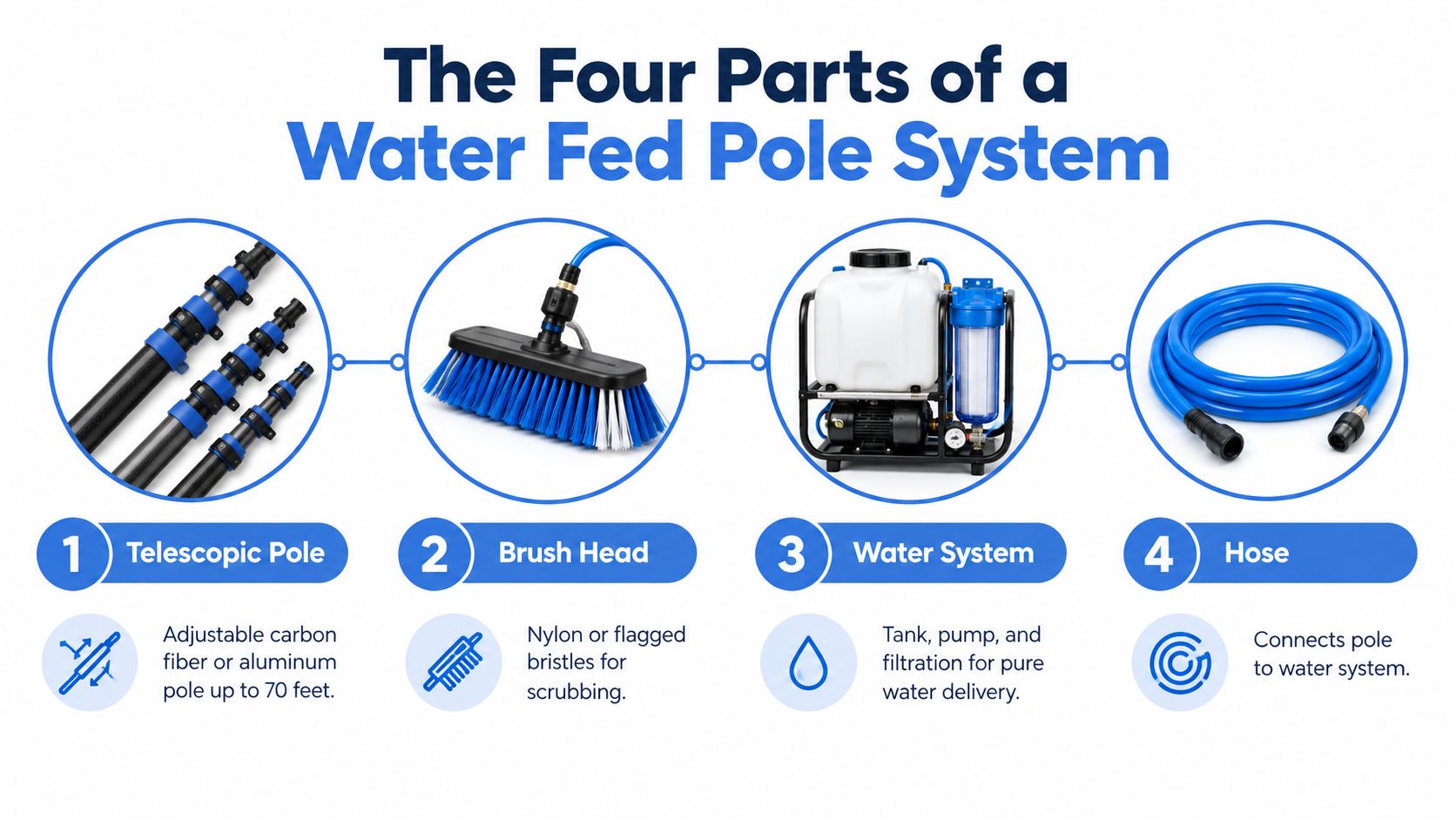
What looks like one tool is really four connected pieces: the pole, the brush head, the hose, and the purified water supply.
Think of the equipment as a window-cleaning fishing rod. The telescopic pole is the rod, the brush is the lure, the hose is the line, and the purified water tank is the reel that feeds the system.
The pole provides reach without putting the cleaner on a ladder. Professional systems commonly use clamped sections made from carbon fiber or aluminum, with working lengths ranging from roughly 6 to 70 feet. Carbon fiber is lighter and stiffer, while aluminum can offer a lower-cost entry point.
At the tip, a soft nylon or flagged-bristle brush agitates the surface. Two to four small spray jets deliver water around the bristles. The brush isn't just spreading water. Its movement breaks the bond between dust, pollen, traffic film, and the glass.
For a closer look at how brush design affects the work, see this guide to water-fed pole window cleaning brushes.
The hose carries water from the purification equipment to the brush. It may run inside the pole for a cleaner setup or alongside it for easier replacement and adjustment. The pump controls the flow, so the operator can rinse effectively without flooding the work area.
The supply may be a portable tank and filtration system mounted in a vehicle, or a stationary unit at a cleaning depot. Reverse osmosis, deionization, or both can remove dissolved minerals before the water reaches the pole. (Learn how the complete system works)
The investment varies widely. An entry-level setup may cost around $200 to $600, while a professional arrangement can cost more depending on pole length, filtration, pumps, tanks, and vehicle integration. The equipment matters, but water quality matters more. A long pole with poor-quality water will still leave spots.
Tap water looks clean, but it usually contains dissolved calcium, magnesium, salts, and other minerals. Those substances stay behind when water evaporates. On glass, the result can be a visible spot, haze, or residue.
Technicians measure this mineral content as total dissolved solids, or TDS, expressed in parts per million. Industry guidance commonly targets purified water below 10 ppm TDS, while many crews aim for 0 ppm at the point of use. (Review industry guidance on pure-water cleaning)
Reverse osmosis, often called RO, pushes water through a semi-permeable membrane. The membrane rejects much of the dissolved material, reducing the load placed on the next filter stage.
Deionization, or DI, uses resin to remove remaining charged mineral ions. The resin exchanges those ions so the water contains little or no dissolved mineral residue. The technician checks the output with a TDS meter, which acts like a live scoreboard for the system.
| Water Source / Stage | Typical TDS (ppm) |
|---|---|
| Tap water | No single value applies |
| Purified water target | Below 10 |
| Many professional systems | 0 |
The exact starting TDS depends on the local water supply, so a technician shouldn't assume that every site behaves the same way. Harder source water places more demand on the filters and DI resin, which affects operating cost and maintenance.
Practical rule: The water must be tested at the pole outlet, not just at the tank. A clean reading at the tank doesn't guarantee the same result after the hose, connectors, and brush.
This is why the glass can air-dry. The brush supplies agitation, while the low-mineral rinse removes loosened soil and evaporates without depositing the same mineral residue. A squeegee often isn't needed for suitable exterior applications. See how pure-water window cleaning is applied in practice.
The first decision happens before the brush touches the glass. The technician positions the vehicle or trolley close enough to keep the hose run practical, checks the surrounding area, and chooses an angle that controls where the rinse water travels.
The pole usually approaches at a slight downward angle. That helps water move away from seals and toward the brush instead of collecting on the sill. The operator also watches for obstructions, overhead lines, fragile surfaces, and people moving through the work zone.
The brush then works in overlapping horizontal passes. After that, the operator changes direction and uses vertical movement to reach the edges and loosen soil that a single pass might leave behind. The lower edge often receives extra attention because dirt and traffic film collect there.

The final rinse is deliberate. The technician lingers where droplets continue to bead, then draws the brush away and allows surface tension to break. A clean pane tends to show a smoother sheet of water instead of isolated beads.
The window may look unfinished for a short time because it's wet. That's normal for this method. The purified water is intended to dry naturally, leaving no mineral residue when the system is producing suitable water.
The result depends on more than technique. A careful operator using exhausted resin can still leave spots, while excellent water quality won't remove bonded scale without additional treatment.
For exterior glass, pure-water pole work changes the access problem. The technician stays on the ground while the brush reaches upper windows, reducing the need to repeatedly climb and reposition a ladder. One manufacturer describes pure-water equipment as suitable for windows up to five stories high in appropriate applications. (Review a manufacturer's pure-water system information)
Squeegee work remains valuable. A professional can control the finish closely on interior glass, small panes, and heavily soiled frames. The squeegee also gives the operator direct tactile feedback, which can be useful when detailing a difficult surface.
| Factor | Water Fed Pole | Traditional Squeegee |
|---|---|---|
| Height access | Commonly reaches from about 25 feet to over 65 feet, with some systems marketed near 90 feet | Access depends on ladder, lift, or other equipment |
| Main cleaning action | Brush agitation and purified-water rinsing | Scrubbing, detergent, and manual water removal |
| Drying method | Air-dries when water purity is suitable | Operator removes water with the squeegee |
| Exterior frames and sills | Can be washed as part of the pass | May require separate attention |
| Interior glass | Usually not the first choice | Often practical and precise |
| Mineral deposits | May need pre-treatment or hand detailing | Still needs suitable treatment and technique |
| Working position | Ground level in many situations | May involve work at height |
The numbers describe reach, not a guarantee. Wind, rooflines, access, electrical hazards, water flow, and pole rigidity can determine whether a specific window is suitable.
Water use also depends on flow rate, rinse time, hose length, and operator habits. A crew that sprays continuously wastes water and uses filtration consumables faster. A squeegee job uses a bucket and detergent cycle, but that doesn't automatically make it more efficient or less wasteful for every building.
The practical answer isn't that one method has replaced the other. Exterior upper glass often suits pure water, while interior panes, restoration work, and detail-heavy areas may call for a squeegee.
Pure water removes loose contamination effectively, but it isn't a universal solvent. Hard-water scale, bonded mineral deposits, cement dust, and old silicone smears can remain after a normal brush-and-rinse pass because they've bonded to the glass.
Years of pollution buildup create a different problem. The brush may need more dwell time and repeated agitation before the surface releases the film. A maintenance clean and a restoration clean aren't the same job.
The workaround is usually selective, not dramatic. A technician may hand-detail the affected pane, use a suitable treatment, or remove a bonded contaminant before returning to the pure-water system for the final rinse.
A water-fed pole is a maintenance tool first. It can handle a great deal of ordinary exterior soil, but restoration requires diagnosis.
Operators also influence the outcome. Over-spraying wastes water and consumes DI resin faster. Poor brush contact leaves soil behind, while rushing the rinse can spread loosened debris rather than remove it.
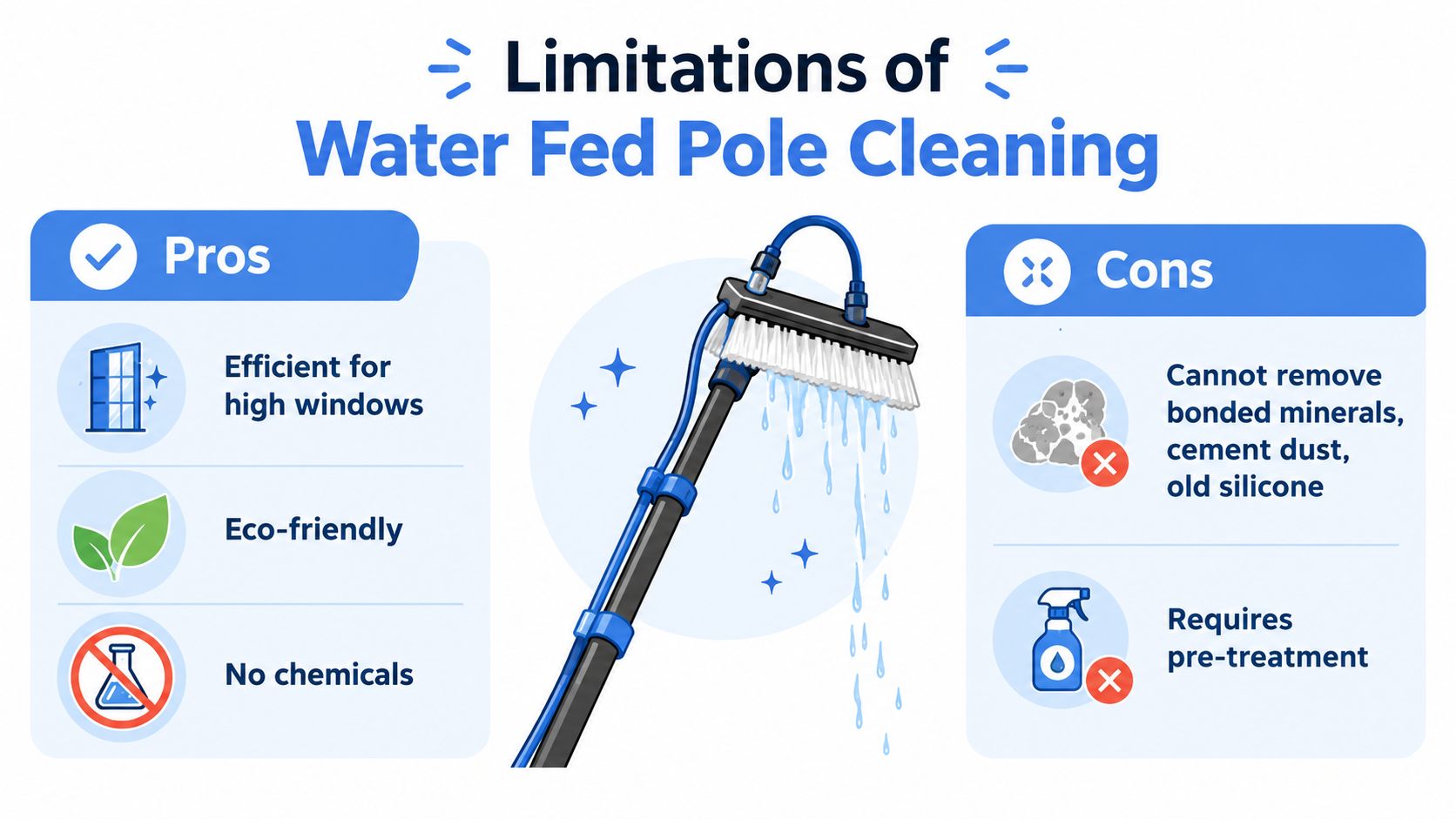
Ask for an assessment when the glass has white scale, paint or cement residue, construction film, or marks that have survived ordinary cleaning. A professional should explain whether the pole alone is suitable or whether hand detailing belongs in the quotation.
A water-fed pole system needs a morning check before it reaches a high window. The most important reading is the TDS value at the outlet. Many crews want 0 ppm at the pole tip, and industry guidance commonly treats readings above 10 ppm as a warning that the purification stage needs attention. (Review practical window-cleaning methods)
DI resin life varies with source-water hardness and how much water the crew produces. Practitioner guidance commonly describes resin replacement intervals around 4 to 8 weeks, but that range shouldn't replace actual TDS testing and usage records.
Store the brush so the bristles don't sit compressed against a hard surface. In freezing climates, vehicle-mounted RO and DI equipment needs winterization because trapped water can damage housings, lines, and fittings.
At the end of the shift, flush the system with clean water, log the gallons processed through the resin, and inspect the pole tip for damage. Good records reveal rising consumption before a failed reading disrupts a full day of work.
A homeowner can rent equipment, but the sensible choice depends on three questions: how high are the windows, what condition is the glass in, and is reliable local help available?
Height is the clearest filter. If a window sits above a safe ladder reach, particularly on a two-story home, a ground-operated pure-water service can reduce the need for ladder work. The pole still requires training and hazard awareness, especially around overhead lines, sloped ground, fragile roof surfaces, and public areas.
Condition matters just as much. Ordinary dust, pollen, cobwebs, and maintenance grime may suit a pure-water pass. Heavy mineral scale, paint overspray, cement dust, and post-construction film often require a professional's treatment choices and hand-detailing experience.
DIY costs can add up quickly. Residential pole kits commonly run $200 to $600, while a portable RO/DI system may rent for $30 to $60 per day. Those figures can make sense for a property with many accessible exterior windows, but a small job may not justify learning the equipment, producing the water, managing the hose, and correcting spotting.
A professional crew also brings liability insurance, work-at-heights training, equipment checks, and commercial-grade filtration. That doesn't make every professional job a one-pass solution, but it gives the property owner someone who can recognize when pure water is appropriate and when restoration work is needed.
Professional Window Cleaning serves homeowners, property managers, and commercial properties in Las Vegas, Phoenix, Denver, Scottsdale, Tempe, Chandler, Gilbert, and Flagstaff.
Professional Window Cleaning uses water-fed poles, purified water, and squeegee techniques according to the glass, access, and level of buildup. Visit Professional Window Cleaning to request a quote and ask which method fits your windows before you schedule the work.
Read our blog posts regularly and keep learning.