
Care and Maintenance
How Long Does Window Cleaning Take
Wondering how long does window cleaning take? Get realistic time estimates for homes, offices, and high-rises, plus the factors that change every job.


You're standing outside a two-storey property, looking at glass that appears clean from the pavement but shows pollen, frame dust, and old water marks as soon as the sun hits it. The brush on your water-fed pole will decide whether that soil lifts cleanly or gets moved from one edge of the pane to another.
Professional window cleaning has only two professional methods: the use of a squeegee or the use of a pure-water system. A water-fed pole window cleaning brush belongs to the second method, but it isn't a minor accessory. Its bristle material, head shape, jet layout, hose, pump, and pole length all work together.
Professional Window Cleaning has been cleaning windows for over 26 years. The practical lesson from that experience is simple: don't buy a brush in isolation. Match the brush to the water flow, the glass, the frames, and the reach you'll use on the job.
A two-storey office with anodised frames can expose a weak brush quickly. The upper sashes may carry sap streaks, pollen, and settled dirt, while a tenant below watches the operator work from the pavement. There's no hand on the glass and no squeegee edge correcting the finish. The brush is the part of the system that physically meets the surface.
A pure-water system uses a telescoping pole, a brush head, and purified water pumped through the pole. The brush agitates dirt, while the water rinses it away and dries without detergent because dissolved minerals have been removed, reducing spotting. The National Window Cleaning Authority explains the basic water-fed pole process, including the role of purified water and ground-based exterior cleaning.
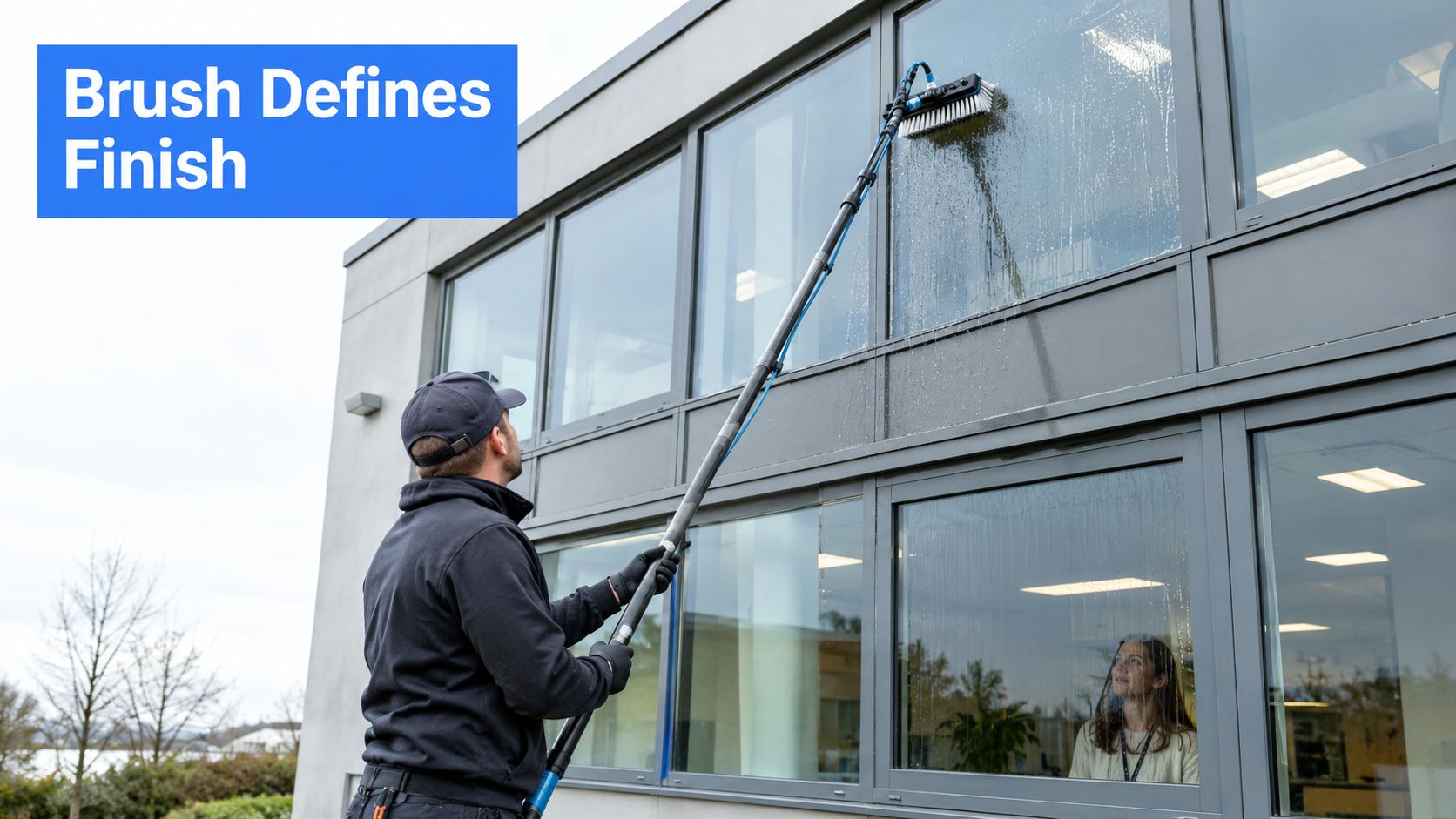
A brush that's too stiff can be harsh on coated or anodised frames. A brush with insufficient agitation may glide over baked-on soil without lifting it. On a sunny elevation, an unflagged nylon brush can also demand more pressure than the glass or frame really needs.
Head width matters as well. A narrow brush gives better control around small panes, sliders, and divided lights. A wider head covers broad commercial glass efficiently, but it can become awkward on narrow openings or uneven frames. Bristle length and trim angle affect how easily the brush enters corners, crosses gaskets, and maintains contact when the pole is held at an angle.
The successful rinse should sheet from the top of the pane toward the sill. If the brush leaves behind broken beads, dry patches, or dirty edges, the problem may not be the water treatment. It may be a poor brush match, inadequate flow, or a technique that never gives the jets a clean path down the glass.
Practical rule: Choose the brush for the surface you'll clean most often, then verify that your hose and pump can supply it properly.
The brush is therefore the most controllable variable in a system where the operator can't reach the glass directly. The pole provides distance, the pump provides movement, and the purification equipment provides suitable rinse water. The brush turns those components into useful contact.
The cleaning path starts at the water supply and ends at the pane. Each stage affects the brush head, so a fault upstream often appears to the operator as poor scrubbing or weak rinsing.
Water enters the treatment equipment. Tap water passes through filtration and purification components that remove sediment and dissolved minerals. The aim is water that won't leave mineral marks as it evaporates.
The pump moves the purified water. A pump pushes water through the hose and up the telescoping pole. Its output must suit the pole length and brush jet demand. If the pump can't keep up, water delivery weakens at the head.
The hose carries flow to the brush. Hose size affects resistance and available flow. A kink, crushed section, or undersized line can restrict the rinse even when the pump is operating normally.
The brush agitates the surface. The bristles must contact the glass and frames. A water-fed brush isn't optional because the bristles loosen dirt and grime so the jets can rinse the particles away. Pure Water Power's brush guidance also describes the brush as the component that scrubs glass and frames before the final rinse.
The jets rinse the loosened soil. Water exiting the jets carries away particles released during the scrub. The operator needs enough flow to keep that rinse active rather than merely wetting the surface.
The glass dries naturally. With dissolved minerals removed, the remaining water can dry without the spotting associated with ordinary tap water. The brush should be lifted slightly from the pane at the end so the water sheets downward instead of breaking into isolated beads.
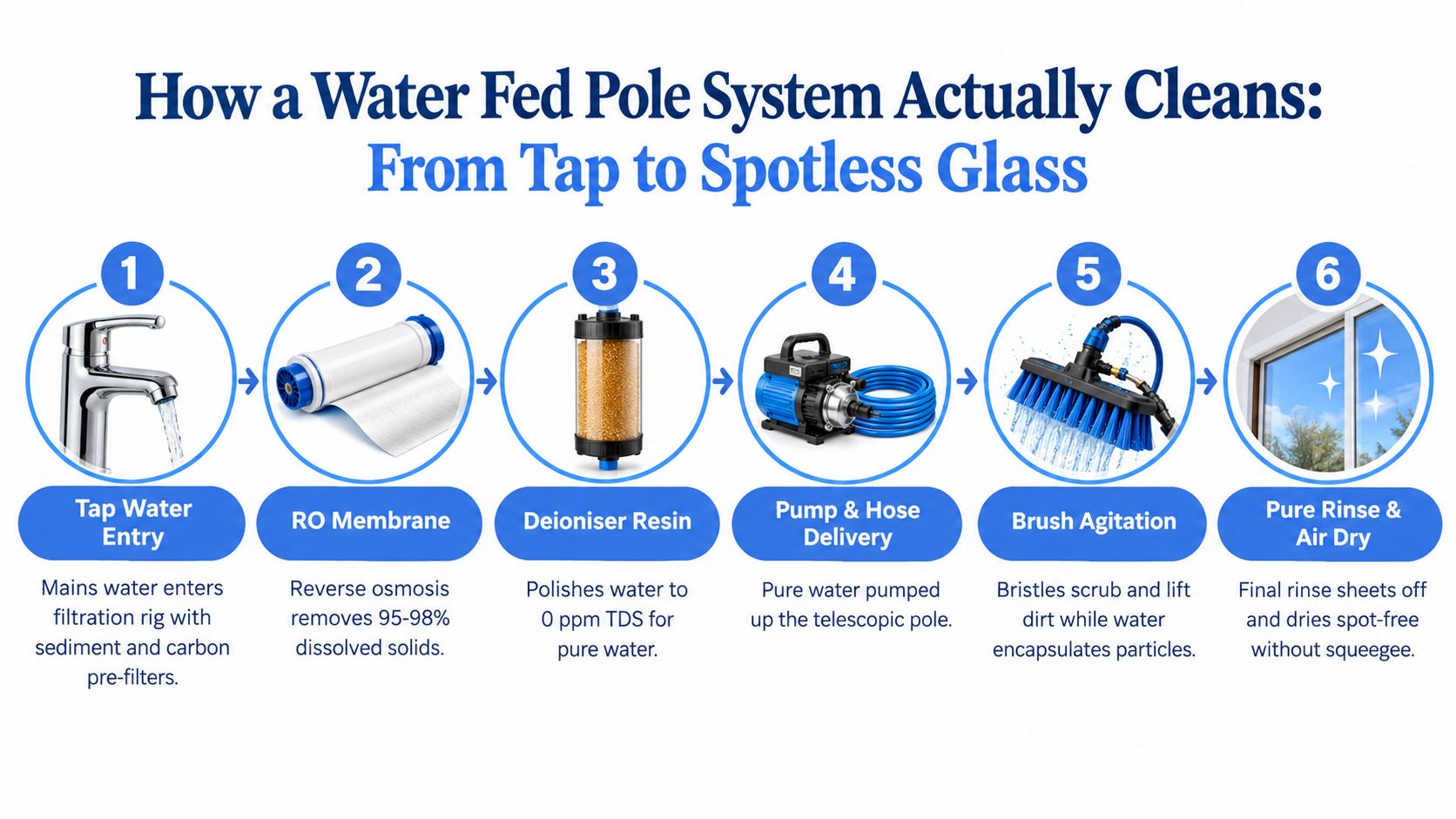
The complete sequence is covered in this guide to window cleaning with pure water, which is useful when a property owner wants to understand why the brush remains on the glass during agitation and then moves away for the rinse.
A starved pump or kinked hose creates the same visible problem as a poor brush. The bristles drag, the jets rinse unevenly, and the water film breaks before it reaches the bottom of the pane. That's why brush selection has to follow the complete flow path rather than a product photograph.
Brush shape should follow the window in front of the operator. A long, slim head may reach narrow sliders and tilt-turn openings more comfortably, while a broader fan-shaped head can cover large commercial panes with fewer passes. Detail brushes suit leaded lights, Georgian bars, tight frame corners, and grime that a broad head can't reach.
| Head Shape / Bristle | Best Suited To | Key Trade-Off |
|---|---|---|
| Channel brush with longer, slim profile | Narrow sliders, tilt-turn windows, restricted openings | Good access, less coverage on broad panes |
| Fan brush with a wider face | Large commercial glass and flat facades | Faster coverage, less convenient around narrow divisions |
| Pencil or detail brush | Georgian bars, leaded lights, frame corners, stuck-on grime | Precise agitation, slower on ordinary broad glass |
| Flagged nylon | Delicate or coated glass where lighter pressure helps | Softer tips can wear and lose cutting ability sooner |
| Unflagged nylon | Abrasive soil and routine exterior work | More durable, but demands careful pressure on sensitive surfaces |
| Natural hog or boar blend | Anodised frames and surfaces needing a softer touch | Holds more water and can slow the operator |
| Polypropylene bristle | Heavy soil and construction dust | Strong agitation, with greater risk of damage if misused |
Flagged nylon has split tips that spread contact across the surface. It can give a gentler cleaning pass with less pressure, which is useful when the glass or coating needs care. Unflagged bristles retain a sharper working tip and generally tolerate abrasion better, but the operator must avoid forcing them into soft or vulnerable finishes.
Natural hog and boar mixes feel softer on delicate frames, particularly anodised surfaces. They also hold water, which can make the brush heavier and slower to move. That trade-off may be acceptable on a careful residential job, but it can become tiring across a large commercial facade.
A wider head isn't automatically better. It needs enough water to rinse its full working face, and it can flex or drag when the pole is extended. A narrow head may be slower across big panes, but it offers better control around mullions and frame interruptions.
Bristle length matters too. Longer bristles can conform to uneven surfaces and enter corners, while shorter trim gives a more direct, controlled contact. The trim angle affects whether the brush stays planted when the pole approaches the glass from below.
The maintenance question is straightforward: do the bristles still separate soil from the surface, or are they bent, split, and permanently flattened? A brush that only polishes dirt around the pane has stopped cutting, even if its jets still flow.
A brush head is a flow consumer. The number of jets and the presence of a rinse bar determine how much water the pump must deliver, while hose diameter determines how easily that water reaches the head.
A two-jet brush typically needs about 0.25 to 0.4 GPM total. A four-jet brush can need about 0.5 to 0.8 GPM, and some four-jet designs with a rinse bar may demand 0.8 to 1.2 GPM total. These figures come from JRacenstein's explanation of water flow rates in window cleaning systems.
A 5/16-inch outside-diameter pole hose generally supports about 0.3 to 0.5 GPM at normal pressures, while 3/8-inch inside-diameter hose can support roughly 1.0 to 1.5 GPM. If the hose can't carry the brush's demand, the brush becomes starved even though the pump is running.
That mismatch shows up as a weak rinse, slow sheeting, or a head that drags across the glass. Longer poles increase the opportunity for friction loss and kinks, so the same brush may perform well on a short pole and poorly at full extension.
For a deeper look at how fittings affect delivery, MA Hydraulics Ltd's lance engineering advice provides useful context on nozzle, hose, and flow relationships. It isn't a substitute for testing your window-cleaning setup, but it reinforces the point that the end fitting can't be evaluated separately from the supply line.
Useful hose connections and fittings can also prevent avoidable restrictions, which is why these hose attachments for window washing deserve attention during setup. A four-jet brush isn't an upgrade if the pump and hose can't feed it.
Streaks after a pure-water clean usually come from contamination or technique, rather than minerals in the rinse. The water fed pole window cleaning brush must move soil away before the final water film travels down the pane. The brush is the controllable part of a complete system, so jets, hose flow, pump output, and pole length still affect how well this method works.
Angle the pole so the first rinse flushes the frame, gasket, sill, and corners. Push loose debris away from the glass where possible. Cleaning the pane first allows frame contamination to run back over a surface that was already scrubbed.
This matters most on a first clean. Sap, insect residue, pollen, and construction dust require more contact and rinsing than maintained glass. JRacenstein's water-fed pole technique guidance notes that frame preparation may take roughly twice as long as cleaning a maintained glass surface.
Keep the bristles wet and use overlapping S-shaped passes from the top down. Overlap prevents untreated strips, while the downward direction works with gravity instead of moving loosened dirt sideways.
Keep the brush moving. Do not scrub dry glass or leave the head parked in one place. Excessive pressure flattens the bristles, changes their contact pattern, and makes the head drag rather than glide.
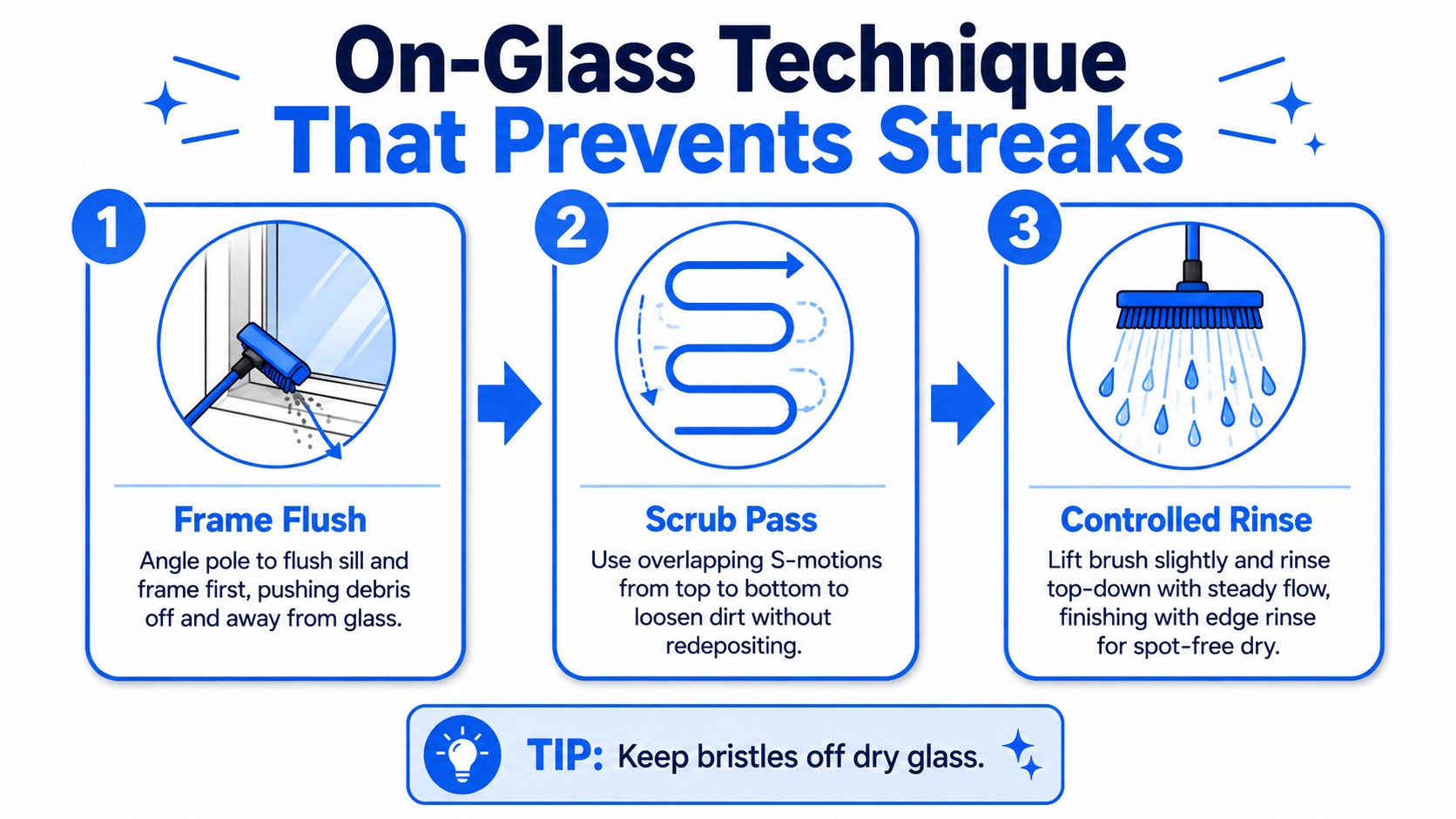
For the final rinse, lift the brush about 2 to 4 inches off the glass. The jets can then create a sheeting action that draws loosened particles down by gravity. This lift-and-rinse stage follows the frame flush and scrub pass, as described in JRacenstein's water-fed pole technique guidance.
A maintained pane may need only a light scrub and controlled rinse. A neglected pane can require repeated frame work before the water runs clear. Watch for dry patches, broken sheeting, sideways drips, and weak flow, since each can leave visible trails.
Professional window cleaning has two methods, and both remain useful. Traditional work applies a cleaning solution and removes it with a squeegee. Pure-water work delivers purified water through a pole and brush, then allows the rinse to dry on the glass.
Pure water has a clear reach advantage for exterior glass. UK safety guidance and industry summaries state that water-fed poles can clean from the ground up to about 70 feet, or 21 metres, reducing the need for ladders and high access on many low- and mid-rise jobs. The market forecast for water-fed pole clean window services valued that market at USD 83.1 million in 2024, projected USD 89.3 million in 2025 and USD 138 million by 2032, with an implied 7.7% CAGR.
| Job condition | Pure-water pole | Traditional squeegee |
|---|---|---|
| High exterior glass | Strong reach from ground level | Requires elevated access |
| Interior glass | Often awkward with hose and pole | Precise and efficient |
| Heavy frame contamination | Brush can flush and agitate | Hand detail can provide greater control |
| Large exterior facade | Good continuous coverage | More setup and repositioning |
| Hand-detailed edges | Less direct control | Strong advantage |
| Ladder-sensitive access | Safer ground-based approach | Greater access risk |
Traditional squeegee work still makes sense for interior glass, ground-level panes, and jobs where the customer expects close edge detailing. Pure-water poles make more sense when reach, privacy, and reduced ladder use outweigh the equipment setup.
Many professional routes use a hybrid approach. They may use a squeegee on lower interior or accessible glass and a water-fed pole outside or above normal hand reach. The brush earns its place when it solves a genuine access or safety problem, not because it's newer.
Buy the brush as part of a matched setup. Start with the glass you clean most often, then check the pole connection, bristle behavior, jet demand, hose capacity, and pump output before comparing prices.
A residential operator may prefer a 9- to 11-inch head, while commercial panels and curtain walls may justify a 14-inch or wider head. Those dimensions are useful starting points, not universal rules. Narrow panes, divided lights, and restricted openings can make a smaller brush more productive than a wide one.
Softer flagged nylon suits solar and coated glass where lighter pressure is preferable. Stiffer polypropylene can help with construction dust and heavier soil, but the operator needs to control pressure and confirm that the surface can tolerate the bristle.
The pole end must also fit the brush. Check whether your system uses a tapered fitting, push-fit connection, or locking collar. A brush that technically attaches but twists under load is a poor purchase.
Flow compatibility deserves equal attention. Compare the brush's jet demand with the hose diameter and pump GPM at working height. A four-jet head that performs well on a high-flow system won't necessarily perform well on a small pump and narrow hose.
The most expensive brush isn't automatically the right one. A properly matched mid-range head will outperform a premium brush that starves for water or doesn't suit the frames.
The water-fed pole window cleaning brush is one controllable part of a larger system. The practical decision starts with the dominant glass condition, then moves through head width, bristle type, pole reach, hose capacity, pump delivery, and water purity.
For a property owner or facility manager, ask the contractor how the brush will handle frames and sills, not just the glass. For a contractor, measure a representative pane, identify the most difficult frame, and test the rinse at the highest working position before committing to a full setup.
Water-fed pole systems have established roots in professional cleaning. JRacenstein's history of window cleaning records Irv Tucker's 1955 consumer washing kit with a 3- to 6-foot pole, a single rubber hose, and horsehair brushes. By the 1960s, the Tucker pole system had moved into commercial window cleaning, and in 1997 Craig Mawlam launched a telescopic pole system integrated with water purification in the United Kingdom.
A simple operational test works well: choose one pane, flush the frame, scrub with overlapping passes, lift the brush for the final rinse, and watch the drying film. If the water breaks before reaching the sill, inspect the brush jets, hose, pump, and pole angle before blaming the glass.
Property owners and contractors in Las Vegas, Phoenix, Denver, and Scottsdale can also use a lead-handling service such as never miss a window cleaning lead when enquiries arrive while crews are working.
Professional Window Cleaning offers residential, commercial, and high-rise window cleaning, including exterior work where a correctly matched water-fed pole brush can improve access and safety. Visit Professional Window Cleaning to request service for your property in Arizona, Colorado, or Nevada and discuss the right approach for your glass.
Read our blog posts regularly and keep learning.