Care and Maintenance
Concentrate Window Cleaner: Professional Guide
Learn how to dilute and apply concentrate window cleaner like pros. Master ratios, safety, and streak-free results for residential and commercial glass.


You hook up a garden hose, spray the glass, watch the dirt run off, and step back expecting a clean finish. Then the sun hits the window and every spot, streak, and missed edge shows up at once.
That usually is not a water problem. It is an attachment problem.
In real window cleaning, there are only two methods professionals use. We use a squeegee, or we use a pure-water system. Everything else is just a variation of how water gets to the glass and how well the tool controls that water. Hose attachments for window washing matter because they decide reach, rinse quality, flow, drag, and whether you are cleaning the window or just making it wet.
After more than 26 years in the trade, one thing stands out. Most bad results start with the wrong connection, the wrong brush, or the wrong expectation of what a basic hose-end gadget can do.
A lot of people start in the same place. They have outside glass that is too high to comfortably reach, dust has built up on the frames, and dragging out a ladder does not sound smart. So they grab the garden hose, pick the sharpest spray pattern, and hope pressure will do the work.
It rarely does.
A standard hose nozzle can rinse loose dust. It does very little for bonded grime, pollen film, bug residue, or the dirty line that forms at the top edge of the glass. On upper windows, it often makes matters worse because the spray reaches the glass, but not with enough control to scrub and rinse correctly.
The attachment is what changes the job from random spraying to effective cleaning. A brush head lets you agitate dirt instead of blasting at it. An angled wand changes your working position so you can hit the upper frame and corners. A proper connector keeps pressure steady instead of leaking at every joint. If you are trying to get closer to a pure-water result at home, a specialized water filter for your hose can also help reduce the spotting that plain tap water often leaves behind.
With a squeegee job, the cleaning solution loosens soil and the rubber removes the water. With a pure-water job, the brush agitates and the purified water does the final rinse and dries spot-free. Those are controlled systems.
A plain hose with a generic trigger nozzle is not a system. It is just water delivery.
Trade reality: If the glass is high, exposed, and already carrying mineral residue or traffic film, the right hose attachment is not optional. It is the difference between a quick rinse and a legitimate cleaning pass.
That is why homeowners, DIYers, and property managers get better results when they stop shopping by package photo and start thinking like a cleaner. The question is not “which nozzle sprays farther?” The question is “which attachment helps me wash, rinse, and control runoff on this specific window?”
A lot of poor results start the same way. Someone buys a spray head that looks powerful, clips it to whatever hose is already on site, and heads for second-story glass in full sun. In Arizona or Nevada, the hose is hot enough to soften cheap fittings by midday. In Colorado, the same setup may feel weak at the glass because lower pressure and longer vertical runs expose every restriction in the line.
Window washing works better when the parts match the job.
Every usable setup has three parts working together:
If one part is wrong, you feel it right away. The brush drags. The pole twists. The connector weeps. The rinse loses force before it reaches the top pane.
The hose does more than move water from the spigot to the window. It also affects how much weight you fight, how smoothly the line moves around corners, and how steady the flow stays once you raise the tool.
A standard garden hose usually works fine as the main supply line across the ground. It is a poor choice for the section riding up a pole or hanging off an extension wand. Too much hose weight at the business end makes the tool feel loose and slow. On upper windows, that lack of control shows up as missed corners, poor scrubbing, and uneven rinsing.
I see this mistake often on large homes and commercial properties. The user blames the brush head, but drag from the hose and bad balance in the setup are often the cause.
Cheap connectors create steady frustration. They leak under pressure, loosen while you work, or reduce flow because the internal opening is too narrow.
The main connector styles are straightforward:
Compatibility matters more than quantity. Mismatched threads, soft washers, and bargain quick-connects are common causes of pressure loss. In hot desert conditions, lower-grade plastic fittings also age fast. After enough UV exposure and heat cycling, they crack or stop sealing well. On properties in dry climates, brass or higher-grade polymer fittings usually hold up better over time.
An extension wand and a water-fed pole do not handle the same way, even if both technically reach the glass. A basic wand gets water higher. A purpose-built pole is lighter in use, routes water more cleanly, and gives better brush control.
That difference matters more on taller elevations and wide western properties, where long hose runs are common. Add several extra fittings, a long supply line, and a weak spigot, and the top window may get a soft rinse instead of a useful cleaning flow.
For homeowners comparing entry-level options, Consumer Reports' guide to cleaning high windows notes that hose-end kits and hose-attach water-fed systems are available at relatively accessible starting prices. Price gets you into the category. It does not guarantee a setup that feels stable, seals well, or performs consistently on mineral-heavy water.
A solid exterior window setup usually includes:
If you want a practical overview of how those parts work together in the field, this guide on how to clean windows with a hose lays out the basic process clearly.
Key takeaway: Good results come from a system that stays sealed, balanced, and controllable under your local conditions, not from one attachment that looks impressive on the package.
That is the part many buying guides skip. In Phoenix and Scottsdale, heat exposes weak plastics and cheap seals. In Las Vegas, hard water punishes poor rinsing habits. In Denver and other higher-elevation areas, marginal pressure shows up faster on upper glass. Build the setup for the conditions, and the attachment you choose has a fair chance to do its job.
The best attachment depends on what you are trying to do. Rinsing loose dust off a first-floor pane is one job. Scrubbing second-story glass with baked-on grime is another.
Most attachment choices become easier when you separate them by function. Some tools are for reach. Some are for agitation. Some are for applying cleaner. Some are only good for pre-rinse.
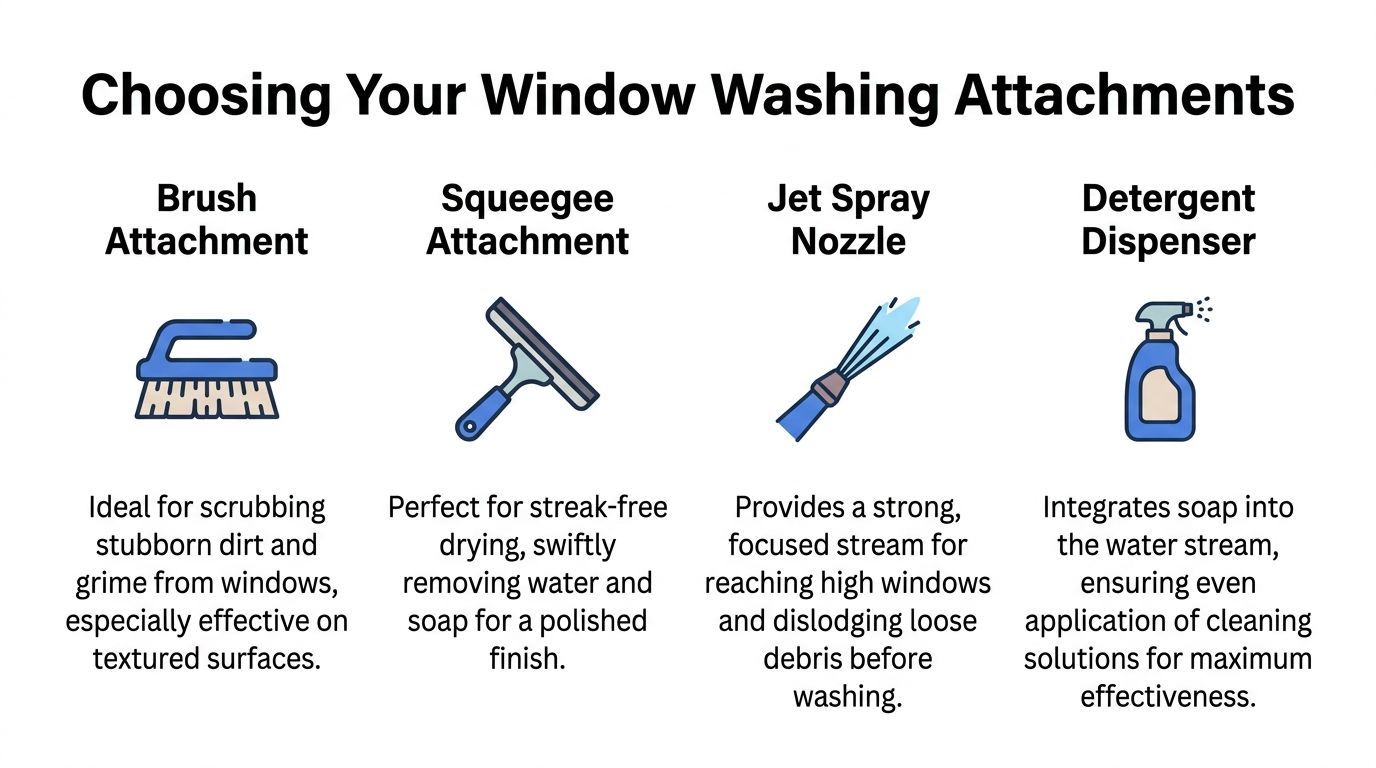
A jet nozzle throws water farther. It is useful for knocking loose debris off upper glass, rinsing frames, or reaching a spot you cannot scrub directly.
Its weakness is obvious. It does not agitate dirt. On glass, distance alone does not equal cleaning.
A fan spray nozzle covers more area and is usually safer around frames and seals because it spreads the force. It works better for a broad rinse after scrubbing.
Best use: Pre-rinse and final rinse on lightly soiled windows.
Poor use: Expecting it to replace a brush or squeegee.
These are popular because they feel productive. You clip one on, add solution, and coat the glass quickly.
They can help on dirty ground-floor glass, especially where bugs or oily residue are present. Their limitation is control. Many hose-end dispensers apply more product than needed, and if the rinse is poor, you are left chasing residue.
A soft-bristle brush head is where hose attachments for window washing start becoming serious tools. The brush gives you contact with the glass, lets you scrub corners and edges, and turns flowing water into a rinse-through cleaning method.
For pure-water work, the brush has to be made for glass. Soft bristles matter. A random deck brush or stiff utility brush is the wrong tool.
If you want a practical walkthrough of what hose-based cleaning can and cannot do, this guide on how to clean windows with hose is a useful companion.
A straight extension is awkward on upper windows. An angled wand or gooseneck helps you keep the brush flat to the glass instead of working off the tip.
That sounds minor until you use one. Better brush angle means better scrubbing at the top frame, less shoulder strain, and fewer missed lines.
These were designed for gutters, but they can help with awkward overhangs and windows above sloped landscaping or architectural features. They are niche tools, not everyday tools.
Use them when access is the problem. Do not expect them to improve cleaning quality on their own.
| Attachment Type | Primary Use | Pros | Cons |
|---|---|---|---|
| Jet spray nozzle | Reaching high glass and blasting off loose dirt | Long reach, quick pre-rinse, easy to use | Does not scrub, can be too aggressive around seals |
| Fan spray nozzle | Broad rinsing after washing | Even coverage, gentler on frames | Limited cleaning power without agitation |
| Soap dispenser | Applying cleaner to dirty windows | Fast product application, helpful on bug residue | Easy to overapply, can leave residue if rinsed poorly |
| Soft-bristle brush | Scrubbing glass and frames with flowing water | Real contact cleaning, better corner coverage | Requires more setup, results depend on brush quality and water |
| Angled wand | Improving working angle on upper windows | Better ergonomics, easier top-edge access | Adds another connection point, can feel awkward on cheap poles |
| Curved gutter-style | Reaching obstructed or unusual window positions | Useful around overhangs and obstacles | Specialized, not ideal for everyday glass cleaning |
Shop rule: If an attachment only changes spray pattern, it is a rinse tool. If it puts bristles on the glass, it is a cleaning tool.
For most homeowners, the most useful combination is simple: a solid rinse nozzle, a soft-bristle brush attachment, and a workable extension setup. That covers far more real jobs than a basket full of gimmicks.
The biggest setup mistakes are simple. Wrong thread. Loose washer. Cheap quick-connect. Hose kinked at the spigot. Those small errors create leaks, weak flow, and a tool that feels worse than it should.
Start with a clean assembly. Dirt in a fitting can keep a washer from sealing. A damaged O-ring can make a good connector act like a bad one.
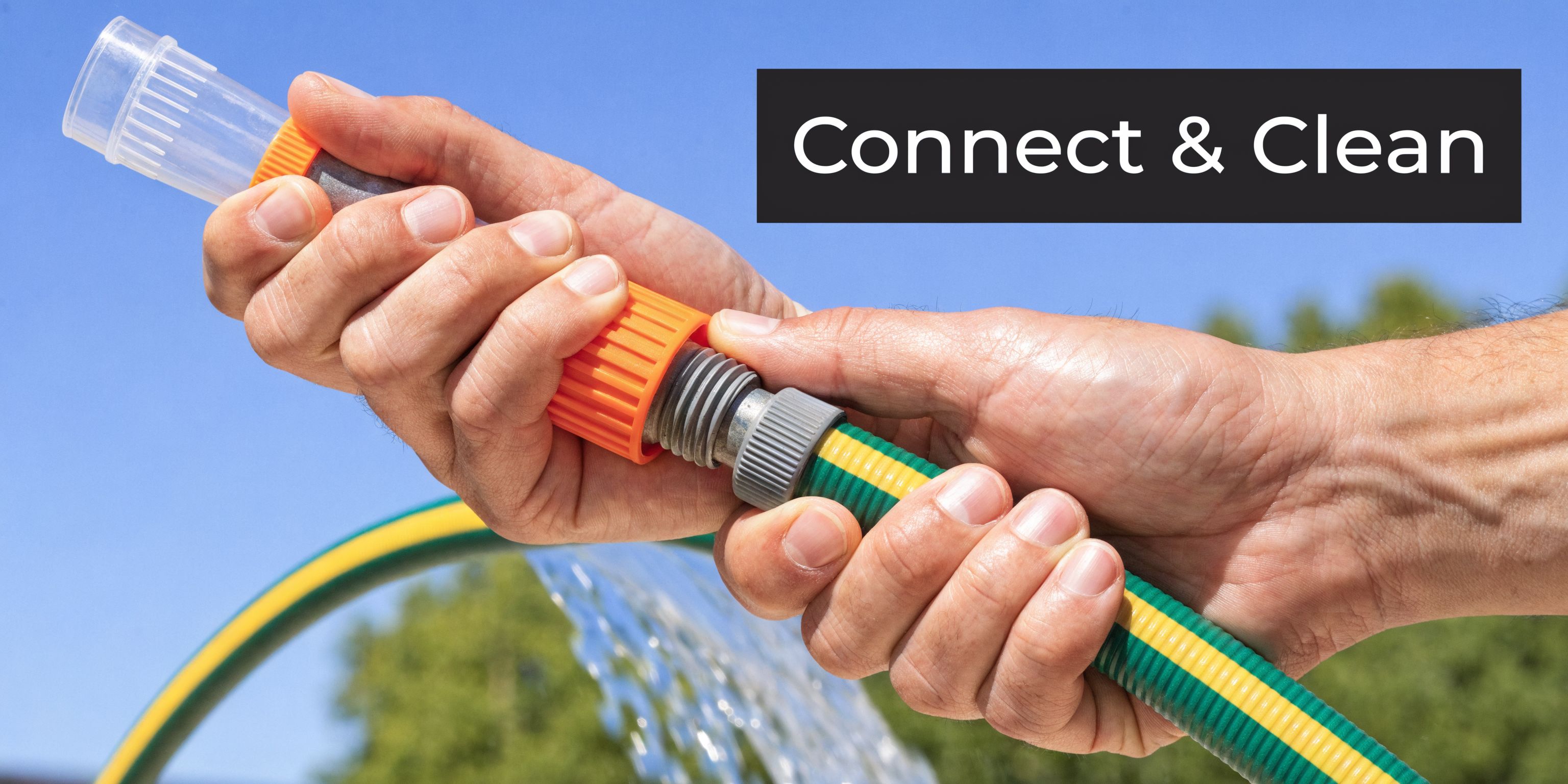
For a standard hose-based window washing setup, build it in this order:
Tighten threaded fittings firmly by hand. Overtightening can flatten washers and create the leak you were trying to prevent.
A water-fed system needs more attention because every fitting affects purity and flow. In professional workflows, non-drip hose fittings can disconnect without dumping water, and BENZ notes their fittings operate up to a maximum pressure of 15 bar (217 psi) on the product page for its non-drip plug system. That matters because when you disconnect a wet line on a pure-water setup, spilled water and contamination are not just messy. They can interfere with the clean workflow you are trying to maintain.
If you switch between a brush, a rinse head, and a traditional tool, quick-change hardware saves time. Good quick release coupler systems are worth studying even outside the window cleaning aisle because they show what a reliable coupling should do. It should connect positively, release cleanly, and not become the weak point of the line.
Cheap plastic quick-connects often feel fine in the driveway and fail on the job. They leak, flex, or seize when grit gets into them.
Practical tip: Keep one spare washer set and one spare female connector in the truck or garage. Most “mystery pressure problems” turn out to be a tired washer or a cracked fitting.
A short visual helps if you are new to hose-end assembly and extension setups:
These are the issues seen most often on residential work:
In dry markets such as Phoenix, careful setup also helps reduce wasted water. Leaks that seem minor at the hose bib become constant runoff during a long rinse cycle.
You feel pressure problems first at the glass. The brush stops rinsing cleanly, upper panes take longer, and a setup that looked fine on paper starts leaving you with extra passes and more detailing than you planned.
A lot of window washing advice treats hose attachments like isolated tools. On real jobs, especially across Arizona, Nevada, and Colorado, the attachment only works as well as the water supply feeding it. Desert heat, long hose runs, elevation, and inconsistent municipal pressure all change how that tool behaves.
After 26 years in this trade, I can say this with confidence. Cleaners often blame the brush head or spray attachment when, often, the primary restriction lies somewhere upstream.
Pole hose size matters. A hose that is too bulky on the pole adds drag, makes the pole harder to control, and wears out the operator faster. A supply hose that is too narrow at the source can starve the entire setup before the water ever reaches the glass. Those are two different problems, and they need two different fixes.
On two-story and three-story work, that distinction shows up fast. If the pole feels heavy and sloppy, look at the hose on the pole. If the rinse dies at the top window, look at the source hose, the run length, and every fitting in between.
Colorado exposes weak setups quickly. At higher elevation, water-fed systems can feel softer at the brush, especially on long runs or larger homes where the hose path is already working against you. Streamline discusses these attachment and water-fed pole considerations on its window cleaning pole attachments category page, and the point matches field experience. A system that feels acceptable near sea level can feel underfed in Denver.
Arizona and Nevada create a different set of problems. Municipal pressure can vary a lot from one property to the next. Add summer heat, warm hoses sitting in the sun, and long runs around stucco walls or pool decks, and the attachment at the end of the line may behave nothing like it did during a quick driveway test.
That is why one-size-fits-all attachment advice falls apart in the Southwest.
Check the water path before replacing the attachment. That saves money and usually solves the problem faster.
If you are considering stronger spray tools to compensate, read this guide on whether pressure washing windows is safe before trying to force the issue. More force is not always better on glass, seals, or aging frames.
Field lesson: Good window results come from usable flow, controlled rinse, and a setup light enough to handle for the full job.
Different regions call for different compromises. In Denver, I would rather reduce restrictions and keep the line efficient than hang a demanding attachment on a weak supply. In Phoenix or Las Vegas, I pay close attention to hose routing, sun exposure, and how quickly hot conditions turn a simple rinse into fast drying on the glass. In Scottsdale, large properties with long hose pulls often punish cheap fittings and overly complicated setups.
Use the table below as a practical guide:
| Region challenge | What usually works better |
|---|---|
| Higher elevation and softer delivery at the tool | Keep the pole hose light and cut unnecessary fittings |
| Variable municipal pressure | Choose an attachment that rinses well without needing aggressive pressure |
| Long hose runs around commercial or estate properties | Simplify the line and use secure, better-quality connectors |
| Hot exposed glass in desert climates | Work smaller sections and use controlled rinse patterns instead of raw force |
Poor pressure creates a predictable chain of problems. The operator scrubs harder, spends longer on each pane, and still finishes with a weaker rinse. Hose attachments for window washing perform best when the whole system is matched to the property, the climate, and the actual water available on site.
A hose attachment that works fine in spring can start leaking, sticking, or spraying crooked by midsummer in Phoenix, Las Vegas, or western Arizona. I have seen perfectly usable gear fail early for one simple reason. It was bought for mild conditions, then left to bake on a truck, drag through grit, and run hard water every week.
Harsh climate wear shows up in predictable places. Seals dry out. Plastic bodies turn chalky and brittle. Fine dust works into quick-connect sleeves and shutoff valves. Mineral-heavy water leaves crust inside jets and around threads, so the rinse pattern changes long before the attachment looks worn out.
If you manage property in the desert Southwest, or clean your own glass year-round, durability starts with material choice and storage habits. Cheap parts usually do not fail all at once. They start by dripping at the coupler, hanging up during disconnect, or producing a weak, uneven fan that slows the whole job.
Analysts at Window Cleaning Supply on its fittings and parts page note that plastic quick-connects can fail faster in high heat and UV, and they also discuss how alkaline water can be harder on lower-grade fittings. That matches what I have seen in the field. Plastic connectors left in direct sun get brittle. Lower-quality metal hardware starts corroding, binding, or pitting far earlier than good brass or well-made composite parts.
The primary cost is downtime. One bad coupler can turn a routine exterior wash into a stop-and-fix job, especially on larger properties where hose runs are already long and the sun is heating every exposed fitting.
Start with the pieces that take the most abuse, not the accessories that look impressive in a catalog.
Brass holds up well in many desert applications. Good composite fittings also have a place, especially where weight matters and the material is rated for heat and UV. The right choice depends on how the gear is used, how long it sits in the sun, and whether the water on site is leaving heavy mineral residue.
Maintenance does not need to be elaborate. It needs to be consistent.
In Colorado, add one more step. Drain everything before storage if temperatures are going to drop. Water trapped in a fitting or valve can freeze, expand, and split parts that looked perfectly fine the day before.
Best habit: At the end of the job, disconnect the attachments, drain the line, and get the gear into shade. More premature failures come from storage between jobs than from actual washing time.
Desert heat and elevation create different maintenance problems. In Arizona and Nevada, sun exposure and alkaline water usually wear parts out first. In Colorado, lower winter temperatures and pressure differences from site to site can be just as hard on seals, valves, and lightweight fittings.
That is why I do not judge an attachment by how it performs on day one. I judge it by whether it still seals cleanly, rinses evenly, and disconnects without a fight after a full season of heat, dust, hard water, and real service.
A hose attachment can solve a lot of problems. It can improve reach, control rinse flow, and make outside maintenance more practical. It cannot turn every property into a safe DIY job.
Once the work moves to upper-story glass, large commercial elevations, post-construction cleanup, or windows that need true pure-water rinsing, professional equipment and training matter. That is especially true when the glass is difficult to access or the result needs to be consistently spot-free across an entire building.
Safety is the biggest dividing line. According to a discussion summarizing occupational safety information on the Window Cleaner Community forum, professionals who switched from ladders to water-fed pole systems saw a 100% decrease in ladder-related fatalities, and U.S. window cleaning fatalities still average about 4 deaths annually. The same discussion cites an OSHA analysis that documented 88 window cleaning accidents over 15 years, with 62 fatalities on its page about safety studies on WFP use.
That is why serious contractors and property managers increasingly prefer ground-based methods on the properties they oversee.
For homeowners, the line is simple:
Professional Window Cleaning has been cleaning windows for over 26 years. There is a reason experienced crews still rely on the same two methods. Squeegee when hand detailing is the right fit. Pure water when height, safety, and efficient exterior cleaning call for a better system.
Usually, no. Many hose-end attachments, seals, and plastic connectors are not built for sustained hot water exposure. If the manufacturer does not specifically rate the attachment for higher temperature use, stay with normal supply water.
Yes, especially if you are using dispensers, filters, or any setup where water could potentially move back toward the home supply. It is a simple protective device and a smart part of a clean setup.
No. Use a brush made for glass work. Soft bristles and a design that rinses through the head matter. A stiff general-purpose scrub brush can mark delicate surfaces and does not rinse the same way.
That is usually water quality, not dirt left behind. If the rinse water carries minerals, it can dry into visible spotting. In those cases, the attachment may be doing its job but the final rinse is still working against you.
Not always. Quick-connects are faster, but only when they are well made and compatible with the rest of the system. A solid threaded connection is slower to change, but often very dependable.
A soft-bristle brush attachment paired with a dependable rinse setup is usually the most useful starting point. It gives you cleaning contact instead of relying on spray force alone.
If your windows are high, heavily soiled, or part of a commercial or multi-story property, it is time to bring in specialists. Professional Window Cleaning provides residential, commercial, and high-rise window cleaning across Arizona, Colorado, and Nevada, including service for homes, condos, car dealerships, stadiums, and medical offices. If you want the job done safely and with the right system for your building, contact Professional Window Cleaning for a quote.
Read our blog posts regularly and keep learning.