Care and Maintenance
High Rise Window Cleaning Cost: A 2026 Pricing Guide
Explore high rise window cleaning cost in 2026, from per-window and per-floor rates to Arizona, Colorado, and Nevada examples that help you budget


The call usually comes after the problem has become impossible to ignore. A homeowner is tired of second-story glass that never looks fully clean from the ground. A property manager has a building with high panels, awkward setbacks, and tenants who notice every streak in the afternoon sun. A commercial site needs clean glass without ladders scattered across entrances all day.
In professional window cleaning, there are only two cleaning methods. We either clean with a squeegee or with a pure-water system. Everything else is access, transport, control, and safety. That is where truck mounted equipment changes the game.
After more than 26 years in this trade, one thing is clear. The companies that invest in better truck mounted equipment usually deliver better outcomes because they can control more of the job. They can reach difficult glass safely, carry purified water on site, position technicians more precisely, and work faster without cutting corners. For clients, that matters as much as the cleaning method itself.
A property manager walks outside at 7 a.m. and sees a crew trying to reach upper glass by shifting ladders around entry walks, hedges, and parked cars. The job may still get done, but the risk, time loss, and chance of missed detail all go up before the first pane is finished.
A ladder still belongs on some work. It is often the wrong access method for taller homes, medical offices with tight exterior layouts, and commercial buildings with glass set above canopies or landscaping. On those properties, access affects the result as much as the technician’s skill.

Ladders create limits that clients can see and limits they usually cannot. Setup takes longer. Working angles get worse. Crews have to keep resetting instead of cleaning. There is also more opportunity for contact with gutters, stucco, planters, signage, and pedestrian paths.
Truck mounted equipment addresses the access and support side of the job. It gives a trained crew better positioning, steadier water delivery, cleaner hose routing, and more control over how the work is performed across the property.
That matters to the client because consistency is what separates a quick wash from a professional result.
Clients evaluating a service provider should pay attention to more than a polished truck wrap. The key question is whether the rig shows planning. Is the system organized, secured, and clearly built for the type of property being serviced? Do technicians handle setup with purpose, or does the crew spend the first half hour sorting hoses, adjusting loose gear, and improvising access?
As of 2025, the global truck-mounted cranes market had surpassed USD 2.8 billion and is projected to reach USD 6.5 billion by 2036, according to Fact.MR’s truck-mounted cranes market report. That does not mean every window cleaning company needs a crane. It does show a broader shift toward mobile equipment that improves reach, control, and jobsite efficiency across building service work.
Key takeaway: On difficult properties, better access equipment usually leads to safer work, tighter execution, and cleaner final results.
That is the standard smart clients should use. A top-tier provider does not just own better equipment. The crew uses it in a way that protects the property, reduces disruption, and produces glass that looks right in full sun, from the curb, and up close.
A crew pulls up to a Phoenix retail center at 6 a.m. Before a brush touches the glass, a property manager can already tell a lot about the company. The truck layout, the way hoses come off the reels, the access plan, and the explanation of why they are using one method instead of another all reveal whether this is a polished operation or a crew figuring it out on site.
Truck mounted equipment is a working system, not just a vehicle carrying water. The truck supports the cleaning method, keeps water quality consistent, manages hose runs, and gives the crew controlled access to glass that would otherwise slow the job down or increase risk. If you want a useful overview of professional window cleaning equipment used in the field, start with how the system supports the property in front of it.
A professional rig combines water storage, purification, pumps, reels, controls, and, on some properties, lift or boom support. Those parts have to work together. If one part is poorly matched, technicians lose pressure, waste time repositioning, or leave spotting on the glass.
Clients in Denver and Las Vegas see this play out in different ways. In Denver, elevation, temperature swings, and hard water can expose weak filtration fast. In Las Vegas and Phoenix, mineral-heavy water, heat, and large expanses of sunlit glass make consistency easy to judge. Good equipment does not guarantee a good result, but weak equipment usually shows up on the glass.
With squeegee work, the truck helps the crew reach the glass safely and carry the tools needed for detailed hand cleaning. This matters on storefront routes, lower commercial glass, interior work, and exterior areas where frames, seals, or buildup call for more controlled detailing.
With a pure-water system, the truck becomes the production base. It stores purified water, feeds it through the hose line at stable pressure, and supports long work cycles without constant refilling. That setup is often the better choice for exterior maintenance on multi-story homes, office buildings, solar-adjacent glass, and large commercial elevations where speed matters but finish quality still has to hold up in full sun.
A capable contractor should be able to tell you why they chose one method, or why they are combining both.
Access is rarely straightforward on modern properties. Tight service lanes, parking limitations, desert landscaping, entry canopies, and mixed-height architecture all affect how equipment can be positioned. A truck mounted system has to fit the site, not fight it.
That is one reason truck-mounted knuckle boom cranes remain relevant in access-related work. Analysts at GM Insights found that hydraulic drive systems held 48% of the market share in 2024 in the truck-mounted knuckle boom cranes market, largely because operators value precise positioning on complex sites. For a client, the takeaway is simple. Controlled positioning reduces awkward setups, cuts unnecessary ladder use, and helps the crew work cleanly around landscaping, pedestrian paths, and parked vehicles.
A strong provider explains the rig in plain language and ties it back to your property. Clear answers usually sound like field experience, not sales copy.
Ask questions such as:
Vague answers usually point to loose operations. Clear, property-specific answers are what clients should look for.
The best truck mounted equipment works because every part supports the rest. Remove one weak link and the whole job gets harder.
A strong rig is designed around flow. Water gets purified, stored, pressurized, delivered, and used at the glass with as few interruptions as possible. At the same time, the vehicle has to stay stable, organized, and safe to operate on real properties.
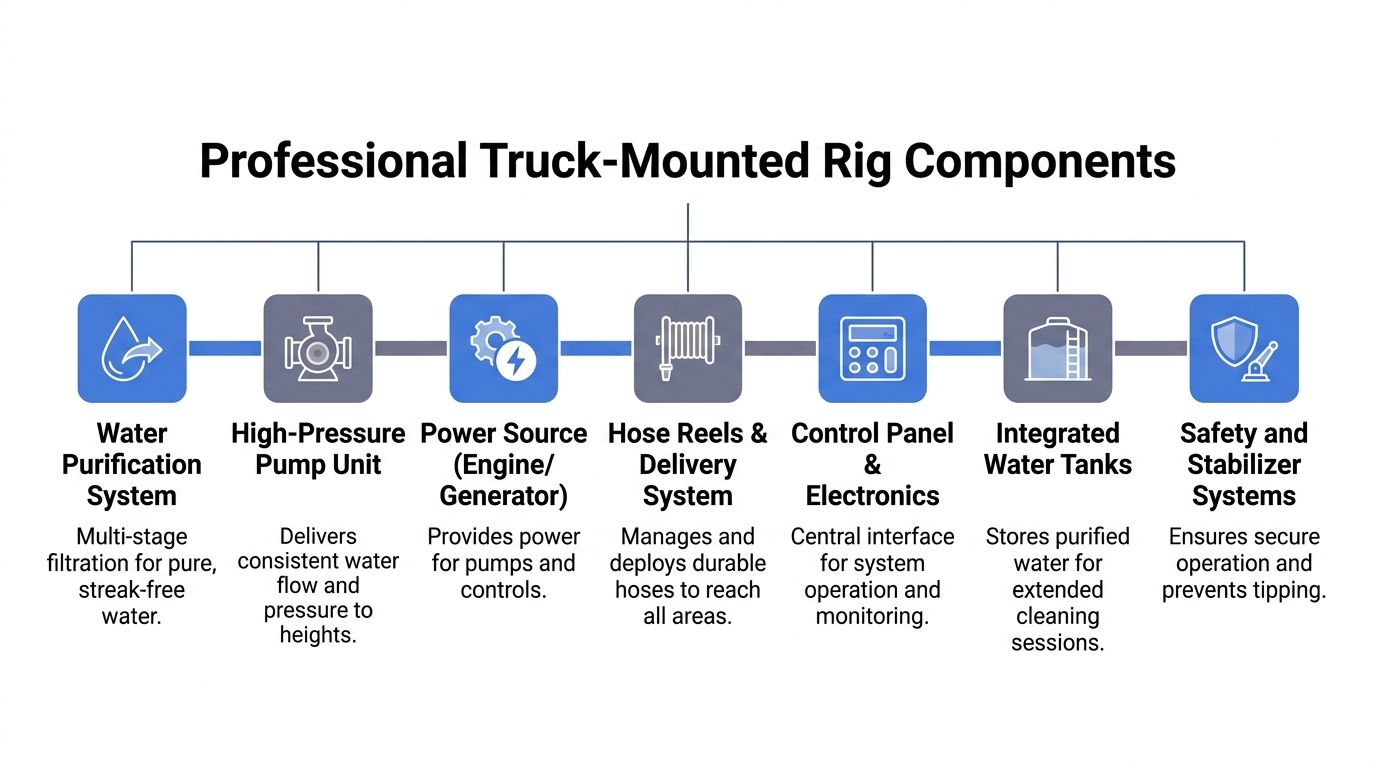
If a company uses pure-water cleaning, the filtration system is the heart of the rig. The goal is simple. Remove the minerals and impurities that cause spotting.
That usually means a multi-stage setup using reverse osmosis and deionization. The truck also needs integrated tanks large enough to keep work moving through the day instead of forcing constant stop-and-start refills.
For clients, this is the part that explains why one company can rinse glass and leave it clean while another leaves mineral marks behind.
Water has to travel from the tank to the brush head with stable pressure. If the pump is weak or inconsistent, the technician loses control at the glass. Rinsing quality drops, and upper-story work gets slower.
Hose reels matter more than many clients realize. Clean reel management reduces tangles, protects landscaping, and helps crews move around the property without dragging lines through the wrong places.
A serious rig has a reliable power source for pumps, controls, and related systems. It also has a control panel that makes operation predictable rather than improvised.
The difference shows up in small ways that affect the whole job:
When the property needs elevated access, the truck may carry a boom or lift. That is where structural quality matters. The access side of the rig must work with the truck chassis, stabilizers, and controls as one package.
For a deeper look at the tools that support advanced field operations, this overview of professional window cleaning equipment gives helpful context.
Tip: If a provider talks only about “having a truck” but cannot explain purification, pumping, hose control, and stabilization, they are describing transportation, not a complete operating system.
What works is a balanced rig. Enough water. Reliable filtration. Strong pump output. Organized hose deployment. Stable access equipment. Clear control systems.
What does not work is overbuilt access with weak water delivery, or a large tank with poor purification, or a fancy boom operated by people who cannot plan site setup. Top-tier results come from integration, not from one impressive piece of hardware.
A truck mounted system earns its value when the equipment fits the property and the crew knows how to use it without creating new problems. That is what clients should evaluate during the estimate. The right rig improves access, protects the site, and keeps the work controlled from start to finish.

On residential work, the benefit is usually lower-impact access. Homes with courtyards, tile roofs, steep grades, pool decks, and delicate landscaping leave very little room for careless ladder use or constant repositioning.
A properly set up truck mounted pure-water system lets a crew cover long exterior window runs with fewer contact points against the house. That helps protect trim, stucco, gutters, and planted areas. It also keeps technicians working in a more predictable pattern, which clients notice right away.
For homeowners, that matters because clean glass is only part of the result. The service should also leave the property looking untouched.
Commercial properties put pressure on time, appearance, and traffic flow. A storefront, medical office, dealership, or office building cannot afford a sloppy setup around entries and parking areas.
An integrated rig gives the crew water supply, hose management, pumping power, and access support in one operating system. The practical advantage is shorter setup, fewer loose components around the site, and better control around customer-facing areas. For a property manager, that often means less disruption to tenants and fewer complaints during the job.
Good operators also know the trade-off. Faster production only helps if the crew can still detail problem glass, work around active pedestrian areas, and avoid turning the front of the building into a staging zone.
Some properties are defined by access constraints before cleaning even starts. Tight setbacks, architectural glass, limited staging, and busy public areas all raise the standard for both equipment and planning.
On those jobs, reach and positioning matter as much as cleaning method. Truck-mounted telescopic boom cranes can reach sheave heights up to 215 feet, according to Altec crane specifications. Clients comparing providers for taller buildings should also review the types of high-rise window washing equipment used on complex access jobs, because the best results come from matching the access method to the building instead of forcing one tool onto every elevation.
In cities such as Denver and Las Vegas, crews often have to handle height, wind exposure, restricted staging, and public visibility at the same time. Equipment capacity matters, but operator judgment matters just as much.
| Client Type | Primary Benefit | What a Good Provider Demonstrates |
|---|---|---|
| Homeowners | Lower-impact exterior access | Fewer ladder touchpoints, cleaner hose routing, and protection for landscaping and exterior finishes |
| Commercial property owners | More controlled workflow | Efficient setup, clear traffic awareness, and minimal disruption around entries and parking areas |
| High-rise and mid-rise managers | Better access planning | The right combination of reach, positioning, and cleaning method for difficult elevations |
The estimate often tells you whether the company owns equipment or operates it well.
Look for signs like these:
A seasoned operator talks about your site in practical terms. That is usually a stronger signal than polished sales language.
Phoenix, Denver, and Las Vegas do not present the same cleaning conditions. Dust load, mineral buildup, heat, wind, and elevation change how glass soils and how equipment performs in the field.
Clients should evaluate truck mounted equipment by what it allows the crew to do well on their specific property. Can they work safely with controlled access? Can they maintain quality at height? Can they finish the job without dragging out setup, overusing ladders, or disrupting the site more than necessary?
That is the standard worth using. The best rigs are impressive because they remove friction from the work and help skilled crews deliver a cleaner, safer, more consistent result.
A truck pulls into a tight condo drive in Phoenix at 7 a.m. Residents are walking dogs, sprinklers have left the pavement slick, and the crew needs to stage hoses without blocking garages. In that moment, the quality of the rig matters less than the discipline of the people running it.
A professional operation shows up in routine habits. The crew inspects the system before work starts, positions the truck with clear purpose, and controls the work zone so the property stays safe while the glass gets cleaned.

Falls get attention. Vehicle movement deserves the same attention.
Service trucks have blind spots, and those blind spots often get worse when tanks, reels, booms, or lifts affect visibility. OSHA describes backing operations as especially hazardous in its guide on avoiding runovers and backovers, which is why experienced crews use spotters, choose parking positions carefully, and reduce unnecessary repositioning on active properties.
That matters even more at occupied sites in Denver and Las Vegas, where tighter access, delivery traffic, or shared parking areas can turn a simple move into the highest-risk part of the job.
Ask how they control the work area, not just how they clean the glass. Strong companies answer with specifics.
Clients who want a better read on elevated access standards can review this guide to high-rise window washing equipment. It helps separate crews who have access gear from crews who understand how to operate it safely.
Equipment condition tells you a lot. Well-kept hose reels, clean tanks, secure fittings, responsive controls, and smooth boom movement usually reflect a company that pays attention before problems reach your property.
Poor maintenance leaves visible clues. Leaks, tangled lines, worn pads, dirty filtration components, and jerky boom operation often point to rushed inspections or deferred repairs. On the client side, that can mean spotting on the glass, avoidable downtime, damage to surfaces, or a crew improvising around equipment problems instead of following a clean plan.
Key takeaway: You are hiring operating judgment, not just machinery. The best providers prove that judgment through inspection routines, controlled vehicle movement, and equipment that is maintained well enough to perform consistently on your property.
A property manager gets three bids for the same building. The lowest number looks good until the crew blocks the main entry longer than expected, leaves mineral spotting on south-facing glass, and has to come back because the access plan did not match the site. That is where cost and value split apart.
Truck mounted equipment affects ROI because it changes production speed, water delivery, access options, and how much improvising happens on your property. In Phoenix, Denver, and Las Vegas, those details matter. Heat, wind, tight parking, and mixed-use layouts punish crews who show up with a generic setup and no clear operating plan.
Clients do not need to know every pump, reel, or filtration spec. They do need to hear whether a company can explain its system in plain language and tie it to the building in front of them.
Ask these questions:
One strong answer is worth more than a polished sales pitch.
ROI shows up in fewer callbacks, cleaner glass on the first visit, less disruption for tenants or homeowners, and lower risk around vehicles, walkways, and exterior finishes. It also shows up in schedule reliability. A crew with the right rig can complete work in the planned window instead of stretching a half-day service into a full-day inconvenience.
That matters even more on properties where appearance affects occupancy, customer perception, or resident satisfaction.
Equipment design is shifting toward lighter, more efficient truck builds. According to Custom Truck One Source on equipment selection, some newer systems show a 28% rise in electric truck-mounted water systems, 40% water-weight reduction, and fuel cost cuts of up to 25% in hybrid pole-lift combinations. For clients, the takeaway is simple. Lighter and more maneuverable rigs can be easier to position on tighter residential streets and busy commercial sites, with less strain on the vehicle and a cleaner operating footprint.
For clients in Scottsdale and similar neighborhoods, that can translate into a practical advantage. A provider using a well-matched rig may be able to work more cleanly in cul-de-sacs, narrow drives, gated communities, and shared parking areas than a company relying on extra hose runs and repeated truck repositioning.
Ask the company to explain why its setup fits your property, not just whether it owns truck mounted equipment.
A serious provider will connect the rig to the result. They will explain how their system helps them protect access points, control water quality, reduce unnecessary movement, and finish with less rework. That is the answer that usually leads to the best long-term value.
Modern truck mounted equipment has changed what clients should expect from window cleaning. Better access, better water delivery, better control, and stronger safety habits all lead to a better outcome on the glass.
That does not replace the fundamentals. Professionals still clean windows in only two ways, with a squeegee or with a pure-water system. The equipment allows those methods to be used with more precision on more demanding properties.
After more than 26 years in business, the difference is not just experience. It is knowing which setup works on which building, where truck mounted equipment improves the result, and where discipline matters more than showmanship.
For homes in Arizona and for taller commercial properties in Las Vegas and Denver, the best service providers think like operators first. They plan the access, protect the site, choose the right method, and let the equipment support the work instead of complicating it.
Some systems produce noticeable operational noise, especially when pumps or power units are running, but a well-maintained rig should sound controlled rather than rough. If noise matters on your property, ask when the loudest part of setup occurs and whether the crew can schedule around tenant or customer traffic.
A careful provider plans parking and hose routing to avoid that. The key issue is not just vehicle size. It is whether the crew evaluates surface condition, slope, edges, irrigation areas, and turning space before they set up.
It depends on the rig and whether the job requires only water delivery or elevated access too. A good contractor should assess your site first and tell you exactly where they plan to position the vehicle.
No. Professional window cleaning still comes down to the two primary methods, squeegee or pure-water cleaning. Truck mounted equipment supports those methods, but it does not eliminate the need to choose the right one for the glass, soil level, and access conditions.
No. It is useful anywhere access, efficiency, and control matter. That can mean a high-rise, a medical office, a dealership, or a large custom home with difficult exterior glass.
Clear answers. They should be able to explain their cleaning method, site plan, safety procedures, and why their equipment fits your property without resorting to vague promises.
If you want window cleaning done with the right method, the right access plan, and the kind of operational discipline that protects your property, contact Professional Window Cleaning. With service across Arizona, Colorado, and Nevada, the team brings decades of experience to residential, commercial, and high-rise work.
Read our blog posts regularly and keep learning.