Care and Maintenance
Medium Bristle Brush Guide for Window Cleaning
Discover why a medium bristle brush is the ultimate tool for window cleaning. Learn about materials, pure-water systems, and expert selection tips.


Professional home window tinting usually lands around $600 to $700, with national averages of about $613 and about $706, and a typical project range running from $317 to $1,145 depending on the job. In plain terms, the final average price for window tinting depends heavily on square footage and film type, which is why one home comes in at a few hundred dollars while another pushes past a thousand.
If you're reading this, there's a good chance you're tired of one of three things. Afternoon glare on the TV. Rooms that heat up faster than the rest of the house. Or windows that feel a little too exposed once the sun goes down.
Tinting is one of those upgrades people often look into after trying cheaper fixes first, like blinds, curtains, or moving furniture away from the harshest windows. Sometimes those help. Sometimes they just cover the symptom and leave the heat, glare, and fading problems in place.
That's also where pricing gets confusing. People search for the average price for window tinting and expect one number. The market doesn't work that way. Installers price by glass area, film choice, labor difficulty, and whether the windows are standard rectangles or something more challenging.
For homeowners in hot markets like Phoenix and Las Vegas, those choices matter even more because sunlight isn't an occasional nuisance. It's a daily part of living with glass.
You notice it on a July afternoon. The west-facing room is brighter than you want, warmer than the rest of the house, and the glare on the television makes everyone shift seats. In Phoenix and Las Vegas, that kind of window problem is not occasional. It shows up day after day, and it usually pushes homeowners to ask the same question first: what does window tinting cost?
The short answer is that tinting is priced more like fitted flooring than a boxed appliance. There is no single shelf price because the installer is working with your exact glass, your exposure to sun, and the film that fits the job. A quote for three standard downstairs windows will look very different from a quote for tall foyer glass, skylights, or a full wall of south-facing windows.
That is why average pricing can help set expectations, but it cannot stand in for an on-site quote.
From our side of the trade at Professional Window Cleaning, that pattern is familiar. Homeowners often call us for cleaning first, then ask about tint after living with heat, glare, fading, or privacy concerns for a season. We see the same thing over and over. The window may be clean, but the room still feels uncomfortable because the issue is not dirt on the glass. The issue is what the glass lets in.
A good way to frame tinting cost is to separate the job itself from the number on the estimate. The job includes glass size, window height, film type, sun exposure, and how difficult the installation will be. The estimate is the installer putting a price on those conditions. If you have ever compared homes with very different amounts of glass, the logic is the same as using a window washing price calculator. More glass, harder access, and more specialized work usually mean a higher total.
Another point causes confusion early. People use “window tinting” to describe several different services. Automotive tinting is commonly sold by vehicle or package. Residential and commercial tinting are usually measured by the glass itself, with labor tied closely to access and complexity. Since this guide is about helping property owners judge home and building projects, the useful question is not “What does tint cost in general?” but “What kind of glass do I have, and how demanding is this installation?”
Seasoned window professionals start there. Before discussing film brands or warranty terms, they look at pane size, frame condition, obstacles near the glass, and whether the work happens on a simple ground-floor window or a tall second-story panel. Tinting follows the same practical rule as cleaning. The right method depends on the window in front of you. That insider view matters because a careful installer is not just selling darker glass. They are pricing the time, precision, and material needed to make the film look right and perform well for years.
A tinting quote makes more sense once you sort it into two buckets. One bucket is the base film and labor for ordinary windows. The other is everything that pushes the job into a specialty category, such as oversized glass, high windows, or premium films.
From our side of the window business at Professional Window Cleaning, this pattern is familiar. Window care jobs often look similar from the street, but the price changes once you get close to the glass. Tinting works the same way. A straightforward set of living room windows is one kind of project. A wall of sun-facing glass in Phoenix or a modern home with tall entry windows in Las Vegas is another.
For homes, installers commonly quote either by total project price or by square foot. In practical terms, many standard residential jobs land in the several-hundred-dollar range, while larger homes or upgraded films push the total higher. Commercial work is often priced by square foot because storefronts, offices, and multi-pane buildings are easier to measure that way.
Here is the simplest way to read the market without getting lost in too many pricing formats.
| Project Type | Typical Price Position | Common Pricing Model |
|---|---|---|
| Residential window tinting | Usually several hundred dollars for a standard project | Per project or per square foot |
| Commercial window tinting | Often quoted on a lower per-square-foot basis for larger runs of glass | Per square foot |
| Premium or specialty film | Noticeably higher than standard film | Per square foot |
| Smart or switchable film | Top-tier pricing category | Premium per square foot |
That table is broad on purpose. National averages can be helpful, but they blend together small single-story homes, larger custom properties, basic film packages, and high-performance products. The result is a rough starting point, not a number you should expect an installer to honor without seeing the glass.
A quick self-check can keep you from comparing quotes that are built on completely different assumptions.
Measure the glass, not just the number of windows
Six small bathroom windows and six large west-facing panels do not belong in the same budget conversation.
Separate standard film from premium film in your mind
Basic privacy or glare-control films usually sit in one pricing tier. Heat-rejecting, decorative, security, and smart films belong in higher tiers.
Look at the windows the way an installer will
Ground-floor rectangles are usually simpler. Skylights, transoms, specialty shapes, and tall foyer windows take more labor and more care.
If you already use glass size to compare home services, a window washing price calculator for estimating by window size and access helps illustrate the same logic. More glass and harder access usually mean more labor, whether the work is cleaning or film installation.
Homeowners in hot markets often ask why one company gives a per-window price and another gives a square-foot price. Both methods can be legitimate. Per-window pricing is a shortcut that works best on simple, fairly uniform jobs. Square-foot pricing is usually more precise, especially when the home has mixed pane sizes.
That difference matters in real homes. A ranch house in Phoenix with consistent bedroom windows may be easy to package. A custom property in Las Vegas with tall accent glass, stairwell windows, and sliding doors usually needs a more detailed quote.
The best way to read any average price is the same way a good window pro reads a pane before cleaning it. Start with the basics, then look for the details that change the work.
One quote can be several hundred dollars apart from another without either installer being wrong. The difference usually comes down to scope, access, and product selection.

Film type is often the biggest price lever. Some homeowners only want a darker appearance or more privacy. Others want stronger heat rejection, glare control, or a premium specialty product.
That's why two estimates for the same windows can look very different. If one quote is based on a basic film and the other is based on a higher-end option, the numbers won't match. The right question isn't “Why is one higher?” It's “Are these even quoting the same film performance?”
Large panes take more film and more handling skill. Tall windows and specialty shapes add setup time and increase the chance of rework if the cut or placement is off.
According to Dark Shade Window Tint's home tinting cost discussion, installation complexity such as oversized or specialty glass, skylights, and tall ceilings raises costs, and taller windows can add about $0.50 to $1.50 per square foot to labor because of added difficulty and risk.
That lines up with what window professionals see every day. Cleaning a high-rise panel isn't priced like a ground-floor slider. Tinting follows the same logic. A second-story arched window costs more because the installer has to solve for access, precision, and time all at once.
Some of the most important pricing details don't stand out until the installer visits the property.
Special shapes
Arched, angled, and custom windows take more cutting and fitting than standard rectangles.
High or obstructed glass
Furniture, stairwells, tall foyers, and tight landings slow the work down.
Oversized panes
Bigger sheets are harder to handle cleanly, especially indoors.
Scope changes
Homeowners sometimes add windows after the estimate. That changes material usage and labor flow.
A good quote should tell you what's included, what's excluded, and what would trigger a change order.
A quote that feels fair in one city can look high or low in another. We see that all the time in window care. The same pane of glass can need a different solution depending on heat, sun angle, local labor costs, and what the customer is trying to fix.

In hot, high-sun markets such as Phoenix and Las Vegas, customers usually care less about the lowest starting price and more about how well the film cuts heat and glare day after day. In a place with stronger seasonal swings, the conversation often shifts toward year-round comfort, UV protection, and how the room feels at different times of day.
That difference matters because film pricing is tied to performance. A budget film may solve brightness. A better film may solve brightness, heat buildup, and fading risk at the same time. From the perspective of a local window company, that is similar to the difference between a quick surface clean and detailed glass care. Both improve the window, but they do not deliver the same result or lifespan.
Regional labor rates also affect pricing. Installers in dense metro areas or fast-growing markets often charge more because overhead, travel time, and scheduling pressure are higher. So if two homeowners request similar tint on similar windows, the final quote can still vary based on zip code alone.
Home window film is usually a performance and appearance decision. Vehicle tint adds compliance. States set rules for how dark certain windows can be, especially front side glass and parts of the windshield, so the film that looks acceptable in one area may create problems in another.
Ask the installer which tint shades are legal where the vehicle is registered. Then confirm that answer with your state's current rules before the work begins. Good shops expect that question. Reputable shops also explain their credentials clearly, which is one reason it helps to understand the difference between bonded and insured window service providers.
For a useful example of how local markets shape service pricing, this guide to Seattle auto detailing costs is worth reviewing. It covers a different service, but the pricing logic is familiar. Labor conditions, customer expectations, and job scope all influence the final number.
A strong installer does more than apply film neatly. They should know which products hold up well in desert sun, which options make sense for privacy without making a room too dark, and which automotive films fit local rules. That kind of advice is hard to fake.
Professional Window Cleaning sees a close parallel with glass maintenance. A cleaner who works in a dusty, sun-heavy market learns quickly which windows show every flaw by midafternoon. Tinting works the same way. Regional experience helps an installer recommend products that still look good and perform well after the first hot season, not just on install day.
DIY tinting can save money on labor. That's the appeal, and it's real. If you're working on a small, low-risk project and you're patient, a DIY route may look attractive at first.
The problem is that window film is unforgiving. Dust, trapped moisture, crooked alignment, edge lift, and bubbles don't always show up immediately. Some flaws appear once the film starts curing and the sunlight hits it at the right angle.
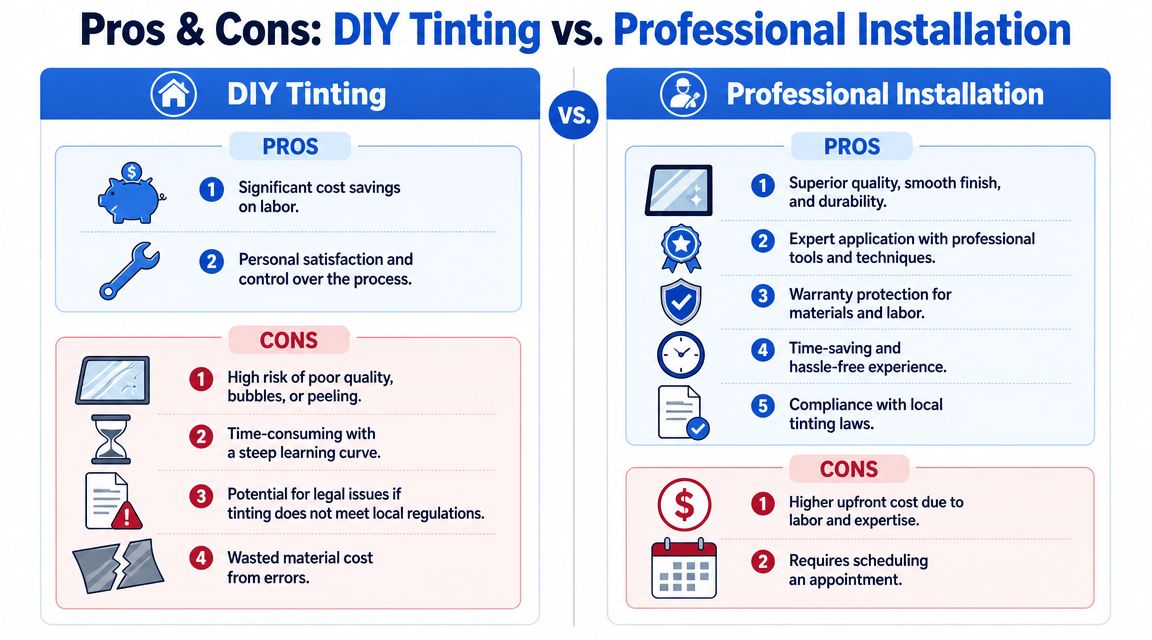
Most failed DIY jobs come down to process control. The glass wasn't cleaned well enough. The film was handled too much. The cut wasn't precise. Or the installer worked in a space where debris kept landing on the adhesive side.
That should sound familiar if you've ever watched window professionals work. In expert window cleaning, there are only two methods professionals use: a squeegee, or a pure-water system. That discipline matters. Professionals don't chase results with random techniques. They use proven methods, the right tools, and repeatable process.
Tinting works the same way. A clean finish depends on preparation, environment, and experience.
DIY makes sense when
You have a very small project, you're comfortable with careful handwork, and you can accept imperfections if the result isn't flawless.
Hiring a pro makes sense when
The glass is visible, expensive, high, large, custom-shaped, or part of a property where appearance matters every day.
DIY gets expensive when
You waste film, have to strip and redo a panel, or end up paying for a professional fix after a failed first try.
Here's a useful explainer on the value of working with a protected service company: bonded vs insured. It isn't tint-specific, but it helps clarify why credentials and accountability matter when someone is working on visible, high-value surfaces.
This video gives a helpful visual sense of application challenges and decision points:
If you choose professional installation, ask direct questions:
What film are you quoting
Ask for the exact product line, not just “premium” or “ceramic-like.”
What surfaces are included
Confirm whether the quote covers every pane you discussed.
What warranty applies
Find out whether labor and film are both covered.
How do you handle difficult glass
Ask specifically about skylights, tall entry windows, and custom shapes.
Cheap tint can become expensive if it has to be removed and redone.
A good tinting project feels a lot like a good window cleaning job. The result should look right, perform the way you expected, and hold up over time. From our side of the glass business at Professional Window Cleaning, that is usually where value is won or lost. The best outcome comes from matching the film to the problem, then installing it cleanly on the right panes.
Start by defining the job in plain language. Are you trying to cut afternoon heat in a Phoenix family room, reduce glare in a Las Vegas office, add privacy to street-facing glass, or protect furnishings from sun exposure? Installers can only price accurately when the goal is clear.
Then compare quotes the way you would compare tires for a truck. Two options may fit, but they may not be built for the same workload. One bid might include a basic dyed film, while another includes a higher-performance ceramic product. If you only compare the total price, you miss what you are buying.
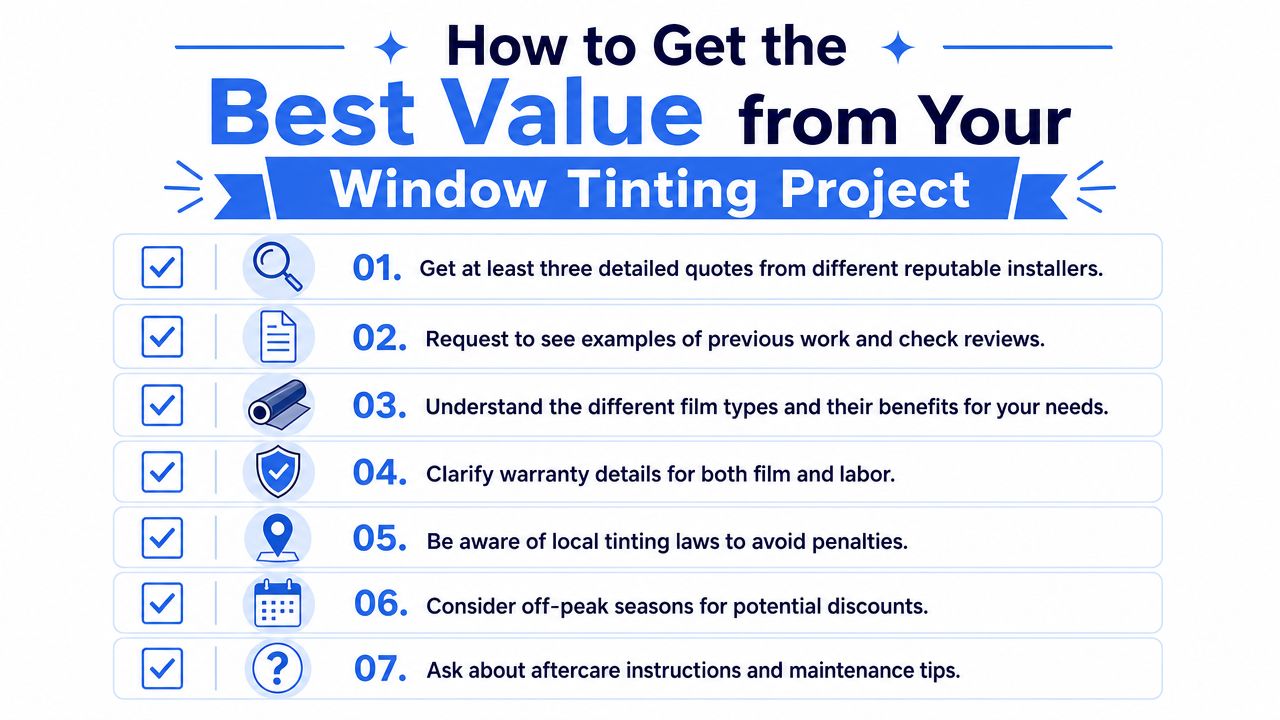
Use this shortlist when you review bids:
Ask for the exact film name
Get the brand and product line in writing so you can compare one quote to another on equal terms.
Confirm the full scope
Make sure the quote clearly lists which panes, doors, sidelights, or upper windows are included.
Review workmanship photos
Look for straight edges, clean corners, and projects with glass similar to yours.
Read the warranty carefully
Film coverage and labor coverage may be different, and that difference matters if bubbling or peeling shows up later.
Ask about cure time and cleaning
Fresh film needs time to settle. Good aftercare instructions help you avoid damaging a new installation.
The upfront number matters, but it is only one part of the decision.
A less expensive film can turn into the higher-cost option if it fades early, performs poorly on west-facing glass, or has to be removed before its time. Removal is labor. Reinstallation is labor plus new material. That is why the cheapest quote often stops being the cheapest once real-world use enters the picture.
As noted earlier, some homeowners treat tinting as a practical upgrade because it can improve comfort and help control cooling demand. The payoff is usually easier to notice in hotter, sunnier climates and on rooms that take direct afternoon sun. In places like Phoenix and Las Vegas, that difference can feel immediate. In a shaded room, the benefit may be more modest.
Certain properties deserve extra scrutiny before you approve a proposal.
One simple rule helps here. The better the installer, the better the questions. If a company does not ask about glass size, sun exposure, access, existing film, or your main goal, the quote is probably too rough to trust.
Both show up in the market, but square footage usually gives the clearest picture because glass area drives both material use and labor.
The installers may be quoting different films, different scopes, or different assumptions about access and difficulty.
Not always. They make more sense when heat, glare, privacy, or specialty performance is the main goal.
Only if the quote is equally detailed, the film is clearly identified, and the workmanship history is strong.
If you want help from a team that's spent more than 26 years working with glass and helping properties look their best, Professional Window Cleaning is a trusted resource for window care across Arizona, Colorado, and Nevada. Whether you're maintaining a home, commercial property, dealership, medical office, or high-rise, their experience with glass, access, and visible finish quality makes them a smart first call.
Read our blog posts regularly and keep learning.