
Care and Maintenance
Best Commercial Window Cleaning: Top Providers for 2026
Compare the best commercial window cleaning providers across AZ, CO, and NV, with criteria for high-rise access, pricing factors, and how to choose a vendor.


If you're trying to budget for window cleaning right now, you're probably seeing prices that don't line up. One calculator gives you a rough national average. Another asks for a window count but ignores screens, tracks, height, and access. Then you call a company and get a totally different number.
That confusion is normal. Window cleaning pricing isn't random, but it also isn't as simple as multiplying a house by a flat number.
After decades in this trade, one thing stays true. A useful window washing price calculator only works if it reflects how pros bid jobs in the field. That means counting the right units, using the right pricing method for the property type, and accounting for the two real cleaning methods professionals use: traditional squeegee work and pure-water systems. Everything else is detail layered on top of that.
In desert markets and mountain markets, details matter even more. Dust, hard water, multi-story access, and building type can change a fast estimate into a bad one. That applies whether you're maintaining a home in Scottsdale, managing storefront glass in Phoenix, or overseeing a condo tower in Las Vegas.
A common question is: What's fair?
The short answer is that window washing in the United States commonly runs from $8 to $16 per window for interior and exterior cleaning, with many pros landing around $10 per window or $4 to $8 per pane, based on 2026 industry cost guides and calculators summarized by HomeWyse.
That broad range exists for a reason. A ground-floor slider with easy access isn't priced the same way as divided-light windows on a second story. A one-time cleanup after long neglect isn't the same as routine maintenance. And a calculator that doesn't ask those questions is usually giving you a starting point, not a final number.
Home-size examples make that clearer. HomeGuide's market summary, cited in the same data set, shows a typical 1,500 sq ft home with 15 windows at $250 on average, scaling to $570 for a 4,200 sq ft home with 42 windows. The same pricing references also note common add-ons for upper-story access and specialty work.
A real calculator isn't guessing. It's taking a few practical inputs and converting them into labor, equipment time, and risk.
At minimum, a useful estimate should consider:
If you want a broader sense of how service pricing works beyond windows alone, this breakdown of cleaning services cost helps show why labor-based services rarely fit one flat price.
Some tools quote by the window. Some quote by the pane. Some blend hourly assumptions in the background. None of those methods is wrong by itself. The problem starts when the method doesn't match the property.
Practical rule: A fair window price comes from matching the pricing method to the job, not forcing every property into the same formula.
For homeowners, the goal isn't to memorize trade math. It's to understand what moves the number up or down so you can spot a realistic quote when you see one.
The price starts with counting glass, but that's not where it ends.
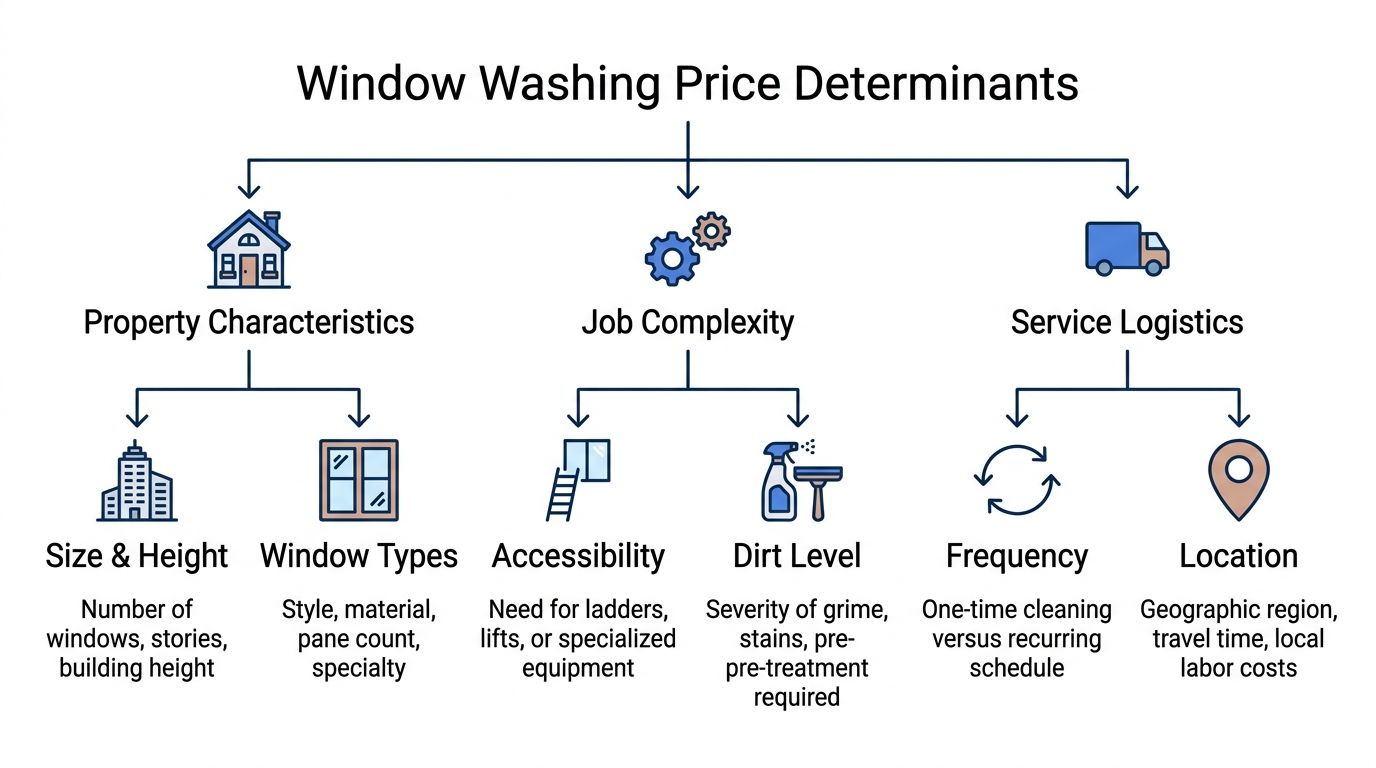
A professional bid usually combines a base formula with adjustments for real-world conditions. According to 2025 to 2026 market pricing summarized by HomeGuide, residential jobs average $260, with a $150 to $370 range, and many pros price labor at $40 to $75 per hour for a 1,500 sq ft house. The same source describes a common structure as number of windows × $10 per window, then add-ons such as screens at $2 each, tracks or sills at $3, and large picture windows at $10 to $20.
Most jobs fall into one of these structures.
| Pricing model | Best use | What it handles well | Where it breaks down |
|---|---|---|---|
| Per pane | Homes with mixed window styles | Divided lights, French panes, true labor volume | Large commercial sites |
| Per window | Simple residential layouts | Fast quoting, standard double-hung or sliders | Underprices specialty glass |
| Hourly | Uncertain or heavily soiled jobs | First-time cleans, problem solving, touch-up work | Harder for customers to compare |
| Square footage or scaled commercial bid | Offices, condos, dealerships, high-rise | Large glass packages, crew scheduling, equipment planning | Too blunt for detail-heavy homes |
Per-pane pricing is usually the cleanest residential method because it follows the actual work. Per-window pricing is faster but can hide complexity. Commercial properties often need square-footage logic or a custom site bid because access, crew size, and safety planning matter as much as the glass itself.
Window count is the base. Everything below is the adjustment.
For larger commercial work, HomeGuide's pricing summary also notes scaled examples such as $185 for 1,000 sq ft with 10 windows and $450+ for 3,200 sq ft with 32 windows, plus premiums for multi-pane grids at $8 to $15 and tinted glass at $8 to $15.
In the field, pros use two methods. One is the squeegee method, which gives precise control and is still the standard for interior work and detailed residential glass. The other is a pure-water system, which uses purified water through poles for efficient exterior cleaning, especially on taller or harder-to-reach glass.
Neither method is automatically "better" for every job. Squeegees win on detail and traditional interior work. Pure-water systems win on reach, speed, and certain commercial exteriors. A serious calculator should reflect which method the crew is likely to use, because production time changes.
The best bids don't just count windows. They account for how the crew will clean them.
Experienced companies also price to protect efficiency and overhead. The same HomeGuide summary notes that pros often factor in 10 to 20 percent margins and may offer 10 to 20 percent off on recurring work. That's not padding. That's what keeps crews insured, equipped, and able to show up consistently.
On the company side, this matters for marketing too. If a contractor doesn't understand acquisition costs, it's easy to chase cheap work and underbid good work. That's why trade businesses benefit from understanding Cost Per Acquisition (CPA) before setting aggressive pricing that looks good on paper but doesn't hold up in the field.
A homeowner in Phoenix calls for a price on a two-story stucco house and starts with square footage. In the field, that number helps very little. Residential window cleaning is priced by labor on the glass in front of you, and labor usually starts with pane count, not house size.
Housecall Pro explains the standard residential approach clearly in its window cleaning pricing guide. The model starts with counting panes, setting a base rate, adjusting for difficulty, then adding screens and tracks. That guide lists typical residential pricing at $4 to $15 per pane, with $2 to $3 per screen and about $3 per track or sill, and notes that tougher access or heavier buildup can raise pricing by 20 to 50 percent.
That framework matches how experienced residential companies quote. It also explains why two homes with similar square footage can price very differently.
A practical residential estimate usually follows this order:
That order matters. A ranch home with large fixed panes may clean faster than a smaller house packed with French panes, cut-ups, and second-story windows over tile or landscaping.
In Phoenix and Las Vegas, sun-baked dust and hard water often change the labor more than homeowners expect. In parts of Colorado, weather exposure and storm residue can do the same. A generic online calculator usually misses that regional difference because it treats all dirt the same. It is not the same.
Use this as a planning tool, not a universal price sheet.
Sample Residential Window Cleaning Price Tiers (Per Pane)
| Window/Pane Type | Standard Grime (1st Floor) | Heavy Grime / 2nd Floor |
|---|---|---|
| Standard pane | $4 to $15 per pane | Base rate plus 20 to 50 percent |
| Large picture-style pane | Often priced toward the higher end of the per-pane range | Often priced toward the higher end, plus complexity adjustment |
| French or divided panes | Count each pane individually | Count each pane individually, then apply complexity adjustment |
One mistake I have seen for years is treating a window opening as one unit no matter how it is built. That is how bids get blown.
Take a two-story home with mixed glass. You might have double-hungs in the bedrooms, sliders at the rear, one oversized picture window, a few transoms, insect screens, and second-story glass above a roof line.
The correct estimate starts by counting panes. A double-hung is often counted as two panes because both sections need separate work. Sliders are usually counted by the glass sections being cleaned. French panes and divided lights take longer because each pane edge has to be detailed by hand. Oversized picture glass may price at the top of the per-pane range because it takes more control and often shows every mistake.
Then break the job into labor groups. First-floor exterior glass with open access sits at one rate. Interior glass with furniture, shutters, or delicate flooring can sit at another. Second-story glass usually gets a complexity increase because setup, ladder placement, or pole work slows production. If the home has oxidation, sprinkler staining, or debris packed into tracks, those items need to be listed separately.
That is how a quote stays accurate.
Strong quotes usually do four things well:
Weak quotes leave too much unsaid. If the homeowner hears one flat number with no explanation, there is a good chance the crew will either rush the work or add charges later.
This matters even more on taller custom homes. Some residential properties start to borrow access issues from commercial work, especially with stacked glass, entry towers, or large foyer windows. Homeowners dealing with those layouts should understand how high-rise and difficult-access window washing changes the price helps change pricing.
Residential pricing still has to cover labor, tools, insurance, travel, and the time lost on undercounted windows. Housecall Pro also notes that companies commonly build estimates from labor, materials, and overhead before adding margin. That is standard business math, not padding.
After 27 years in this trade, I can tell you where bad pricing usually starts. The estimator counts openings instead of panes, ignores screens, guesses on second-story access, and assumes every house cleans at the same speed. That bid looks attractive on the phone. It falls apart on the job.
Good residential pricing is plain, itemized, and specific. It shows how the company counted the work, where the difficulty is, and what is included. That is the kind of quote that holds up in Phoenix, Las Vegas, Colorado markets, and anywhere else crews have to price real labor instead of guessing from square footage.
A property manager approves a low bid for a mid-rise office, then the problems start. The crew needs access the bid never accounted for, interior work has to be pushed after hours, and the final invoice climbs because the original price was built from rough guesses instead of a real site plan.
That is how commercial jobs go sideways.

Commercial and high-rise pricing starts with production, access, and risk. Pane count alone will not carry the estimate. On a storefront in Arizona, the key question may be how fast a crew can move without disrupting customers. On a medical office in Colorado, interior scheduling and security rules can slow the job more than the glass itself. On a tower in Nevada, the access method can drive the price before cleaning even begins.
Lucid Bots' commercial window cleaning pricing article outlines the standard estimating method clearly: measure glass square footage, assess height and access, calculate labor, materials, and overhead, then apply margin. The same article explains that high-rise access can add large premiums when lifts, drones, or specialized equipment are required, and it warns that weak market research leads to underbidding.
Commercial bids fail when someone treats the property like a bigger house.
A house estimate usually lives or dies on count accuracy. A commercial estimate lives or dies on access accuracy, site rules, and crew efficiency. Two buildings with the same amount of glass can price very differently if one has open ground access and the other requires lift work, escort requirements, traffic control, or overnight interiors.
Here is how the pricing logic usually changes:
| Factor | Residential | Commercial ground-level | High-rise |
|---|---|---|---|
| Primary pricing unit | Pane or window | Window package or square footage | Square footage, access plan, equipment |
| Main challenge | Counting accurately | Routing crews and minimizing disruption | Safety, rigging, lifts, staging, insurance |
| Best cleaning method | Squeegee, sometimes pure-water | Often mixed method | Often pure-water, lift work, or rope-access planning |
| Quote style | Fast estimate | Site-informed estimate | Detailed scope and access review |
In Phoenix and Las Vegas, heat changes production rates, especially on large exterior routes where water management and crew timing matter. In Colorado, wind, colder months, and access around snow or ice can change both scheduling and safety requirements. A useful calculator has to leave room for those regional differences, because commercial pricing is never just glass times a rate.
For a low-rise office, retail center, school, dealership, or medical building, I want answers to a few plain questions before I trust the number:
Recurring work changes the math. A quarterly storefront route is priced differently from a one-time cleanup on neglected glass. Buildings that stay on schedule usually cost less per visit because the crew is maintaining condition, not correcting months or years of buildup.
Once the building needs rope access, swing stage, lifts, or a formal staging plan, the estimate becomes a project quote.
That price has to cover labor and cleaning time, but also equipment, safety procedures, insurance exposure, site coordination, and approvals from building management. If you want a better sense of how those jobs are scoped, this guide to high-rise window washing access and pricing factors explains what changes once height becomes the main cost driver.
High-rise work costs more because safe access costs more. That expense starts before the first piece of glass is cleaned.
The better commercial estimates I see have a few traits in common:
That last point matters. Good bidders state the assumptions up front. If roof access is unavailable, if tenant spaces are locked, or if mineral staining is heavier than expected, the quote should say so. That protects the customer and the contractor.
Commercial work can be more systematic than residential work, but only when the estimator understands the property type. Ground-level retail, multi-tenant office buildings, casinos, condominium towers, and high-rise mixed-use buildings do not belong in one flat formula.
A homeowner in Scottsdale enters 32 windows, two stories, inside and out, and gets a clean number in under a minute. Then the crew arrives and finds hard water on the lower panes, tight access around the pool deck, and sunscreens that take extra labor to remove and reinstall. That is how online pricing gets close, then misses.
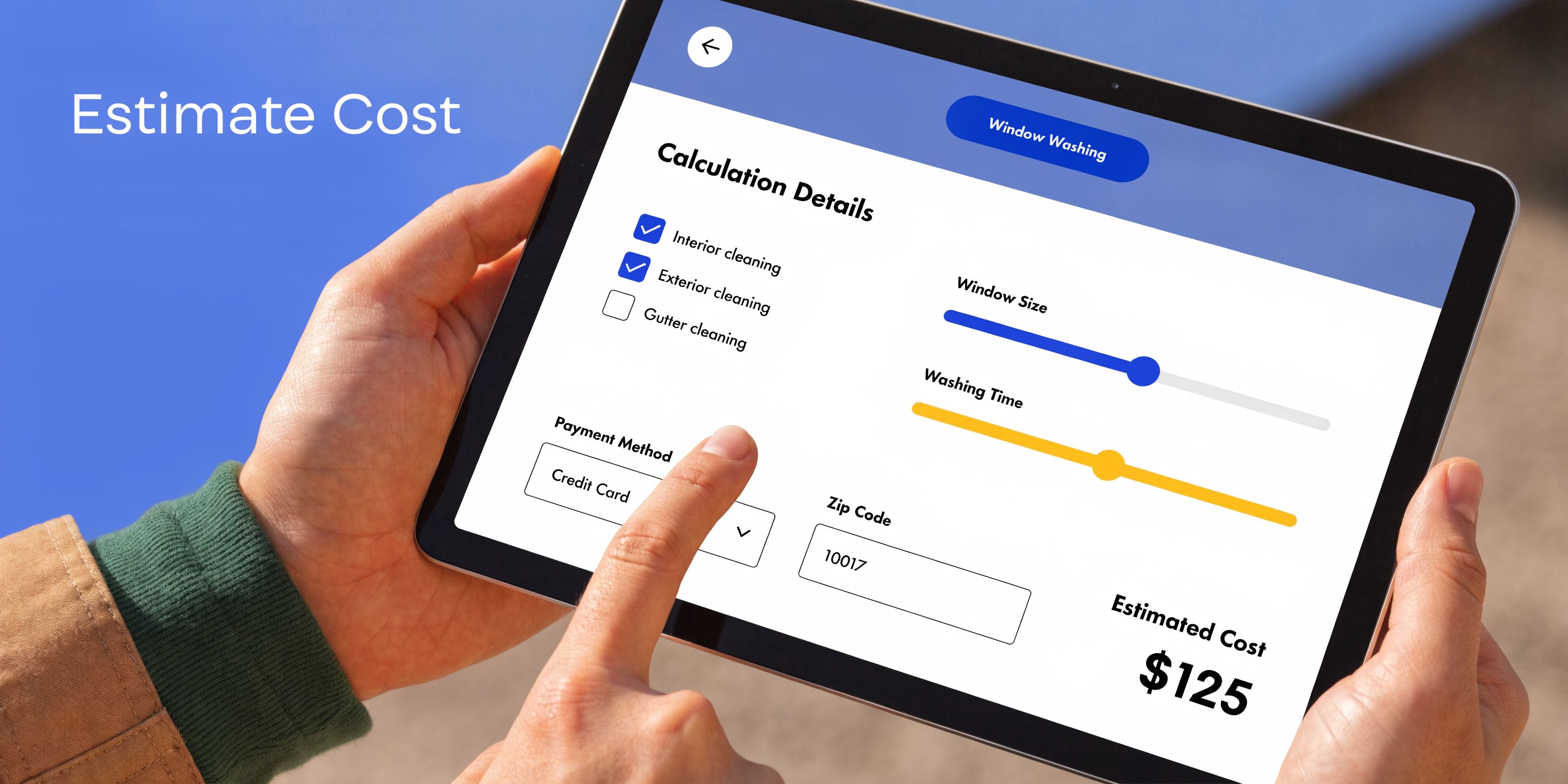
Our calculator works best as a first-pass estimating tool. Use it to build the scope, not to lock in a final invoice. It does a good job with countable items. Property type, panes, story level, interior versus exterior, and common add-ons all belong in a calculator. Glass condition, access friction, and restoration work usually do not.
The most useful inputs are straightforward:
If a calculator skips those fields, the result is only a rough budget number.
Generic tools also flatten work that should be priced differently. A tract home in Phoenix, a mountain property in Colorado with divided-light panes, a storefront route in Las Vegas, and a suspended-access high-rise job in Nevada do not belong in one formula. Residential pricing is usually count-driven. Commercial pricing depends more on layout, frequency, and site coordination. High-rise pricing changes again because access method and safety requirements start driving labor.
That gap shows up fast in desert markets. Arizona and Nevada properties often have mineral buildup, oxidized frames, insect debris, and baked-on dust that are hard to judge from a checkbox. Colorado adds its own issues, including weather swings, ladder placement on sloped lots, and storm residue. A calculator can count glass. It cannot inspect condition.
I have seen the same pattern for years. The closer a job is to standard residential maintenance cleaning, the closer the calculator will be. The farther a property moves toward first-time service, neglected glass, commercial complexity, or high-rise access, the more likely the number needs a human review.
Use the result for four things:
For companies building their own estimating process, a cleaning service quote template helps standardize what gets counted and what still needs site verification.
One last limit matters. Calculators are strongest on simple residential work and weakest on anything with unusual access, specialty glass, or operational restrictions. That is especially true for commercial and high-rise properties, where staging, tenant coordination, and approved work hours can change the price even if the glass count stays the same.
The cheapest quote isn't always the lowest-cost decision. In window cleaning, bad pricing usually shows up later as missed details, rushed work, no-shows, or surprise add-ons.
A better approach is to ask better questions.
You'll get a better estimate if you provide clean information upfront.
Send:
That saves time and reduces the chance of a reset when the crew gets there.
Maintained glass is easier to price and easier to clean. That's why recurring service usually creates better value than one-off rescue work.
Some verified market summaries note recurring discounts in the trade. More important than the discount itself is what regular service prevents. Heavy buildup, neglected tracks, and baked-on debris are expensive because they add labor and slow the job down.
If you're maintaining a property in Tempe or Chandler, consistency usually beats waiting until the glass is visibly overdue.
A professional quote should show scope clearly. If you're comparing bids, it helps to use the same structure each time. Even a simple cleaning service quote template can make line items easier to compare so you can see whether one company included screens, tracks, or interior glass while another didn't.
Field advice: If two quotes are far apart, don't ask which one is cheaper. Ask which one included more work.
Customers get into trouble when they choose based on a single number without checking scope. They also get bad outcomes when they assume every company cleans the same way.
Remember the two methods. Pros use a squeegee or a pure-water system. The method should fit the property. If a quote ignores how the work will be done, the number may not hold.
On a lot of homes, yes. Pane pricing follows labor better, especially on houses with French panes, divided lights, transoms, or a mix of old and new window styles. Per-window pricing can work on simple tract homes in places like Phoenix or Henderson, but it often hides the extra time that small panes, cut-ups, and detailed frames add.
They are often bidding different scopes, even when the house is the same.
One quote may include interior and exterior glass, screens, tracks, and sills. Another may cover exterior glass only. One crew may plan to ladder every problem area and detail edges by hand. Another may use a pure-water system on the outside and leave out anything that needs restoration. Until the scope matches line for line, the totals are not comparable.
Usually. Second-story work changes speed, setup, and risk.
A straightforward two-story stucco home in Arizona may add only modest labor if access is open and the windows are standard. A custom home with tight side yards, steep landscaping, or windows set over tile roofs is a different job entirely. In Denver, weather and seasonal access can affect scheduling. In Las Vegas, heat exposure can shorten productive ladder time on certain elevations.
Usually not. Standard cleaning removes dirt, dust, and routine buildup. Mineral staining, paint specks, silicone, and construction debris take separate restoration work, different tools, and more time. If you see sprinklers hitting the glass, ask that question before you approve the quote.
Commercial pricing is built differently.
Ground-level storefront work can price lower per pane because the crew can move fast and repeat the same process. Mid-rise and high-rise work cost more because access equipment, safety planning, insurance requirements, and site coordination start driving the job as much as the glass itself. That difference shows up fast in Colorado and Nevada on larger properties.
Yes. Use it to set a realistic budget range and to compare one scope against another.
Do not treat it as the final number on a three-story custom home, a post-construction clean, or any property with stain removal, difficult access, or specialty glass. Calculators are strong on standard conditions. The field is where unusual conditions show up.
Send clear photos. List the city, number of stories, interior or exterior service, screen count, and anything unusual like hard water, solar screens, or skylights.
That saves time for both sides and gets you a quote that holds up when the crew arrives.
If you want pricing from a contractor that handles residential homes, commercial properties, and high-rise work across Arizona, Colorado, and Nevada, contact Professional Window Cleaning. They have been in business since 1999 and serve major markets across the Southwest and Mountain West, including Phoenix, Scottsdale, Denver, and Las Vegas.
Read our blog posts regularly and keep learning.