Care and Maintenance
8 Home Window Cleaning Tips for a Clearer View
Use these home window cleaning tips for better tools, timing, seasonal care, DIY methods, and knowing when professional help makes sense.


If you're managing a commercial property right now, you already know the problem. One building has clear glass, bright entrances, and a cared-for look. The one next door has water spots, drag lines, and dirty edges around the frames. Tenants notice it. Visitors notice it. Prospective clients notice it.
That difference usually isn't about effort. It's about using the right commercial window cleaning supplies for the right method.
After more than 26 years in the trade, one thing stays true. Professionals really use only two methods to clean windows well at scale. The traditional squeegee method and the pure-water method. Every serious supply decision comes back to those two systems. If you understand that, you make better choices on tools, safety, labor, and long-term cost whether you're maintaining a storefront, medical office, office campus, dealership, or high-rise.
For property managers in service areas like Las Vegas, Phoenix, Denver, and Scottsdale, the details matter even more because climate, height, traffic, and hard water all change what works in the field.
Commercial glass tells on you fast. A streak across a lobby entrance or mineral spotting on storefront glass can make an otherwise well-run property look neglected. Good supplies don't just help cleaners move faster. They control the finish.
That matters because the commercial side of the industry isn't a side niche. It carries the bulk of the work. Fortune Business Insights reports that the commercial segment holds the major share of the global window-cleaning services market, and some industry estimates suggest commercial contracts contribute 55% of global window-cleaning revenue in a market shaped by office towers, retail sites, and other non-residential buildings that need specialized cleaning (Fortune Business Insights on the commercial window-cleaning services market).
A property manager can buy a spray bottle and a household squeegee anywhere. That doesn't make it a commercial solution.
On a commercial route, cleaners deal with:
If the washer sleeve doesn't hold enough solution, the glass dries before the pull. If the squeegee rubber is worn, it leaves lines. If the towel sheds lint, the final detail looks worse, not better.
Practical rule: Commercial window cleaning supplies should solve a specific failure point. Soil loading. Debris removal. Water control. Edge detailing. Safe access.
The first cost is visible. Streaks, spots, missed corners, drips on frames.
The second cost is operational. Crews slow down, redo work, and switch tools too often. That shows up in labor time, disruption to tenants, and frustration for anyone trying to manage a maintenance schedule.
A clean result on commercial glass comes from matching the supply kit to the property. Ground-floor restaurant glass needs a different setup than a mid-rise office facade. A shaded building in Denver isn't the same job as sun-baked glass in Phoenix. The supply choice sets the method. The method sets the result.
Every professional window cleaning setup comes back to two methods. You either clean with a squeegee system or with a pure-water system. Good companies use both, because each one solves a different field problem.
A quick visual makes the difference easier to see.
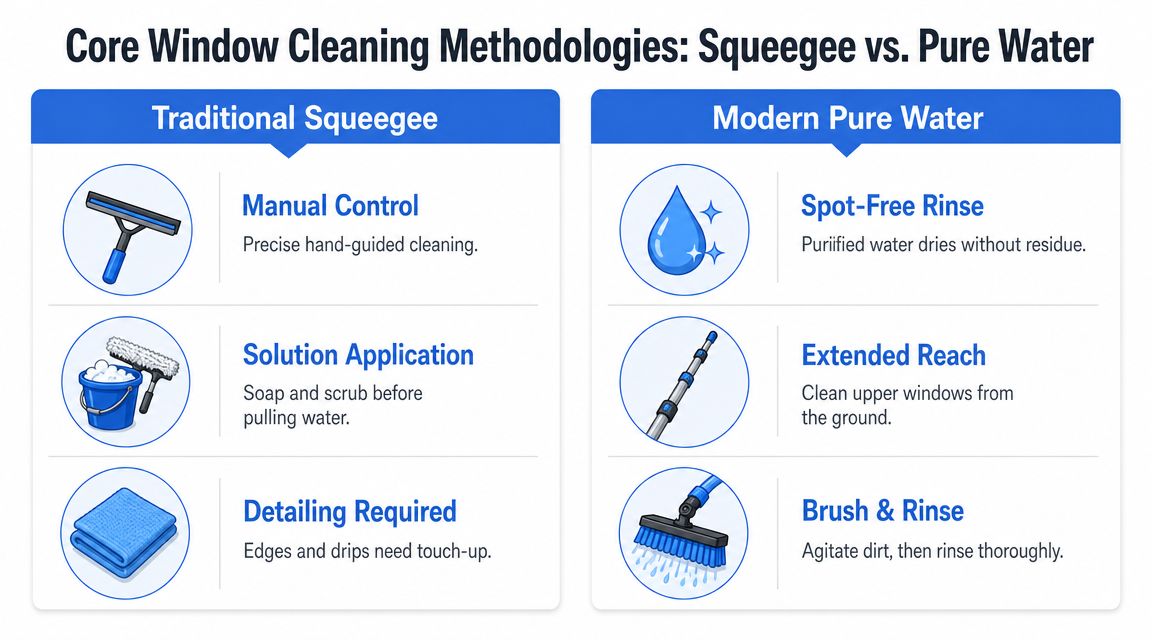
The traditional method is controlled by hand. The cleaner wets the glass with a washer or T-bar, agitates the soil, then removes the water with a squeegee. After that, edges and frames get detailed with a cloth.
This method is still the right choice for a lot of commercial work:
A skilled tech can correct small issues on the fly with a squeegee. That's the big advantage. Precision.
A pure-water system filters water so it can dry on glass without leaving mineral residue behind. The cleaner scrubs the glass with a brush on a water-fed pole, then rinses with purified water and lets it dry naturally.
For commercial glass, wide-blade squeegees and water-fed pole systems are the most efficiency-critical supplies because they reduce pass count on large panes and let crews clean from the ground with deionized water, which is used specifically to avoid streaks and spotting as water dries (J. Racenstein on essential window cleaning equipment for professionals).
Here's a field example of the method in action.
Ground-level pole work changes the labor and safety equation on exterior commercial glass. That's why pure water became standard for so many multi-story properties.
| Factor | Traditional Squeegee Method | Pure Water System |
|---|---|---|
| Primary use | Interior glass, storefronts, detail-heavy work | Exterior glass, upper floors, larger facades |
| Main tools | Washer, bucket, squeegee, detailing cloths | Filtration unit, hose, water-fed pole, brush |
| Finish control | Immediate visual control by hand | Spot-free finish after proper rinse and dry |
| Best access range | Close and reachable glass | Higher glass cleaned from the ground |
| Detailing needs | Usually requires edge detailing | Usually avoids hand detailing when conditions are right |
| Common strength | Precision on doors, partitions, and problem glass | Efficiency and safer reach on exteriors |
| Common limitation | Slower on big elevations | Depends heavily on water quality and rinse technique |
Neither. The wrong method loses.
If I need perfect detailing on interior lobby glass, I want a squeegee in my hand. If I need to clean exterior panes several stories up from the ground, I want a pure-water setup. Property managers get into trouble when they assume one system should do every job equally well. It won't.
The traditional kit looks simple until you use a bad one on a full commercial route. Then every weak part shows up. Rubber chatters. Sleeves stop carrying water. Cheap handles twist. Towels leave lint on dark glass.
Professional supply kits for commercial window cleaning typically combine a T-bar and sleeve, scrapers/blades, squeegees, and microfiber towels, because each tool addresses a different potential failure mode in the cleaning process, from lifting soil to final detailing (Grainger's guide to must-have window cleaning supplies and tools).
The basic traditional kit should include:
If you're vetting a contractor or reviewing your in-house setup, ask practical questions:
Those answers tell you whether the operator understands the method or just owns a few tools.
A strong squeegee setup isn't one tool. It's a sequence. Wet, loosen, remove, detail.
A traditional setup often includes extension poles and, for some work, ladders. That doesn't mean more ladder use is always better. In many cases, the safer choice is to keep technicians on the ground whenever the glass and conditions allow.
If you're comparing ladder options for occasional access work, this 20 ft aluminum extension ladder guide gives a useful overview of what to look at before a ladder goes into rotation.
For a broader look at the gear used in the field, Professional Window Cleaning also has a practical overview of professional window cleaning equipment that shows how traditional tools fit into a full working setup.
Pure-water cleaning looks simple from the ground. Brush the glass, rinse it, walk away. The reason it works is the system behind it.
The setup has three working parts. Water purification, pole delivery, and brush agitation. If one part is wrong for the property, the result falls apart.
The water has to be cleaned before it ever reaches the glass. In the field, that usually means one of two paths. A DI setup that uses deionization alone, or an RO/DI setup that combines reverse osmosis with deionization.
The practical difference is operating behavior. DI-only can be a workable choice in some conditions, especially when the water source and job profile line up. RO/DI becomes more attractive when water conditions are harder on the system and the workload is more demanding.
A property manager doesn't need to become a filtration expert. But it helps to understand why one bid includes a more complex cart or tank setup than another. The filtration stage isn't an accessory. It's what makes spot-free drying possible.
The pole delivers purified water to the glass and gives the cleaner safe reach from the ground. Pole choice changes how the work feels and how well crews can control the brush at height.
What matters most in practice:
A soft maintenance clean on regular exterior glass doesn't call for the same brush behavior as neglected glass with built-up grime around edges and frames.
The pure-water method doesn't hide mistakes. It reveals them after drying.
If the frame wasn't flushed well, dirty water can bleed back. If the brush didn't break soil loose, residue stays on the pane. If the rinse was rushed, the glass can dry with visible imperfections even when the water itself is properly purified.
Field note: With pure water, the glass often looks worst right after cleaning and best after drying. That's normal. The system is designed around a final spot-free dry, not a hand-detailed finish.
If you want a technical overview of how purification and pole systems work together, this guide to pure water window washing is a useful reference.
A property manager usually sees the problem after the crew leaves. The storefront glass at eye level looks fine, but upper exterior panes dry with spots, or the detail work at the entrance takes too long and labor costs climb. In commercial work, those misses usually come from choosing supplies that do not match the building.
Start with the method. Then choose the supplies that support it.
For most properties, the decision comes down to two professional systems. Traditional squeegee work handles close-detail glass, interior panes, entry doors, grease, fingerprints, and any area where the finish gets inspected from a few feet away. Pure-water systems handle large exterior elevations, repetitive pane layouts, and upper glass that can be cleaned safely from the ground. On many sites, the right answer is both.
Industry guidance from Unger makes the hard-water point clearly. In mineral-heavy markets, the choice between a DI cart and an RO/DI setup affects both operating cost and job speed over time (Unger on what matters when purchasing commercial window cleaning supplies).
After 26 years in the trade, I can say this plainly. Good crews do not force one system onto every property. They match the method to the glass, the access, and the local water conditions.
| Property factor | What it usually points to |
|---|---|
| Interior partitions, lobby glass, entry doors | Traditional squeegee work |
| Exterior upper floors reachable from the ground | Pure-water system |
| Heavy handprints, grease, adhesive, or close-detail glass | Traditional squeegee work |
| Large exterior elevations with repetitive panes | Pure-water system |
| Mixed-use property with street-level presentation and upper facade work | Both methods in one service plan |
That last row matters more than many managers expect. A mixed commercial property often needs squeegee work at ground level and pure water above it. Using one method for the whole site can lower quality, slow the job, or both.
Hard water punishes bad equipment choices fast.
In places such as Phoenix, Scottsdale, and Las Vegas, mineral-heavy supply water can burn through resin quickly if a crew relies on the wrong setup. A small DI cart may work for limited glass or occasional service. On larger exterior routes, especially with frequent service and multi-story reach, an RO/DI system usually controls cost better and keeps water quality more stable.
That does not mean pure water is wrong for hard-water markets. It means filtration has to be sized correctly for the work. If it is not, the supply cost rises, production slows, and spot-free results become harder to repeat.
Before approving supplies or reviewing a contractor's process, ask a few direct questions:
Those answers usually point to the right setup quickly.
If the site has a lot of upper exterior glass, decent ground access, and a properly matched filtration system, pure water usually gives the best combination of safety and production. If the property has interior glass, low glass, specialty soil, or a high presentation standard at eye level, traditional squeegee work still gives tighter control.
The strongest service plans are built around the property itself, especially in hard-water regions where supply choices affect labor, finish quality, and cost on every visit.
A technician steps out at 6:30 a.m., the sidewalk is already damp from irrigation overspray, tenants are arriving, and a hose has to cross the main entry. That job can go wrong before a brush or squeegee touches the glass.
Safety starts with the method. Traditional squeegee work creates more close-contact hazards at entrances, interiors, and ladder points. Pure-water work often reduces ladder use and keeps more exterior cleaning on the ground, but it adds long poles, hoses, wet walk paths, and moving brush heads overhead. In hard-water markets such as Phoenix and Las Vegas, crews also spend more time managing filtration, tanks, and supply lines, so setup discipline matters just as much as cleaning skill.
The market for window cleaning equipment continues to grow, which is one reason standards around training, PPE, and jobsite control keep getting tighter (window-cleaning equipment market projections and segment growth).

The right gear depends on how the glass is being cleaned.
For traditional work, crews usually need:
For pure-water work, the list shifts slightly:
I tell property managers to watch for one simple sign of a disciplined contractor. The PPE changes with the task. If the same setup is used for interior lobby glass, storefront detailing, and multi-story pole work, the crew is probably cutting corners somewhere.
Serious incidents get attention. Routine slips, trips, and struck-by problems happen more often.
On commercial routes, the basic controls are usually straightforward:
This matters even more with pure-water systems because hoses can run a long distance from the vehicle to the work area. With traditional squeegee work, the hazard is usually concentrated near the glass. With pure water, the hazard can extend across the property if the setup is sloppy.
Once work leaves the ground, supply choice and safety planning become inseparable. Water-fed poles reduce some ladder exposure, which is one reason many commercial contractors use them for upper exterior glass. They do not remove risk. Pole handling near pedestrians, traffic, building edges, and overhead utilities still has to be controlled.
If the scope requires ladders, lifts, rope descent, or fall-arrest systems, ask for the actual plan. That includes equipment inspection, anchor or lift procedures, exclusion zones below the work, and proof that the crew assigned to the site is trained for that access method. A property manager should not have to assume those steps are covered.
PPE, signage, hose control, ladder policy, and fall protection belong on the same supply checklist as squeegee rubber, brushes, poles, and filters.
Good glass does not justify a preventable injury. The right supplies help crews work faster, but the right protocols are what keep the job under control.
Buying commercial window cleaning supplies is only half the job. The other half is keeping them ready to work. A premium squeegee with damaged rubber, a dirty brush, or a neglected filtration setup can underperform just as badly as cheap equipment.
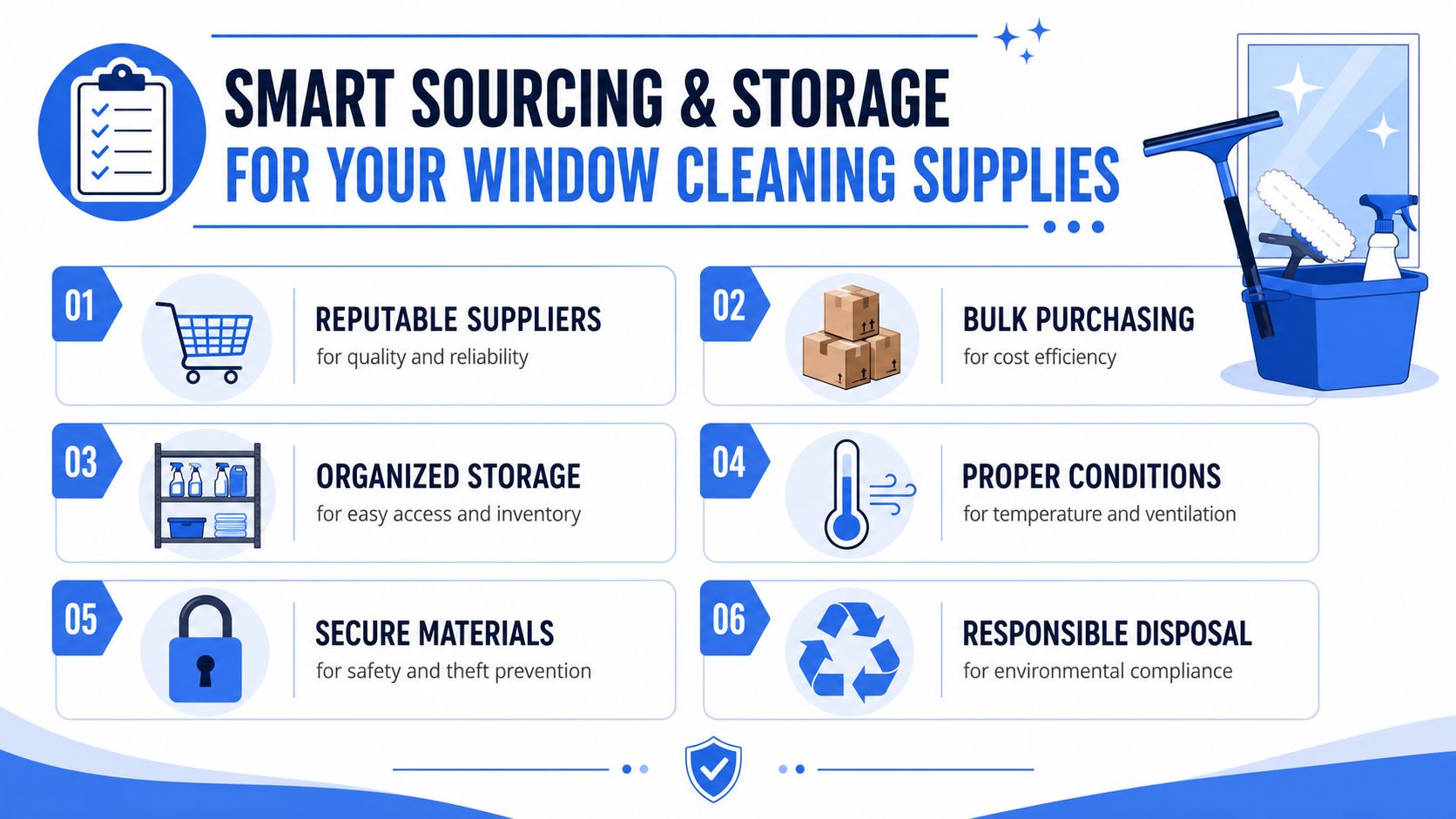
For commercial work, specialty distributors usually make more sense than general retail outlets because they stock parts that professionals replace and maintain. That includes channels, rubber, sleeves, scraper blades, pole sections, brushes, hoses, and filtration components.
When choosing a supplier, look for:
A good purchasing decision isn't just about the first order. It's about whether you can keep the system working six months from now without scrambling for parts.
I've seen more tools ruined in storage than on the glass.
Use a simple standard:
This is the mindset shift that separates a workable setup from a professional one. Your supplies aren't random consumables. They're production equipment tied directly to finish quality, labor speed, and safety.
If you're sourcing for multiple properties, standardize where possible. Keep the traditional kit complete. Keep pure-water gear matched to local conditions. Replace small worn parts before they create big visible problems. The cleanest buildings usually come from the most disciplined supply routines, not the fanciest tool list.
If you need help choosing the right method, equipment mix, or service plan for your property, contact Professional Window Cleaning. We provide residential, commercial, and high-rise window cleaning, and we can help you evaluate whether traditional squeegee work, a pure-water system, or a combination of both makes the most sense for your building.
Read our blog posts regularly and keep learning.