Care and Maintenance
Concentrate Window Cleaner: Professional Guide
Learn how to dilute and apply concentrate window cleaner like pros. Master ratios, safety, and streak-free results for residential and commercial glass.


You wash the glass. It looks good when it's wet. Then it dries, and every streak, haze mark, and water spot shows up all over again. That's the moment a lot of homeowners start hearing about cleaning with distilled water and wonder if they've been missing the one trick that makes windows dry clear.
There's a good reason distilled water comes up so often. It removes one of the biggest causes of spotting. But after 26 years in window cleaning, I can tell you this plainly: distilled water helps, sometimes a lot, but it isn't magic. Professionals still rely on only two real methods to clean windows properly: a squeegee or a pure-water system.
For homeowners in places like Scottsdale and Denver, distilled water can be a smart upgrade over tap water for smaller jobs, touch-ups, and final detailing. The key is knowing where it works, where it falls short, and how professionals push beyond the DIY version to get dependable spot-free results on a larger scale.
Most window problems don't come from a lack of effort. They come from what gets left behind after the water evaporates. Tap water often carries dissolved minerals, and those minerals are exactly what can dry onto glass as spots, film, or faint streak lines.
Distilled water is made by boiling water and condensing the steam, which removes nearly all contaminants and minerals, including the calcium and magnesium that commonly cause residue on glass, according to Culligan's explanation of distilled vs purified water. That's why people notice cleaner-looking results when they switch from the faucet to a jug of distilled water.
The appeal is easy to understand. You spray a pane with mineral-free water, wipe it with a clean microfiber cloth, and the glass often dries with less haze than it would with hard tap water. On mirrors, interior glass, small patio doors, and French panes, that can make a visible difference.
But there's a catch. Distilled water doesn't add cleaning power by itself. It doesn't cut grease the way a proper soap mix can, and it doesn't remove heavy buildup just because it's pure.
Straight talk: Distilled water is a better rinse medium. It isn't a replacement for sound technique.
That's where a lot of DIY advice goes sideways. It treats the water as if it does the whole job. It doesn't. Soil still has to be loosened, moved, and removed without re-depositing it across the glass.
Good results come from a combination of water quality, clean tools, and the right method for the pane in front of you. If you're also comparing cleaning agents, this overview of commercial ammonia window cleaner is useful because it helps separate what the cleaner does from what the rinse water does. That's an important distinction if you want clarity instead of just a wet-looking window for a few minutes.
Homeowners usually notice the biggest improvement from distilled water on smooth, reflective surfaces where dried residue shows up fast. Glass is unforgiving. It tells on your water, your cloth, and your timing.
The science behind cleaner glass is simple. Total dissolved solids, usually shortened to TDS, are what matter. If water contains dissolved minerals or contaminants, those solids can stay on the surface after the water evaporates. The higher the contamination in the rinse, the higher the chance you'll see spots.
Distilled water helps because it has no mineral content, so it leaves fewer deposits than hard water. Distillation removes nearly all contaminants and minerals, and that lack of calcium and magnesium is the practical reason it reduces spotting and residue on glass, as explained in the earlier cited Culligan reference. Professionals, though, usually take the concept further and focus on purity at the system level, not just buying a bottle labeled distilled.
Tap water is the least predictable option because local mineral levels vary. One house might get passable results on interior glass, while another gets obvious spotting every time.
Distilled water is far cleaner than tap water for small-scale cleaning. It's a solid DIY option because it removes the most common source of residue.
Deionized water is what many professional pure-water systems are built around. That matters because the goal isn't just “better than tap.” The goal is water that stays pure enough through the rinse cycle to dry clear on its own.
If you want a deeper look at the professional side, this article on pure water window washing gives a good overview of how the method works in the field.
| Water Type | Typical TDS (PPM) | Best Use Case | Key Characteristic |
|---|---|---|---|
| Tap water | Varies | General washing where perfect drying isn't critical | Contains dissolved minerals and contaminants |
| Distilled water | About 0 TDS in the ideal use case discussed by window cleaners in field guidance | Small DIY window jobs, detailing, final wipe tasks | Mineral-free rinse medium that reduces residue |
| Deionized water | Targeted at about 0 TDS in professional pure-water work | Exterior window cleaning where spot-free drying matters | Purified for controlled rinse-and-air-dry results |
On glass, the issue isn't whether the water looks clean in the bottle. The issue is what stays behind after drying.
Store-bought distilled water is useful. It just doesn't scale well, and it doesn't guarantee that the water stays uncontaminated from container to glass. Equipment, hoses, frames, seals, and airborne dust can all compromise the finish.
That's also why homeowners looking at filtration options sometimes compare methods before choosing a household setup. If that's on your list, Ring Hot Water's purifier selection is worth reviewing for a general look at water purification choices. For window cleaning, though, the takeaway is narrower: lower dissolved solids usually mean a cleaner final dry on glass.
Preparation is where most streak-free jobs are won or lost. People tend to focus on what they'll spray onto the glass, but the frame, sill, and track are often the reason the pane ends up dirty again a few minutes later.
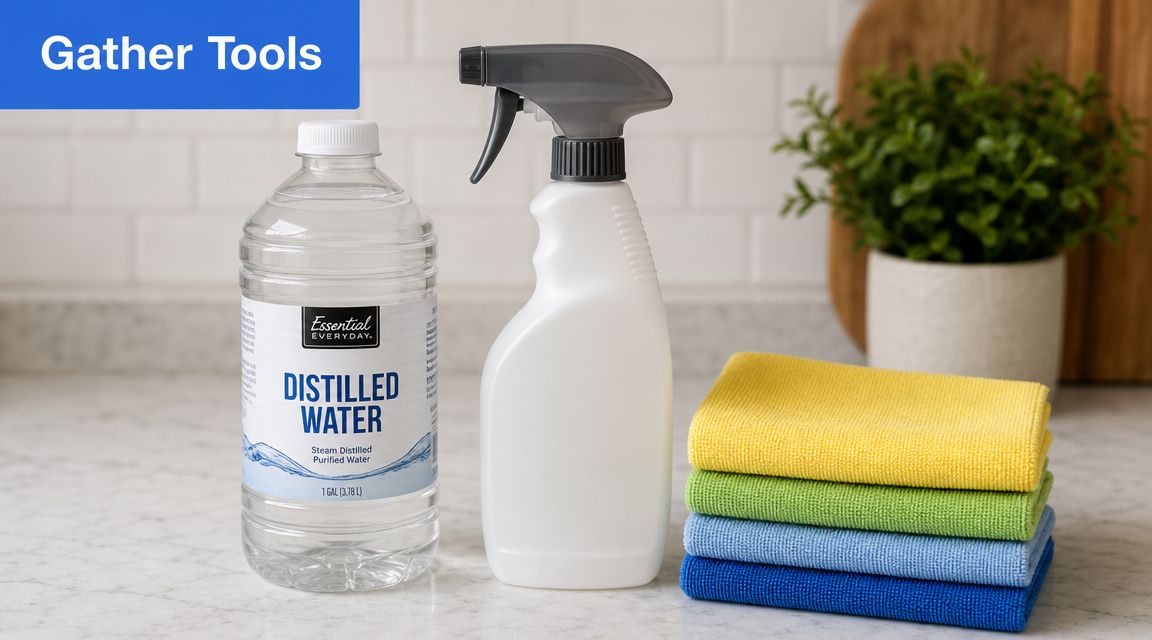
For DIY cleaning with distilled water, keep the setup simple:
If you're choosing reusable bottles and want something sturdier than disposable plastic, this guide for low-waste living is a practical reference.
This step is non-negotiable. For a pure-water cleaning process to succeed, the water must remain pure throughout the rinse and drying cycle, and field guidance from window cleaners stresses cleaning frames first because even 0 TDS water can leave marks if it picks up contamination from dirty frames or surrounding surfaces, as discussed in this window cleaning community thread on distilled water and pure-water cleaning.
In Las Vegas, where dust settles fast, skipping the frame is one of the quickest ways to ruin clean glass. You wipe the pane, then a little runoff comes out of the top edge or side gasket, and now the whole finish needs another pass.
Field rule: Clean the frame, sill, and track before the glass. If the dirt above the pane is still there, it's going to end up on the pane.
A lot of haze comes from using one towel for everything. Don't do that.
Use this simple sequence:
For more on choosing the right towel type, this guide to microfiber cleaning towels is helpful.
For light cleaning, plain distilled water is often enough for dust, fingerprints, and fresh smudges. Once grease, cooking residue, bug marks, or hand oils are involved, you'll usually need proper glass-cleaning chemistry or a standard window soap process. The water helps the finish. It doesn't replace the need to break down soil.
There are only two legitimate professional methods: the squeegee and the pure-water system. For homeowners cleaning with distilled water, the practical version usually comes down to either a microfiber approach for small panes or a squeegee approach for larger glass.
Start with the simpler method if you're working indoors or doing touch-ups.
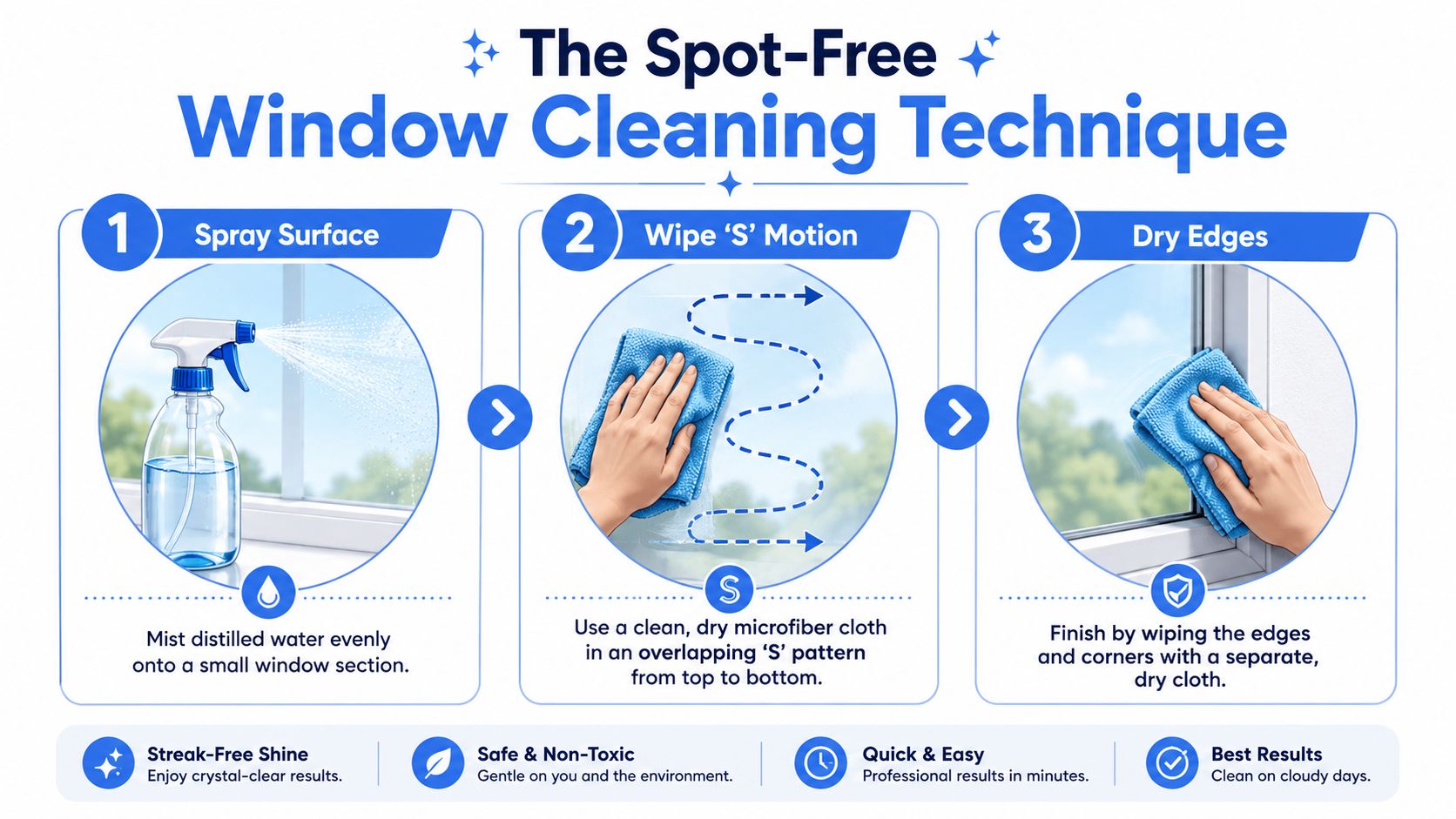
This works well for bathroom mirrors, interior windows, French panes, and smaller sections of glass where control matters more than speed.
Use this process:
The reason the S pattern works is simple. It keeps you moving dirt off the cleaning path instead of shoving it back and forth in straight lines. Paper towels tend to smear and shed. A good microfiber towel grabs more contamination and releases less lint.
For larger panes, a squeegee is the superior tool. It's faster, more consistent, and closer to true professional window cleaning.
Basic technique matters:
Don't race. Most beginner streaks come from trying to move too fast before the hand position is under control.
A squeegee doesn't forgive bad angles, dirty rubber, or hesitation. But once you learn it, nothing beats it for flat glass.
A quick visual can help if you want to see motion and timing in action.
Even a good method struggles under bad conditions. Hot sun dries water too quickly. Wind pushes dust onto wet glass. Overspray from landscaping, hard-water sprinklers, or nearby traffic film can undo your work.
That's why pros pay attention to timing and sequence:
For DIY work, distilled water improves the rinse and the final appearance. For professional exterior work, the standard moves up to purified water produced for spot-free drying through a controlled system. That's a different category than carrying jugs and hand-wiping each pane.
Homeowners can get noticeably better results with distilled water and sound technique. Just don't confuse a helpful material with a complete cleaning system.
The biggest myth around cleaning with distilled water is that once you buy it, spotting problems are over. That's not how glass works. Distilled water can reduce residue, but the final result still depends on contamination, technique, and drying conditions.
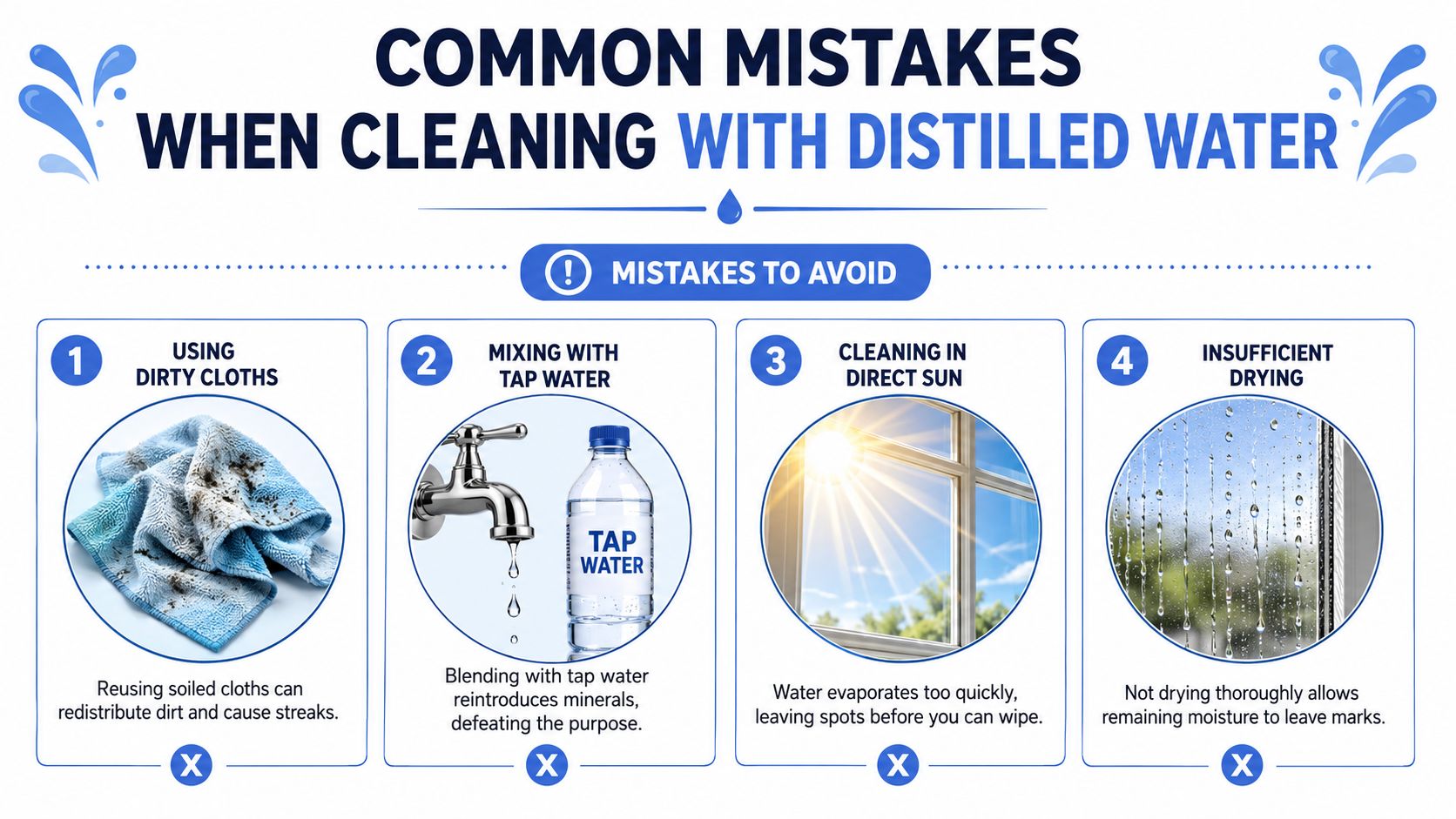
A common misconception is that distilled water is a guaranteed fix for water spots. The key issue is TDS, and while distilled water is much purer than tap water, it is not the same as the deionized water used in professional pure-water systems. Spotting can still happen from dirty frames or airborne dust, as explained in this article on distilled water versus deionized water for window cleaning.
Experience is critical. If a pane is heavily soiled, you need enough cleaning action to break that soil loose first. If your applicator, towel, or squeegee rubber is dirty, pure water won't save the finish. If dust is blowing across the glass while it dries, you may still get marks.
That doesn't mean distilled water failed. It means the whole workflow failed.
Clean water helps. Clean tools, clean frames, and controlled drying are what finish the job.
If you're seeing repeating lines, that's often the cloth or the squeegee edge. If you're seeing drips after the pane looked perfect, check the upper frame. If the whole surface looks cloudy, it may be leftover film, oxidation, or residue that needed stronger cleaning before the final rinse.
Professional systems reduce these variables by controlling water purity continuously and by using methods designed for exterior glass at scale. Distilled water is a smart DIY material. It just isn't a foolproof one.
There's a point where distilled water stops being practical. Small interior jobs, touch-ups, mirrors, and a few accessible panes are one thing. A multi-story home, a large storefront, or a broad run of exterior glass is something else entirely.

Call a professional when any of these apply:
DIY articles often recommend distilled water but rarely deal with logistics at scale. For large residential or commercial jobs, hauling gallons of store-bought water is impractical, which is one reason professionals rely on on-site purification systems for efficiency and consistent quality, as noted in this piece on distilled water and large-scale cleaning tradeoffs.
A professional crew isn't just bringing more labor. They're bringing the right method for the glass, safe access tools, and water treatment designed for repeatable results. That matters on commercial properties, high-rise work, and homes where the exterior glass has to dry clean without hand-detailing every edge.
This is especially true in dry, dusty service areas where environmental contamination builds fast. Property owners in Phoenix, Arizona, Colorado, and Nevada deal with conditions that punish mediocre technique.
For small jobs, cleaning with distilled water makes sense. For larger, riskier, or more demanding work, professional window cleaning is usually the smarter move.
If you want dependable results without the trial and error, Professional Window Cleaning handles residential, commercial, and high-rise window cleaning across Arizona, Colorado, and Nevada. After more than 26 years in the trade, we know when a squeegee is the right tool, when a pure-water system is the better choice, and how to get glass clean.
Read our blog posts regularly and keep learning.