Care and Maintenance
Window Cleaner for Tinted Windows: Safe Methods
Find the best window cleaner for tinted windows and learn safe cleaning methods that protect film, prevent streaks, and extend tint life.


If you're looking at your windows in Los Angeles and wondering why they already look dull again, you're not imagining it. In this city, glass picks up grime fast. Smog, dust, hard-water spots, and coastal residue can make a clean view disappear sooner than most property owners expect.
That's why hiring the right los angeles window washers matters. Not just any cleaner. A real professional who understands access, safety, and the right cleaning method for your building. I've been around this trade a long time, and after more than 26 years in professional window cleaning, I can tell you this with confidence: the biggest mistake property owners make is treating window washing like a commodity. It isn't.
Los Angeles has been part of the professional window cleaning world for a long time. By 1991, more than 400 members of the International Window Cleaning Association met in Los Angeles to discuss tools and techniques, which shows the city was already a serious high-rise maintenance market, according to Allied Universal's history overview. That history still shows up today in how the work should be done: planned, specialized, and safety-driven.
Los Angeles sells light, views, and presentation. If your windows are dirty, your property looks neglected even when the rest of it is in good shape. That applies to homes in the hills, medical offices, dealerships, condo towers, and office buildings downtown.
Clean glass does more than improve appearance. It changes how people experience the space. In a house, it makes natural light feel cleaner and more open. In a commercial property, it affects first impressions before anyone reaches the front desk. In a high-rise, it's part of the building's brand whether the owner admits it or not.
A lot of owners think dirty windows mean somebody just needs a rag and a ladder. That's the wrong mindset. Los Angeles leaves a film on glass that often builds in layers. Airborne pollution settles. Sprinklers leave mineral spotting. Traffic corridors add residue. Coastal moisture can leave its own mess.
Practical rule: In Los Angeles, if you wait until the glass looks obviously bad, you've usually waited too long.
That delay matters because neglected buildup is harder to remove cleanly. The work takes longer, the detailing gets fussier, and the result depends much more on the skill of the technician.
The smart approach is simple. Don't shop for the cheapest body with a bucket. Shop for a company that understands your building type, your access issues, and the local grime pattern around your property.
Use this standard when you're evaluating a vendor:
Los Angeles rewards maintenance. Dirty glass stands out here because sunlight exposes everything.
Window cleaning isn't one service. It breaks into residential, commercial, and high-rise work, and those categories matter. If you hire the wrong type of company, the job usually goes sideways through poor equipment, bad scheduling, or weak safety practices.
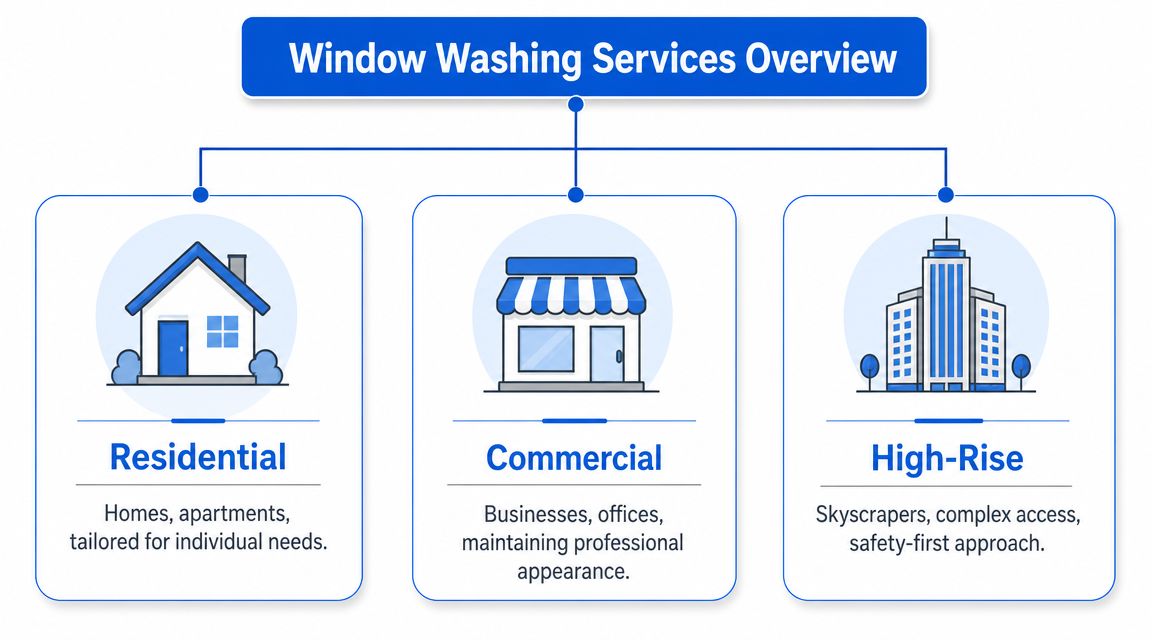
Residential cleaning is detail-heavy. It usually includes interior glass, exterior glass, screens, tracks, and close attention to floors, furnishings, and landscaping. A good residential technician works carefully around paint, blinds, drapes, and fragile surfaces.
This work also demands strong route planning. A hillside home, a stucco property with narrow side yards, or a house with lots of divided panes all require different tools and pacing.
Commercial window cleaning is a maintenance business more than a one-time service business. Storefronts, offices, dealerships, and medical buildings need consistency. Miss one visit and the whole property starts to look tired.
Local providers often separate commercial work from residential and high-rise work, and many push scheduled maintenance because recurring service lowers contamination buildup from dust and urban pollution, which can reduce labor intensity per visit versus infrequent deep cleanings, as noted by Sunrise Window Cleaners.
That point matters. If you manage a portfolio, recurring service usually beats reactive booking.
| Service type | Best fit | What matters most |
|---|---|---|
| Residential | Homes, condos, apartments | Detail work, interior care, screen and track cleaning |
| Commercial | Offices, storefronts, clinics, dealerships | Recurring schedules, appearance, minimal disruption |
| High-rise | Towers, large mixed-use buildings, upper-level access work | Safety systems, access planning, compliance |
High-rise window washing is its own trade. It's not just “commercial, but taller.” Access method, anchor points, suspended equipment, rope systems, and rescue planning all come into play.
If a company mainly cleans homes and suddenly says it can handle your tower, slow down and verify everything.
For large buildings, ask specifically what access method they're proposing and why it fits your property. If they can't explain that clearly, they're not the right contractor.
A Los Angeles property owner usually sees the result before they understand the method. One cleaner leaves crisp, clear glass. Another leaves haze at the edges, drip marks on frames, or spotting that shows up again by afternoon sun. The difference is usually the system, and whether the crew knows when to use it.
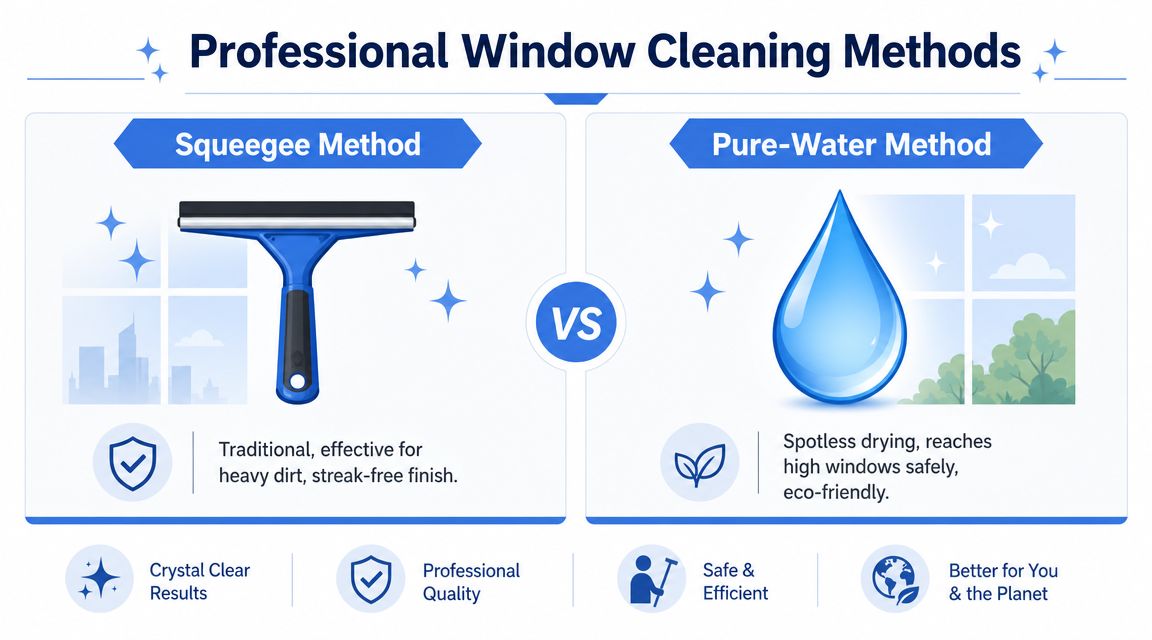
Professional window cleaning comes down to two real methods. Squeegee work and pure-water cleaning. A serious company should be comfortable with both, because Los Angeles properties rarely need just one approach.
Squeegee cleaning is still the gold standard for close-detail work. It gives the technician direct control over scrubbing pressure, edge work, and final finish. That matters on interior glass, French panes, first-floor storefronts, and any window with stuck-on grime that needs hand work instead of a quick rinse.
Skill decides the outcome here. Good squeegee work leaves clean edges, dry frames, and no streaks. Poor squeegee work shows up fast, especially in bright LA light.
Best uses include:
Pure-water cleaning uses filtered water fed through a pole to scrub and rinse exterior glass. The water dries without mineral residue, which is why it can leave windows clear without hand-drying every pane. If you want the nuts and bolts, read this guide to pure-water window washing.
This method is a strong fit for exterior maintenance on homes, low-rise commercial buildings, and upper windows that can be cleaned safely from the ground. In Los Angeles, that matters. A company that can clean upper exterior glass without overusing ladders is usually making smarter safety decisions.
Pure water is not the answer for every pane. It works best when the glass is being maintained regularly and the crew understands how to scrub frames, rinse fully, and account for local dust and residue. If they rush the rinse, you get spotting. If they use it on the wrong job, you get disappointed.
Pure-water cleaning is a professional maintenance method. It is not a shortcut for dirty glass that really needs hand detailing.
The right answer for many LA properties is both. Homes with large exterior panes, divided lights, sliders, and interior glass often need a mix. So do commercial sites where upper glass is maintained with pure water and lower entry glass is finished by hand.
Use this standard:
Professional Window Cleaning may use pure-water on upper exterior sections and switch to squeegee work for interiors and detailed lower glass. That is what competent tool selection looks like. The method should fit the glass, not the other way around.
Los Angeles dirt isn't one thing. That's why generic cleaning advice usually fails here. Different neighborhoods foul windows in different ways, and if your cleaner doesn't understand that, they'll either under-clean the glass or overpromise on how long it stays clean.

A key buyer question in this market is how often windows really need cleaning, because coastal smog, wildfire smoke, and hard-water dust accelerate re-soiling, especially for properties near the coast, inland dust zones, or freeway corridors, as noted by RayAccess.
Near major roads, glass often picks up a gray traffic film. In coastal areas, salt air leaves residue that dulls clarity faster. Inland properties often battle mineral spotting from irrigation overspray and dry dust that sticks after moisture hits the pane. After smoke events, many buildings get a fine layer of residue that makes windows look hazy even when they were cleaned recently.
Those contaminants don't all come off the same way. Some need standard maintenance cleaning. Some need more aggressive hand work. Hard-water spotting, in particular, can become a restoration issue if owners ignore it too long.
Don't ask, “How cheap can I get my windows cleaned?” Ask, “How fast does my location re-soil the glass?”
Use this practical framework:
Clean windows in Los Angeles are less about one perfect appointment and more about setting the right interval for your location.
If you own or manage glass-heavy property in Los Angeles, stop booking only when tenants complain or when you have an event coming up. That's backward. Build a recurring schedule around your environment and building use. It's easier to maintain clean glass than to rescue neglected glass.
In evaluating vendors, owners make expensive mistakes. They compare bids, glance at a certificate, and assume all vendors are basically the same. They aren't. In high-access work, the cheapest bid can also be the weakest plan.
High-rise window washing is a safety-intensive trade. A government analysis recorded 88 window cleaning accidents over a 15-year period, with 62 fatalities, or about 70% of those incidents proving fatal, according to reporting summarized through ABC7's window washer coverage. That's enough to end the debate. Safety is not a marketing extra.
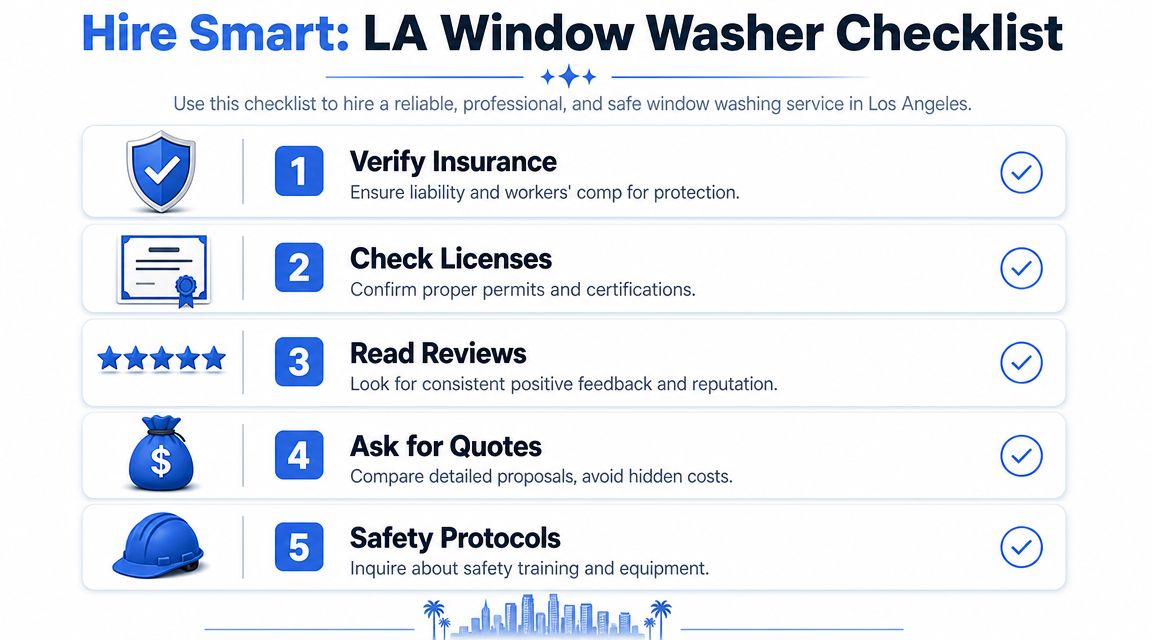
For serious work, especially commercial and high-rise, require documentation before the first day on site. California facilities treat window washing as controlled maintenance work, and UCLA's rules reflect that approach by requiring service request handling and centralized approval through its window-washing regulations page. That's the right mindset for owners too.
Ask for these items up front:
Don't ask only for a price. Ask better questions.
How are you accessing this building?
A pro answers clearly. A weak contractor gets vague.
What safety system are you using for this property?
They should talk about anchors, tie-off, equipment, and rescue readiness in plain English.
Who carries the insurance and who is performing the work?
Subcontracting can muddy accountability fast.
What's included in the quoted service?
Hidden exclusions usually show up here.
Can you provide a written plan for the job?
If the answer is no, move on.
Here's a real-world reminder of why access planning matters. This rescue footage of a window washer stuck on a downtown Los Angeles high-rise shows how fast a mechanical problem can become an emergency.
After you vet safety, watch how the company presents itself. Well-run service businesses usually communicate clearly, estimate clearly, and follow a repeatable process. If you're curious what that kind of disciplined lead handling looks like from the business side, this guide on how cleaning companies attract more cleaning customers is worth a look because it highlights the systems stronger operators tend to build.
A visual example helps. Watch this before you sign off on any serious exterior access job.
Hire the company that makes safety boring. Boring is what you want when people are working above sidewalks, tenants, and parked cars.
In Los Angeles, price follows difficulty. A ground-floor bungalow with decent access is one job. A hillside home with mineral-stained glass, tight side yards, and neglected tracks is another.
Expect any honest quote to reflect access, pane count, height, glass condition, and add-ons like screen washing or track cleaning. On commercial properties, frequency matters too. Monthly route work is priced differently from a one-time cleanup after months of smog, dust, and sprinkler spotting.
Low bids usually mean one of three things. The crew is skipping details, the company is underinsured, or the quote leaves out work you assumed was included. Ask for a written scope that spells out what gets cleaned, what does not, how the crew will reach the glass, and whether hard water stain removal is separate.
Usually, no. You should worry more about wasteful habits and poor technique than the fact that water is being used.
A professional crew uses water in a controlled way, whether they are cleaning with a squeegee or a pure-water system. In Los Angeles, the bigger issue is choosing the right method for the glass and the buildup on it. Smog film, coastal salt, dust, and hard water stains do not all respond to the same process. If a company gives you one standard approach for every property, keep looking.
For residential service, be there if the crew needs interior access or has to pass through locked gates, garages, or side yards. If the work is exterior only, many homeowners schedule service without staying on site, but only after access instructions are clear and complete.
For commercial buildings and multi-unit properties, someone still needs to handle the logistics. That means access, parking, tenant notices, alarm issues, and any restricted areas. In Los Angeles, small access mistakes turn into delays fast, especially in dense neighborhoods and busy commercial corridors.
If you want a provider that understands Los Angeles glass conditions, property access, and maintenance planning, Professional Window Cleaning handles residential, commercial, and high-rise window washing. Ask for three things before you book. A clear scope. A clear safety plan. A cleaning method that fits your building instead of the cheapest package on the sheet.
Read our blog posts regularly and keep learning.