Care and Maintenance
Clean Window Cleaning Steps for Streak-Free Glass
Clean window cleaning uses a squeegee or pure water. Get DIY steps, desert-season timing, and when to hire a pro.


Glass restoration services can clear surface mineral film and light scratches below about 0.001 inch, but fogged insulated units and damaged coatings need replacement rather than polishing. A small test patch is what separates those cases before anyone prices a whole elevation.
You're on the sidewalk in late afternoon, looking at a condo or storefront that used to read as clear glass. Sprinklers have been kissing the lower lites for months, dust has baked on, and the pane looks permanently milky. A replacement bid just arrived that prices every opening the same way.
That bid is the wrong first move. Some of those panes still have sound glass under a film a careful clean can lift. Others are etched, coated, or holding moisture between two lites. Paying to polish the second group, or to replace the first, spends the glazing budget twice.
Say the south elevation of a small retail condo looks cloudy after a summer of overspray. From the curb it reads as ruined glass. Up close, some of the haze sits on the surface like a chalky skin, and some of it stays put when you wipe a corner with a damp cloth.
Glass restoration services are work on the pane you already have. The aim is to reduce surface mineral film or a light scratch and, where the surrounding frame needs it, to add protection on sills and frames. It is not an automatic order for new glass, and it is not a harder version of a window wash.
Crews clean glass in only two ways. With a squeegee, the operator stays close to the pane and pulls dirt, moisture, and solution off so the glass dries in place. With a pure-water system, a brush on a water-fed pole agitates the glass, frames, and sills, then purified water rinses the soil so it can dry without spots from dissolved minerals, as an industry guide to the two professional methods describes. Neither method cuts etching or a scratch that has entered the glass.
Restoration starts with a small condition check, not a full polish. The National Park Service preservation brief on stained and leaded glass says to identify the glass type, original materials, weathering products, and surface deposits first, because stripping a crust can change the surface itself.
On that storefront, the tech should sort the mark before any compound comes out:
Test soft or deionized water on one small patch first. Add a neutral, non-ionic detergent only if the water is not enough. Acidic, caustic, abrasive, and ammonia cleaners are a poor fit on sensitive glass because they can etch or scratch it. Before the rest of the pane is touched, look at that patch for haze, waviness, a changed reflection, and clarity. If the patch looks worse, stop. A credible service names the defect before it removes any glass.
Restore when a test patch clears surface film, or a light scratch under about 0.001 inch, and the glass stays free of haze and waviness. Replace when the defect is inside the unit, inside a functional coating, at the edge, or deep enough that polishing would thin the pane. Those two rules sort an elevation faster than a single "restore everything" price.
Walk one opening at a time. Mineral film on uncoated exterior glass is often same-day work and usually costs less than a new lite, because the deposit is sitting on the surface. A light scratch can come down if a sample stays optically flat. A deep scratch, a crack, or damage at the edge is a replacement, since polishing there can weaken the edge or leave a wave you will see every afternoon.
Fog or debris between panes is a failed insulated-glass seal. Polishing the outer face cannot put gas back or stop condensation. A discolored Low-E or spectrally selective coating should not be abraded, because taking off the damaged layer takes off the coating. Tempered, laminated, and impact-rated glass has to be identified before any abrasive work.
Practical rule: Treat the cost column as a 2026 planning band against a new lite, not a quote. Price only the openings whose sample passed.
| Defect | Decision | Why | Time | Planning cost versus new glass |
|---|---|---|---|---|
| Surface mineral film on uncoated glass | Restore after a test clean | Deposit sits on the surface | Same day for a small run | Often well below a new lite |
| Light scratch under about 0.001 inch | Restore if uncoated and the sample stays clear | Damage is in the outer surface only | Hours per pane | Usually below replacement |
| Deep scratch, crack, or edge damage | Replace | Polishing can weaken the edge or leave distortion | Order and install, days to weeks | Full unit cost |
| Fog or debris between panes | Replace the insulated unit | Seal failure, not a surface film | Days to weeks for fabrication | New insulated unit |
| Discolored or scratched Low-E coating | Replace the coated lite | Polishing strips the coating | Days to weeks | New coated lite |
| Historic rippled or stained glass | Conserve, do not flatten or buff on site | Irregularities and leadwork are part of the material | Studio time, often weeks | Conservation pricing, not commodity glass |
On a single south wall, mark each opening restore, replace, or test first. Restore is the uncoated film and the light scratches whose samples stayed clear. Replace is fogged units, damaged coatings, cracks, and edge hits. Test first is everything you have not proved yet, including any lite you cannot name as annealed, tempered, laminated, or coated.
Only the test-first group gets a price after a passed sample. If the replacement scope also includes the irrigation lines that threw minerals onto the glass, itemizing that plumbing work in Exayard plumbing estimating software keeps the glazing number and the water-repair number from blurring into one lump sum.
A same-day polish on three uncoated storefront lites is a different job from a two-week wait on insulated units. Mixing them into one line item is how a cheap-looking restoration turns into a second invoice.
Scratch work is controlled removal of a thin layer of glass, not a repair of the pane's strength, and it is not a third way to wash a window. The Pilkington instruction for mechanical scratch removal treats light scratches below approximately 0.001 inch as candidates only when the damage stays in the surface, and it cites about 700 rpm for the drill in that procedure.
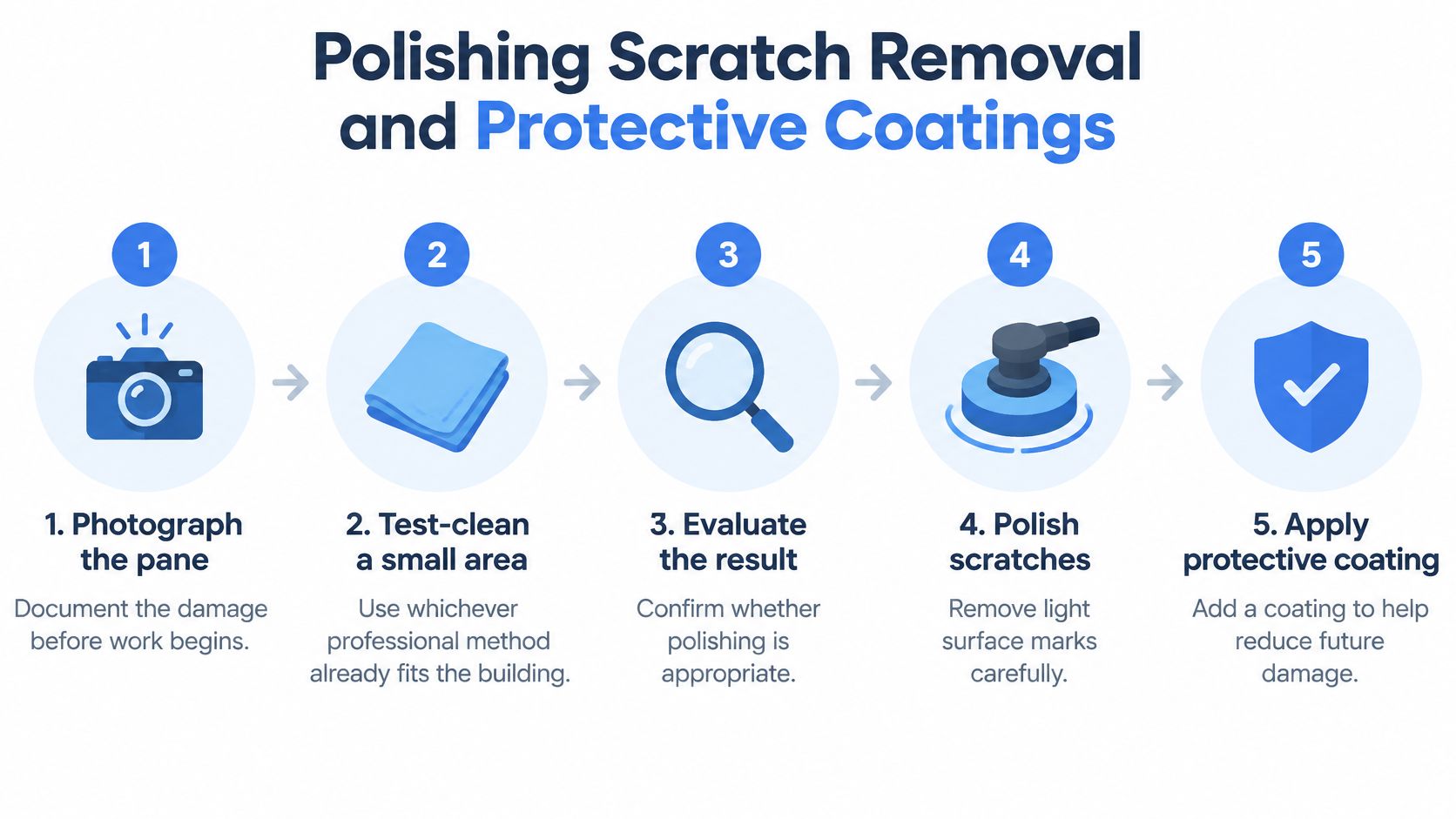
Before a whole elevation is booked, confirm whether the glass is coated, laminated, insulated, tempered, or decorated, and whether the defect is on a reachable interior or exterior face. A passed test panel is the only green light for the rest of the run.
We use soft brushes and microfiber on sills and frames so the protection goes on clean glass and trim, not on grit that would scratch the edge you just tried to save.
Owners in Arizona, Nevada, and Colorado often inherit white spots from sprinklers, mineral-heavy water, and intense sun, then hear that any spot can be buffed off. That advice skips the only test that matters. Architectural-glass guidance warns that restoration depends on heat, pressure, proximity to edges, and the specific glass type, and the Stuart Dean architectural glass paper is blunt that restoration is not automatically the cheaper or greener option.
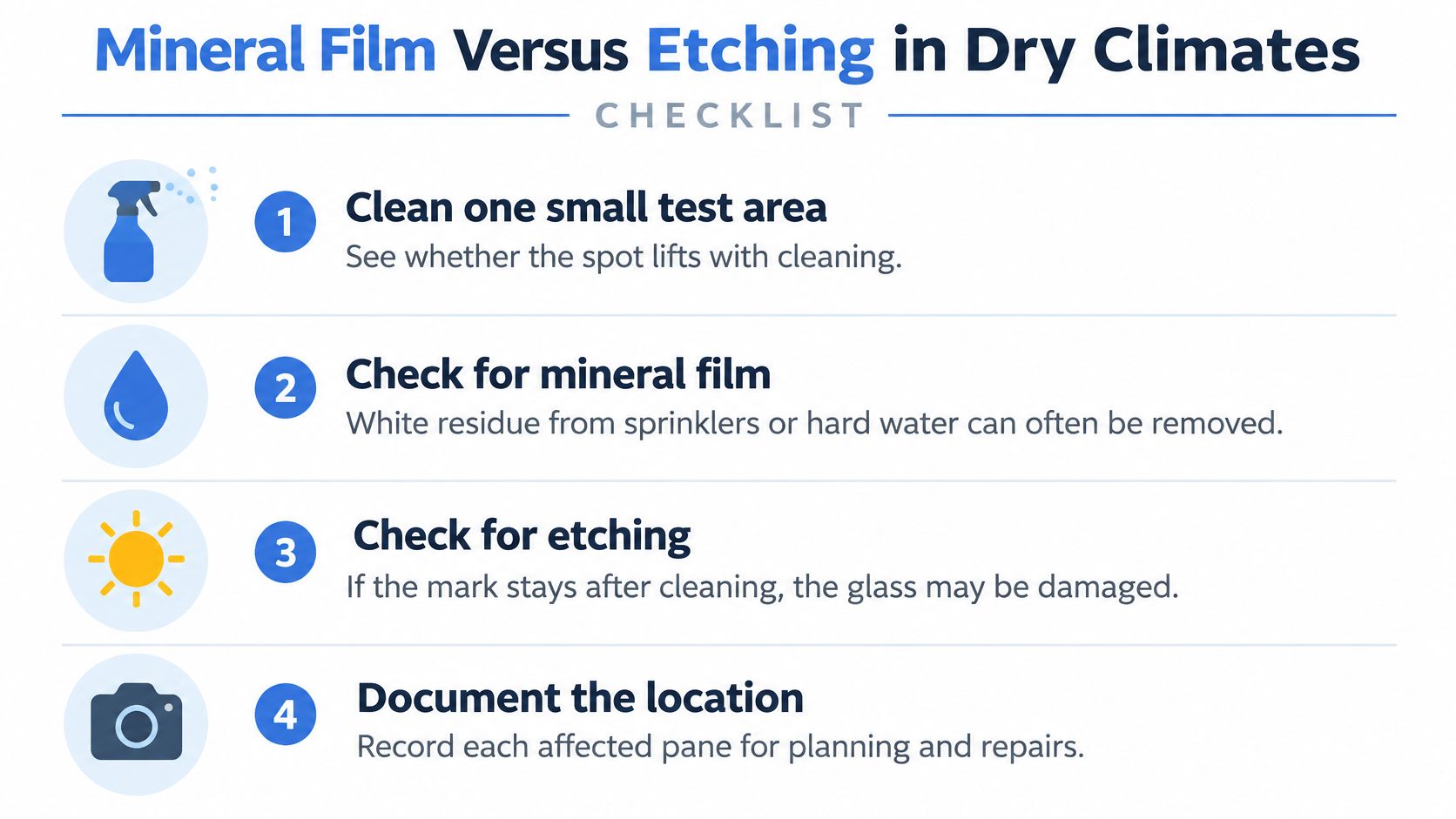
Clean one small area thoroughly. If the mark leaves with the wash, it was residue. If a dull patch stays in the same place under raking light, minerals have etched the surface, and polishing must remove glass, not soil.
Heavy pressure and heat can worsen distortion. A fogged insulated unit still needs a new unit, because a clearer outer face does not reseal the spacer or replace lost gas. Aggressive treatment can also damage coatings. Calling that "green" because you avoided a dumpster is only true when the pane was restorable.
Stop, or switch to replacement, when you see any of these:
Office glass that only has hard-water stain and mineral deposit on the surface is a restore candidate once the test passes. Our office window cleaning includes specialized treatments that remove hard water stains and mineral deposits, which is the right scope for that passed test and the wrong scope for a cracked or fogged lite.
The question an owner really has is simple. Can this pane be restored without a safety, warranty, or appearance problem? Only a passed test panel answers yes. Fix the sprinkler pattern before you pay for a second polish, or the same minerals will etch the glass you just cleared.
A church on a side street, or an older commercial block with a leaded transom, is a different job from a scratched storefront lite. The colored glass and the lead came are the window. Buffing that surface in place to make it "flatter" erases the thing the building is known for.

Stained and leaded windows generally need trained conservators. The National Park Service brief on stained and leaded glass reports that less than 1% of stained and leaded glass in the United States predates 1700, so most surviving windows are later work. They still should not be treated as interchangeable modern panes. A credible job starts with condition photos, measurements, and a written split between original fabric, later repairs, and new material.
When the window must leave the opening, the usual path is removal, crating, studio photography, rubbings, piece-by-piece disassembly, conservation of the glass and lead, and reassembly. That record is the job, not a courtesy photo at the end.
Older architectural glass often carries bubbles and ripples. The University of Bern account of historic window glass notes that most window glass manufactured before 1960 shows those production marks, left by cylinder blowing, drawing, rolling, and related methods. Those irregularities document how the pane was made, so restoration should keep them rather than polish the surface flat and anonymous.
If a piece is missing, restoration-grade glass can be chosen to match the old appearance instead of a perfectly clear modern lite. Our church window cleaning uses methods suited to the glass and the construction, with interior and exterior work, and it is not a substitute for that studio sequence. Owners comparing art glass windows with ordinary lites should screen the studio, check references, look at finished projects, and require duplicate documentation so a permanent record stays with the building.
A short look at how a conservator handles a panel makes the difference obvious. The glass leaves the wall, and the work happens on a bench, not from a pole.
Refuse an on-site scratch polish for leaded or rippled historic glass. If someone offers to "shine it up" from a ladder in an afternoon, that is the wrong trade for this opening.
High-rise condominiums, medical offices, car dealerships, and stadiums do not need a one-time shine. They need a lifecycle budget, and that starts with a survey that sorts openings instead of averaging them.
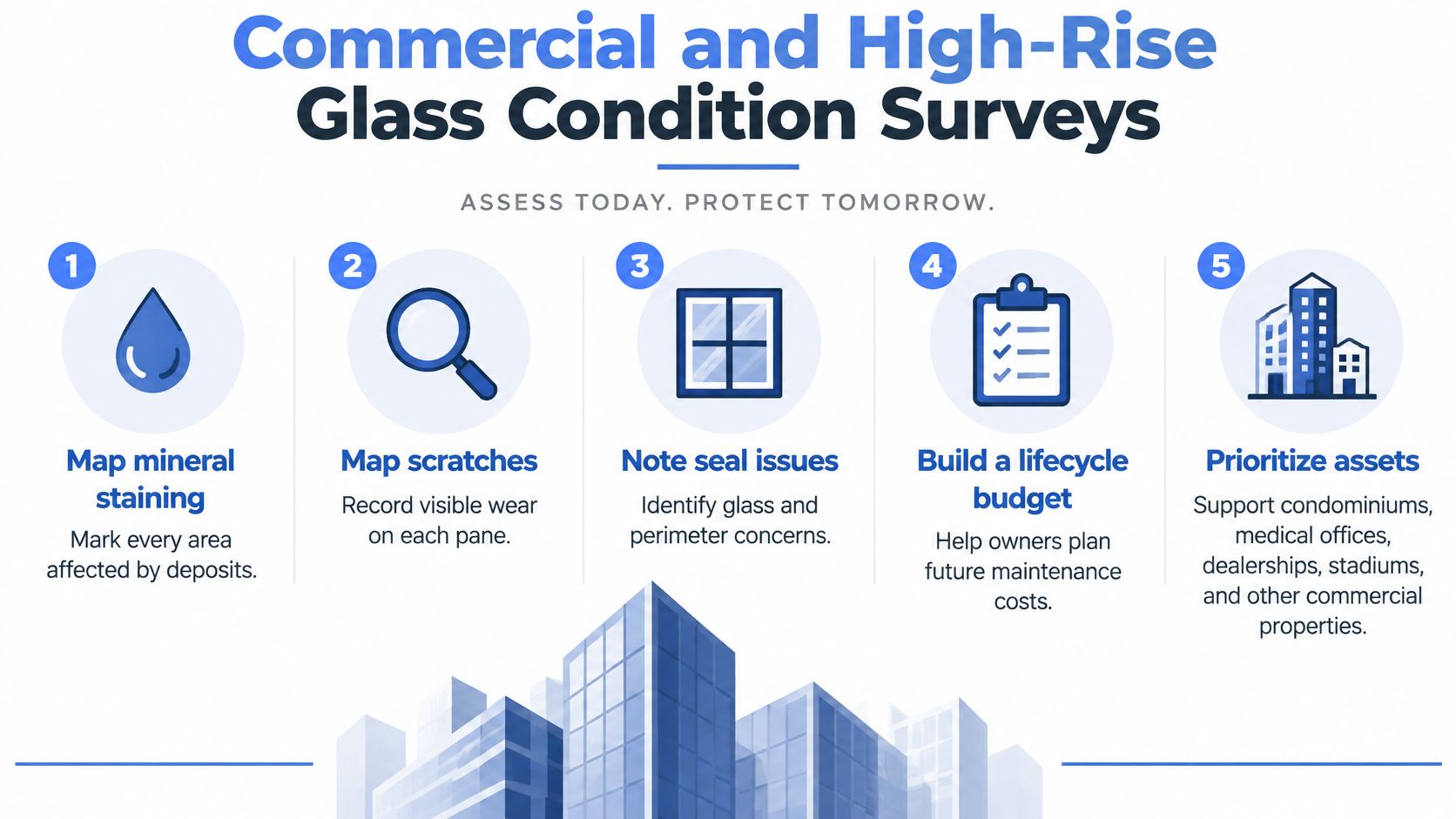
A useful one-page brief does five things. It maps mineral staining and scratches. It photographs representative elevations. It records glass type and which way the opening faces. It flags condensation between panes. It sorts each opening into restore or replace.
Polishing can improve how an elevation looks. It does not restore a failed seal, lost insulating gas, or a degraded Low-E coating. Replacing scarred glass without stopping irrigation overspray, construction residue, or a bad wash habit just feeds the same damage to the new panes.
Window performance still belongs in the budget conversation. A 2025 Frontiers in Public Health study reported that optimizing residential building glass reduced modeled annual energy consumption from 50.95 to 40.26 kWh/m², a 20.98% reduction, and another 2025 result in that work put improved glazing at 55.72 kWh/m²/year. Those figures show why failed coatings and failed units matter. They are not a promise that a polish lowers the utility bill.
Access has to match the height. We use specialized equipment to reach any window, and water-fed poles with eco-friendly solutions where a pure-water clean is the right of the two methods. For towers, the survey and the wash plan belong with high-rise window cleaning, not with a ground-floor price stretched upward.
Professional Window Cleaning has been cleaning windows since 1999 and covers residential, commercial, and high-rise work in Phoenix, Scottsdale, Tempe, Chandler, Gilbert, Flagstaff, Denver, and Las Vegas. The deliverable you should leave with is that one-page survey, not a single aesthetic quote.
A pane can look cloudy for different reasons, and polishing is not a universal fix. Before approving replacement or restoration, ask for a test on a representative area. It should show whether the surface problem can be removed and help distinguish it from damage that cleaning cannot address.
Ask the contractor to record the glass type and show the test result in before-and-after photos taken in consistent light. Have the estimate identify which panes are candidates for restoration, which need replacement, and which should not be polished. Keep the findings with the project records.
That record makes bids easier to compare. It also helps prevent a recommendation for full replacement from resting on one difficult-looking pane.
Professional Window Cleaning provides residential, commercial, and high-rise window cleaning, including office treatments for hard-water stains and mineral deposits. The company offers a free, no-obligation estimate and a satisfaction guarantee, and addresses customer concerns promptly. Customers in Las Vegas can call (702) 800-4994. Professional Window Cleaning has been in business since 1999.
Use the test result to decide what happens next. If cleaning removes the deposit, address the source of the water and the maintenance routine. If the glass remains damaged, discuss replacement for those panes rather than assuming the entire elevation needs new glass.
Read our blog posts regularly and keep learning.