Care and Maintenance
Medium Bristle Brush Guide for Window Cleaning
Discover why a medium bristle brush is the ultimate tool for window cleaning. Learn about materials, pure-water systems, and expert selection tips.


Art glass windows are so much more than just a way to let in light. They're unique works of art, painting your rooms with color and transforming a simple building into something truly special. Each one is an architectural treasure that tells a story, casting patterns and life into a space in a way no standard window ever could.
Think of your art glass window not as a simple pane but as a living painting. The individual glass pieces are the artist's brushstrokes, the metal lines are the intricate sketch work, and the sunlight is the ever-changing paint. The result is a dynamic masterpiece that shifts with every passing cloud and hour of the day.
This is exactly why these windows need such specialized care. They aren't just functional elements to be scrubbed clean; they are delicate, often irreplaceable, assets. Preserving them means protecting a legacy—whether that’s a piece of your family's history, a significant architectural feature, or simply a reflection of your own personal taste.
From historic scenes to modern abstract designs, an art glass window adds immense character and value to a property. The tradition of using decorative glass as a major architectural feature has a rich history, with an incredible peak during the Medieval period.
Between 1150 and 1550, stained glass became a dominant force in European architecture. During this 400-year golden era, magnificent windows were installed in cathedrals, churches, and the homes of the wealthy, cementing their place as a premier form of decorative craftsmanship. You can learn more about this introductory period of stained glass history and its impact on art and architecture.
An art glass window does more than let light in; it gives that light a voice. It can whisper with soft, muted tones in a study or sing with vibrant colors in a grand entryway, defining the atmosphere of a room.
This deep connection between art, history, and architecture is what truly sets art glass apart. Unlike modern, mass-produced windows, every piece of art glass has its own story and its own structural quirks. Cleaning them the wrong way can cause irreversible damage.
Improper cleaning can lead to serious problems, such as:
For over 26 years, Professional Window Cleaning has understood the unique value of these treasures. We provide expert, gentle care for art glass in homes and businesses across Las Vegas, Phoenix, Denver, and Scottsdale, helping owners protect their luminous investments for generations to come.
Figuring out what kind of art glass you have is the first step to truly appreciating it. Is it a classic leaded panel or something more modern? Knowing the style isn't just for trivia—it tells you a story about its age, value, and, most importantly, the right way to care for it. Let's walk through the key types so you can become a more informed steward of your home's unique art.
Most people picture leaded glass when they think of "stained glass." Imagine a jigsaw puzzle, but instead of cardboard, the pieces are colored and textured glass. The lines holding it all together are dark, metallic channels called lead came.
These lead lines do more than just hold the puzzle together; they're the drawing itself, outlining every single shape. If you lean in close, you can see the solder at the joints where the metal was fused. It’s a technique that has given us everything from grand cathedral masterpieces to the charming little windows next to a front door.
Now, picture an artist painting with fire and molten glass. That's the heart of fused glass. Instead of being separated by metal, different pieces of glass are carefully arranged and then fired in a kiln at blistering temperatures—often over 1,400°F.
The intense heat melts the individual pieces into a single, seamless sheet of glass. The look is often smooth and modern, with soft, blended edges where the colors meet. You won't find the distinct black lines of a leaded window here, just a smooth, unified design.

This is what makes art glass so special. It’s a unique blend of pure artistic expression, the beautiful way it plays with light, and its power to tell a story without words.
To help you quickly tell these styles apart, here’s a quick reference table.
| Glass Type | Key Characteristic | Common Use Cases |
|---|---|---|
| Leaded Glass | Pieces of glass are joined by metal strips (lead came). | Traditional windows, church windows, historic homes, entryways. |
| Fused Glass | Multiple glass pieces are melted together in a kiln. | Modern art installations, cabinet doors, decorative panels. |
| Beveled Glass | Thick glass with angled edges that create prisms of light. | Entryway doors, sidelights, transoms, elegant accent windows. |
| Etched Glass | Frosted or translucent designs created with acid or sandblasting. | Bathroom windows, pantry doors, privacy screens, corporate logos. |
| Painted Glass | Details are painted onto the glass and fired for permanence. | Figurative scenes, portraits, intricate patterns on leaded glass. |
This table should give you a solid starting point for identifying the beautiful glass features in your own home.
Beyond the two main construction methods, artists use other techniques to create stunning effects. Each one adds a different texture and personality to the window. The technicians at Professional Window Cleaning have seen it all in our 26+ years of service, and we're experts at identifying and safely cleaning these delicate variations in cities like Phoenix and Scottsdale.
Beveled Glass: This style is all about sparkle. Thick, clear glass is ground down at an angle along the edges, which acts like a prism. When sunlight hits it just right, your room will fill with dancing rainbows.
Etched Glass: Think of a permanently frosted window pane. Using sandblasting or acid, an artist can create a translucent design that offers privacy while still letting in soft, diffused light.
Painted Glass: Sometimes, you need details that cut glass just can't achieve. For that, artists turn to special enamels painted directly onto the glass. After being fired in a kiln, these details become permanent, allowing for lifelike faces and intricate patterns.
Paying attention to the overall aesthetic can also offer clues. For example, some pieces might show a clear Gothic design influence, with its pointed arches and deep, rich colors. Recognizing these design trends can help you narrow down your window's age and story.
For centuries, these luminous creations were reserved for cathedrals, the ultimate display of status and devotion. But the craft took a major hit. For roughly 300 years, between 1550 and 1850, stained glass nearly vanished due to sweeping religious and cultural changes, and many of the original techniques were lost. You can dive deeper into the rise, fall, and modern rebirth of this art form.
This long period of neglect could have been the end. But in the 19th century, a newfound passion for historical styles sparked a rediscovery of these lost methods, setting the stage for one of art's greatest revivals.
The early 20th century saw an explosion of creativity, led by artists who weren't just reviving old styles but completely reinventing them for the modern world.
This revival solidified art glass windows as a serious and valuable art form. An authentic window from this era, or a piece by a known modern artist, isn't just a home feature—it's a signed work of art that can significantly boost your property's value. It’s why our team at Professional Window Cleaning approaches every project with such respect, especially in historic neighborhoods like those in Denver.
Once you know this history, it’s impossible to look at your windows the same way. They stop being just glass and become valuable assets that demand careful preservation. Neglecting their upkeep or trying a risky DIY cleaning is like taking a scouring pad to an old painting.
An authentic art glass window can be a significant selling point for a property, often appraised as a unique piece of art. Its presence can set a home apart, appealing to buyers who value history, craftsmanship, and distinctive character.
Protecting this investment starts with the right care. The delicate lead cames, the fragile glass itself, and any painted details are all vulnerable to harsh chemicals and improper handling. Getting professional help isn't an expense—it's essential maintenance for protecting your property's value. With over 26 years of experience, we know what's at stake and have the expertise to preserve these irreplaceable treasures.
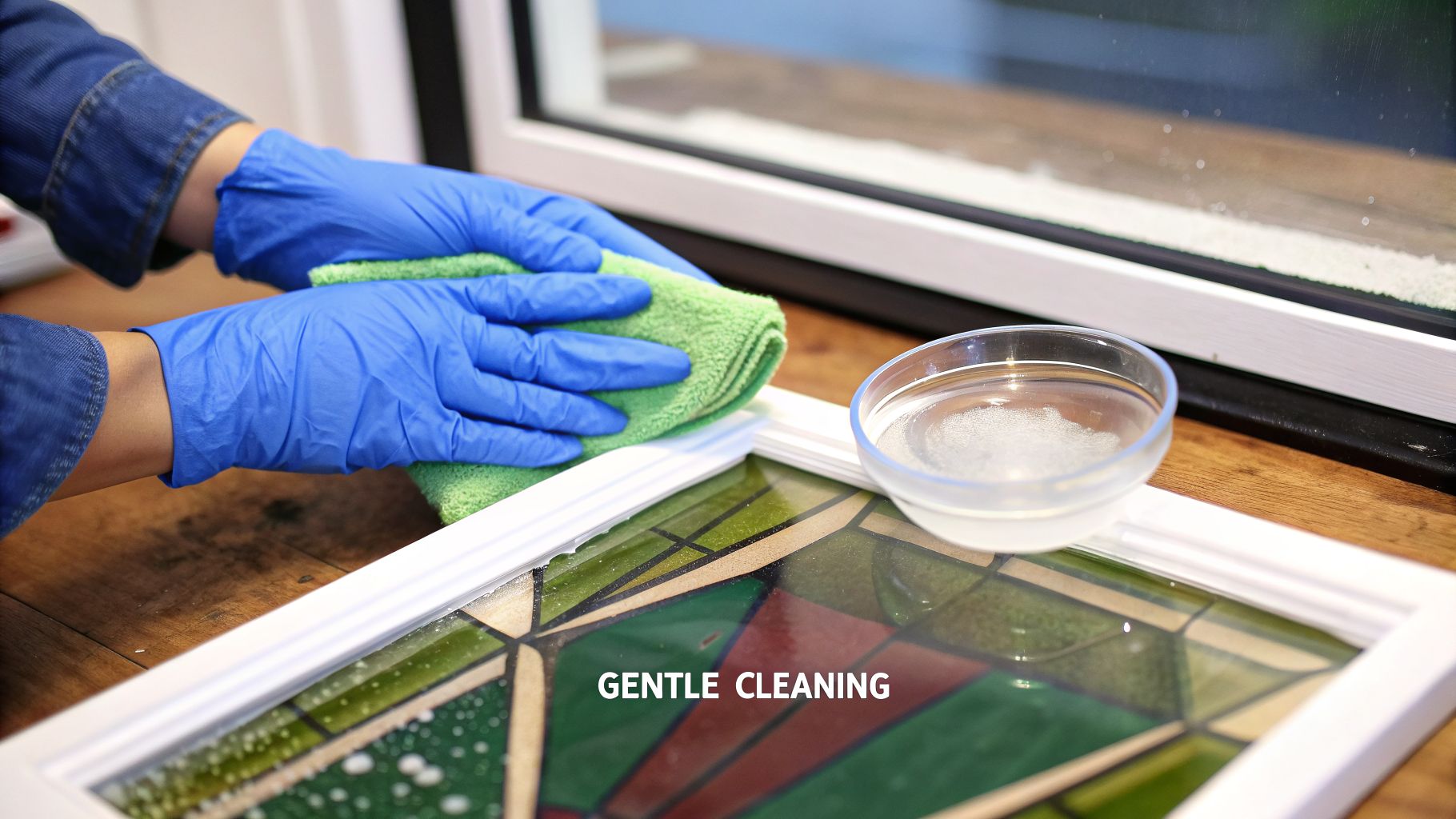
When you’ve got a piece of art glass, you’re not just cleaning a window—you’re preserving a piece of history. Think of it like this: you wouldn't wash a durable dinner plate the same way you'd dust a fragile antique vase. The same principle applies here. The two professional cleaning methods for modern glass—a squeegee or a pure-water system—can be downright disastrous for delicate, intricate art glass windows.
For standard windows, professional window cleaners use either a squeegee for a perfect streak-free finish or a state-of-the-art pure-water system. But for art glass? Never. A squeegee can exert too much pressure, popping aging lead cames loose or even cracking a fragile pane. A pure-water system can force water deep into the crevices, inviting long-term moisture damage.
That’s why the professional approach to art glass is always a gentle, hands-on one, entirely different from standard window cleaning methods.
The absolute biggest mistake we see homeowners make is grabbing a standard household glass cleaner from under the sink. While these products work wonders on modern surfaces, their chemical makeup is the sworn enemy of art glass.
The most common culprits are chemicals you probably use all the time:
Using these products is like trying to clean a watercolor painting with a magic eraser. The damage might be subtle at first, but it’s cumulative and irreversible. With over 26 years of experience, our teams in cities like Denver and Scottsdale, have seen the unfortunate results and know exactly what to avoid.
So, how do we get these fragile works of art sparkling without causing harm? It’s all about a methodical process that puts the window's preservation above everything else. The secret isn't some miracle product; it's a return to simple, gentle materials.
Our professional toolkit for art glass is surprisingly basic:
The fragility of historical art glass is not a modern concern; it’s rooted deep in its creation. Around 1000 AD, glassmakers used woodland ash in their formulas, which produced a glass far less durable than today’s standard. As you can discover more insights about stained glass history, this historical vulnerability is precisely why these windows have always required careful maintenance and professional care.
While you can certainly use this gentle method for a light dusting, there are many times when calling a professional is not just a good idea—it's essential. For valuable, antique, or particularly complex art glass windows, the risk of accidentally causing damage is just too high to go it alone.
Give a specialist a call if:
A trained technician knows how to properly assess the window's condition, apply just the right amount of pressure, and clean without compromising the piece. More importantly, they know what not to do, which is often the most valuable knowledge of all. While some mineral deposits can be a pain on regular windows, and you can check out our guide on how to clean hard water stains on glass, it's a different ballgame with art glass. When in doubt, professional help is always the safest bet.
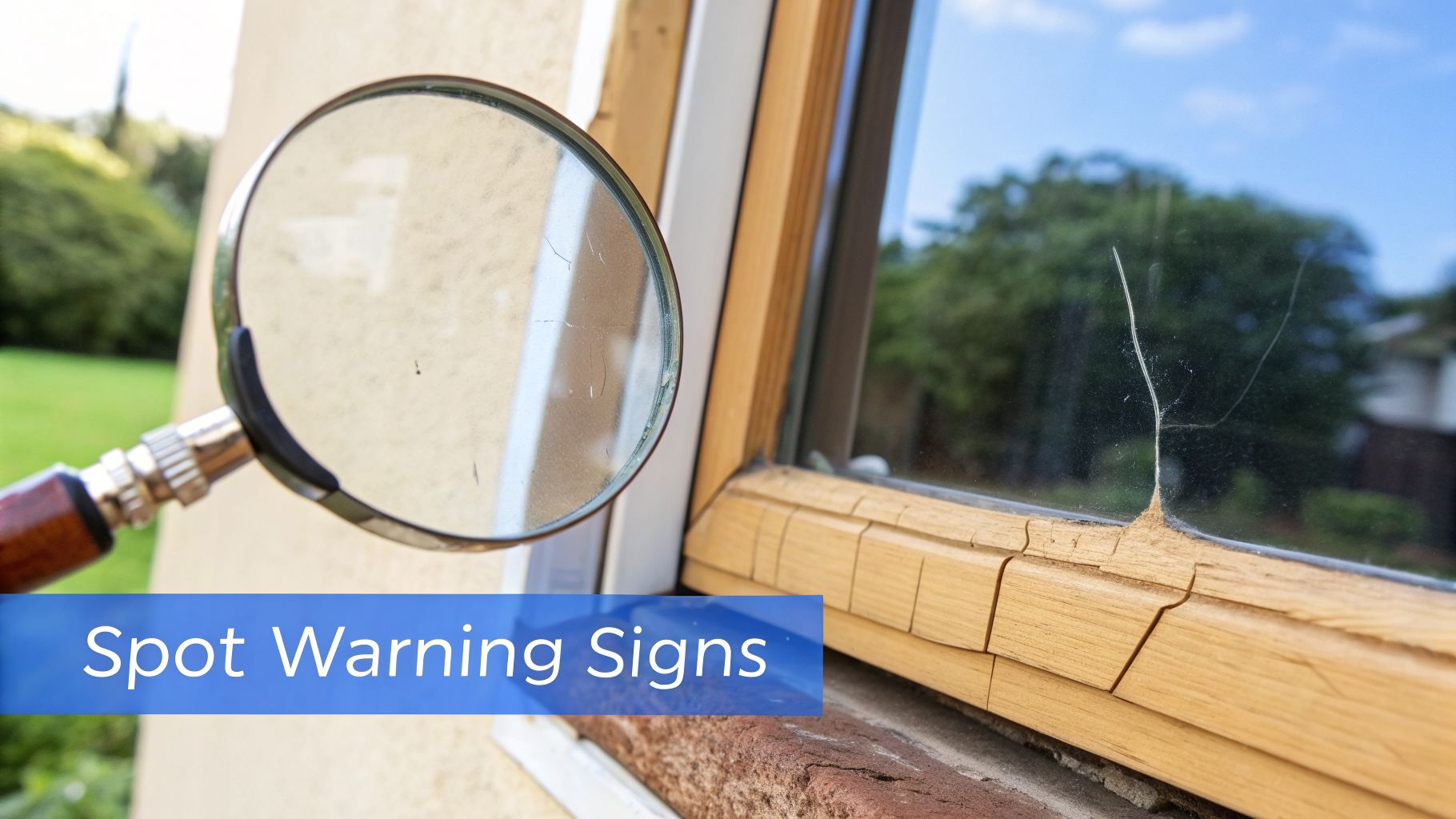
Think of your art glass windows like a priceless family heirloom or a vintage automobile. To keep them in pristine shape, you’ve got to learn how to spot the small issues before they snowball into major, expensive disasters. Ignoring those early whispers of trouble is the fastest way to turn a simple repair into a full-scale restoration.
The key is to be proactive. This means regularly checking your art glass windows not just for their beauty, but for their structural health. Once you know what to look for, you can catch problems early and take action before it’s too late. We proudly serve homeowners across Las Vegas, Phoenix, Denver, and Scottsdale.
The most serious signs of trouble are the ones affecting the window's core structure. These issues tell you the entire piece is under stress and could lead to a catastrophic failure if you don't act fast. If you see any of these, it's time to call in a pro.
These structural problems are often invisible from a few feet away. That's why during a professional cleaning, a trained technician does more than just wash the glass; they perform a close-up visual inspection, which is a key part of our service.
Beyond the overall structure, you need to inspect the materials themselves. Damage here might seem purely cosmetic at first, but it can quickly become a much bigger headache. We’ve seen these small issues spiral out of control in homes all across our service areas.
To help you get started, we've put together a simple checklist. Use this to systematically inspect your art glass windows and figure out what steps to take next.
| Symptom | What to Look For | Recommended Action |
|---|---|---|
| Bowing/Sagging | The entire window panel bulges inward or outward. | Urgent: Call a professional restorer immediately. Do not touch. |
| Rattling | Glass pieces feel loose or make noise when gently tapped. | Call for a professional assessment. The lead may need re-cementing. |
| Cracked Solder | Gaps or fractures where lead strips meet. | This is a structural issue. Schedule a professional inspection soon. |
| Cracked Glass | Hairline fractures or full breaks in individual glass pieces. | Isolate the issue. If it's one piece, a repair might be simple. If multiple, it's more serious. |
| Flaking Paint | Painted details on the glass are chipping, peeling, or fading. | Protect from further sun/moisture damage and consult a restoration expert. |
| White Powder on Lead | A chalky, white residue on the surface of the lead cames. | A sign of lead oxidation. A pro can assess the severity and clean it. |
Keeping this checklist handy can make your regular inspections quick and effective, ensuring you don't miss a thing.
If you notice any of these warning signs—especially structural problems like bowing or widespread rattling—resist the temptation to poke, prod, or try a DIY fix. You could easily make the problem much worse. The safest and smartest first step is to call for a professional assessment.
With over 26 years of experience, our team can perform a delicate cleaning and provide an expert evaluation. If we find signs of significant damage, we’ll connect you with one of our trusted restoration partners who specialize in this intricate work. This is especially important for preserving historic building windows, where maintaining character is paramount.
Being proactive is the best way to ensure your beautiful art glass remains a stunning, stable feature for decades to come.
Once you understand the history and artistry sitting in your window frames, the next logical step is figuring out how to properly care for it. You've got questions, and we've got answers. Let's walk through the most common concerns homeowners have about maintaining their art glass.
For art glass that’s safe inside your home, a gentle cleaning about once a year is usually plenty to keep dust and fingerprints at bay. Art glass windows facing the outdoors are a different story—they take a beating from the elements and often need attention twice a year.
The real key is to use your eyes, not just the calendar. If you live in a dusty climate like Phoenix, or a windy one near Las Vegas, you'll see that film of dirt build up much faster. But be careful. Over-cleaning can be just as damaging as letting grime sit, since every cleaning session introduces a tiny risk of wear.
When you're dealing with antique or especially fragile pieces, don't guess. A professional can help you create a custom care plan that keeps the glass clean while preserving it for the long haul.
Absolutely not. Reaching for a standard, off-the-shelf glass cleaner is one of the worst things you can do to your art glass. Nearly all of them contain ammonia or vinegar, harsh chemicals that can wreak havoc on the window's delicate structure.
These aggressive ingredients can:
The only DIY method we’d ever recommend is a pH-neutral soap heavily diluted in distilled water, applied gently with a soft, lint-free cloth. While our team at Professional Window Cleaning uses the two main pro methods—squeegees and pure-water systems—on modern windows, those techniques are far too aggressive for most art glass windows. A gentle, hands-on approach is the only safe way.
Knowing whether you need a repair or a full restoration is critical. Think of it this way: a repair is like putting a bandage on a cut, while restoration is like major surgery to address a systemic problem. We have over 26 years of experience helping homeowners in Denver and Scottsdale make this distinction.
Repair is a targeted fix for a small, isolated issue. This could mean:
Restoration, on the other hand, is a complete overhaul for a window that is failing on a larger scale. This process involves carefully taking the entire window apart, cleaning each individual piece of glass, replacing any broken panes with historically accurate matches, and rebuilding the whole thing with brand-new lead cames. Those cames are the structural backbone, and they typically have a lifespan of 75-100 years.
A professional can tell you whether a simple spot-fix will do the trick or if a full restoration is needed to save the window for the next generation.
While it’s true that professional art glass cleaning costs more than a standard window wash, it’s not just an expense—it’s an investment in preserving a valuable asset. The meticulous labor, specialized skill, and time involved are reflected in the price, but that cost is a drop in the bucket compared to the alternative.
The price tag for restoring a window damaged by a DIY cleaning mistake can easily soar into the thousands, dwarfing the cost of years of proper professional care. Several things factor into the price of a professional cleaning, including:
With over 26 years of experience, we know exactly how to handle these irreplaceable pieces safely. We provide clear, transparent quotes for our specialized services in areas like Las Vegas, Phoenix, Denver, and Scottsdale, so you know you’re protecting your art glass for decades to come.
Your art glass windows are a source of beauty, history, and value. Entrust their care to the experts who understand what's at stake. Contact Professional Window Cleaning today for a consultation and let us help you keep your luminous treasures sparkling for years to come. Visit us online at https://www.professionalwindowcleaning.com to schedule your service.
Read our blog posts regularly and keep learning.